

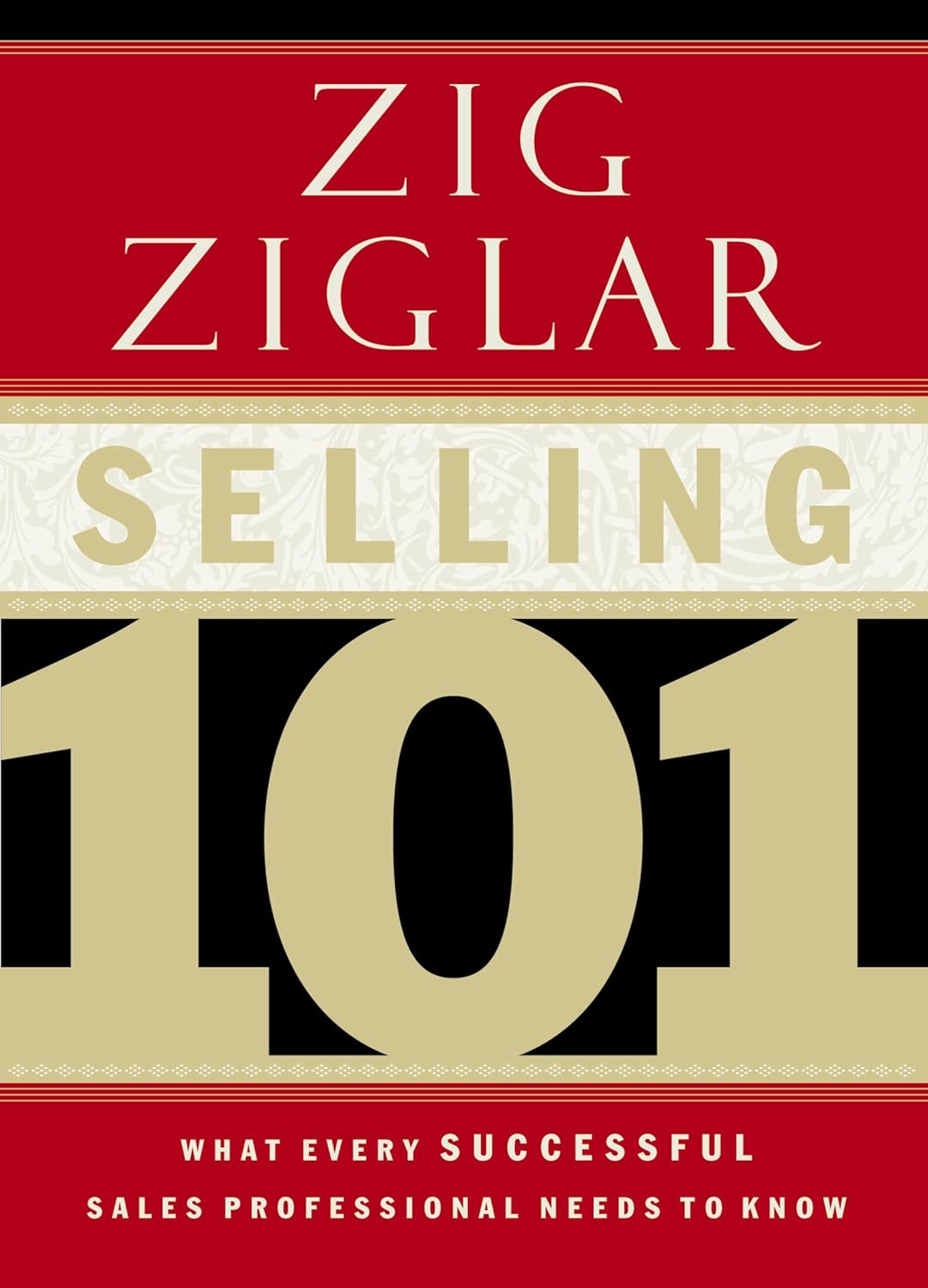
About Selling 101 by Zig Ziglar – A Practical Guide to Finding Customers, Understanding Needs, Handling Objections, Closing Sales, and Building Trust
Selling 101 by Zig Ziglar is a short sales guide for people who want to understand the basic habits behind effective selling. Ziglar focuses on finding prospects, asking useful questions, understanding customer needs, recommending solutions, closing sales, giving good service, and managing time.
The book is made for sales professionals and anyone who needs to explain the value of a product, service, or idea. Ziglar connects selling with listening, preparation, honesty, service, and long-term relationships.
Because the book is compact, readers can move through the main ideas quickly and return to specific chapters when they need help with a sales problem.
Selling Starts With the Right View of the Job
Ziglar begins by treating selling as a real profession that requires skill, learning, and discipline.
A salesperson should not depend only on natural charm or luck. Good results come from understanding the product, preparing for conversations, learning about customers, practicing useful questions, and improving after each sales call.
This makes the book useful for beginners who may think successful sellers are simply born confident.
Ziglar argues that skills can be learned.
He also stresses that attitude matters. A salesperson who expects every conversation to fail may avoid calls, rush the process, or stop following up too early. A better approach is to prepare carefully, stay realistic, and keep improving.
Finding People Who May Actually Buy
One of the early chapters focuses on finding people who are willing and able to buy.
This is important because time can be wasted when a salesperson speaks to people who do not need the product, cannot afford it, or have no reason to make a decision.
Ziglar encourages better prospecting.
That means identifying people or businesses who may have a real problem the product can solve.
Modern sellers might call this lead qualification.
The wording may be older, but the idea is still useful: not every contact deserves the same amount of time.
Good prospecting helps a salesperson focus effort where there is a reasonable chance of helping someone and making a sale.
Call Reluctance Can Stop Sales Before They Start
Many salespeople know what to do but avoid doing it.
They delay calls, fear rejection, worry about bothering people, or wait for the perfect moment.
Ziglar addresses this problem directly in his chapter on call reluctance.
The practical point is simple.
A salesperson cannot learn what a prospect needs without starting the conversation.
Fear of rejection can feel personal, but a “no” may simply mean the timing, offer, price, need, or customer is not right.
The goal is not to enjoy rejection. It is to stop treating every rejection as proof that the salesperson has failed as a person.
Regular action makes prospecting easier and creates more chances to improve.
Sell by Design, Not by Chance
Ziglar argues that a sales conversation should have a clear structure.
A salesperson should know what information needs to be discovered before making a recommendation.
This reduces random talking.
Instead of giving the same speech to every customer, the seller can guide the conversation through questions.
The process becomes more useful because the customer’s situation shapes the recommendation.
This is one of the book’s strongest ideas.
A good sales process is not a script that ignores people. It is a planned way to make sure important questions are asked and important needs are understood.
Planning also gives new salespeople more confidence because they know what step comes next.
Questions Help Reveal the Real Need
A major chapter is built around the idea that questions are the answer.
Ziglar wants salespeople to ask before they tell.
A customer may describe one problem while the deeper need is something else.
For example, someone asking for a cheaper option may actually care more about reducing risk, saving time, getting better support, or avoiding a future problem.
Useful questions help uncover that difference.
The salesperson can then stop guessing.
Listening becomes as important as speaking.
This approach is still useful in retail, business-to-business sales, services, consulting, freelancing, and online customer support.
The seller learns what matters first and presents the offer second.
Need Awareness Comes Before a Strong Recommendation
Sometimes customers know they have a problem but do not understand its full effect.
Ziglar discusses the importance of helping people become aware of the need.
This does not mean inventing fear or exaggerating a problem.
It means helping the customer see the cost, inconvenience, risk, or missed benefit connected with the current situation.
A person is unlikely to act if the problem feels too small to matter.
Clear questions and examples can help the customer judge the issue for themselves.
Once the need is clear, the recommendation has a stronger reason behind it.
Sell to the Problem, Not Just the Product
Ziglar’s chapter on need solution focuses on matching the offer to the customer’s problem.
Features alone are not enough.
A customer may not care that a product has ten functions.
They care about which function helps them save time, reduce cost, improve comfort, avoid risk, increase sales, or solve another specific problem.
The salesperson therefore needs to translate product details into useful outcomes.
This is the difference between saying what something has and explaining why it matters.
For modern eCommerce, product pages, customer chats, and sales calls, this remains one of the most useful lessons in the book.
Closing Is the Natural Next Step
Some people become uncomfortable when it is time to ask for the order.
Ziglar treats closing as a normal part of the sales process.
If the customer has a real need, understands the solution, and feels comfortable with the offer, asking for a decision is not rude.
The problem comes when a salesperson tries to close before enough value has been established.
A strong close should follow the work that came before it.
The customer should understand what is being offered, why it fits, what it costs, and what happens next.
This makes the final decision easier and clearer.
Objections Can Provide Useful Information
A customer may raise concerns about price, timing, features, trust, risk, or the need to speak with someone else.
An objection is not always a final rejection.
It can be information.
The salesperson should first understand the concern rather than immediately arguing against it.
A clear answer may remove a misunderstanding.
In other cases, the objection may reveal that the product is genuinely not suitable.
Ethical selling includes knowing when not to force a sale.
A customer who feels pushed into the wrong purchase may never return.
Customer Satisfaction Comes After the Sale
Selling 101 does not stop at getting the order.
Ziglar includes a chapter about moving beyond basic customer service toward customer satisfaction.
That matters because repeat business, referrals, and reputation often depend on what happens after payment.
The customer needs the promised product or service, clear communication, and help if something goes wrong.
A seller who disappears after the sale weakens trust.
A seller who follows through makes the original promise more believable.
For small businesses, this is especially important because one satisfied customer can return many times and recommend the business to others.
Time Management Supports Better Sales
The final chapter connects sales performance with control of time and life.
Salespeople often have many possible tasks: prospecting, follow-up, meetings, paperwork, learning, travel, customer service, and planning.
If urgent but low-value tasks fill the day, important selling work can be delayed.
Ziglar encourages readers to use time with more purpose.
That may mean setting priorities, planning calls, protecting prospecting time, and avoiding needless delay.
The exact tools available today are different from those in 2003, but the problem is the same.
Good intentions do not produce results unless time is given to the right actions.
The Book Is Short and Easy to Revisit
Selling 101 is much shorter than many full sales manuals.
Google Books lists the HarperCollins Leadership edition at 112 pages.
The compact format makes it useful for readers who want the basics without reading a large textbook.
The book has thirteen main chapters covering professional sales skills, prospecting, call reluctance, sales planning, questions, need analysis, need awareness, solutions, closing, customer satisfaction, and time management.
Because the chapters are short, readers can return to one topic before a sales call, training session, or team discussion.
Publication and Edition Details
HarperCollins Leadership published Selling 101: What Every Successful Sales Professional Needs to Know in 2003.
Google Books lists an April 1, 2003 publication date and a length of 112 pages.
One widely listed edition carries ISBN-10 0785264817 and ISBN-13 9780785264811.
Google Books also lists another 2003 edition with ISBN 9781418530297.
The publisher description states that the material was drawn from Ziglar on Selling, Ziglar’s larger sales book.
Because formats and editions can differ, customers who need a specific ISBN or cover should check the exact edition before ordering.
About Zig Ziglar
Zig Ziglar was an American salesman, author, trainer, and motivational speaker. Born Hilary Hinton Ziglar in 1926, he spent years in sales before becoming a well-known speaker.
His books include See You at the Top, Secrets of Closing the Sale, Ziglar on Selling, Top Performance, and Selling 101. He died in 2012. His work often connects sales skills with attitude, goals, ethics, service, and personal development.
Who Will Benefit Most From Selling 101?
Selling 101 is useful for new salespeople, retail staff, small business owners, entrepreneurs, freelancers, customer service teams, marketers, account managers, and students learning sales basics.
It can also help anyone who needs to explain value, present ideas, speak with customers, or ask for decisions. Experienced sellers can use it as a quick refresher. Readers can adapt its face-to-face principles to email, social media, online stores, messaging apps, and video calls.
Book Quality at Bookish Wonderland
Bookish Wonderland offers this title with premium eye-soothing cream paper, crystal-clear printing, and high-quality stitched plus glue binding.
The cream paper supports comfortable reading, while clear printing keeps the short chapters and practical sales ideas easy to follow. Strong binding supports repeated use and shelf storage.
The copy is suitable for personal reading, sales training, business study, team learning, gifting, or building a business and self-development collection.
Why Order from Bookish Wonderland?
Bookish Wonderland delivers books across Bangladesh, including inside and outside Dhaka. Cash on Delivery is available nationwide.
Customers in Dhaka can also ask about fast or urgent delivery when available.
If you are checking Selling 101 by Zig Ziglar Book price in Bangladesh, it is useful to compare the physical quality of the copy along with the listed price.
Book customization is also available. For stock, customization, or delivery questions, you can contact Bookish Wonderland through Facebook or Instagram.
Why Selling 101 Remains Useful
Selling 101 by Zig Ziglar gives readers a clear introduction to core sales habits.
It moves from finding prospects to asking questions, discovering needs, recommending solutions, closing, serving customers, and managing time.
Its main lesson is simple: understand the customer before presenting the product. That idea works in stores, offices, online businesses, freelance work, and services.
Order your copy from Bookish Wonderland for nationwide delivery, Cash on Delivery, premium cream paper, clear printing, and strong stitched plus glue binding.
If you require any customization or have any questions, please inbox us via FB or Insta.
| Primary Specification | |
| Author | Zig Ziglar |
| Genre | Business, Sales, Personal Development, Self-Help |
| ISBN-13/ISSN | 978-0785264811 |
| ISBN-10 | 9780785264811 |
| Publisher | HarperCollins Leadership |
| Publishing Date | April 1, 2003 |
| Language | English |
| Reading Age | 16+ |
| Format | Printed Book |
| Physical Specification & Quality | |
| Paper Quality | Premium eye-soothing cream paper |
| Binding Quality | High quality stitched and glue binding (for longevity) |
| Print Quality | Crystal-clear print |
| Pages | 112 pages |
| Country | USA |
| Logistics Information | |
| Weight | 134 gm |
| Length | 8.5 inches |
| Width | 5.6 inches |
| Height | 0.49 inch |