

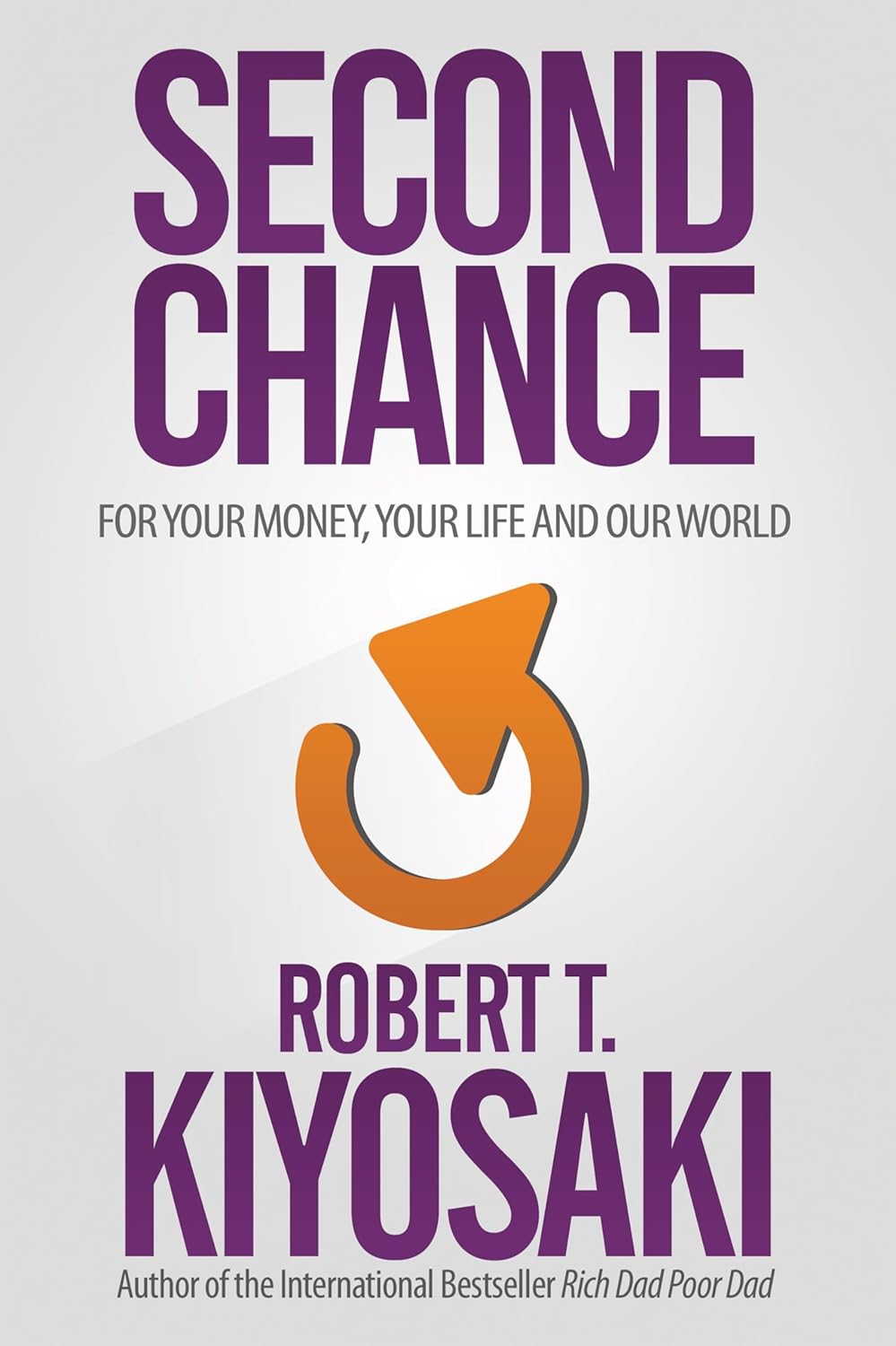
About Second Chance: for Your Money, Your Life and Our World by Robert T. Kiyosaki – Understand Money, Build Financial Knowledge, and Prepare for a Changing World
You work hard, earn money, pay your bills, and try to save something for the future. But what happens when prices rise, jobs become uncertain, or the economy changes in ways you never expected?
Is getting a good education and finding a secure job enough to protect your financial future? Should you save more, start a business, or learn how investing works?
Second Chance: for Your Money, Your Life and Our World by Robert T. Kiyosaki explores these questions through a different approach to personal finance.
Known for writing Rich Dad Poor Dad, Kiyosaki believes that many traditional ideas about money need to be reconsidered. He examines how economic systems have changed, why financial education matters, and how people can prepare for an uncertain future.
The book is divided into three main parts: The Past, The Present, and The Future. It uses history, the author's experiences, and his financial philosophy to explore the relationship between money, debt, employment, education, and investing.
Rather than offering a simple plan for becoming rich, the book encourages readers to question familiar advice and learn how money works.
Whether you are a student, employee, entrepreneur, or someone interested in building financial knowledge, this nonfiction guide offers ideas that can help you think more carefully about your financial decisions.
It is important to understand that Kiyosaki presents his own financial views and predictions. His opinions should be examined alongside reliable financial information rather than treated as guaranteed results or personal investment advice.
Meta description correction: Use the following exactly 150-character version instead:
Second Chance: for Your Money, Your Life and Our World by Robert T. Kiyosaki. Explore money and growth. Cream paper, delivery in Bangladesh. Shop now
Is the Traditional Path to Financial Security Enough?
For many years, people have been encouraged to study hard, find stable employment, save money, and prepare for retirement.
These are familiar and often useful goals.
However, Kiyosaki argues that depending entirely on traditional financial advice may leave people unprepared for economic change.
He asks readers to examine how their money is managed and what might happen if their source of income suddenly disappears.
The book does not suggest that education or employment has no value. Instead, it presents the author's argument that people should develop financial knowledge alongside their professional skills.
This gives readers a reason to think about their own plans rather than assuming that one financial path will suit everyone.
Understand Why the Book Begins With the Past
The first section examines the history of money, economic change, and the ideas that influence financial decisions.
Kiyosaki believes that understanding past events can help people recognise possible risks and opportunities.
He discusses changes in financial systems and considers how governments, banks, and large organisations affect the economy.
The section also introduces the ideas of R. Buckminster Fuller, an American thinker whose work strongly influenced Kiyosaki.
Rather than offering a simple history lesson, the author connects these subjects to his concerns about financial education and personal independence.
Some of his interpretations are controversial, so readers should distinguish his arguments from established economic facts.
Meet the Thinker Who Influenced Robert Kiyosaki
R. Buckminster Fuller was an inventor, designer, and writer interested in how humanity could use knowledge and technology to solve problems.
Kiyosaki credits Fuller with helping him think differently about the economy and the future.
One of the ideas discussed in the book comes from Fuller's work Grunch of Giants.
The term GRUNCH refers to what Fuller called the Gross Universal Cash Heist, a critical way of describing his concerns about concentrated economic power.
Kiyosaki uses these ideas to explore who benefits from financial systems and why ordinary people should learn more about how money works.
These arguments provide a major part of the book's background, although they should not be treated as proof of a coordinated financial conspiracy.
Discover Why Financial Education Matters
You may spend years studying mathematics, science, literature, and other important subjects without learning much about personal finance.
When you begin earning money, you suddenly face decisions about spending, borrowing, saving, and investing.
Kiyosaki believes that understanding these subjects is essential.
He encourages readers to learn financial terms and examine how money moves through businesses and households.
For example, understanding interest can help you compare loans. Learning about cash flow can help you see whether a business earns enough to cover its costs.
The book aims to make readers more curious about financial decisions.
It is a starting point for learning, not a replacement for reliable financial education or professional advice.
Learn the Difference Between Assets and Liabilities
A major idea in Kiyosaki's work is that understanding assets and liabilities can change the way you view money.
He often describes assets through their ability to generate income and liabilities through the money they require.
This is his simplified teaching method.
In formal accounting, an asset is an economic resource, while a liability is an obligation. A home can be an asset even when it costs money to maintain.
The book's practical message is to examine whether the things you buy improve or weaken your financial position.
For example, an income-producing property may generate rent, but expenses, repairs, taxes, and borrowing costs can reduce or eliminate its profit.
Understanding the complete financial picture matters more than simply calling something an asset.
Why Earning a Salary Is Not the Whole Story
A regular salary can provide stability and help people meet important needs.
However, Kiyosaki wants readers to think about the difference between income earned through work and income produced by investments or businesses.
He encourages readers to explore ways of developing assets that may generate cash flow.
This could involve learning how a business operates or understanding how an investment produces income.
The important word is learning.
Starting a company or buying property requires money, knowledge, planning, and an understanding of risk.
The book's ideas can encourage financial curiosity, but they do not establish that entrepreneurship is safer or more profitable than employment.
A suitable path depends on personal circumstances.
Understand Inflation and Its Effect on Everyday Life
Have you noticed that the same amount of money may buy fewer things over time?
That is one effect of inflation, which means a general rise in prices.
Kiyosaki discusses inflation as part of his wider concerns about money and the economy. He encourages readers to consider the purchasing power of their savings.
The book challenges traditional saving advice, but that does not mean keeping savings is useless.
Emergency savings can help with unexpected expenses. Different saving and investment choices carry different risks.
The useful lesson is to understand inflation, interest, and purchasing power before choosing what to do with your money.
Why Debt Can Be Both Useful and Dangerous
Many people are taught to avoid borrowing money whenever possible.
Kiyosaki challenges this rule by discussing how borrowing can sometimes help finance income-producing investments or business activities.
He argues that understanding debt is more useful than treating every type of borrowing as identical.
However, debt creates real obligations. Interest payments continue even when an investment performs poorly.
Borrowing to purchase property or start a business can produce serious losses, including the loss of personal assets.
The book introduces an alternative view of borrowing, but readers should examine repayment costs and seek qualified advice before taking financial risks.
The Present: Look at Your Financial Position Today
The middle section, called The Present, encourages readers to examine the world as it currently exists.
Kiyosaki asks them to compare familiar financial beliefs with changes in employment, technology, and economic systems.
For readers, this creates an opportunity to review personal circumstances.
What are your regular expenses? How much debt do you owe? Do you have emergency savings? What financial skills would you like to develop?
You do not need to answer every question immediately.
The important idea is to understand your starting position before making plans.
Although the book's discussion reflects conditions around 2015, its approach to examining personal financial choices can still encourage useful reflection.
The Future: Question the Rules You Have Always Followed
The final section is the largest collection of practical challenges to familiar financial advice.
Its chapters examine traditional messages about education, employment, mistakes, debt, saving, and investing.
Kiyosaki asks readers to consider alternative ways of thinking about these subjects.
For example, he challenges the idea that good school grades automatically lead to financial security.
He also encourages people to learn from mistakes and examine opportunities outside conventional employment.
These arguments are presented from the author's particular financial philosophy.
They should not be interpreted as instructions to abandon education, stop saving, or borrow recklessly.
The value for readers lies in examining the reasons behind financial rules rather than following advice without understanding it.
Discover Why Mistakes Can Become Learning Opportunities
Nobody makes perfect decisions all the time.
You might choose an unsuitable course, spend too much on a project, or discover that a business idea does not work.
Kiyosaki encourages readers to treat mistakes as experiences they can learn from.
This idea can help reduce the fear of trying something new.
However, learning through mistakes does not mean ignoring the consequences of financial decisions.
A useful approach is to begin with small, manageable experiments.
You could practise budgeting, study a business model, or test demand before investing a large amount of money.
The aim is to improve your knowledge while keeping possible losses within limits you can afford.
Prepare for Change in the Information Age
Technology has changed how people work, communicate, learn, and manage money.
Kiyosaki discusses the shift from the Industrial Age to the Information Age.
He believes that knowledge and the ability to adapt are increasingly important when economic systems change.
His book encourages readers to look beyond traditional career paths and develop skills suited to a changing world.
You might apply this idea by learning about digital business, improving professional skills, or understanding new financial services.
Technology creates opportunities, but it also introduces risks such as fraud and misleading information.
Learning how to evaluate information is just as important as finding it.
Can an Economic Crisis Create New Opportunities?
A financial crisis can cause serious problems.
People may lose jobs, businesses may close, and families may struggle to meet essential expenses.
Kiyosaki argues that major changes can also create opportunities for people who understand what is happening.
He encourages readers to prepare instead of responding only with fear.
That message does not mean every crisis is beneficial or that anyone can easily profit from difficult circumstances.
The practical lesson is to develop knowledge, examine risks, and build a financial plan that can withstand uncertainty where possible.
Preparation may include keeping suitable emergency savings and avoiding financial commitments that are too difficult to manage.
Why You Should Read the Economic Predictions Carefully
Second Chance was published in 2015, and some of its predictions concern events that were expected to happen soon afterward.
For example, the book discusses the possibility of a major financial crash in 2016.
Those forecasts belong to the period in which the book was written. They should not be presented as predictions about the economy in 2026.
A contemporary review in Publishers Weekly also questioned the usefulness of some of Kiyosaki's advice and noted the book's repeated predictions of financial trouble.
Read the historical discussion to understand the author's perspective, and use current, independently verified information when making real financial decisions.
Who Should Read Second Chance?
This book is suitable for adult readers interested in personal finance, financial education, entrepreneurship, economics, and self-improvement.
It may appeal to employees concerned about long-term financial security, entrepreneurs exploring business ideas, and readers who want to understand Kiyosaki's financial philosophy.
Fans of Rich Dad Poor Dad may recognise familiar themes presented through a wider discussion of economic change.
The book is not a detailed guide to investing in Bangladesh, nor does it provide personalised financial recommendations.
Readers seeking practical investment instructions should use additional resources and consider their financial circumstances.
Meet Robert T. Kiyosaki
Robert T. Kiyosaki is an American entrepreneur, financial educator, and author known for Rich Dad Poor Dad.
His work focuses on financial education, entrepreneurship, investing, and challenging conventional ideas about money.
Second Chance was published by Plata Publishing in 2015. Google Books lists the English edition with ISBN 9781612680460 at 400 pages, although bibliographic records for other formats report different page counts.
Enjoy a Premium Edition From Bookish Wonderland
Bookish Wonderland offers a premium reading edition designed for comfort and regular use.
The edition features:
-
Premium eye-soothing cream paper: Soft-coloured pages for comfortable reading.
-
Crystal-clear printing: Sharp, clean text that makes the explanations easy to follow.
-
High-quality stitched and glue binding: Designed to keep pages together and support long-term use with proper care.
You can keep the book in your personal finance collection and return to its ideas whenever you want to review your financial goals.
Check the Current Price and Delivery Options
To check the Book price in Bangladesh for Second Chance by Robert T. Kiyosaki, visit the current product listing at Bookish Wonderland.
We offer nationwide delivery, including locations inside and outside Dhaka.
Cash on Delivery is available across Bangladesh, and customers in Dhaka can ask about our fast or urgent delivery option.
If you have questions about availability, book customization, or delivery, contact Bookish Wonderland through Facebook or Instagram.
Give Yourself a Second Chance to Understand Money
You cannot control every change in the economy, but you can develop your financial knowledge and make more informed decisions.
Second Chance encourages readers to examine the past, understand the present, and prepare for possible changes in the future.
Its ideas challenge familiar beliefs about employment, saving, investing, and financial independence.
Whether you agree with every argument or simply want to explore a different perspective, the book offers plenty of questions worth considering.
Order Second Chance: for Your Money, Your Life and Our World by Robert T. Kiyosaki from Bookish Wonderland today and begin exploring a broader understanding of money, financial education, and personal growth.
If you require any customization or have any questions, please inbox us via FB or Insta.
| Primary Specification | |
| Author | Robert T. Kiyosaki |
| Narrator | Tim Wheeler |
| Genre | Personal Finance, Business, Economics, Self-Help |
| ISBN-13/ISSN | 978-1612680460 |
| ISBN-10 | 1612680460 |
| Publisher | Plata Pub |
| Publishing Date | January 1, 2015 |
| Edition | First Edition |
| Language | English |
| Reading Age | 18+ |
| Format | Printed Book |
| Physical Specification & Quality | |
| Paper Quality | Premium eye-soothing cream paper |
| Binding Quality | High quality stitched and glue binding (for longevity) |
| Print Quality | Crystal-clear print |
| Pages | 352 pages |
| Country | USA |
| Logistics Information | |
| Weight | 374 gm |
| Length | 8.5 inches |
| Width | 5.6 inches |
| Height | 1 inch |