

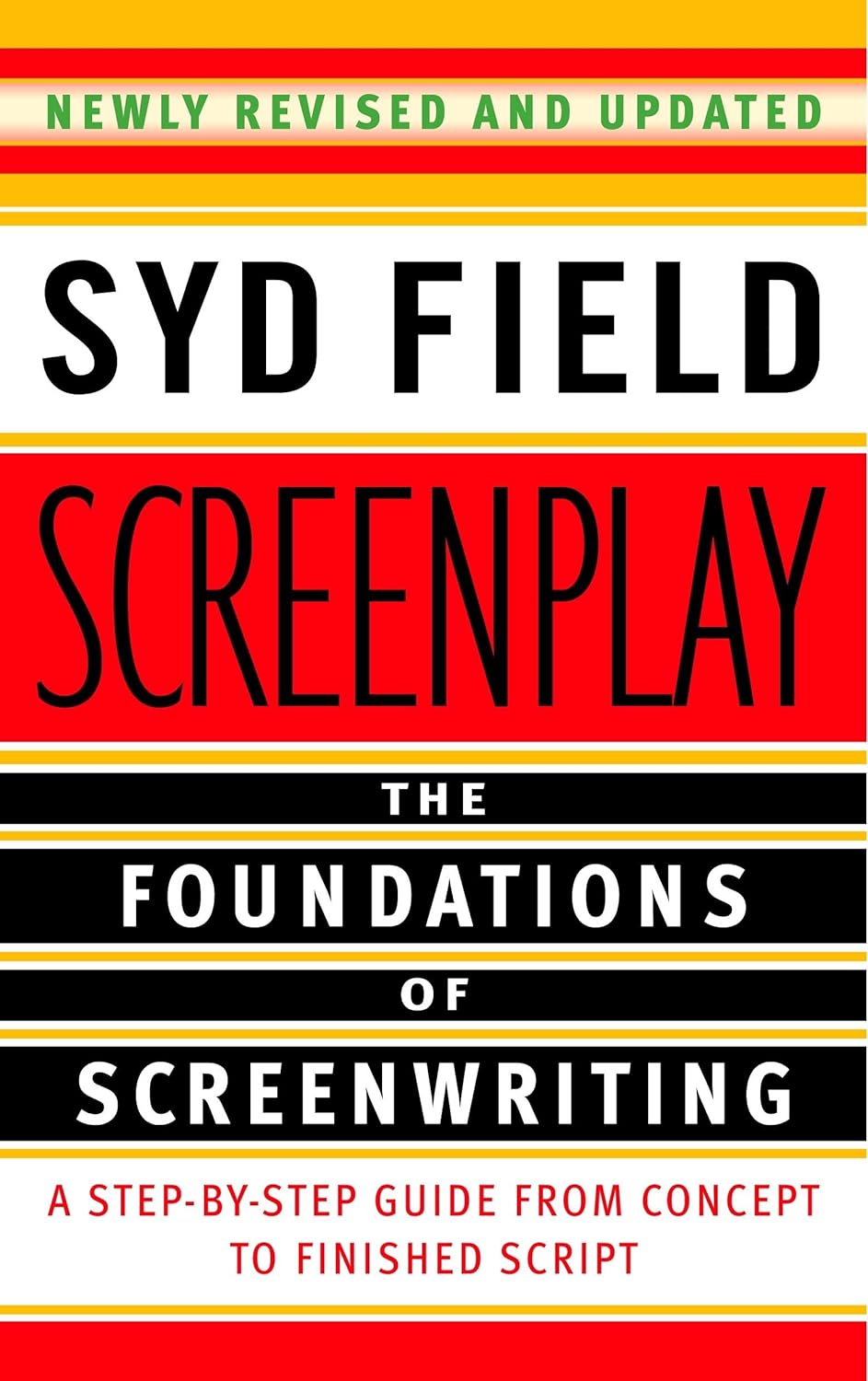
About Screenplay: The Foundations of Screenwriting by Syd Field – Learn Screenplay Structure, Create Memorable Characters, and Turn Your Story Idea Into a Film Script
Have you ever watched a great movie and thought, "I wish I could write a story like that"?
You have an exciting idea. You can imagine the main character, a few powerful scenes, and perhaps even the ending. But when you sit down to write, everything becomes confusing.
Where should the story begin? How do you keep the middle interesting? What makes a character memorable? And how do you turn your imagination into a screenplay that other people can understand?
Screenplay: The Foundations of Screenwriting by Syd Field helps aspiring writers explore these questions.
First published in 1979, this influential screenwriting guide explains how movie stories work and how writers can develop their ideas into structured scripts. It introduces Field's well-known three-act screenplay model, explores character development, and explains important elements of visual storytelling.
The revised edition also covers dialogue, adaptation, storytelling problems, and ways to protect your written work.
Whether you are a beginner dreaming of writing your first movie, a film student learning story structure, or an experienced writer looking to improve your technique, this book offers a practical introduction to the craft.
You do not need a film degree or expensive equipment to begin. You need an idea, a willingness to learn, and the patience to turn your thoughts into a story that can be seen on screen.
A Great Movie Begins With a Clear Story
Every movie starts with an idea, but an idea alone is not a finished story.
Imagine a young woman who wants to become a famous singer. That could be the beginning of a film. But what does she want badly enough to fight for it? What stands in her way? What might she lose if she fails?
Syd Field encourages writers to develop their ideas by asking these important questions.
He explains that a screenplay needs a clear subject, meaningful action, and characters whose choices help move the story forward.
Instead of filling pages with random events, you learn to connect scenes to a central dramatic situation.
This approach helps you understand what your movie is really about before spending months writing it.
Discover Syd Field's Famous Three-Act Structure
One of the most important lessons in the book is the three-act screenplay structure, often called Syd Field's Paradigm.
The model divides a story into three main parts: setup, confrontation, and resolution.
The first act introduces the characters and their situation. The second follows their struggles as problems become more difficult. The third brings the central conflict toward its conclusion.
In Field's model for a traditional 120-page feature screenplay, these sections occupy roughly 30, 60, and 30 pages respectively.
These lengths are guides, not rules that every film must follow.
The model gives beginners a way to organise their ideas while leaving room for different stories and creative approaches.
Act One: Make Your Audience Care From the Beginning
The opening of a film has an important job.
It introduces your main character, shows the world they live in, and gives the audience a reason to become interested.
Imagine a story about a poor student who discovers a mysterious letter.
The opening might show the student's difficult life before the letter arrives and changes everything.
Field explains why the early pages of a screenplay are especially important to readers evaluating a script.
They need to understand the basic situation and see a reason to continue.
This section helps aspiring writers think carefully about their opening scenes rather than beginning with unnecessary explanations or confusing events.
Act Two: Keep the Story Moving When Problems Grow
Many beginners find the middle of a screenplay the hardest part to write.
They know how their story begins and how they want it to end, but they struggle to create meaningful events between those points.
Field's second act focuses on confrontation.
The main character faces obstacles while trying to achieve a goal.
Each problem should create meaningful pressure, reveal information, or lead to another important decision.
For example, a character searching for a missing friend may discover that someone is hiding information.
That discovery could force the character to change their plan.
The book helps writers understand how connected obstacles can sustain interest throughout the middle of a story.
Act Three: Give Your Story a Meaningful Ending
A good ending should grow from the events that came before it.
Your main character has faced difficulties, made decisions, and learned important information. Now the central conflict must reach a conclusion.
Field calls this final section the resolution.
The ending does not always need to be happy.
A character may achieve their goal, fail, or discover that their original goal was not what they truly needed.
What matters is that the conclusion feels connected to the story.
The book encourages writers to think about their ending while developing the screenplay rather than waiting until the final pages to decide what happens.
Learn How Plot Points Change Everything
How does a story move naturally from one act to another?
Field introduces plot points, important events that change the direction of the story.
Plot Point I moves the action from the setup into the main confrontation. Plot Point II leads the story toward its resolution.
Imagine a detective investigating a missing person. A discovery near the end of the first act may reveal that the disappearance involves a much larger crime.
Later, another discovery may change the detective's understanding of the entire case.
These turning points help connect different parts of the story.
Field's official Paradigm worksheet also provides a way to practise organising a screenplay around its beginning, two major plot points, and ending.
Create Characters Who Feel Like Real People
A strong plot becomes more interesting when readers care about the people involved.
Field devotes important sections of the book to creating and developing characters.
He encourages writers to think about a character's background, needs, relationships, and actions.
You might know that your main character wants to become a doctor. But why is that dream important? What are they afraid of? How do they behave when someone challenges them?
These questions can help you develop a person who feels more complete.
The book also explores how character and story structure work together.
A character's decisions should influence what happens rather than leaving them as someone who simply watches events unfold.
Show the Story Instead of Explaining Everything
Movies tell stories through images, sounds, actions, and dialogue.
That means writing a screenplay is different from writing a novel.
A novelist can spend several pages describing what a character thinks. A screenwriter must consider how the audience will understand that feeling through something they can see or hear.
Imagine that a character feels lonely.
Instead of writing a long explanation, you might show them eating alone while an unanswered message remains on their phone.
Field's guidance introduces the importance of visual storytelling and choosing actions that communicate meaning.
This can help writers create scenes that are easier for filmmakers and audiences to understand.
Write Dialogue That Sounds Natural
Dialogue can reveal personality, create tension, and move a story forward.
But beginners sometimes make characters explain everything they are thinking.
Field discusses how to write dialogue that fits the character and the situation.
Imagine two friends who are angry with each other. They might discuss an ordinary problem while avoiding the real reason for their disagreement.
Their actions and words together can reveal the tension.
The book encourages writers to think about what dialogue contributes to a scene.
A conversation should serve the story rather than simply fill space between important events.
Understand How Scenes and Sequences Work Together
A screenplay is built from smaller units of dramatic action.
A scene presents an event in a particular setting. Several connected scenes can form a sequence that develops a larger part of the story.
Field explores these elements to help readers build a screenplay step by step.
Imagine a character preparing for an important competition.
A sequence might include training, facing a setback, receiving help, and deciding to try again.
Each scene contributes to the larger goal.
Understanding these connections can help writers avoid adding events that do not serve their story.
The book's chapters on scenes, sequences, and storylines provide a framework for developing individual ideas into a complete narrative.
Learn the Correct Way to Format a Screenplay
A screenplay must communicate clearly with the people who may read and produce it.
Its layout differs from an ordinary story or essay.
Writers need to understand scene headings, action descriptions, dialogue, and other formatting elements.
Field includes a section devoted to screenplay form.
This helps beginners become familiar with the professional presentation of film scripts.
You can use the lessons alongside suitable screenwriting software when preparing your own work.
Formatting alone will not make a weak story successful, but a clear layout can make your script easier to read and understand.
Turn a Book or Article Into a Film Script
Have you ever read a novel and imagined how it would look as a movie?
Adapting written material for the screen involves more than copying dialogue and removing descriptions.
A long novel may contain many characters, events, and internal thoughts that cannot all fit into a feature film.
Field discusses how to approach adaptations of novels, plays, and articles.
Writers must decide which events are essential and how to communicate important information visually.
The chapter gives readers an introduction to turning existing material into a screenplay.
If you plan to adapt copyrighted material, you must also check whether you have the necessary rights and permissions.
Overcome Writer's Block and Finish Your Draft
Starting a script can feel exciting. Completing it is often much harder.
You may become unhappy with your dialogue, discover a problem in the middle, or feel uncertain about your ending.
Field addresses common writing difficulties and encourages readers to approach screenwriting as a craft that develops through practice.
A useful approach is to identify the specific problem rather than deciding that your entire idea has failed.
Perhaps your main character needs a clearer goal, or a scene has no important purpose.
The book gives you tools to examine these problems.
You can also use its structural model to review your draft and find sections that need more work.
Learn From Familiar Hollywood Films
One way to understand storytelling is to examine films that have already been made.
Field uses examples from well-known movies to explain how structure, character, and dramatic action work.
The revised edition updates many of its examples to include more contemporary films.
Rather than presenting a theory without showing how it works, the author connects his ideas to actual cinematic storytelling.
This approach may be particularly useful for film students.
You can watch a movie, identify its major turning points, and compare your observations with Field's framework.
The goal is to understand storytelling choices, not copy another writer's scenes.
Structure Should Guide Your Creativity, Not Control It
Some writers worry that using a three-act structure will make every screenplay feel the same.
Field's approach is better understood as a way to organise a story rather than a demand that all films follow identical events.
Different genres, characters, and themes can work within similar broad structures.
A romantic comedy, mystery, and family drama may all have beginnings, conflicts, and resolutions, yet tell completely different stories.
The book helps writers understand why dramatic structure matters while developing their own creative ideas.
You can study the model, practise it, and adjust your approach when the needs of your story justify doing so.
A structure is a writing tool, not a guarantee of artistic quality or commercial success.
Who Should Read This Screenwriting Guide?
This book is suitable for aspiring screenwriters, film students, independent filmmakers, and people interested in storytelling.
It can also help novelists who want to understand how writing for film differs from writing prose.
Beginners will find explanations of basic concepts, while writers with an unfinished script can use the book to examine their structure and characters.
If you enjoy watching movies and want to understand how their stories are created, the examples offer another way to appreciate filmmaking.
This is an instructional nonfiction book, not a collection of complete movie scripts.
Meet Syd Field, the Screenwriting Teacher
Syd Field (1935–2013) was an American screenwriting teacher, author, and lecturer whose work helped popularise the three-act screenplay model.
His books have been used in film education around the world.
He was inducted into the Final Draft Hall of Fame in 2006 and was the first inductee into the Screenwriting Hall of Fame of the American Screenwriting Association.
The revised Delta paperback edition of Screenplay was published on November 29, 2005. It contains 336 pages and carries ISBN-13 9780385339032.
A Premium Edition From Bookish Wonderland
Bookish Wonderland offers a premium reading edition for students, writers, and readers who enjoy collecting practical reference books.
Our advertised edition features:
-
Premium eye-soothing cream paper: Soft-coloured pages for comfortable reading.
-
Crystal-clear printing: Sharp text that makes the explanations easy to follow.
-
High-quality stitched and glue binding: Designed to support repeated reading and help the pages remain secure with proper care.
You can keep this book beside your notebook and return to its lessons whenever you begin a new screenplay or revise an existing draft.
Check the Book Price in Bangladesh
To check the current price of Screenplay: The Foundations of Screenwriting by Syd Field, visit its product listing at Bookish Wonderland.
We offer nationwide delivery, including locations inside and outside Dhaka.
Cash on Delivery is available across Bangladesh, and customers in Dhaka can ask about our fast or urgent delivery option.
For questions about availability, customization, or delivery, contact Bookish Wonderland through Facebook or Instagram.
Order from Bookish Wonderland
Every finished screenplay begins with someone willing to turn an idea into words.
Syd Field's guide gives you a way to understand structure, develop characters, write meaningful scenes, and approach the difficult process of completing a film script.
Whether you dream of working in cinema or simply want to explore storytelling, this book offers practical lessons you can apply to your own creative projects.
Order Screenplay: The Foundations of Screenwriting by Syd Field from Bookish Wonderland today and begin developing your ideas into stories designed for the screen.
If you require any customization or have any questions, please inbox us via FB or Insta.
| Primary Specification | |
| Author | Syd Field |
| Narrator | Eric Michael Summerer |
| Editor | Sabrina Bowers |
| Genre | Nonfiction, Screenwriting, Creative Writing, Film Studies |
| ISBN-13/ISSN | 978-0385339032 |
| ISBN-10 | 0385339032 |
| Publisher | Delta |
| Publishing Date | November 29, 2005 |
| Language | English |
| Reading Age | 14+ |
| Format | Printed Book |
| Physical Specification & Quality | |
| Paper Quality | Premium eye-soothing cream paper |
| Binding Quality | High quality stitched and glue binding (for longevity) |
| Print Quality | Crystal-clear print |
| Pages | 320 pages |
| Country | USA |
| Logistics Information | |
| Weight | 343 gm |
| Length | 8.5 inches |
| Width | 5.6 inches |
| Height | 0.71 inch |