

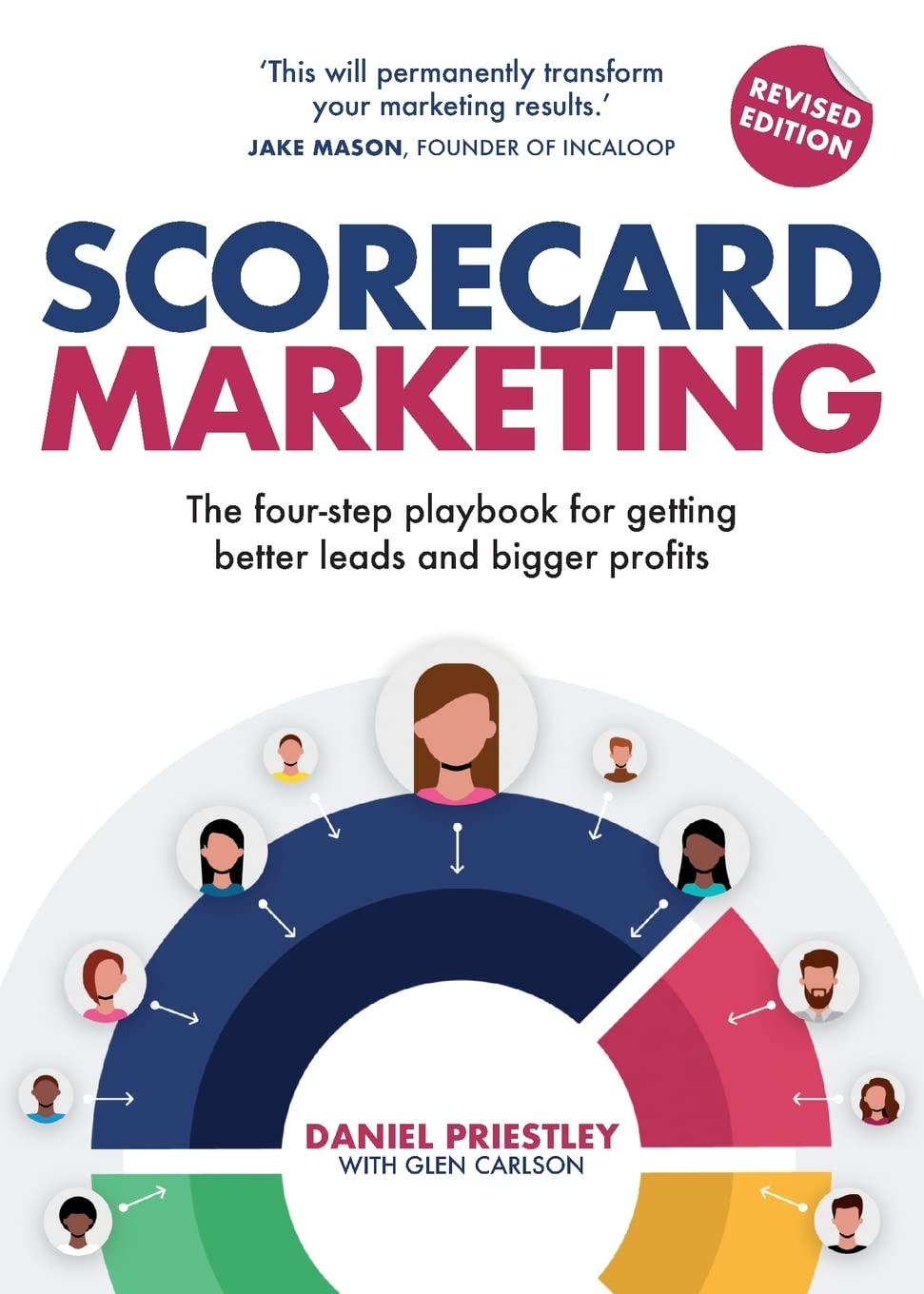
About Scorecard Marketing by Daniel Priestley with Glen Carlson: A Practical Guide to Attracting Better Leads, Understanding Customers, and Growing Your Business
You have a good product or service. You post on social media, run advertisements, and spend hours answering messages. People visit your website, but many leave without buying anything. Others give you their email addresses, yet you have no idea what they actually need.
Sound familiar?
Scorecard Marketing by Daniel Priestley with Glen Carlson introduces a different approach to finding customers. Instead of asking people to sign up for a generic newsletter or download another free guide, it shows businesses how to offer an interactive assessment that gives visitors useful information about themselves.
A visitor answers a short set of questions and receives a personalised score or report. The business learns about that person's needs, challenges, and interests. This can help both sides decide whether a product or service is a good fit.
The book explains the thinking behind this method and presents a four-step playbook for building a scorecard campaign. Its subtitle is The Four-Step Playbook for Getting Better Leads and Bigger Profits.
If you run a small business, sell services, manage marketing campaigns, or want to understand your customers more clearly, this guide offers a practical framework to explore.
It is not a promise of automatic sales. A useful scorecard still needs a suitable audience, thoughtful questions, a relevant offer, and testing. But the book shows how marketing can become more helpful and personal before a sales conversation even begins.
Why Getting More Visitors Is Not Always Enough
Imagine that one thousand people visit your website today. Some are curious. Some are comparing prices. A few are ready to buy. Others may never need what you sell.
If you treat everyone in exactly the same way, you may spend too much time speaking to people who are not a suitable match.
Priestley and Carlson explain why lead generation should involve more than collecting names and email addresses.
A good marketing system should help you understand what visitors want and whether your offer could help them.
The goal is to build a more useful relationship with potential customers before asking for a purchase.
What Exactly Is Scorecard Marketing?
Scorecard marketing uses an assessment, quiz, or questionnaire to help someone understand their current situation.
For example, a business coach might offer a business growth scorecard. Visitors answer questions about their sales, team, marketing, and business goals.
At the end, they receive a result showing possible strengths and areas for improvement.
The business can use the answers to understand which services may be relevant.
Unlike a simple contact form, the scorecard gives something useful back to the person completing it.
The authors present this exchange of value and information as the foundation of their approach.
Understand Why People Decide to Buy
Before trying to sell something, you need to understand why someone might want it.
The book discusses psychological tension: the difference between a person's present situation and the situation they want to reach.
Someone might feel frustrated because their business is not growing. Another person may want to improve their health or learn a valuable skill.
A useful assessment can help people recognise and explain these needs.
The important part is to ask honest questions that help visitors understand their situation.
The aim should not be to frighten people or invent problems so they feel forced to buy.
Help People Discover Needs They Have Not Considered
Sometimes, customers know exactly what they want. They search for a product, compare options, and make a decision.
Other people know something could be better but have not decided what they need.
The book calls attention to these less obvious interests and desires.
For example, a business owner may believe they need more advertising. A scorecard could help them recognise that slow customer follow-up is another issue worth examining.
This creates a chance for more informed conversations.
A useful assessment helps the customer discover something meaningful rather than pushing them toward a predetermined answer.
Step One: Create a Landing Page That Builds Interest
The practical framework begins with a landing page.
This is the webpage where visitors discover your scorecard and decide whether to complete it.
The page should clearly explain what they will learn.
A vague promise such as “Take our quiz” gives people little reason to participate.
A more useful concept might invite business owners to assess how prepared they are for growth.
The book explains how a clear concept and an engaging presentation can encourage participation.
Visitors should understand what the assessment covers, how their information will be used, and what they will receive afterward.
Step Two: Ask Questions That Reveal Real Needs
Once visitors begin the scorecard, the questions become the most important part of the experience.
Good questions are easy to understand and relevant to the result.
A business assessment might ask about the customer's main goals, current challenges, available resources, and plans for the coming months.
Each answer can help build a clearer picture.
The authors discuss organising questions into categories and assigning scores to answers.
However, a score is only useful when the questions and scoring method make sense.
Avoid collecting unnecessary personal information, and do not ask questions simply because the technology allows it.
Step Three: Give Each Person a Useful Result
Imagine finishing a detailed questionnaire and receiving a message that simply says, “Thank you.”
You might feel that your time was wasted.
A scorecard should provide something more valuable.
The book's third practical step focuses on delivering results that help people understand their answers.
A visitor might receive a score, an explanation of different categories, and practical suggestions about what to explore next.
The result should reflect what the person actually said.
This personalised experience is one of the main differences between scorecard marketing and an ordinary contact form.
Step Four: Turn Useful Conversations Into Sales
A completed scorecard is not the end of the process.
The final step focuses on marketing, follow-up, and sales.
Some participants may be ready to speak with a business immediately. Others may need more information before making a decision.
The book encourages businesses to use assessment results when deciding what to offer next.
Someone seeking basic information might receive an educational guide, while a person who requests help could be invited to book a consultation.
Follow-up should remain relevant and respect the customer's communication choices.
The objective is to make the next step helpful rather than pressure people into buying.
Find Out Which Leads Are Worth Following Up
Not every person who completes a questionnaire will become a customer.
Some may have no suitable need, while others may be interested but unable to purchase yet.
A scorecard can help businesses organise these different responses.
For example, a marketing agency might identify visitors who need website improvements, advertising support, or help converting enquiries into sales.
The agency can then decide which conversations to prioritise.
This can reduce guesswork, although the scores should not be treated as perfect predictions of customer behaviour.
A person is more than a number, and their circumstances may change.
Make Your Marketing Feel More Personal
Generic marketing often sends the same message to every subscriber.
But people have different goals and problems.
The book explains how information collected through a scorecard can help businesses offer more relevant communication.
Someone interested in starting a business may need beginner resources. An established owner might be more interested in improving operations.
Their follow-up messages should reflect these different needs.
Personalisation works when customers receive something genuinely useful.
Businesses should also explain their data practices, obtain appropriate permission, and provide a clear way to stop unwanted messages.
Build a Marketing Tool You Can Improve Over Time
A scorecard does not have to be used only once.
After launching one, you can examine whether visitors understand the questions, complete the assessment, and find the results useful.
Their responses may reveal common customer problems or unclear parts of your offer.
You can then improve the questions, landing page, or results.
The authors describe a scorecard as a lasting digital asset that businesses can develop over time.
Its value depends on regular maintenance and relevant information, not simply leaving an old questionnaire online.
See How Different Businesses Could Use This Method
The approach can be adapted to several types of business.
A coach might create an assessment about personal goals. A consultant could help owners evaluate business systems. A training company might help visitors identify skills they want to develop.
An online bookstore could offer a reading-preference quiz that helps customers discover suitable genres or books.
These are possible applications, not promises that every campaign will succeed.
Each business needs to choose questions that fit its audience and offer.
The book is especially relevant when understanding a customer's needs before a sale makes the buying process easier.
Understand the Difference Between a Quiz and a Scorecard
A simple online quiz might tell someone which fictional character resembles them.
That can be entertaining, but it may not provide useful business information.
A marketing scorecard is designed to assess defined areas and deliver a result that people can act on.
It might measure business readiness, identify common challenges, or show where someone needs further information.
The scoring method should match the purpose of the assessment.
If the questions are weak or the results are misleading, the scorecard loses its value.
A useful result is more important than an impressive-looking number.
Learn About ScoreApp Without Confusing It With the Book
The book introduces a marketing method that its authors have developed alongside software tools.
ScoreApp is a platform designed to create assessments, collect responses, and deliver personalised results.
It can also help businesses organise leads and connect information with other marketing systems.
However, reading Scorecard Marketing does not mean you must purchase a software subscription.
The book explains the underlying approach, while software is one possible way to put it into practice.
Readers should compare available tools, costs, and data requirements before choosing a platform.
Is This Book Suitable for Marketing Beginners?
Yes. The book is designed for business owners and marketers who want to understand a specific lead-generation method.
Its four-step approach makes the process easier to follow, even if you have never built an interactive assessment.
It may be useful for entrepreneurs, consultants, coaches, agency owners, and sales teams.
Readers looking for a complete introduction to every marketing channel should know that this book focuses mainly on scorecard-based lead generation. It is a specialised guide rather than a general marketing textbook.
Meet Daniel Priestley and Glen Carlson
Daniel Priestley and Glen Carlson are entrepreneurs and cofounders of Dent Global, an entrepreneur training company.
Their work focuses on helping businesses develop their positioning, attract customers, and grow.
In Scorecard Marketing, they share a method built around interactive assessments and personalised communication.
The book was first published by Rethink Press in 2022. A revised paperback edition followed on May 30, 2023, with ISBN-13 9781781337998 and 190 pages. Edition details may vary.
A Premium Business Book for Your Collection
Bookish Wonderland offers a premium reading edition for entrepreneurs, students, and marketing professionals.
The edition features:
-
Premium eye-soothing cream paper for comfortable reading.
-
Crystal-clear printing for sharp, easy-to-follow text.
-
High-quality stitched and glue binding for lasting use with proper care.
You can keep the book near your workspace and revisit its lessons while developing marketing campaigns.
Check the Book Price in Bangladesh
To check the current price of Scorecard Marketing by Daniel Priestley with Glen Carlson, visit its product listing at Bookish Wonderland.
We provide nationwide delivery, including locations inside and outside Dhaka.
Cash on Delivery is available across Bangladesh. Customers in Dhaka can also ask about fast or urgent delivery.
For availability, book customization, or other questions, contact Bookish Wonderland through Facebook or Instagram.
Start Building More Useful Customer Connections
You do not need to treat every visitor as an identical sales prospect.
Scorecard Marketing shows how a thoughtful assessment can help customers understand their needs while giving businesses better information for relevant follow-up.
Its lessons offer a practical starting point for creating a more interactive marketing experience.
Order Scorecard Marketing by Daniel Priestley with Glen Carlson from Bookish Wonderland today and explore a different way to attract, understand, and connect with potential customers.
If you require any customization or have any questions, please inbox us via FB or Insta.
| Primary Specification | |
| Author | Daniel Priestley with Glen Carlson |
| Genre | Business, Marketing, Entrepreneurship, Sales |
| ISBN-13/ISSN | 978-1781337998 |
| ISBN-10 | 1781337993 |
| Publisher | Rethink Press |
| Publishing Date | May 30, 2023 |
| Language | English |
| Reading Age | 18+ |
| Format | Printed Book |
| Physical Specification & Quality | |
| Paper Quality | Premium eye-soothing cream paper |
| Binding Quality | High quality stitched and glue binding (for longevity) |
| Print Quality | Crystal-clear print |
| Pages | 188 pages |
| Country | UK |
| Logistics Information | |
| Weight | 210 gm |
| Length | 8.5 inches |
| Width | 5.6 inches |
| Height | 0.43 inch |