

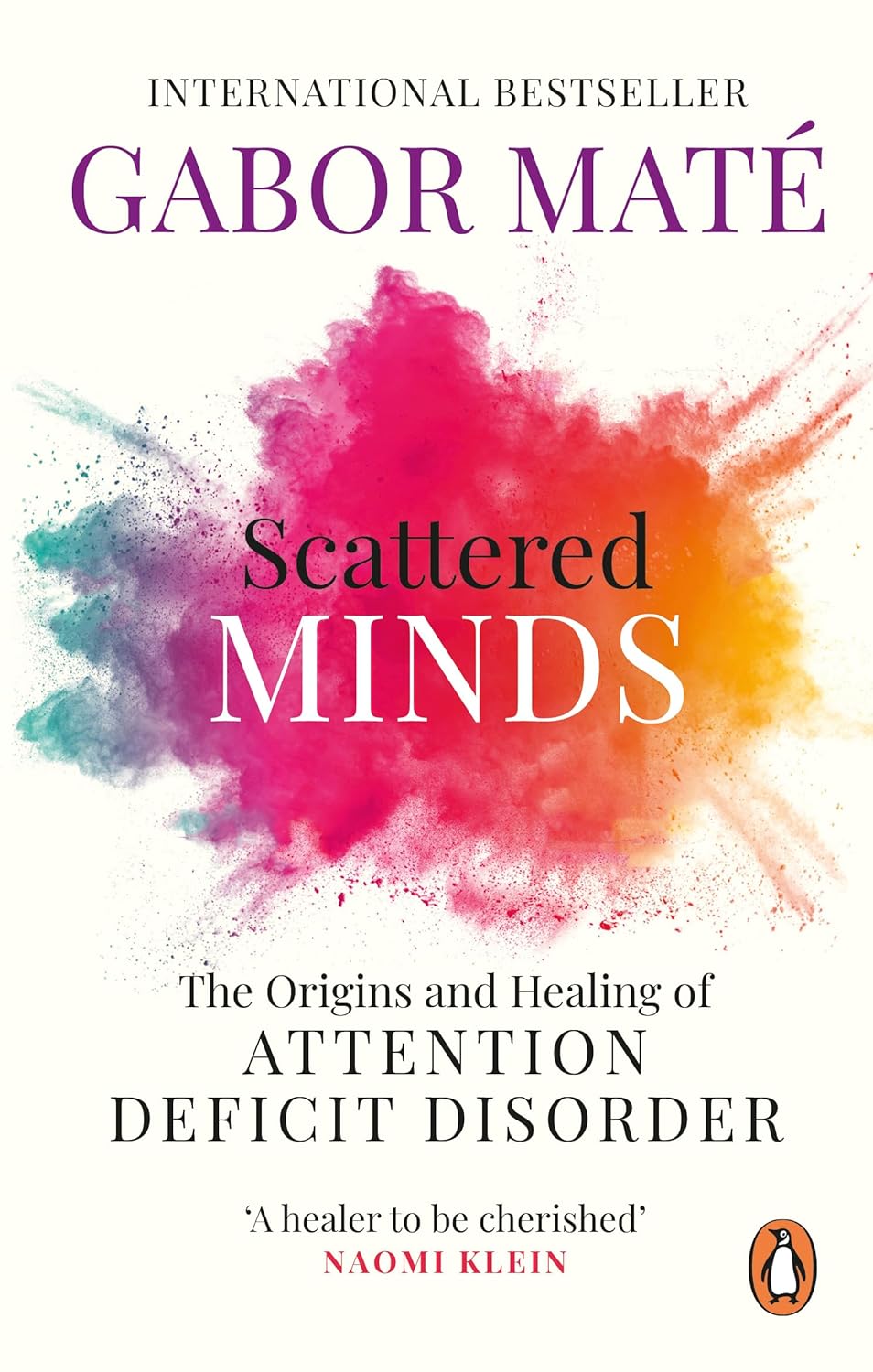
About Scattered Minds by Gabor Mate, M.D.: Understand ADHD, Explore Emotional Development, and Discover a More Compassionate Approach to Attention Difficulties
Why can a simple task feel so difficult for one person when it seems easy for everyone else? Why might a child struggle to follow instructions even when they want to do well? And why do some adults spend years believing they are careless or lazy before finally understanding their attention difficulties?
Scattered Minds by Dr. Gabor Maté explores these experiences through personal stories, medical observations, and the author's perspective on attention deficit disorder.
Drawing on his experience as a physician, a parent, and someone diagnosed with ADD himself, Maté examines distractibility, impulsivity, emotional sensitivity, family relationships, and the challenges of everyday life.
He places particular importance on early development, emotional connection, and supportive environments. The book also discusses parenting, adult relationships, self-esteem, and ways people can seek support.
An important distinction: Maté argues that environmental stress plays a central role in causing ADHD. This is his interpretation, not the established medical consensus. Current evidence shows that ADHD involves substantial genetic influences alongside environmental factors; no single cause explains every case. The book is therefore most useful as one perspective to consider alongside current, evidence-based information.
A Personal Account, Not Just a Medical Explanation
One reason this book feels personal is that Maté writes about his own experiences with attention difficulties. He also draws on his work with patients and his experiences as a parent of children diagnosed with ADD.
Rather than discussing symptoms only as a list, he describes how they can affect relationships, work, family life, and the way people see themselves.
Readers encounter situations involving forgotten tasks, emotional reactions, and trouble staying organised. These examples help explain why attention difficulties can have effects beyond school or the workplace.
The book's personal stories make its ideas accessible, though individual experiences cannot establish the cause of ADHD for everyone.
Understand What Attention Difficulties Can Look Like
Someone with ADHD may struggle to finish a task, remember an appointment, organise their work, or avoid distractions. Other people experience restlessness, impulsive behaviour, or a mixture of these difficulties.
Maté examines attention through examples from daily life. He encourages readers to look beyond a person's outward behaviour and consider what they may be experiencing.
A child who forgets homework is not necessarily refusing to cooperate. An adult who misses deadlines may need an assessment and practical support rather than criticism alone.
These examples can build understanding, but a book cannot diagnose ADHD. Symptoms must be evaluated by a qualified healthcare professional.
Explore How the Developing Brain Is Connected to Attention
Maté devotes part of the book to early brain development. He examines how children learn to manage attention, emotions, and behaviour as they grow.
He argues that early experiences and emotional environments have a major influence on the development of these abilities.
This is one of the book's central ideas, but it should be understood in context. Research shows that ADHD has strong genetic influences and can involve several environmental risk factors. A difficult childhood is not required for someone to develop ADHD.
The book provides an opportunity to explore Maté's developmental perspective without treating it as the only explanation.
Discover the Importance of Emotional Connection
Children depend on adults for safety, care, and support.
Maté discusses attachment and attunement, including how adults respond to a child's feelings and needs.
He encourages parents to pay attention to emotional connection instead of focusing only on correcting behaviour.
A child who is upset may find it difficult to listen to instructions. Taking time to understand the situation can help adults respond more thoughtfully.
A supportive relationship can benefit a child's wellbeing, but parenting behaviour alone does not determine whether a child develops ADHD.
The value of this discussion lies in considering the emotional needs of children alongside their practical difficulties.
Move Away From Blame and Toward Understanding
When a child struggles at school, parents may feel that they have done something wrong.
Adults with attention difficulties may also spend years blaming themselves for unfinished work, forgotten tasks, or strained relationships.
Maté encourages readers to approach these experiences with greater compassion.
Understanding the reasons behind a difficulty can make it easier to seek appropriate support.
However, compassion should never turn into another form of blame. Parents do not cause ADHD simply by failing to provide enough affection.
The book is most helpful when its ideas encourage supportive relationships rather than guilt or accusations.
Why Some Children React More Strongly to Their Surroundings
Maté explores sensitivity and the different ways children respond to everyday experiences.
One child may become overwhelmed by a noisy classroom, while another may struggle when routines change.
He considers how emotional experiences can affect attention and behaviour.
This encourages readers to look closely at the needs of an individual child rather than assuming every child responds in the same way.
A quieter learning space, clearer instructions, or a predictable routine may help some children manage specific challenges.
The right approach depends on the child, and difficulties that interfere with daily life deserve professional assessment.
Understand Family Life Through a Different Lens
Attention difficulties can affect the whole household.
A parent may repeatedly remind a child to complete chores. The child may become frustrated, and ordinary conversations can turn into arguments.
Maté examines family relationships and the emotional patterns that can develop around these situations.
His discussion invites readers to ask what each family member needs and how communication might improve.
It can be useful to separate a child's behaviour from assumptions about their intentions.
A family may benefit from clear expectations, practical assistance, and professional guidance when needed.
The goal is to support everyone involved rather than identify someone to blame.
When a Child Pushes Back Against Instructions
Why might a child resist a request, even when it seems simple?
Maté discusses oppositional behaviour and what he calls counterwill, a term associated with resistance to feeling controlled.
He explores how adults might respond without turning every disagreement into a contest.
For example, a parent could offer an appropriate choice about when to begin a task rather than issuing repeated threats.
This does not mean removing all boundaries. Children still need clear expectations and suitable support.
The book's discussion can help readers think about the emotional side of conflict, while persistent behavioural concerns may require assessment for other contributing conditions.
Help Children Feel Accepted While They Learn
A child who hears constant criticism may begin to believe that every mistake makes them a disappointment.
Maté places importance on unconditional positive regard: showing care for a child even when their behaviour needs attention.
This approach separates a child's worth from the difficulty of completing a task.
Parents can offer encouragement while also teaching useful skills and maintaining reasonable limits.
For example, helping a child break homework into smaller parts may be more productive than repeatedly calling them careless.
Current clinical guidance also supports parent education and behavioural approaches as parts of ADHD care.
Find Better Ways to Support Learning at School
School can be difficult when lessons require long periods of concentration, careful organisation, or several instructions at once.
Maté explores the experiences of children with attention difficulties in the classroom.
His discussion encourages teachers and parents to recognise that a child may need a different approach to learning.
Practical support could involve written instructions, help organising assignments, or suitable classroom adjustments.
The book can start a useful conversation, but individual educational plans should reflect professional assessment and the student's needs.
Evidence-based school programmes and appropriate learning accommodations can improve how children with ADHD manage academic demands.
Understand the Challenges of the Teenage Years
Teenagers want greater independence while still needing guidance and support.
Attention difficulties can make this period more complicated, particularly when schoolwork, friendships, and personal responsibilities become demanding.
Maté discusses how parents can maintain relationships with teenagers without turning every conversation into criticism.
His ideas encourage adults to listen and recognise the importance of growing independence.
Clear boundaries remain important, especially when safety is involved.
For families dealing with significant difficulties, professional support can help address ADHD symptoms and any additional emotional or behavioural concerns.
Discover Why ADHD Can Continue Into Adulthood
ADHD does not always disappear when someone finishes school.
Adults may experience ongoing problems with organisation, time management, attention, or impulsivity.
Maté devotes a substantial section to adult experiences, drawing on personal stories and clinical observations.
He examines how these difficulties can affect employment, relationships, and everyday responsibilities.
Some people first receive an ADHD diagnosis as adults because their earlier symptoms were overlooked or their difficulties became more noticeable when life grew demanding.
Understanding this possibility may encourage readers to seek a proper assessment rather than relying on self-diagnosis.
Explore the Link Between Attention and Self-Esteem
Repeated difficulties can change how people think about themselves.
Someone who regularly forgets appointments or struggles to finish projects may begin to believe they are incapable of doing anything well.
Maté explores these feelings in his discussion of adult ADHD and self-esteem.
His writing encourages readers to understand their experiences without defining their entire identity through their difficulties.
This does not mean ignoring mistakes or avoiding responsibility.
Instead, it means recognising where additional skills, treatment, or support may help.
The book offers readers a chance to consider how greater self-understanding could improve their relationship with themselves.
Why Relationships Can Become Complicated
Attention difficulties may affect conversations, shared responsibilities, and daily routines.
A person might forget an important arrangement or struggle to follow a long discussion. Their partner may interpret the behaviour as a lack of interest.
Maté examines how these misunderstandings can affect relationships.
His discussion encourages greater awareness of personal habits and the feelings of others.
Practical changes, such as shared calendars and clear agreements, may help some couples manage everyday responsibilities.
However, no single relationship strategy works for everyone.
When difficulties are serious, qualified professionals can help couples understand their situation and explore appropriate support.
Learn About Self-Parenting and Personal Care
In the section on adult ADHD, Maté introduces self-parenting.
He encourages adults to consider how they treat themselves and how their surroundings affect their wellbeing.
This includes reflecting on personal needs rather than responding to every difficulty with harsh self-criticism.
The discussion may interest readers who want to develop more supportive daily habits.
Simple steps, such as writing reminders, organising a workspace, or establishing a manageable routine, can complement appropriate care.
These strategies are tools for daily life, not cures for ADHD.
A healthcare professional can help determine which treatments and supports are suitable for an individual.
Understand What Medication Can and Cannot Do
The book includes a chapter devoted to medication.
Maté examines the benefits and limitations of medical treatment as part of his wider approach to attention difficulties.
Readers should understand that medication remains an established treatment option for ADHD.
The US National Institute of Mental Health identifies medication, psychotherapy, and behavioural interventions as effective approaches. Treatment plans may combine several methods depending on individual needs.
This book should not be used to stop prescribed medication or replace professional advice.
Its personal and emotional perspective can be explored alongside a treatment plan developed with a qualified clinician.
Who Should Read Scattered Minds?
This book may interest adults living with ADHD, parents, caregivers, teachers, psychology students, and readers exploring attention and emotional development.
It offers personal stories and an accessible introduction to Maté's ideas.
Parents may find its discussion of family relationships interesting, while adults may connect with its chapters on self-esteem and everyday responsibilities.
Readers seeking a current clinical guide should use additional evidence-based resources.
Because the book presents a disputed explanation of ADHD's origins, it is especially important to distinguish the author's views from established research.
It is a book for learning and reflection, not a diagnostic tool.
Meet Dr. Gabor Maté
Gabor Maté is a physician and author known for writing about addiction, stress, childhood development, and emotional wellbeing.
His other books include When the Body Says No, In the Realm of Hungry Ghosts, and The Myth of Normal.
In Scattered Minds, he draws on his professional and personal experiences to examine attention difficulties.
The book was originally published in 1999. Avery published a 368-page paperback edition on February 7, 2023, with ISBN-13 9780593714379. Other editions may have different page counts.
Enjoy a Premium Edition From Bookish Wonderland
Bookish Wonderland offers a premium reading edition designed for comfortable reading and long-term use.
-
Premium eye-soothing cream paper: Soft-coloured pages for a comfortable reading experience.
-
Crystal-clear printing: Sharp text that makes the explanations easy to follow.
-
High-quality stitched and glue binding: Designed to keep pages securely together through regular use with proper care.
You can keep the book in your personal collection and revisit individual chapters when exploring a particular subject.
Check the Book Price in Bangladesh
To find the current price of Scattered Minds by Gabor Maté, visit the product listing at Bookish Wonderland.
We offer nationwide delivery, including locations inside and outside Dhaka. Cash on Delivery is available across Bangladesh.
Customers in Dhaka can also ask about fast or urgent delivery.
For questions about availability, book customization, or edition details, contact Bookish Wonderland through Facebook or Instagram.
Discover a Different Perspective on Attention
Scattered Minds invites readers to look beyond everyday difficulties and consider the experiences of people who struggle with attention.
Through personal stories and discussions of childhood, family life, and adulthood, Maté offers his perspective on how people can be understood and supported.
Read it with an open mind, consider its ideas alongside current medical evidence, and explore the questions that matter to you.
Order Scattered Minds by Gabor Maté, M.D. from Bookish Wonderland today and add this thought-provoking psychology and personal development book to your collection.
If you require any customization or have any questions, please inbox us via FB or Insta.
| Primary Specification | |
| Author | Gabor Maté MD |
| Narrator | Daniel Maté |
| Genre | Psychology, Self-Help, Mental Health, Parenting |
| ISBN-13/ISSN | 978-0593714379 |
| ISBN-10 | 0593714377 |
| Publisher | Avery |
| Publishing Date | February 7, 2023 |
| Language | English |
| Reading Age | 18+ |
| Format | Printed Book |
| Physical Specification & Quality | |
| Paper Quality | Premium eye-soothing cream paper |
| Binding Quality | High quality stitched and glue binding (for longevity) |
| Print Quality | Crystal-clear print |
| Pages | 368 pages |
| Country | Canada |
| Logistics Information | |
| Weight | 391 gm |
| Length | 8.5 inches |
| Width | 5.6 inches |
| Height | 1 inch |