Skip to product information
1 of 1

Bookish Wonderland

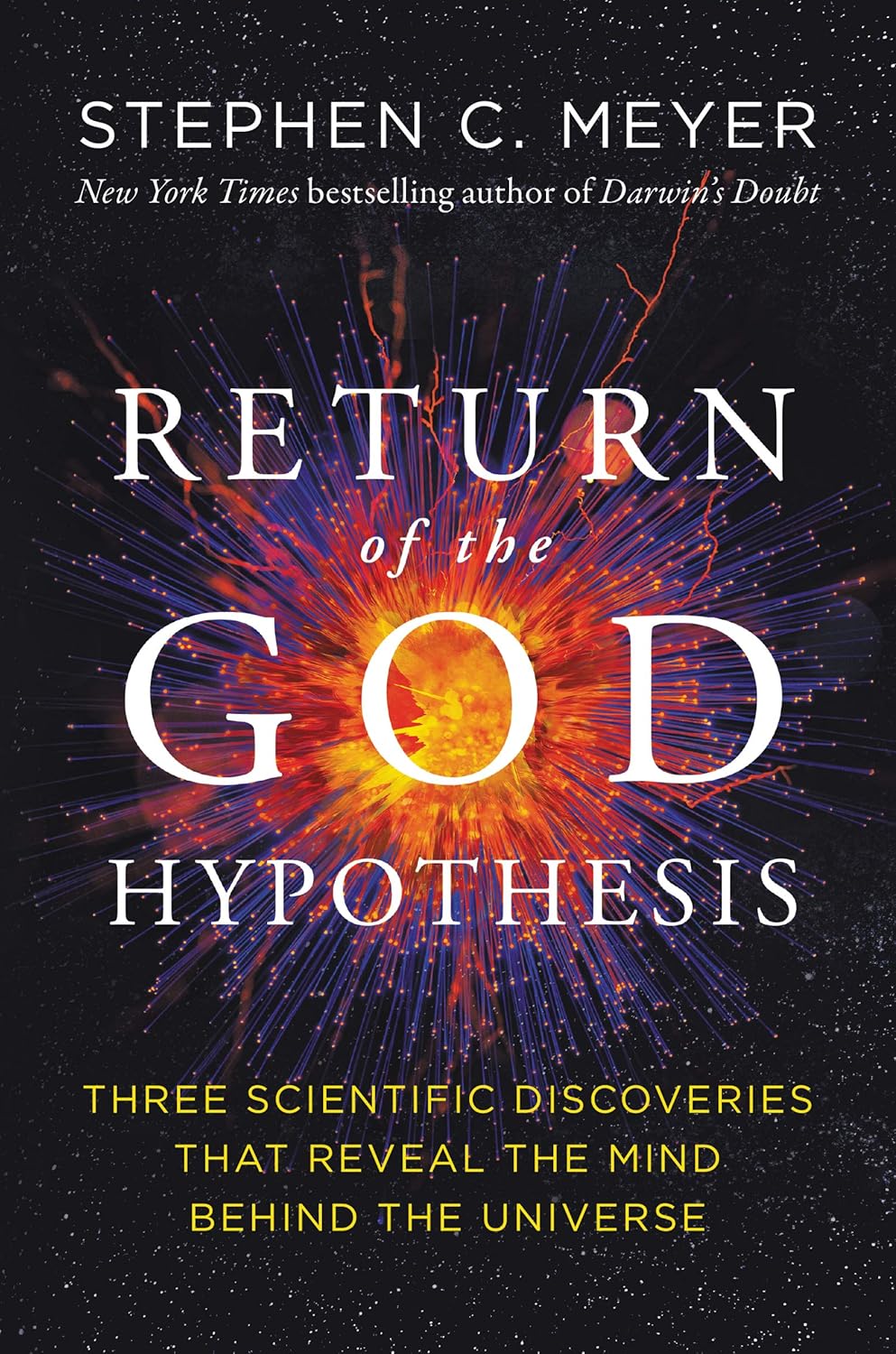
Return of the God Hypothesis by Stephen C. Meyer

Return of the God Hypothesis by Stephen C. Meyer

Regular price Tk 508.00 BDT
Regular price Sale price Tk 508.00 BDT
Sale Sold out
Book cover type
Quantity

Return of the God Hypothesis by Stephen C. Meyer examines whether scientific discoveries support belief in a creator. Meyer revisits the relationship between science and religion, arguing that the universe's beginning, its finely tuned physical conditions, and information encoded in DNA raise questions that material explanations have not resolved. Drawing on cosmology, physics, biology, and philosophy, he presents intelligent design as an alternative account of cosmic and biological origins. He discusses the Big Bang, the conditions necessary for life, and the complexity of living cells while challenging naturalistic interpretations of this evidence. Building on arguments from his books, Meyer moves beyond proposing an unspecified designer and contends that a transcendent, personal God provides the most satisfactory explanation. The book combines scientific discussions with historical and philosophical reasoning to make a case for theism. Its conclusions reflect Meyer's interpretation of contested scientific and philosophical questions rather than an established scientific consensus. Read More

View full details

About Return of the God Hypothesis by Stephen C. Meyer – A Detailed Case for Theism, Cosmic Origins, Fine-Tuning, and Biological Information

Can modern science tell us anything about whether a creator exists? Return of the God Hypothesis by Stephen C. Meyer takes that large question and builds a long argument around discoveries in cosmology, physics, and biology. Meyer is a philosopher of science and an advocate of intelligent design. In this book, he argues that a personal, intelligent creator offers the best explanation for several features of the universe and life.

The book focuses on three areas: the apparent beginning of the universe, the fine-tuning of physical laws and constants, and the information found in DNA and living systems. Meyer compares theism with other explanations and argues that theism has greater explanatory power.

This is not a light devotional book. It is a long work about science, philosophy, history, and arguments for God. Readers should also know that intelligent design is highly disputed within mainstream science. The value of the book is therefore not that every scientist accepts Meyer's conclusions, but that it gives a detailed presentation of his case and invites readers to examine the reasoning for themselves.

Why Meyer Thinks the Question of God Returned to Science

Meyer begins with history. He argues that the rise of modern science did not always push belief in God away. Many early scientists believed that studying nature could reveal order and rational structure.

Later, especially during the nineteenth and twentieth centuries, many thinkers came to see natural explanations as enough. God was often treated as unnecessary in scientific discussion. Meyer challenges that story. He argues that several discoveries made during the modern scientific age have reopened questions about ultimate origins.

His main question is simple: what kind of explanation best accounts for the universe and for the information needed for life?

Rather than asking readers to accept a conclusion only because it is religious, Meyer presents what philosophers call an inference to the best explanation. He compares different possibilities and argues that a personal creator explains the evidence better than purely material causes.

The Beginning of the Universe Is the First Major Part of the Case

One part of Meyer's argument concerns cosmology.

Modern cosmology describes an expanding universe and traces its observable history back to an extremely hot, dense early state. Meyer discusses Big Bang cosmology and other work about whether the universe had a beginning.

He argues that if the physical universe began to exist, then its cause cannot simply be another ordinary physical event inside the same universe. From there, he considers whether a cause beyond space, time, matter, and energy provides a better explanation.

This is a philosophical argument built from scientific findings, not a laboratory proof of God. That difference matters. Cosmologists continue to study early-universe models, quantum cosmology, inflation, and questions about what can meaningfully be said about an ultimate beginning.

Meyer uses the evidence as part of a broader case for theism. Readers interested in the relationship between cosmology and philosophy may find this section especially engaging.

Fine-Tuning Raises Another Big Question

The second major subject is fine-tuning.

Physicists describe nature using laws, constants, and starting conditions. Some of these values appear to fall within narrow ranges that allow complex chemistry, stars, planets, and life as we know it.

Meyer argues that this apparent fine-tuning is more expected if the universe was designed by an intelligent agent than if its life-permitting conditions appeared without purpose.

He also discusses alternatives, including multiverse ideas. Supporters of multiverse explanations argue that if many universes exist with different physical conditions, it may be less surprising that at least one permits observers. Meyer examines such proposals and argues that they do not remove the need for a deeper explanation.

The scientific observations and the philosophical conclusion should be kept separate. Fine-tuning is a real topic in physics and philosophy, while what best explains it remains debated. The book gives Meyer's side in detail and asks readers to compare competing explanations rather than treating the question as already settled.

DNA and Biological Information Form the Third Main Argument

The third major area is biology.

DNA stores sequence information used in living cells. Cells also contain complex molecular systems that copy, regulate, and use genetic information.

Meyer has written about this subject in earlier books, and Return of the God Hypothesis brings that argument into a larger case. He argues that information-rich biological systems are best explained by intelligence because, in ordinary experience, meaningful or functionally specific information often comes from minds.

Mainstream evolutionary biology does not accept intelligent design as a scientific replacement for evolutionary theory. Scientific organizations have argued that intelligent design does not provide testable mechanisms in the way accepted scientific theories are expected to do.

That disagreement is important for readers to know. Meyer presents a challenge to standard material explanations; he is not summarizing a scientific consensus.

For readers interested in origin-of-life debates, genetics, philosophy of biology, or intelligent design, this section gives a clear view of the questions Meyer believes naturalistic explanations have not solved.

The Book Tries to Compare Competing Worldviews

One useful feature of the book is that Meyer does not discuss only one isolated fact.

He asks readers to consider whether several lines of evidence point in the same direction. A cosmic beginning, fine-tuning, and biological information become parts of one larger argument.

He compares theism with materialism and other proposed explanations. His goal is to ask which worldview can explain the widest range of evidence with the fewest serious problems.

This method is common in philosophy, history, and some forms of scientific reasoning. It does not produce mathematical certainty. It asks which explanation appears strongest when several facts are considered together.

That makes the book useful for readers who enjoy arguments rather than slogans. You are invited to follow the steps, ask whether the comparisons are fair, and decide whether the conclusion follows.

This Is a Book to Read with a Critical Mind

Return of the God Hypothesis makes strong claims, so careful reading matters.

Meyer argues that theism provides the best explanation for the evidence he discusses. Critics disagree with parts of his science, his treatment of alternatives, and the move from unexplained features of nature to a designing mind. Some religious scholars also agree with belief in God while questioning intelligent design as the best way to connect theology and science.

This does not make the book useless. It makes comparison important.

A thoughtful reader can examine Meyer's case, then read responses from cosmologists, biologists, philosophers, and theologians with different views. Doing that can turn one book into the beginning of a much wider study.

Who Is Stephen C. Meyer?

Stephen C. Meyer is a philosopher of science and a prominent advocate of intelligent design. His earlier books include Signature in the Cell and Darwin's Doubt.

Return of the God Hypothesis builds on themes from those books but goes further. Meyer moves from arguing for intelligent design in biology to asking what kind of intelligence could explain both life and the universe.

His author site lists the book as a 552-page HarperOne title published on March 30, 2021.

The book is written for general readers, but it is detailed. You do not need to be a professional physicist or biologist to begin, though some chapters may require slow reading because they discuss scientific models, probability, philosophy, and competing explanations.

A Premium Edition for Serious Reading

Bookish Wonderland offers this title in a physical edition prepared for readers who want a comfortable copy for study, discussion, and repeated reading.

  • Premium eye-soothing cream paper gives the pages a soft, warm tone that feels comfortable during longer reading sessions.
  • Crystal-clear printing keeps the text sharp and makes detailed explanations easier to follow.
  • High-quality stitched and glue binding helps keep the pages secure through regular use and supports long-term durability.

These specifications describe the edition offered by Bookish Wonderland, not every edition sold by other stores or publishers.

A printed copy can be especially useful for a book like this. Readers may want to mark arguments, return to earlier chapters, compare sections, or keep notes while reading.

Who Should Read Return of the God Hypothesis?

This book may appeal to readers interested in science and religion, intelligent design, philosophy of science, cosmology, fine-tuning, origin-of-life questions, and arguments for God's existence.

It can also interest believers who want to understand a modern design argument and skeptics who want to read that argument from a leading advocate rather than only through summaries.

Students may find it useful as a starting point for debate, but it should be read beside other sources because its central intelligent-design claims are contested.

If you want a short inspirational book, this is probably not the best choice. If you enjoy long-form arguments and are willing to compare evidence and objections, it may suit you much better.

Use It for Personal Study, Discussion, or Debate

You can read the book from beginning to end, but it also works as a reference for specific topics.

A study group could take one section at a time and compare Meyer's argument with another viewpoint. A student could use it to understand contemporary intelligent-design reasoning. A reader exploring faith could use it as one voice in a larger discussion about whether science and belief in God conflict.

The best use is active reading. Write down the main claim of each chapter. Ask what evidence supports it. Note which alternatives Meyer considers. Then check how critics respond.

That process helps separate persuasive writing from strong evidence and makes the reading experience more valuable.

Check the Book Price in Bangladesh Before Ordering

If you are searching for the Book price in Bangladesh for Return of the God Hypothesis by Stephen C. Meyer, check the current amount shown on the Bookish Wonderland product page before placing your order. Prices and stock can change, so the live listing is the right place to confirm the latest amount.

Bookish Wonderland delivers inside and outside Dhaka and offers Cash on Delivery across Bangladesh. Readers in Dhaka can also ask about fast or urgent delivery, depending on location and service availability.

If you need help with availability, customization, or delivery, contact Bookish Wonderland through Facebook or Instagram before ordering.

Read the Argument, Test the Evidence, and Decide for Yourself

Return of the God Hypothesis asks one of the oldest human questions through the language of modern science: does the universe point beyond itself?

Stephen C. Meyer answers yes. He builds his case from cosmology, fine-tuning, and biological information and argues that a personal creator provides the best overall explanation.

Not every scientist or philosopher accepts that conclusion, and intelligent design remains strongly disputed within mainstream science. That disagreement is exactly why careful readers may find the book interesting. It offers a substantial argument that can be examined, compared, challenged, and discussed.

Order Return of the God Hypothesis by Stephen C. Meyer from Bookish Wonderland if you want a serious nonfiction book about science, philosophy, God, and intelligent design.

Read slowly, question carefully, compare other views, and decide where you think the evidence leads.

If you require any customization or have any questions, please inbox us via FB or Insta.

Primary Specification
AuthorStephen C. Meyer
NarratorTimothy Andrés Pabon
EditorTerry McGrath
GenreReligion, Philosophy of Science, Science and Religion, Intelligent Design
ISBN-13/ISSN 978-0062071514
ISBN-100062071513
PublisherHarperOne
Publishing DateApril 4, 2023
LanguageEnglish
Reading Age18+
FormatPrinted Book
Physical Specification & Quality
Paper QualityPremium eye-soothing cream paper
Binding QualityHigh quality stitched and glue binding (for longevity)
Print QualityCrystal-clear print
Pages576 pages
CountryUSA
Logistics Information
Weight596 gm
Length8.5 inches
Width5.6 inches
Height1.3 inch
What is Return of the God Hypothesis by Stephen C. Meyer about?

Return of the God Hypothesis: Three Scientific Discoveries That Reveal the Mind Behind the Universe by Stephen C. Meyer is a nonfiction book exploring the relationship between scientific discoveries, philosophy, and belief in God. Meyer argues that three areas of research—the origin of the universe, the fine-tuning of physical laws and constants, and the information associated with living systems—provide reasons to consider an intelligent creator. He discusses Big Bang cosmology, DNA, the origin of life, and the appearance of new animal forms in the fossil record. The book also examines the history of science and compares theism with alternative explanations for the universe's existence and apparent suitability for life. Its central argument is that a personal God provides a compelling explanation for these observations. Readers should understand that this is Meyer's philosophical interpretation of scientific findings rather than an established scientific conclusion.

How many books are in the series of Return of the God Hypothesis by Stephen C. Meyer, and what are they?

There are no books in a series for Return of the God Hypothesis by Stephen C. Meyer. It is a standalone religious and philosophical Nonfiction book.

What are the three scientific discoveries discussed in Return of the God Hypothesis?

Stephen C. Meyer organises much of Return of the God Hypothesis around three broad areas of scientific research. The first is evidence associated with the expansion and early history of the universe, which he connects to the philosophical question of whether the universe has a cause. The second is cosmic fine-tuning: the observation that certain physical constants and conditions appear closely connected to the possibility of complex life. The third concerns biological information, including DNA, the origin of the first living systems, and the development of new animal forms. Meyer argues that these observations collectively support the hypothesis of an intelligent creator. The underlying scientific subjects are genuine areas of research, but the conclusion that they establish divine design is disputed. The book is therefore a discussion of scientific evidence interpreted through a particular philosophical and theistic framework, not a report of three discoveries that scientists universally regard as proof of God.

How does Return of the God Hypothesis use the Big Bang theory to argue for God's existence?

Return of the God Hypothesis discusses the expansion of the universe, observations of distant galaxies, and modern cosmological theories to develop an argument about the universe's origin. Meyer reasons that evidence for a universe with a finite history raises the question of what could explain its existence. He argues that a cause beyond the physical universe is consistent with the idea of a transcendent creator. However, Big Bang cosmology does not itself identify a divine cause or conclusively establish what, if anything, preceded the earliest state described by current models. Cosmologists continue to investigate questions about the early universe and the limits of existing theories. Readers should therefore distinguish between the scientific evidence for cosmic expansion and Meyer's additional philosophical argument about an ultimate cause. The book is useful for understanding how he connects these questions, but that connection remains a subject of debate.

What does cosmic fine-tuning mean in Return of the God Hypothesis, and does Meyer discuss the multiverse?

Cosmic fine-tuning refers to the observation that certain physical constants and conditions appear to fall within ranges that permit complex structures and life as we know it. Stephen C. Meyer argues that these conditions are better explained by intelligent design than by chance or physical necessity. He also examines alternative proposals, including multiverse models in which different universes might have different physical properties. His discussion asks whether such explanations remove the need for a designer or simply raise further questions about the larger system producing those universes. Fine-tuning is a legitimate subject of scientific and philosophical discussion, but assigning probabilities to alternative universes is difficult because the relevant possibilities and their distributions are not fully established. Consequently, the observation of life-permitting conditions does not, by itself, demonstrate that God exists. Readers interested in cosmology and the philosophy of probability may find this debate particularly engaging.

What does Stephen C. Meyer argue about DNA, the origin of life, and the Cambrian explosion?

Meyer argues that the information contained in DNA and the development of complex biological structures raise questions that, in his view, are better explained by intelligence than by unguided processes. He revisits the origin-of-life arguments from Signature in the Cell and the discussion of the Cambrian explosion from Darwin's Doubt. The Cambrian explosion refers to an interval in Earth's history during which many major groups of animals became prominent in the fossil record. Meyer interprets the emergence of biological information and new body plans as evidence supporting intelligent design. Scientists, however, distinguish between research on life's initial origin and evolutionary biology, which studies how living populations change and diversify. Evolution is supported by extensive evidence, while the precise pathways leading to the first living systems remain an active research area. Some biologists have also criticised Meyer for overlooking or understating relevant experimental advances in origin-of-life chemistry.

Does Return of the God Hypothesis scientifically prove God exists, and why do scholars disagree with Stephen C. Meyer?
Return of the God Hypothesis presents Meyer's argument that theism offers an explanation for the universe and life, but it does not provide a universally accepted scientific proof of God's existence. The disagreement concerns both the interpretation of scientific evidence and the standards used to evaluate proposed explanations. Meyer argues that scientists can infer intelligence by comparing the explanatory power of competing hypotheses. Critics respond that intelligent design lacks sufficiently testable predictions and that unresolved scientific questions do not establish supernatural intervention. The U.S. National Academies does not recognise intelligent design as a supported scientific explanation. Criticism is not limited to atheists: Christian biologist Darrel Falk, writing for BioLogos, has challenged Meyer's representation of biological research while maintaining his own belief in God. The book is best understood as an argument within philosophy of religion and debates about science and faith, rather than an uncontested statement of scientific consensus.
Is Return of the God Hypothesis suitable for beginners, and who should read it?
Return of the God Hypothesis is intended for adults interested in science, philosophy, religion, apologetics, and debates about intelligent design. Readers do not need a degree in physics or biology, as Stephen C. Meyer explains many technical subjects and uses analogies to make complex arguments more approachable. Nevertheless, the book is substantial and discusses cosmology, molecular biology, scientific methodology, competing metaphysical explanations, and historical arguments. Readers unfamiliar with these subjects may need to read slowly or consult additional resources. Mature teenagers aged approximately 17 and above may also find it accessible if they have a strong interest in the topic, although this is a suggested age rather than an official publisher rating. The book may interest religious readers examining arguments for theism and nonreligious readers wanting to understand Meyer's position. Those seeking an introductory science textbook should choose a different resource because this work primarily develops a contested philosophical argument.
Is Return of the God Hypothesis by Stephen C. Meyer available in a premium edition at Bookish Wonderland?

Bookish Wonderland's premium English book offering is designed for customers who want comfortable reading and durable physical construction. Its advertised specifications include eye-soothing cream paper, crystal-clear printing, and high-quality stitched and glue binding. These features are particularly relevant to a substantial nonfiction title such as Return of the God Hypothesis because readers may spend considerable time studying individual arguments, reviewing explanations, and returning to earlier chapters. A carefully produced physical copy can also be suitable for a personal collection of books on science, philosophy, and religion. However, the term premium edition describes Bookish Wonderland's supplied physical quality and does not automatically identify an official limited or collector's edition from HarperOne. Customers seeking a particular cover, publisher's format, ISBN, or page count should confirm the exact version currently available before ordering.

What are the paper and print quality of Return of the God Hypothesis from Bookish Wonderland?

Bookish Wonderland specifies premium eye-soothing cream paper and crystal-clear printing for its printed English books. The warmer cream-toned pages offer a softer-looking background than bright white paper, while sharply reproduced text helps readers distinguish words, punctuation, and technical terminology. These characteristics are particularly useful for Return of the God Hypothesis because it contains extended discussions of cosmology, biology, philosophy, and references to scientific research. Readers may need to compare passages, return to particular arguments, or examine notes carefully rather than reading the book continuously like a novel. Clean printing can make this process more convenient by reducing distractions from unclear lettering. The paper also provides a traditional appearance for customers who enjoy collecting substantial nonfiction works. Exact font size, paper thickness, and layout may vary by supplied edition, so customers with specific requirements should confirm the available copy's details.

How durable is the binding of Return of the God Hypothesis, and is it suitable for repeated reading and long-term study?

Bookish Wonderland uses high-quality stitched and glue binding for its premium printed books. Stitching supports the page sections, while adhesive helps reinforce the spine and hold the pages together during ordinary handling. This construction can be useful for a lengthy work like Return of the God Hypothesis because readers may repeatedly consult its discussions of the Big Bang, fine-tuning, biological information, and philosophical objections. Students and researchers may also return to its notes and bibliography when checking references or comparing opposing arguments. Good binding supports repeated use, although a book's actual longevity depends on manufacturing quality, storage, and handling. Readers should avoid forcing the spine completely flat, folding pages excessively, or exposing the copy to moisture and prolonged direct sunlight. Keeping it upright in a clean, dry location can help preserve its pages and binding for future reference.

Why should I buy Return of the God Hypothesis from Bookish Wonderland, and is Cash on Delivery available across Bangladesh?

Bookish Wonderland makes English-language books on science, religion, and philosophy accessible to customers across Bangladesh, including readers interested in Return of the God Hypothesis by Stephen C. Meyer. The store's advertised premium specifications include comfortable cream paper, crystal-clear printing, and sturdy stitched and glue binding, making the book suitable for personal reading, academic discussion, or a long-term nonfiction collection. Nationwide delivery covers locations inside and outside Dhaka, so customers do not need to rely on a nearby specialist bookstore to place an order. Cash on Delivery is available across Bangladesh, allowing readers to pay when their books arrive. Customers located in Dhaka can also request fast or urgent delivery when that option is available. Before purchasing, readers should confirm the supplied edition, current stock, final book price, shipping charges, and estimated arrival time with Bookish Wonderland.