

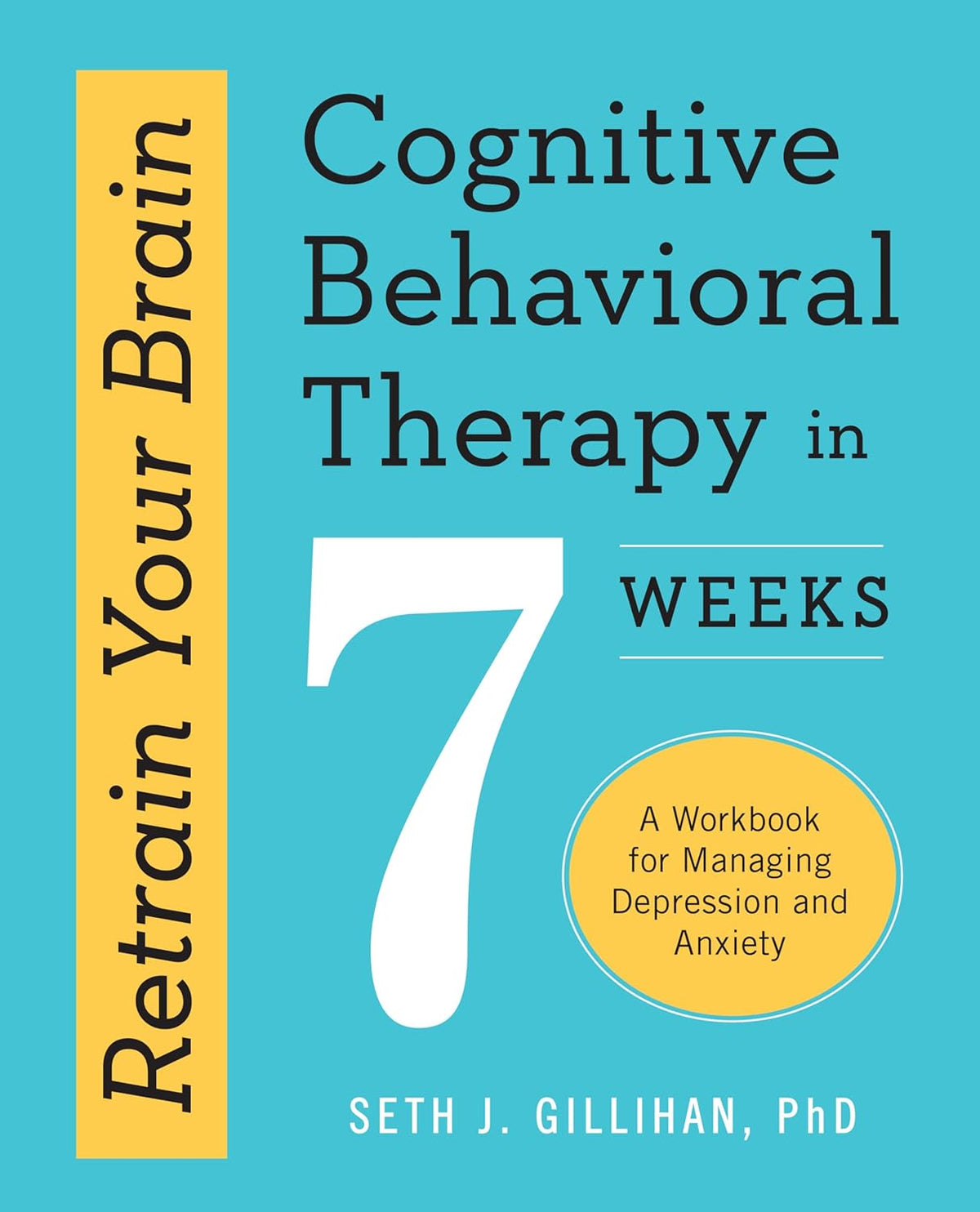
About Retrain Your Brain: Cognitive Behavioral Therapy in 7 Weeks by Seth J. Gillihan – A Practical CBT Workbook for Better Daily Habits
Feeling stuck in the same thoughts can make everyday life harder. You may worry about small things, avoid tasks, lose interest in activities, or feel as if your mind keeps repeating the same negative message. Retrain Your Brain: Cognitive Behavioral Therapy in 7 Weeks by Seth J. Gillihan gives readers a simple, step-by-step way to learn basic cognitive behavioral therapy skills and practise them in daily life.
The book is an interactive workbook rather than a long theory book. Each week builds on the week before it. You learn how thoughts, feelings, and actions can affect one another, then use exercises to notice patterns and try different responses. The workbook covers goals, activity planning, thought patterns, time and task management, and facing fears.
It is written for adults who want an easy introduction to CBT. It can be useful for self-guided learning, but it is not a replacement for professional mental health care when symptoms are severe, getting worse, or causing major problems in daily life.
Start by Understanding How CBT Works
Cognitive behavioral therapy, often called CBT, is based on a simple idea: thoughts, feelings, and actions are connected.
For example, if you think, “I will fail,” you may feel anxious and avoid starting a task. Avoiding the task can then make the problem feel even bigger. CBT helps you notice this kind of cycle and test a different response.
Retrain Your Brain explains the basic model in clear language. You do not need to study psychology first. The workbook uses examples and writing exercises so that you can connect the ideas with situations from your own life.
The goal is not to force yourself to think positively all the time. Instead, CBT asks you to look at thoughts more carefully, check whether they are accurate or helpful, and choose actions that move you toward what matters.
Week One Helps You Set Clear Goals
The seven-week plan begins by helping you decide what you want to change.
A goal such as “I want to feel better” is understandable, but it can be hard to measure. The workbook encourages more specific goals. You may want to return to an activity you stopped doing, finish a task you keep avoiding, improve a routine, or face a situation that makes you anxious.
Instead of trying to fix everything at once, you can focus on a few areas that matter most. This makes progress easier to notice and can stop the process from feeling too large.
The workbook also asks you to check in with yourself as you move forward. This helps you see what is changing, what still feels difficult, and which skills may need more practice.
Getting Back to Life Means Taking Small Actions
When people feel low or anxious, they often stop doing things that once gave them energy, connection, or a sense of achievement.
The workbook introduces behavioral activation, a CBT method that focuses on action. Instead of waiting until motivation appears, you plan small activities and see how they affect your mood and daily routine.
This could mean taking a short walk, finishing one household task, calling someone, returning to a hobby, or doing another useful activity that has slowly disappeared from your life.
Small actions may sound simple, but they can break a cycle of withdrawal and inactivity.
The point is not to stay busy every minute. It is to make room for activities that support your values, responsibilities, health, and relationships.
Learn to Notice Thought Patterns
Many thoughts appear so quickly that we treat them as facts.
You might think, “Everyone will judge me,” “Nothing ever works,” or “If I make one mistake, everything is ruined.” CBT teaches you to notice these automatic thoughts instead of accepting them immediately.
Retrain Your Brain includes exercises that help you write down situations, thoughts, feelings, and reactions. Seeing them on paper can make patterns easier to notice.
You may discover that certain situations bring the same type of thought again and again. Once you can see the pattern, you can begin asking better questions.
What evidence supports this thought? What evidence does not? Is there another possible explanation? What would I say to a friend in the same situation?
These questions help create a more balanced view.
Break Negative Thinking Without Pretending Everything Is Fine
CBT is sometimes misunderstood as “just think positive.”
That is not the aim.
The workbook teaches readers to challenge thoughts that may be too extreme, incomplete, or unhelpful. A balanced thought does not need to sound cheerful. It needs to be more accurate and useful.
For example, “I always fail” may become, “This task is difficult, but I have completed hard things before and I can take one step now.”
That small change can affect emotion and action.
The goal is not to deny real problems. It is to stop adding extra pain through thoughts that treat the worst possibility as certain.
Over time, practising this skill can help readers respond to stressful situations with more flexibility.
Make Time and Tasks Feel More Manageable
A long list of unfinished work can create stress before you even begin.
One section of Retrain Your Brain focuses on time and task management. The workbook helps readers break large jobs into smaller steps, decide what matters, and reduce the habit of waiting until a task feels perfect or easy.
A large task such as “prepare for an exam” can become smaller actions: choose one chapter, study for twenty minutes, answer practice questions, and review mistakes.
This approach can make action feel possible.
The same idea can help with household jobs, work projects, personal routines, or other tasks that become overwhelming when viewed as one giant problem.
Facing Fears Is Part of the Seven-Week Plan
Avoidance can make anxiety stronger.
If a situation feels frightening, staying away from it may bring quick relief. But the brain can then learn, “I escaped because this was dangerous.” The fear may stay the same or grow.
CBT often uses gradual exposure, where a person approaches feared situations in planned steps rather than avoiding them completely.
Retrain Your Brain introduces this idea and guides readers through exercises for facing fears.
The important word is gradual. The aim is not to push yourself into the hardest situation immediately. You build a list, start with a manageable step, and practise.
For serious trauma, severe anxiety, or situations where safety is uncertain, professional guidance may be more appropriate than self-directed exposure.
Each Week Builds on the Last
The workbook is cumulative.
That means the exercises are not random tips placed beside one another. Goal setting connects with activity planning. Activity planning connects with mood. Thought work connects with behavior. Facing fears uses skills developed earlier.
By the final week, the aim is to bring the tools together so you have a simple plan for future challenges.
This structure is useful for readers who often buy self-help books, read a few pages, and then stop because there is no clear path.
Here, the seven-week schedule gives you a starting point and a reason to keep moving.
You can still go at your own pace. A workbook is most useful when the exercises are done carefully, not when pages are rushed only to finish quickly.
Who Is Seth J. Gillihan?
Seth J. Gillihan, PhD, is a licensed psychologist who specializes in cognitive behavioral therapy and mindfulness-based approaches.
His official website describes Retrain Your Brain as a practical workbook for changing patterns of thought and behavior connected with anxiety and depression. The book draws on his clinical experience and is designed to make CBT skills easier for general readers to understand.
The original 2016 Callisto edition is 236 pages and was published on October 18, 2016.
A Premium Edition for Writing, Reading, and Revisiting
Because this title is a workbook, the physical reading experience matters. Bookish Wonderland offers an edition prepared for readers who want a comfortable copy for regular use.
- Premium eye-soothing cream paper gives the pages a soft, warm tone that feels comfortable during longer reading sessions.
- Crystal-clear printing keeps instructions, examples, and exercises sharp and easy to follow.
- High-quality stitched and glue binding helps keep pages secure when the book is opened and used repeatedly.
These details describe the edition offered by Bookish Wonderland, not every edition sold by other stores or publishers.
Who May Find This Workbook Useful?
This book may suit adults who want a structured introduction to CBT and prefer practical exercises over long theory.
It can be helpful for readers dealing with mild to moderate anxiety or depression, everyday worry, avoidance, low motivation, or negative thought habits. The Association for Behavioral and Cognitive Therapies describes the workbook as covering CBT basics for mild to moderate anxiety and depression.
It may also be useful for someone already in therapy who wants extra practice between sessions, if their clinician agrees.
This book cannot diagnose a condition, and it cannot replace personalized care. If symptoms feel severe, include thoughts of self-harm, or make it hard to function safely, professional support is more appropriate than relying on a workbook alone.
Use It Like a Workbook, Not Just a Reading Book
The best way to use Retrain Your Brain is to do the exercises.
Keep a pen nearby. Write down goals. Track activities. Notice thoughts. Try the suggested steps. Return to earlier pages when you need them.
You do not have to complete every exercise perfectly.
The value comes from practising the skills and seeing which ones help you understand your own patterns.
Check the Book Price in Bangladesh Before Ordering
If you are searching for the Book price in Bangladesh for Retrain Your Brain: Cognitive Behavioral Therapy in 7 Weeks by Seth J. Gillihan, check the current amount shown on the Bookish Wonderland product page before placing your order. Prices and stock can change, so the live listing is the best place to confirm the latest amount.
Bookish Wonderland delivers inside and outside Dhaka and offers Cash on Delivery across Bangladesh. Readers in Dhaka can also ask about fast or urgent delivery, depending on location and service availability.
If you need help with availability, customization, or delivery, contact Bookish Wonderland through Facebook or Instagram before ordering.
Build One Skill at a Time
Changing a thought habit or avoidance pattern usually takes practice, not one perfect day.
Retrain Your Brain gives readers a seven-week structure for learning CBT skills in small steps. It starts with goals, moves through activity and thought work, includes time management and facing fears, and ends by helping readers bring the tools together.
Order Retrain Your Brain: Cognitive Behavioral Therapy in 7 Weeks by Seth J. Gillihan from Bookish Wonderland if you want a practical workbook that turns CBT ideas into exercises you can use in everyday life.
Read slowly, write honestly, practise the skills, and use the book as one tool in a wider plan for taking care of your mental health.
If you require any customization or have any questions, please inbox us via FB or Insta.
| Primary Specification | |
| Author | Seth J. Gillihan, PhD |
| Narrator | Timothy Andrés Pabon |
| Genre | Self-Help, Psychology, Mental Health, Cognitive Behavioral Therapy |
| ISBN-13/ISSN | 978-1529336467 |
| ISBN-10 | 1529336465 |
| Publisher | Sheldon Press |
| Publishing Date | July 23, 2020 |
| Language | English |
| Reading Age | 18+ |
| Format | Printed Book |
| Physical Specification & Quality | |
| Paper Quality | Premium eye-soothing cream paper |
| Binding Quality | High quality stitched and glue binding (for longevity) |
| Print Quality | Crystal-clear print |
| Pages | 240 pages |
| Country | USA |
| Logistics Information | |
| Weight | 264 gm |
| Length | 8.5 inches |
| Width | 5.6 inches |
| Height | 0.79 inch |