

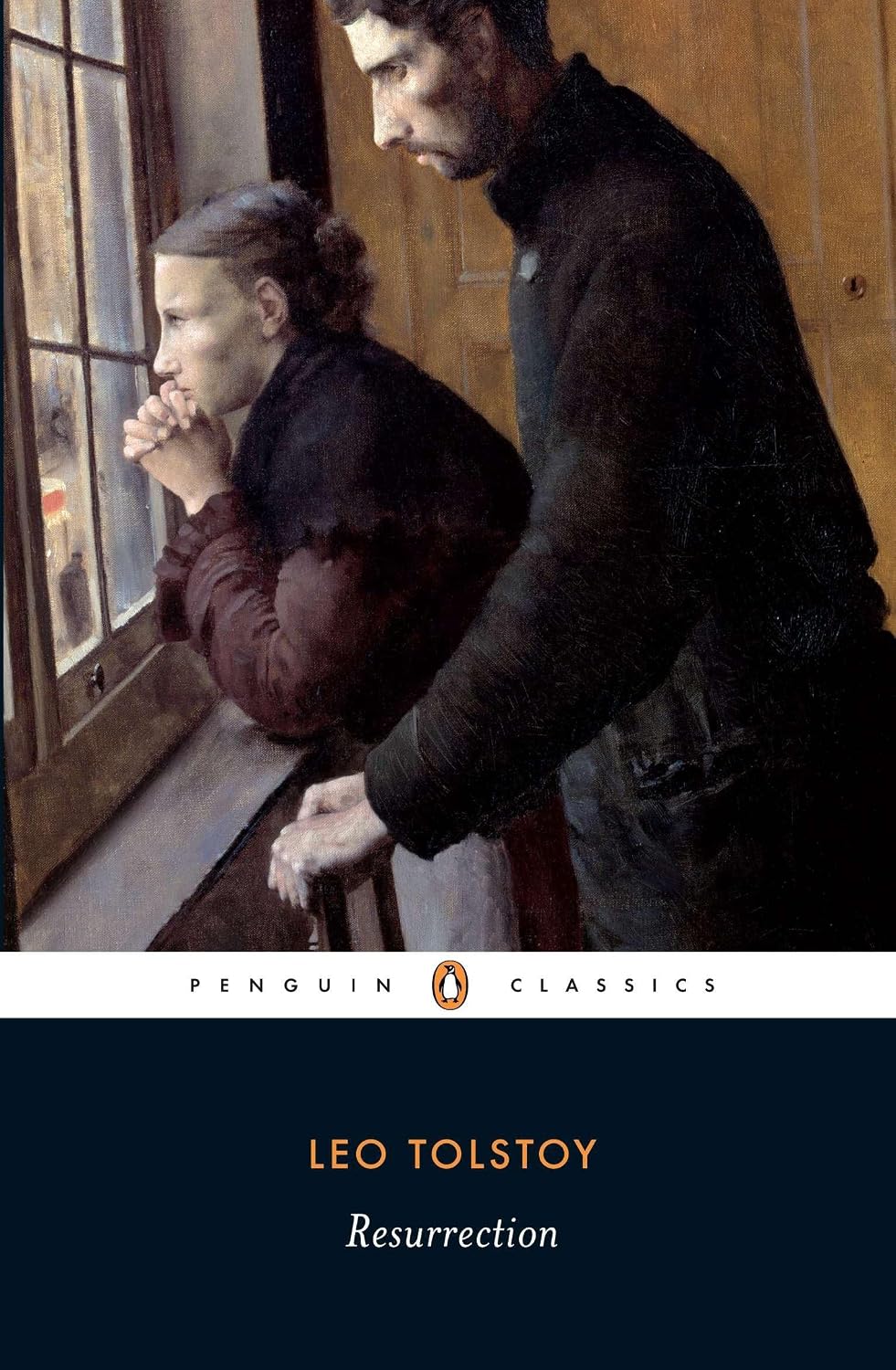
About Resurrection Novel by Leo Tolstoy – A Powerful Classic About Guilt, Justice, Redemption, and a Life Changed by Conscience
What happens when one mistake from the past suddenly stands in front of you again? Resurrection by Leo Tolstoy begins with Prince Dmitri Nekhlyudov serving on a jury in a murder trial. Among the accused, he recognizes Katyusha Maslova, a woman he once knew when she was young. Years earlier, he seduced her and then left her. Her life later became much harder, and now she is facing prison.
The shock forces Nekhlyudov to look at himself honestly. He cannot pretend that the suffering before him has nothing to do with his choices. He decides to help Maslova and begins a long journey through courts, prisons, government offices, and finally toward Siberia.
First published in 1899, Resurrection was Leo Tolstoy's last completed novel. It is both a personal story of guilt and a sharp criticism of social injustice. Tolstoy asks whether a person can truly change, whether punishment always creates justice, and what real moral responsibility looks like when regret is no longer enough.
A Jury Seat Brings the Past Back to Life
Nekhlyudov enters the courtroom as a wealthy nobleman. He expects to perform a public duty, listen to the case, and return to his comfortable life.
Then he sees Maslova.
The woman before him is not simply another defendant. She is connected to a painful memory he has tried to place far behind him. When she was younger, Maslova lived in a respectable household where Nekhlyudov knew her. He took advantage of her affection and then moved on with his life.
Seeing her accused of murder makes the past impossible to ignore.
The trial becomes a turning point because Nekhlyudov begins to understand that his private actions had public consequences. He had the wealth and freedom to leave. Maslova had far fewer choices. The difference between their lives becomes one of the novel's central moral questions.
Maslova's Conviction Exposes a Broken System
Maslova's case does not only reveal Nekhlyudov's guilt. It also exposes problems inside the legal system.
Tolstoy shows courts filled with rules, procedures, officials, and formal language, yet justice can still go wrong. People follow their roles while losing sight of the human being whose life is being decided.
Maslova is convicted and sentenced to hard labor in Siberia, even though the case is more complicated than the final judgment suggests.
For Nekhlyudov, this makes private regret feel too small. Saying sorry cannot undo what happened. He begins visiting prisons, speaking with officials, and trying to help with appeals.
His effort takes him into parts of Russian society he had rarely seen closely. He meets prisoners, poor families, political detainees, bureaucrats, guards, and people trapped inside systems that powerful citizens can easily ignore.
Redemption Requires More Than Feeling Bad
The title Resurrection points toward moral and spiritual awakening.
Nekhlyudov begins the novel as a man protected by money, status, and habit. He has learned to live without looking too closely at the damage caused by his past behavior.
Maslova's appearance breaks that comfortable distance.
He starts questioning his property, relationships, social position, and way of living. He wants to make amends, but Tolstoy does not make redemption simple. A person cannot automatically repair another person's life simply because he now feels guilty.
That tension gives the book emotional depth. Nekhlyudov wants to save Maslova, but she is not merely a tool for his moral improvement. She has her own history, anger, needs, and choices.
The novel therefore asks an important question: is redemption about feeling forgiven, or about changing how you live even when you cannot erase the past?
A Love Story, but Not a Simple Romance
Resurrection contains love, regret, loyalty, and sacrifice, but it is not a conventional romance.
Nekhlyudov's feelings toward Maslova are mixed with guilt. He believes he owes her something enormous, and at one point he is prepared to reshape his future around that responsibility.
Maslova, however, is not frozen in the role of the young woman he remembers. Life has changed her. She does not simply wait for him to arrive and solve everything.
This difference makes their relationship more interesting. Nekhlyudov must learn that repentance does not give him control over Maslova's future. Helping another person is not the same as deciding what that person should want.
Readers who enjoy complicated relationships may appreciate the way Tolstoy avoids an easy emotional solution.
Tolstoy Looks Closely at Wealth and Poverty
One of the strongest parts of Resurrection is its wide view of Russian society.
Nekhlyudov moves between drawing rooms, courtrooms, estates, prisons, government offices, and crowded spaces where poor people live under conditions far removed from aristocratic comfort.
Tolstoy uses these contrasts to question why some people have land, power, and security while others can lose freedom through poverty, bad luck, or unfair institutions.
Nekhlyudov's growing discomfort with his property becomes part of his transformation. He begins asking whether his comfortable position depends on arrangements that harm others.
These questions were connected to Tolstoy's later moral and social beliefs. The novel does not simply tell readers that one rich man behaved badly. It asks them to look at the larger structures around him.
The Prison Journey Expands the Story
As Maslova's sentence carries her toward Siberia, the novel becomes broader.
Nekhlyudov follows and encounters many prisoners along the way. Some are convicted criminals. Others are political prisoners. Some appear dangerous, while others seem trapped by circumstances, law, or official indifference.
This journey forces him to see people whom polite society prefers not to see.
Tolstoy gives attention to the physical difficulty of imprisonment, the loss of dignity, the separation of families, and the way institutions can treat human beings as categories rather than individuals.
The prison scenes are important because they move the story beyond Nekhlyudov's private guilt. His awakening becomes connected to a larger awareness of suffering.
Why the Novel Still Feels Relevant
Resurrection was published more than a century ago, but many of its questions remain easy to understand.
Can a legal system follow rules and still produce injustice? Can wealth protect people from consequences? Can charity become selfish when the giver wants to feel morally clean? Can a person change after causing real harm?
These are not only Russian questions from the nineteenth century.
Modern readers may recognize the same tension between law and justice, status and responsibility, punishment and reform.
The book does not give every question a simple answer. Instead, it puts Nekhlyudov in situations where his old assumptions stop working.
That makes Resurrection valuable for readers who enjoy classics that are not only about the past. The setting is historical, but the moral problems continue to feel alive. It rewards patient readers who enjoy ideas alongside strong character drama.
Tolstoy's Final Completed Novel
Leo Tolstoy is best known around the world for War and Peace and Anna Karenina, but Resurrection offers a different kind of reading experience.
It was first published in 1899 and became his last completed novel. By this period, Tolstoy had developed strong religious, moral, and social views that often brought him into conflict with powerful institutions.
Those concerns are visible throughout Resurrection. The novel criticizes hypocrisy in government, law, class, and religion while focusing on the possibility of personal moral change.
Penguin Classics describes the book as an intimate psychological story of guilt, anger, and forgiveness as well as a broad picture of Russian life.
That combination makes the novel both personal and political without losing its central human story.
A Premium Edition for Comfortable Classic Reading
A long classic becomes easier to enjoy when the physical book feels comfortable to hold and read. Bookish Wonderland offers this title in an edition prepared for readers who want a durable copy for regular use.
- Premium eye-soothing cream paper gives the pages a warm, soft appearance for comfortable reading.
- Crystal-clear printing keeps the text sharp and easy to follow across long chapters.
- High-quality stitched and glue binding helps keep the pages secure and supports long-term durability.
These physical details describe the edition offered by Bookish Wonderland, not every edition published elsewhere.
A durable printed copy is useful for a novel like Resurrection because readers may want to return to important scenes, mark ideas, or keep the book as part of a classic literature collection.
Who Should Read Resurrection?
Choose this novel if you enjoy Russian classics, moral fiction, social criticism, courtroom stories, psychological character studies, and books about guilt and redemption.
Readers of Tolstoy's other novels may enjoy seeing how his later beliefs shaped his fiction. Students of literature can explore its treatment of class, law, religion, punishment, and conscience.
The book is also a strong choice for readers who like stories where the main character changes through contact with people outside his normal social world.
Because the novel includes prostitution, imprisonment, injustice, death, and difficult moral themes, it is better suited to mature teens and adults than young children.
This is not a fast modern thriller. It takes time to examine people, systems, and ideas. Readers who enjoy slow, thoughtful classics are more likely to appreciate its style.
A Valuable Choice for Study and Discussion
Resurrection offers many questions for a classroom or book club.
Is Nekhlyudov truly helping Maslova, or is he sometimes trying to repair his own conscience? Does punishment make society safer or simply hide unwanted people? How much responsibility does one person carry for harm caused years earlier? Can someone become morally different without being able to undo past actions?
These questions make the novel useful for discussion because readers may disagree strongly while still finding evidence in the story.
You can also compare Resurrection with Tolstoy's earlier novels and see how his later moral concerns changed his storytelling.
Check the Book Price in Bangladesh Before Ordering
If you are searching for the Book price in Bangladesh for Resurrection by Leo Tolstoy, check the current amount shown on the Bookish Wonderland product page before ordering. Prices and stock can change, so the live listing is the right place to confirm the latest amount.
Bookish Wonderland delivers inside and outside Dhaka and offers Cash on Delivery across Bangladesh. Readers in Dhaka can also ask about fast or urgent delivery, depending on location and service availability.
If you need help with availability, customization, or delivery, contact Bookish Wonderland through Facebook or Instagram before placing your order.
Follow a Journey from Guilt Toward Moral Awakening
Resurrection begins with a man looking across a courtroom and seeing the result of a mistake he once tried to forget.
From that moment, Nekhlyudov can no longer return easily to his old life. His attempt to help Maslova takes him through courts, prisons, social classes, and finally toward Siberia. Along the way, he discovers that one person's guilt is connected to much larger questions about justice, privilege, punishment, and human dignity.
Tolstoy does not offer a simple story where one good deed fixes everything. He asks whether real change requires giving up comfort, accepting responsibility, and learning to see other people as fully human.
Order Resurrection by Leo Tolstoy from Bookish Wonderland if you want a major Russian classic with emotional depth, social criticism, and a serious search for redemption.
Read it for Maslova's strength, Nekhlyudov's awakening, Tolstoy's view of society, and the difficult question at the heart of the novel: what does it really mean to become a better person?
If you require any customization or have any questions, please inbox us via FB or Insta.
| Primary Specification | |
| Author | Leo Tolstoy |
| Narrator | Simon Vance |
| Genre | Literary Fiction, Philosophical Fiction, Social Realism |
| ISBN-13/ISSN | 978-1445706290 |
| ISBN-10 | 1445706296 |
| Publisher | Lulu Press, Inc. |
| Publishing Date | February 25, 2010 |
| Language | English |
| Reading Age | 18+ |
| Format | Printed Book |
| Physical Specification & Quality | |
| Paper Quality | Premium eye-soothing cream paper |
| Binding Quality | High quality stitched and glue binding (for longevity) |
| Print Quality | Crystal-clear print |
| Pages | 52 pages |
| Country | Russia |
| Logistics Information | |
| Weight | 75 gm |
| Length | 8.5 inches |
| Width | 5.6 inches |
| Height | 0.13 inch |