

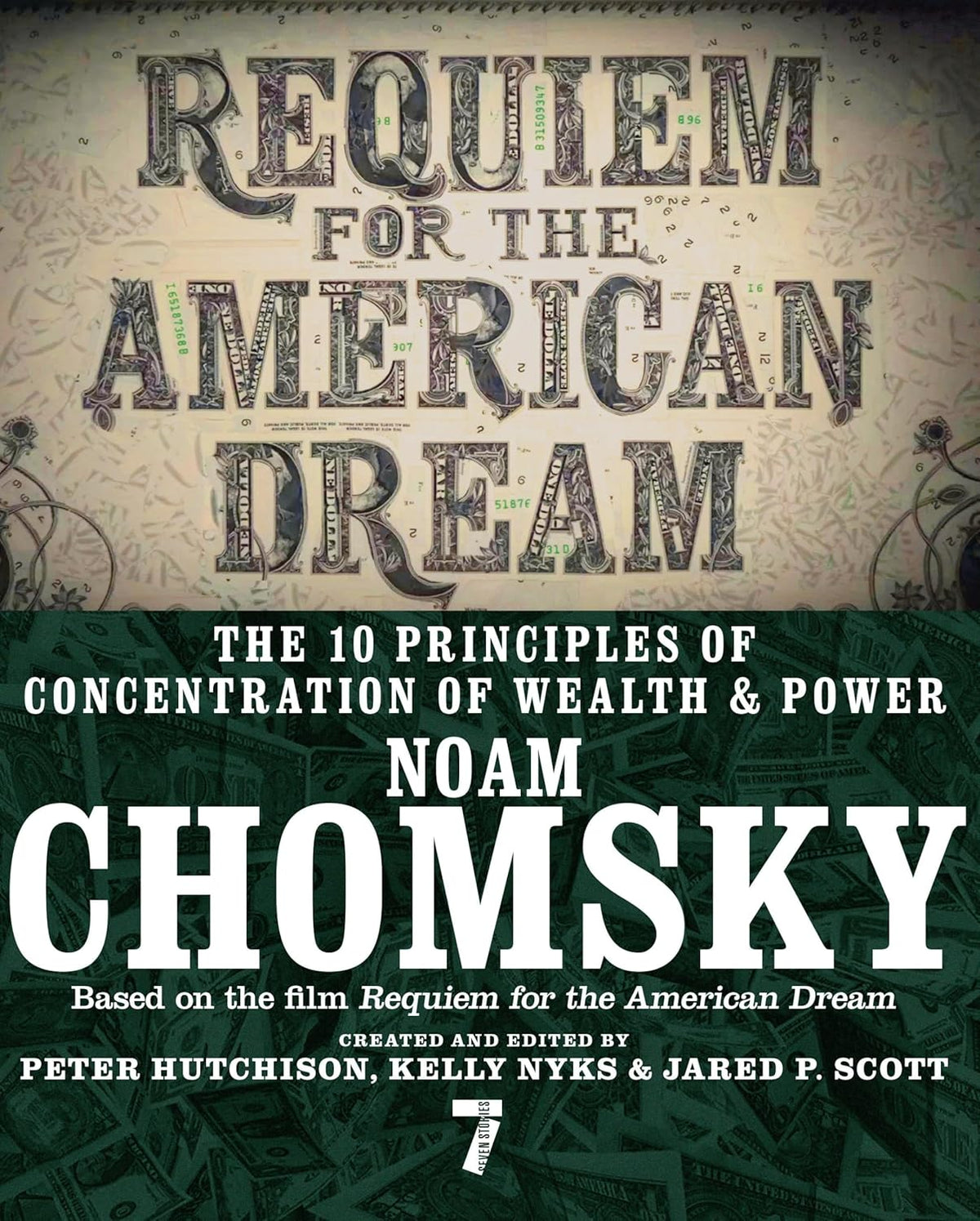
About Requiem for the American Dream: The 10 Principles of Concentration of Wealth & Power by Noam Chomsky – A Clear Guide to His Argument About Wealth, Power, and Democracy
Why do some people have much more money and political influence than others? Why does economic inequality grow in some periods? How can wealth shape public policy, elections, media, and the choices people feel they have? Requiem for the American Dream: The 10 Principles of Concentration of Wealth & Power by Noam Chomsky is built around these questions.
Published by Seven Stories Press in 2017, the book grew from long-form interviews conducted between 2011 and 2016 by filmmakers Peter Hutchison, Kelly Nyks, and Jared P. Scott. Chomsky presents ten principles that, in his view, help explain how wealth and political power became increasingly concentrated in the United States.
This is not a neutral textbook on American politics or economics. It is Chomsky's argument. He criticizes neoliberal policies, corporate influence, weak labor power, campaign finance, deregulation, and mass persuasion. Readers can use the book to understand his position, compare it with other evidence and viewpoints, and decide where they agree or disagree.
The Book Begins with the American Dream
The title points to a familiar idea: that people should have a fair chance to improve their lives through work, education, and opportunity.
Chomsky argues that this promise has become harder to achieve because wealth and power reinforce each other. In his account, people and institutions with greater economic resources can gain more influence over politics. Political decisions can then create rules that protect or increase that economic advantage.
That cycle is the main frame of the book.
The text does not claim that every wealthy person acts in the same way or that every political decision has one cause. Instead, Chomsky focuses on broad structures and long-term trends. His aim is to show how policies, institutions, and public ideas can work together over time.
Readers interested in inequality, democracy, political economy, or modern United States history may find this a useful entry point into his thinking.
Principle One: Reduce Democracy
Chomsky's first principle is "Reduce Democracy."
He argues that powerful groups have often worried about too much public influence over political and economic decisions. In his telling, democratic participation can threaten concentrated wealth when large numbers of people demand stronger public services, labor rights, redistribution, or limits on private power.
The chapter places this claim in a long historical frame. Chomsky connects debates about democracy with questions about property, class, and political control.
His interpretation is contested. Political historians differ over how democratic institutions have changed and why, and the United States has seen both expansions and restrictions of participation over time.
Principle Two: Shape Ideology
The second principle is "Shape Ideology."
Chomsky argues that public beliefs about government, business, markets, and individual responsibility can influence what policies people accept. He pays attention to institutions that shape ideas, including education, media, business groups, and political organizations.
In his view, if people are taught to see social problems only as personal failures, they may be less likely to support collective solutions.
This is an argument about framing. The same economic problem can be described in different ways depending on who is speaking and what values they emphasize.
Principle Three: Redesign the Economy
Chomsky's third principle is "Redesign the Economy."
He argues that changes in business organization, trade, finance, and production shifted more power toward owners and investors while weakening many workers.
He is especially critical of financialization and the movement of production across borders when those changes reduce worker bargaining power or encourage firms to focus heavily on short-term returns.
Economists disagree about the benefits and costs of globalization, financial development, trade, and corporate restructuring. These processes can create gains in productivity, investment, and consumer choice while also producing job losses, regional decline, or greater inequality in some settings.
Principle Four: Shift the Burden
The fourth principle is "Shift the Burden."
Chomsky argues that tax systems, public spending choices, wages, and social policy can move more economic pressure onto ordinary workers and the middle class while protecting advantages at the top.
He discusses changes in taxation and public policy as part of a larger pattern of redistribution upward.
Tax policy is complicated, and economists disagree about how different taxes affect growth, investment, work, inequality, and government revenue. Chomsky's analysis emphasizes distribution: who pays, who benefits, and whose interests receive the strongest political support.
Principle Five: Attack Solidarity
The fifth principle is "Attack Solidarity."
Chomsky uses solidarity to mean the idea that people share responsibilities toward one another. He argues that public programs are often weakened when citizens are encouraged to think only as isolated individuals rather than members of a community.
He discusses Social Security, public education, and other shared institutions as examples.
His broader claim is moral as well as political: a society changes when people stop seeing another person's problem as something that concerns them.
Different political traditions disagree over how much responsibility should belong to individuals, families, markets, charities, or government. This chapter clearly places Chomsky on the side of stronger collective responsibility.
Readers can compare that view with arguments for smaller government, private provision, or greater personal choice.
Principle Six: Run the Regulators
The sixth principle is "Run the Regulators."
Chomsky argues that industries can gain strong influence over the agencies and rules meant to control them. Political science and economics often discuss related ideas using terms such as regulatory capture.
The concern is simple: if regulated industries have greater information, money, access, or lobbying power than ordinary citizens, rules may be written or enforced in ways that favor those industries.
This does not mean every regulator is controlled by business. Regulatory systems vary greatly, and agencies can also impose major costs on firms.
Principle Seven: Engineer Elections
The seventh principle is "Engineer Elections."
Chomsky focuses on the role of money in campaigns and political parties. He argues that expensive elections can make candidates and parties more dependent on wealthy donors and organized interests.
Campaign finance is one of the most debated parts of democratic politics. Supporters of stronger limits argue that large donations and outside spending can create unequal political influence. Opponents of some restrictions argue that political spending can also be protected expression and that limits may favor established institutions.
Chomsky's position is strongly critical of concentrated private money in politics.
Principle Eight: Keep the Rabble in Line
The eighth principle uses Chomsky's provocative phrase, "Keep the Rabble in Line."
He focuses heavily on labor unions and organized workers. Chomsky argues that unions can give workers collective power that balances employers and other wealthy institutions. He therefore sees attacks on organized labor as part of a wider concentration of power.
Research on unions covers many questions, including wages, productivity, inequality, workplace rules, political activity, and business flexibility. Findings can differ by country, period, industry, and policy design.
The chapter presents unions mainly as democratic counterweights to concentrated economic power.
Readers interested in labor history may find this section especially useful because it connects workplace organization with broader questions about political voice.
Principle Nine: Manufacture Consent
The ninth principle is "Manufacture Consent."
Chomsky argues that advertising, public relations, and mass media can shape what people want, fear, and believe. He is concerned with the ability of powerful institutions to influence public attention and define which ideas seem normal.
This does not mean audiences simply accept every message. People interpret media differently, and modern media systems include many competing voices.
Still, the chapter raises questions that remain important in the age of social media: who chooses what receives attention, how commercial incentives affect information, and how repeated messages can influence public opinion.
Chomsky asks readers to become more aware of persuasion rather than treating communication as neutral.
Principle Ten: Marginalize the Population
The final principle is "Marginalize the Population."
Chomsky argues that people can become politically weak when they feel isolated, cynical, distracted, or convinced that participation will change nothing.
In his view, concentrated wealth benefits when large parts of the public withdraw from meaningful political action.
This chapter brings the earlier arguments together. Economic pressure, weak collective institutions, costly elections, media influence, and public frustration all become parts of one system in Chomsky's account.
Readers may agree with some links and reject others. The important point is that the book presents them as connected rather than separate problems.
Read It as an Argument, Not the Final Word
Requiem for the American Dream is best read as a strong political argument.
Chomsky selects evidence and historical examples to support his interpretation of American political economy. Other scholars place different weight on market competition, technological change, globalization, public policy, voter behavior, institutions, and individual choice.
A careful reader can benefit by comparing his claims with economists, historians, political scientists, and writers from different schools of thought.
That does not weaken the reason to read the book. It makes the reading more useful. You can identify Chomsky's claims, check the evidence, compare alternatives, and form your own view.
A Premium Edition for Focused Reading
Bookish Wonderland offers this title in a physical edition designed for regular reading and study.
- Premium eye-soothing cream paper gives the pages a warm, comfortable appearance.
- Crystal-clear printing keeps the text sharp and easy to follow.
- High-quality stitched and glue binding helps keep the pages secure through repeated use.
These specifications describe the edition offered by Bookish Wonderland, not every edition sold elsewhere.
A printed copy can be useful for a political book because readers may want to underline claims, mark examples, or return to earlier chapters while comparing arguments.
Who Should Read This Book?
This book may suit readers interested in politics, economics, inequality, democracy, media, labor, corporate power, or Noam Chomsky's political thought.
Students can use it as an introduction to one influential critical perspective. Book clubs can use the ten-principle structure for discussion. Readers who disagree with Chomsky may still find it useful because it presents his position in a compact form.
The book is political nonfiction, not a neutral civics guide. Reading other perspectives alongside it will give a broader understanding of the issues.
Check the Book Price in Bangladesh Before Ordering
If you are searching for the Book price in Bangladesh for Requiem for the American Dream by Noam Chomsky, check the current amount shown on the Bookish Wonderland product page before ordering. Prices and stock can change, so the live listing is the right place to confirm the latest amount.
Bookish Wonderland delivers inside and outside Dhaka and offers Cash on Delivery across Bangladesh. Readers in Dhaka can also ask about fast or urgent delivery, depending on location and service availability.
If you need help with availability, customization, or delivery, contact Bookish Wonderland through Facebook or Instagram before placing your order.
Explore the Argument and Form Your Own View
Requiem for the American Dream gives readers a compact map of Noam Chomsky's argument about inequality and political power in the United States.
Across ten principles, he connects democracy, ideology, economic change, taxation, solidarity, regulation, elections, labor, media, and political participation. The book asks readers to consider whether these forces reinforce one another and what that means for democratic life.
You do not need to agree with every conclusion to learn from the book. Read it carefully, compare its claims with other sources, and decide which arguments you find convincing.
Order Requiem for the American Dream from Bookish Wonderland if you want an accessible introduction to Chomsky's political and economic critique.
If you require any customization or have any questions, please inbox us via FB or Insta.
| Primary Specification | |
| Author | Noam Chomsky |
| Narrator | Donald Corren |
| Editor | Peter Hutchison, Kelly Nyks and Jared P. Scott |
| Genre | Political Science, Economics, Sociology, Social Criticism |
| ISBN-13/ISSN | 978-1609807368 |
| ISBN-10 | 1609807367 |
| Publisher | Seven Stories Press |
| Publishing Date | March 28, 2017 |
| Edition | Illustrated |
| Language | English |
| Reading Age | 18+ |
| Format | Printed Book |
| Physical Specification & Quality | |
| Paper Quality | Premium eye-soothing cream paper |
| Binding Quality | High quality stitched and glue binding (for longevity) |
| Print Quality | Crystal-clear print |
| Pages | 192 pages |
| Country | USA |
| Logistics Information | |
| Weight | 212 gm |
| Length | 8.5 inches |
| Width | 5.6 inches |
| Height | 0.58 inch |