

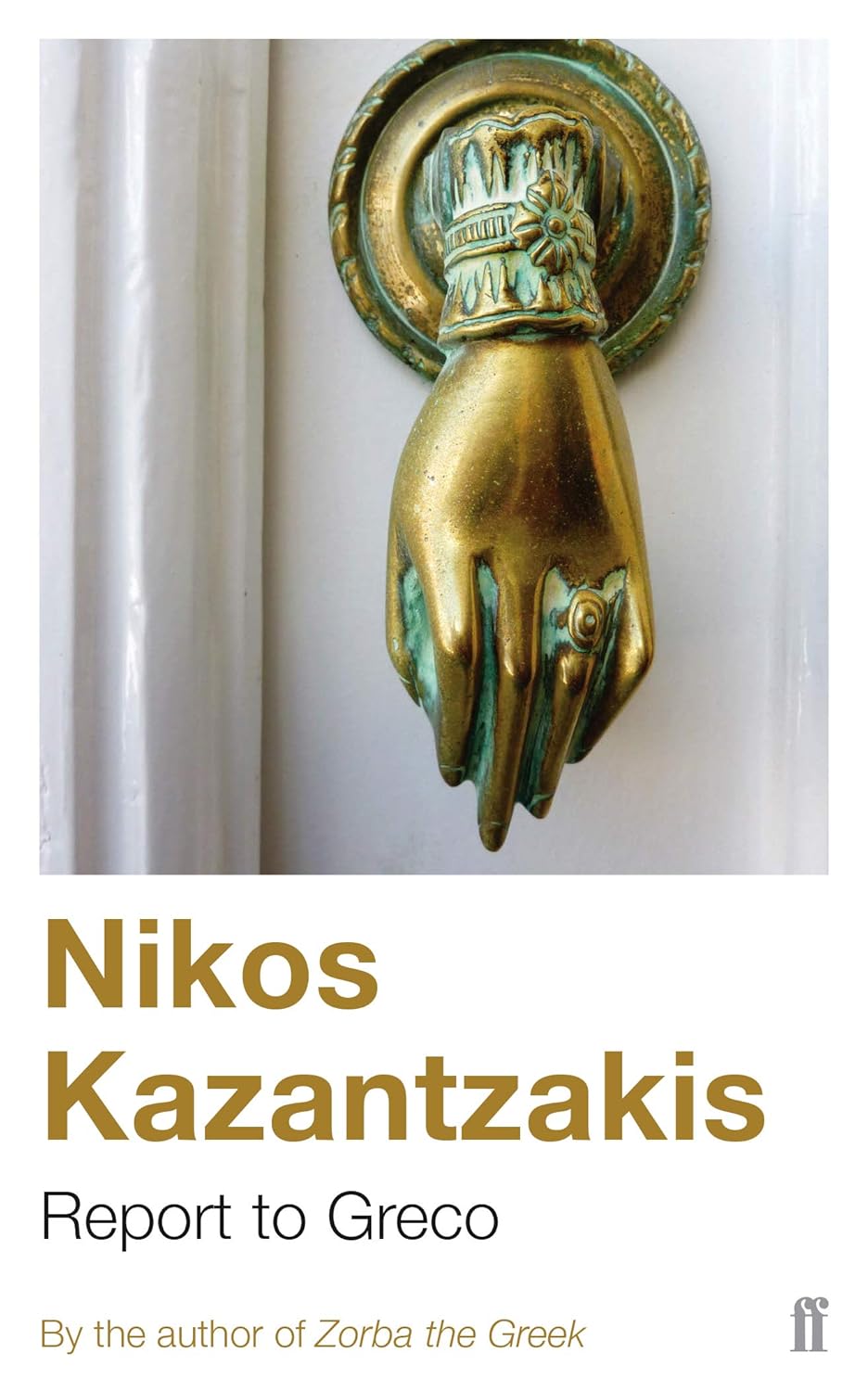
About Report to Greco by Nikos Kazantzakis – A Deep Journey Through Life, Faith, Travel, Struggle, and the Search for Meaning
Some books tell you what happened in a life. Report to Greco by Nikos Kazantzakis tries to show what that life felt like from the inside. Written near the end of Kazantzakis's life and published after his death, this unusual work looks back at the people, places, ideas, fears, hopes, and spiritual struggles that shaped him.
Kazantzakis does not write a simple day-by-day autobiography. He turns memory into a personal and philosophical journey. He looks back at childhood in Crete, family, religion, travel, teachers, writers, political ideas, and the questions that followed him across his life. The book is framed as a report to El Greco, the famous Cretan-born painter whom Kazantzakis treats as a spiritual ancestor.
The result is part memoir, part meditation, and part search for meaning. Readers meet a writer who keeps asking difficult questions about freedom, God, death, duty, the body, the spirit, and what a human being should do with the short time given to them.
This Is Not a Normal Autobiography
If you expect a simple list of dates, jobs, and achievements, Report to Greco offers something very different.
Kazantzakis selects memories because of what they meant to his inner life. A place can become a symbol. A meeting can lead to a long reflection. A childhood memory can open into a question about courage, fear, faith, or freedom.
That is why the book is often described as an intellectual or poetic autobiography. The facts of Kazantzakis's life matter, but the book is also about how he understood those facts later.
He is less interested in saying, "This happened, then that happened," and more interested in asking, "What did this experience do to me?"
Crete Stands at the Beginning of His Inner World
Kazantzakis was born in Crete in 1883, and the island has a powerful place in his imagination.
In Report to Greco, Crete is more than a birthplace. It becomes a source of memory, identity, pride, struggle, and spiritual energy. Childhood experiences, family influence, local traditions, and the island's history help shape the way he sees freedom and human responsibility.
His father appears as a strong presence in his early life, while religion, community, landscape, and the idea of resistance enter his imagination at a young age.
These memories help readers understand why struggle becomes such an important word throughout Kazantzakis's writing. He often sees life not as a quiet search for comfort but as an effort to rise, create, resist fear, and move beyond one's limits.
El Greco Becomes the Person Receiving the Report
The title is important.
Kazantzakis does not present the book as a report to a government, teacher, or ordinary reader. He addresses El Greco, the Renaissance painter born in Crete who later built his career in Spain.
For Kazantzakis, El Greco represents a creative spirit who left his homeland but carried something of it into a larger world. That makes him a powerful figure to receive this final account.
The device gives the autobiography a personal shape. Kazantzakis can speak as if he is explaining what he learned, where he failed, what he loved, and what he continued to seek.
Readers do not need to know art history before starting the book. The meaning becomes clear through the idea of one Cretan artist speaking across time to another.
Faith Is a Question, Not an Easy Answer
Religion runs deeply through Report to Greco, but the book is not a simple statement of settled belief.
Kazantzakis wrestles with God, Christ, spiritual discipline, doubt, desire, death, and the tension between body and spirit. He is drawn toward faith, but he also questions religious ideas and institutions.
He wants meaning, yet he does not want an answer that feels too easy. He is interested in the human desire to rise above fear and selfishness while still living inside a physical body with ordinary needs.
Readers who enjoy books about spiritual searching may find these pages powerful. Readers who disagree with Kazantzakis may still find the honesty of the struggle interesting.
The book asks you to think, not simply accept.
Ideas and Thinkers Become Part of the Journey
Report to Greco reflects that hunger. Philosophy, religion, literature, politics, art, and history all enter the story. The publisher describes the book as moving through subjects as wide as the Hegelian dialectic and the nature of human existence.
Kazantzakis studied philosophy under Henri Bergson in Paris and was influenced by many thinkers across his life. Rather than hiding these influences, he makes them part of the autobiography.
An idea matters because of what it does to him. Does it free him? Does it create another problem? Does it help him understand suffering? Does it push him toward action?
This makes the book especially interesting for readers who like philosophy but prefer it connected to a human life instead of presented only as abstract theory.
Travel Becomes a Way of Testing the Self
Different places expose him to new beliefs, cultures, people, and ways of thinking. Travel becomes more than sightseeing. It becomes a test.
Leaving familiar ground forces him to question what he has inherited and what he truly believes. New landscapes and encounters can disturb old ideas, while returning home can make familiar things look different.
Readers who enjoy travel memoirs may appreciate how places become part of the author's inner development. The journey is both geographical and spiritual.
The Book Keeps Returning to Struggle
He often presents human life as a movement between opposing forces: body and spirit, fear and courage, life and death, freedom and duty, earth and something beyond earth.
Report to Greco shows how these tensions developed inside him.
He does not describe peace as simply avoiding conflict. Instead, he often finds meaning in the effort itself. A person may never solve every contradiction, but the act of continuing to search can still matter.
This can make the book feel intense, but it also gives it energy. Kazantzakis writes like someone who does not want to sleepwalk through life.
For readers who enjoy books that challenge comfort and ask large questions, that energy can be one of the strongest reasons to keep reading.
It Helps Explain the Writer Behind His Famous Novels
Many readers know Kazantzakis through works such as Zorba the Greek or The Last Temptation of Christ.
Themes that appear in his fiction are connected here to his own experiences and questions. Freedom, faith, rebellion, desire, death, spiritual effort, and the joy of life all appear in different forms.
You do not need to read his novels first. In fact, this book can work as an introduction to the ideas that shaped his writing.
A Book to Read Slowly, Not Rush Through
Report to Greco is best approached with time.
Some pages tell vivid memories. Others move into philosophy or spiritual reflection. A reader may want to stop after a section and think before continuing.
Keep a pencil or notebook nearby if you enjoy marking ideas. Write down a question that catches you. Return to a passage after a few days. Compare what Kazantzakis says about freedom in one part with what he says about faith in another.
P. A. Bien Brings the Work into English
The original Greek work was published in 1961, after Kazantzakis's death in 1957.
The English translation appeared in 1965 and was translated from Greek by P. A. Bien, also known as Peter Bien. Bibliographic records classify the work as autobiography, while the current Simon & Schuster description calls it a fictionalized account and intellectual autobiography.
Different editions have different page counts. The original 1965 Simon and Schuster English edition is listed at 512 pages, while the current Simon & Schuster ebook edition is listed at 506 pages.
A Premium Edition for Thoughtful Reading
Bookish Wonderland offers this title in a physical edition made for readers who want a comfortable copy for long reading sessions and repeated use.
- Premium eye-soothing cream paper gives the pages a soft, warm tone.
- Crystal-clear printing keeps the text sharp and easy to follow.
- High-quality stitched and glue binding helps keep the pages secure and supports long-term durability.
These details describe the edition offered by Bookish Wonderland, not every edition sold by other publishers or stores.
A durable printed copy suits a reflective book like this because readers may want to return to important passages, mark ideas, or keep it as part of a literature, philosophy, or memoir collection.
Who Should Read Report to Greco?
Choose this book if you enjoy autobiography, philosophy, spiritual reflection, Greek literature, travel writing, or books about a person's search for meaning.
It may especially appeal to readers who already enjoy Kazantzakis and want to understand the ideas behind his fiction.
Students of literature can use it to explore the author's intellectual development. Readers interested in religion can examine his restless relationship with faith. People who enjoy philosophy can follow the thinkers and ideas that challenged him. Travel readers can enjoy the way places shape his inner life.
This is not a light memoir filled only with funny memories. It asks serious questions and sometimes moves through dense ideas. Patient readers are more likely to enjoy it.
A Strong Choice for Study, Journaling, or Book Clubs
Report to Greco can create rich discussion because readers may respond very differently to Kazantzakis's beliefs.
A book club can ask what he means by struggle, how Crete shapes his identity, why he chooses El Greco as the listener, and whether his spiritual search ever reaches a final answer.
You can also use the book for personal journaling. After each major section, ask what idea stayed with you and whether you agree with it.
Check the Book Price in Bangladesh Before Ordering
If you are searching for the Book price in Bangladesh for Report to Greco by Nikos Kazantzakis, check the current amount shown on the Bookish Wonderland product page before ordering. Prices and stock can change, so the live listing is the right place to confirm the latest amount.
Bookish Wonderland delivers inside and outside Dhaka and offers Cash on Delivery across Bangladesh. Readers in Dhaka can also ask about fast or urgent delivery, depending on location and service availability.
If you need help with availability, customization, or delivery, contact Bookish Wonderland through Facebook or Instagram before placing your order.
Follow a Writer Through a Lifetime of Questions
Report to Greco is not only about where Nikos Kazantzakis went or what he achieved. It is about what he kept searching for.
He looks back at Crete, family, faith, philosophy, travel, art, teachers, fear, freedom, death, and the restless need to grow. By addressing his story to El Greco, he turns autobiography into a final report from one searching Cretan spirit to another.
The book does not promise simple answers. Its strength comes from the seriousness of the questions.
Order Report to Greco by Nikos Kazantzakis from Bookish Wonderland if you want a thoughtful classic that brings memoir, philosophy, travel, and spiritual reflection together.
Read it slowly. Follow the memories. Question the ideas. Then decide which parts of Kazantzakis's lifelong search speak most strongly to you.
If you require any customization or have any questions, please inbox us via FB or Insta.
| Primary Specification | |
| Author | Nikos Kazantzakis |
| Narrator | Joshua Saxon |
| Genre | Autobiography, Philosophical Literature, Spiritual Literature |
| ISBN-13/ISSN | 978-0571195077 |
| ISBN-10 | 0571195075 |
| Publisher | Faber & Faber |
| Publishing Date | January 1, 1998 |
| Language | English |
| Reading Age | 18+ |
| Format | Printed Book |
| Physical Specification & Quality | |
| Paper Quality | Premium eye-soothing cream paper |
| Binding Quality | High quality stitched and glue binding (for longevity) |
| Print Quality | Crystal-clear print |
| Pages | 512 pages |
| Country | Greece |
| Logistics Information | |
| Weight | 532 gm |
| Length | 8.5 inches |
| Width | 5.6 inches |
| Height | 1.14 inch |