

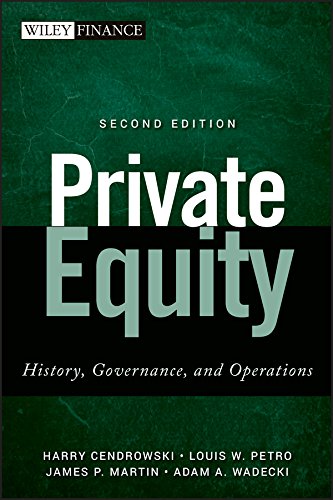
About Private Equity: History, Governance, and Operations by Harry Cendrowski, Louis W. Petro, James P. Martin & Adam A. Wadecki – Understand Investment Funds, Business Risks, and What Happens After a Deal
Buying a company is only one part of private equity. Investors must raise money, choose businesses, check financial information, agree on terms, guide management, and eventually find a way to sell their investment. Private Equity: History, Governance, and Operations by Harry Cendrowski, Louis W. Petro, James P. Martin and Adam A. Wadecki explains how those connected activities work and why careful decisions matter at every stage.
The book moves through three broad areas. First, it examines the history of private equity and how funds invest and exit. Next, it explores governance, internal controls, and financial reporting. Finally, it looks inside businesses, considering competitive intelligence, organizational behavior, lean methods, and manufacturing due diligence. This wide view makes the text useful for readers who want to understand more than a headline about a company being bought or sold.
Wiley published the first edition in 2008 and a revised second edition in 2012. Its examples reflect those periods, so readers should check current laws, market conditions, and deal data separately. The book offers a detailed framework, not a guarantee of investment success.
Understand What Private Equity Actually Does
Private equity generally involves investment in businesses through funds or other ownership arrangements. Investors provide capital, fund managers select opportunities, and the owners seek to improve the value of their holdings over time. The details vary widely between venture capital, buyout funds, and other strategies.
The book introduces the parties and the structure connecting them. Limited partners provide much of a fund's capital, while general partners manage investments under agreed terms. Those terms can influence fees, incentives, reporting, and what decisions a manager may make.
If you are new to the subject, learning these relationships can make the industry feel less mysterious. You can begin to see who supplies money, who makes decisions, who carries risk, and why investment agreements deserve close attention.
Start with History Instead of Chasing Headlines
News stories often focus on a huge acquisition or a successful sale. Such moments are only snapshots. Private equity operates over years, through changes in interest rates, business confidence, fundraising, and the wider economy.
The book reviews historical fundraising, investment levels, returns, and exit trends. It also examines how private equity returns relate to public market indexes. That background helps readers understand why a deal that looks attractive in one period may look very different in another.
Historical figures are not forecasts. The industry's size, rules, financing costs, and competitive environment have changed since the book's original editions. Treat its figures as evidence about the periods studied, then compare them with newer reports before making present-day decisions.
Learn How Funds Raise Money and Set Incentives
Before buying companies, most private equity funds need commitments from investors. Fundraising can involve explaining a strategy, showing past experience, negotiating terms, and building trust with institutions or other eligible investors.
The book discusses the fundraising process and the agreements that shape the relationship between fund managers and investors. Incentives matter because the people choosing investments may be rewarded differently from the people supplying capital. Clear terms and monitoring can help address those differences, although they cannot eliminate every conflict.
Look Beyond the Purchase Price
A private equity deal is not finished when a buyer and seller agree on a number. The buyer needs to understand the company, its market, obligations, people, and ability to generate cash. A low price does not automatically mean good value if serious problems remain hidden.
The book connects investment analysis with governance and business operations. This makes due diligence more than checking whether a spreadsheet adds up. Readers are encouraged to think about systems, controls, management, competition, and the way work happens inside the company.
That perspective can help students and professionals understand why two businesses with similar revenue might carry very different levels of risk. It also explains why careful preparation before a transaction can matter long after contracts have been signed.
Understand the Two Common Ways Investors Exit
Private equity owners usually expect to realize the value of an investment at some point. The book explores exits through initial public offerings, often called IPOs, and through mergers and acquisitions.
An IPO brings shares to public investors, but it also introduces legal, reporting, and market demands. A sale to another company or buyer involves a different process, including negotiations, transaction terms, and legal considerations. Neither route is automatically available or suitable for every business.
The book has separate chapters on the transaction and legal sides of both approaches. These sections help readers connect the aim of earning a return with the practical steps needed to leave an investment. Legal requirements differ by jurisdiction and change over time, so its discussion should not replace current professional advice.
Protect Value Through Better Governance
After a fund invests, ownership alone will not improve a company's performance. People must decide who has authority, how managers are monitored, and what information investors receive. These are questions of governance.
The authors examine governance structures for private equity funds and portfolio companies, including differences from public-company arrangements. They discuss how ownership stakes, management incentives, debt obligations, and frequent monitoring can shape behavior.
Good governance does not mean checking every small decision. It means giving people clear responsibilities and making sure important risks receive attention. Poorly designed incentives may encourage short-term choices or hide problems. A clear reporting process can help investors and managers recognize issues earlier and discuss solutions.
Internal Controls Are More Than Paperwork
A business needs dependable processes for handling money, recording transactions, approving payments, and protecting assets. These processes are often called internal controls.
The book explains their value and discusses how to evaluate them. Weak controls can make financial information unreliable or allow errors and misconduct to remain unnoticed. Even a growing company can be difficult to manage if its owners cannot trust the numbers being reported.
For a new reader, think of controls as sensible checks: who approves a payment, who records it, and how someone confirms that the amount is correct? The real systems can be much more complex, but the purpose is similar.
Strong controls support sound decisions. They cannot guarantee that every mistake or fraud will be caught, yet they can reduce avoidable risks and make accountability clearer.
Know Why Financial Statement Fraud Matters
A company may look healthy on paper while its records hide losses, overstate assets, or report income incorrectly. Private equity investors can face major losses if they rely on misleading information before making a deal.
One chapter addresses financial statement fraud and the investment decision. The wider governance section also considers professional standards, giving readers a reason to examine both financial evidence and the people responsible for producing it.
The lesson is not to suspect every company. It is to ask careful questions, check important claims, and understand the limits of the information available. Accountants, auditors, advisers, and fund teams have different responsibilities, and good judgment requires knowing where specialist help is needed.
Look Inside the Business After the Deal
The final part of the book shifts toward operations. It examines competitive intelligence, the human side of organizations, lean transformation, and manufacturing due diligence.
This matters because financial results come from real activities. Employees serve customers, factories make products, suppliers deliver materials, and managers organize the work. Improving a company may require understanding how those activities fit together rather than changing targets on a spreadsheet.
Use Lean Thinking Without Assuming Every Fix Is Easy
Lean methods focus on examining processes and reducing work that does not create value for customers. The book includes a chapter on beginning a lean transformation, followed by material on manufacturing due diligence.
For a factory, this might mean studying how materials move, where delays occur, or why products need to be remade. The details depend on the business, its workers, equipment, and customers. No single improvement method fits every company automatically.
Readers can use these chapters to see why operational change requires observation and cooperation. A financial target may be set in minutes, but improving a real production process can take time, investment, and honest feedback from the people doing the work.
Who Created This Professional Reference?
Wiley credits Harry Cendrowski, Louis W. Petro, James P. Martin, and Adam A. Wadecki as the four editors of its second edition. Their published biographies describe experience across private equity, consulting, accounting, enterprise risk management, and operations.
The book brings those areas together rather than treating private equity as a topic belonging only to investment bankers. Wiley lists the second edition as a 384-page hardcover, with print ISBN 9781118138502. Exact page counts and formats can differ across editions, so check the offered copy's specifications before purchasing.
A Premium Edition for Repeated Study
Bookish Wonderland offers a printed copy for readers who want to keep a detailed finance reference at their desk. The store's supplied edition includes:
- Premium eye-soothing cream paper with a soft, comfortable page tone.
- Crystal-clear printing for readable explanations and technical material.
- High-quality stitched and glue binding designed to hold pages securely during regular use.
These features describe Bookish Wonderland's offered edition, not every Wiley edition sold elsewhere. A physical copy makes it convenient to mark a useful framework, revisit an earlier chapter, or bring a reference to a study session.
Who Should Add This Book to Their Shelf?
This text may suit finance students, private equity analysts, investment professionals, accountants, consultants, risk managers, and business owners preparing for investment discussions. Wiley also identifies it as suitable for advanced and graduate-level classrooms.
Beginners can start with the introductory chapters, but the book is not a quick motivational guide. Some discussions assume interest in accounting, legal processes, investment structures, or operations. Readers seeking current tax rules, live fund returns, or personal investment advice should use updated specialist sources alongside it.
Check the Book Price in Bangladesh Before Ordering
For the Book price in Bangladesh for Private Equity: History, Governance, and Operations by Harry Cendrowski, Louis W. Petro, James P. Martin and Adam A. Wadecki, consult the current amount on the Bookish Wonderland product page. Check availability and the offered edition before ordering instead of relying on an older price.
Bookish Wonderland delivers inside and outside Dhaka and offers Cash on Delivery nationwide. Customers in Dhaka can ask about fast or urgent delivery, subject to their address and service availability. Questions about customization or edition details can be sent through Facebook or Instagram.
Move from Deal Headlines to a Fuller Understanding
Private equity involves far more than buying a business and hoping its value rises. Investors must think about fundraising, agreements, market history, exit routes, management, controls, and operations. This book places those subjects side by side so readers can see how one decision affects another.
Order Private Equity: History, Governance, and Operations from Bookish Wonderland if you want a substantial reference for learning the structure behind private equity deals. Read it chapter by chapter, compare its historical material with current information, and use its practical questions to guide further study.
If you require any customization or have any questions, please inbox us via FB or Insta.
| Primary Specification | |
| Author | Harry Cendrowski, Louis W. Petro, James P. Martin and Adam A. Wadecki |
| Genre | Business, Finance, Investment, Corporate Governance |
| ISBN-13/ISSN | 978-1118138502 |
| ISBN-10 | 1118138503 |
| Publisher | Wiley |
| Publishing Date | May 1, 2012 |
| Edition | 2nd |
| Language | English |
| Reading Age | 18+ |
| Format | Printed Book |
| Physical Specification & Quality | |
| Paper Quality | Premium eye-soothing cream paper |
| Binding Quality | High quality stitched and glue binding (for longevity) |
| Print Quality | Crystal-clear print |
| Pages | 384 pages |
| Country | USA |
| Logistics Information | |
| Weight | 405 gm |
| Length | 8.5 inches |
| Width | 5.6 inches |
| Height | 0.85 inch |