Skip to product information
1 of 1

Bookish Wonderland

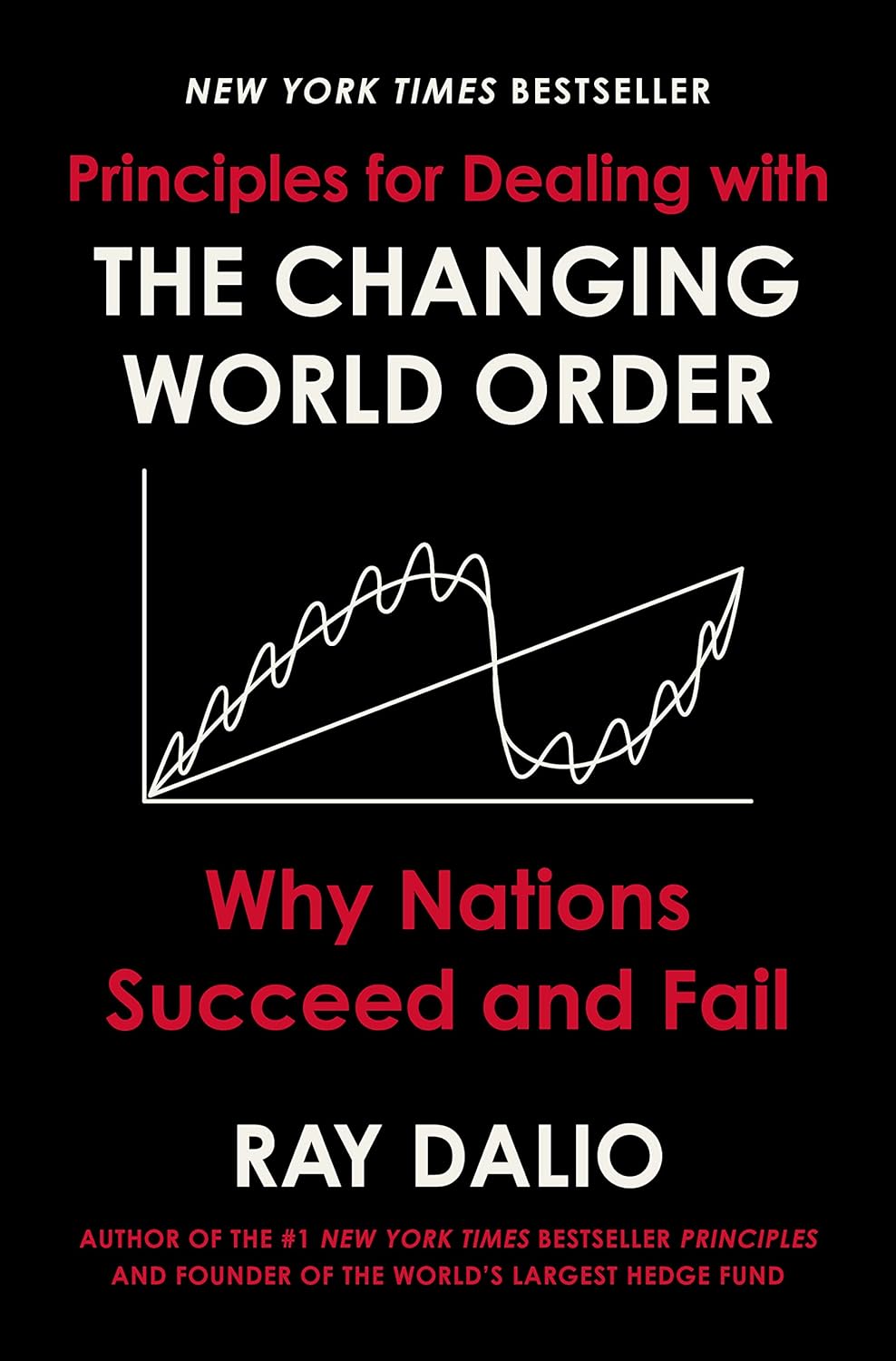
Principles for Dealing with the Changing World Order: Why Nations Succeed and Fail by Ray Dalio

Principles for Dealing with the Changing World Order: Why Nations Succeed and Fail by Ray Dalio

Regular price Tk 406.00 BDT
Regular price Sale price Tk 406.00 BDT
Sale Sold out
Book cover type
Quantity

In Principles for Dealing with the Changing World Order, investor Ray Dalio examines why nations gain power, dominate affairs, and eventually decline. Drawing on five centuries of political history, he compares the Dutch, British, and American empires while considering China's rise. Dalio proposes a recurring Big Cycle shaped by debt, money creation, internal conflict, external rivalry, education, innovation, and competitiveness. He explains how widening wealth gaps, financial crises, and shifting reserve currencies can coincide with struggles over global leadership. Historical charts and measures help him illustrate the patterns he believes connect these developments. The book then applies his framework to contemporary conditions, tensions between the United States and China, and discusses ways individuals, investors, and policymakers might prepare for uncertainty. Rather than treating history as a sequence of isolated events, Dalio presents a model for recognizing changes in economic strength and international power while emphasizing the importance of understanding forces. Read More

View full details

About Principles for Dealing with the Changing World Order: Why Nations Succeed and Fail by Ray Dalio – Understand Economic Cycles, Global Power, Debt, and History

Why do powerful countries rise, and why does their position sometimes weaken? How can debt, money, education, trade, and conflict change the lives of ordinary people? Principles for Dealing with the Changing World Order: Why Nations Succeed and Fail by Ray Dalio explores these questions by looking across hundreds of years of economic and political history. Dalio, an investor and the founder of Bridgewater Associates, draws on historical records and financial data to develop what he calls the Big Cycle.

His central idea is that certain patterns can appear in the growth and decline of major powers. He studies how a country gains wealth and influence, how debt and internal tensions can build, and how competition between countries can reshape an international order. These are Dalio's interpretations, not fixed laws that guarantee what will happen next.

This substantial nonfiction book brings together history, economics, investing, and geopolitics. It gives curious readers a framework for asking better questions about world events without needing to accept every conclusion or make a prediction about any country's future.

Start with a Bigger View of World Events

News stories often explain one event at a time. A currency weakens, a government borrows money, a trading relationship becomes tense, or an economy grows quickly. Each headline may be important, but it can be hard to understand how the pieces connect.

Dalio tries to show a larger picture. He compares different periods and asks how financial conditions, political systems, education, technology, and international competition can affect one another. His aim is to identify patterns that daily news may not reveal.

The book does not make history simple or predictable. Countries have different institutions, cultures, and circumstances. A pattern that describes one period may fail to describe another. Still, studying several cases together can help readers identify questions to investigate before drawing conclusions from a dramatic headline.

What Does Dalio Mean by the Big Cycle?

The Big Cycle is Dalio's model for understanding long periods of national growth, strength, strain, and change. It brings together economic developments and political conditions instead of treating them as completely separate subjects.

In his framework, a rising power may improve education, become more productive, trade widely, develop financial markets, and gain a strong currency. Over time, success may also create new pressures, including larger debts, costly commitments, and disagreements over the distribution of wealth.

Dalio asks readers to watch how these forces interact. His framework can help organize historical information, but it should not be read as a clock that tells us exactly when a country will rise or decline. Real history includes surprises, policy changes, innovations, and events that no simple cycle can fully capture.

Debt Can Shape More Than a Household Budget

Borrowing helps people, businesses, and governments pay for things before they have all the required money. Used carefully, credit can support investment and growth. If debt grows faster than the ability to repay it, however, difficult choices may follow.

Dalio examines long debt cycles and the connections among lending, interest rates, economic activity, and government decisions. He discusses what can happen when borrowers struggle and how attempts to manage debt may affect the value of money.

The important lesson for readers is to separate an amount of debt from the wider situation. Who owes it? In what currency? What interest must be paid? How much income supports repayment? Different answers can lead to very different outcomes. The book offers a historical framework, not personal investment instructions or a live assessment of today's markets.

Why the Value of Money Matters

Money is useful partly because people trust that other people will accept it. Major currencies can also be used widely for international trade, borrowing, and official reserves.

Dalio explores how monetary systems develop and how their importance can change. He considers the role of credit, debt, central banks, and confidence in understanding shifts in the value of money. In his account, a country's economic strength and international financial position are closely connected.

Internal Conflict Is Part of the Framework

Economic numbers are not Dalio's only focus. He also examines what he calls internal order and disorder: the relationships among social groups, political institutions, and competing interests inside a country.

His argument is that sharp divisions and disagreements about wealth, values, and power may affect a nation's ability to solve shared problems. He studies how these pressures have appeared in different historical settings.

These are complex political questions. Historians and political scientists disagree about the causes of particular conflicts and how much weight to place on inequality, institutions, leadership, or outside events. Dalio offers one model for comparing them. Readers can gain a fuller understanding by checking the historical evidence and considering other accounts alongside his.

Competition Between Countries Changes the Picture

The book also looks beyond national borders. Dalio studies how established powers and rising powers interact through trade, finance, technology, diplomacy, and military strength.

He argues that changes in relative strength can put pressure on an existing international order. This does not mean every rivalry must end in war. Economic ties, institutions, diplomacy, and national choices can shape very different paths.

For readers interested in international relations, this section connects familiar economic subjects with questions about global influence. It explains why Dalio looks at money and politics together when comparing historical powers. His discussion is a lens for studying past relationships, not a verified forecast of any current dispute.

Follow the Dutch, British, and American Examples

Dalio examines the Dutch Empire and the guilder, the British Empire and the pound, and the United States and the dollar. He uses these cases to compare trade, financial centers, innovation, military influence, and the international standing of currencies.

Readers can see what he counts as a sign of strength and why he believes some financial and political changes deserve attention.

Every case also has limits. These countries developed in centuries, under different political systems and global conditions. Comparing them may reveal similarities without proving that their histories follow a single fixed path. The book is most useful when its comparisons prompt careful questions rather than quick conclusions.

Understand How China Fits into His Study

China receives a substantial part of Dalio's historical analysis. He explores its economic development and international role, then considers its relationship with the United States in the context of his broader framework.

The discussion includes history, trade, technology, financial strength, and strategic competition. Dalio uses these subjects to illustrate his interpretation of changing relative power. He does not provide a universally accepted account of either country's political system or economic future.

Readers should distinguish the historical figures and assessments published in 2021 from later developments. For a current comparison, use updated statistics and research from multiple credible sources. That approach keeps an informative book from becoming an outdated substitute for live evidence.

Charts Make Large Ideas Easier to Explore

This is a detailed book, but it is not only long paragraphs. Dalio uses charts, historical comparisons, and measured indicators to explain how he sees different forces moving together.

Visual material can help readers compare periods and understand terms that might otherwise feel abstract. It can also invite useful questions: how was an indicator measured, which countries were selected, and what information might be missing?

Reading a chart carefully matters just as much as reading the surrounding explanation. A clear picture can make an argument easier to follow without proving that the underlying model is correct. Treat each chart as evidence to examine, not as a prediction machine.

Who Is Ray Dalio?

Ray Dalio founded the investment firm Bridgewater Associates in 1975. His experience studying economies and financial markets informs the way he approaches history in this book. He seeks patterns that might help explain how economic and political conditions are connected.

The hardcover was published by Avid Reader Press, an imprint of Simon & Schuster, on November 30, 2021. That edition is listed at 576 pages, with ISBN 9781982160272. Other formats may differ, so check the details of the copy you order.

The book includes economic interpretation as well as history. Dalio's professional background gives context to his approach; it does not make every historical judgment or future scenario certain.

A Premium Edition for Your Study Shelf

Bookish Wonderland offers a physical copy prepared for readers who enjoy returning to important chapters and studying detailed nonfiction. Its supplied edition features:

  • Premium eye-soothing cream paper with a soft, comfortable page tone.
  • Crystal-clear printing that keeps the text and explanations easy to follow.
  • High-quality stitched and glue binding designed to keep the pages secure during regular reading.

These details describe Bookish Wonderland's offered edition, not every version published elsewhere. A printed book gives you a convenient way to mark a question, compare two chapters, or revisit an idea while following economic news.

Who Will Find This Book Interesting?

This title may appeal to readers interested in economic history, global trade, national debt, currencies, international relations, and the rise of major powers. Business students, analysts, history readers, and people trying to understand financial news may find its broad approach useful.

You do not need to agree with Dalio to learn how he builds his framework. Some chapters contain detailed charts and unfamiliar terms, so beginners may want to read slowly and look up concepts as they go. The book is not a quick guide to choosing stocks, nor is it a substitute for current financial advice or specialist research.

Read It with Questions, Not Certainty

Try writing down Dalio's main claim after each section. Then ask which evidence supports it, which cases differ, and what another historian or economist might say. This can turn the book into a useful starting point for discussion instead of a set of conclusions to memorize.

Its greatest practical use may be helping readers connect questions that are often studied separately. Debt and education, trade and currency, or internal politics and foreign relations may all deserve attention when examining a country's history. Comparison builds understanding, but it cannot remove uncertainty.

Check the Book Price in Bangladesh Before Ordering

For the Book price in Bangladesh for Principles for Dealing with the Changing World Order by Ray Dalio, check the current amount on the Bookish Wonderland product page. The listing is the right place to confirm price and availability before you order.

Bookish Wonderland delivers inside and outside Dhaka and offers Cash on Delivery nationwide. Customers in Dhaka can ask about fast or urgent delivery, depending on their address and service availability. If you have questions about the edition or need customization, contact the store through Facebook or Instagram.

Explore History Without Assuming It Must Repeat

Dalio brings together debt, money, political tension, trade, and changes in international influence to explain his Big Cycle idea. His comparisons invite readers to look beyond single headlines and ask how several forces may be connected.

Order Principles for Dealing with the Changing World Order: Why Nations Succeed and Fail by Ray Dalio from Bookish Wonderland if you want a substantial introduction to this economic and historical framework. Follow his evidence, compare other perspectives, and decide which ideas help you understand the past.

If you require any customization or have any questions, please inbox us via FB or Insta.

Primary Specification
AuthorRay Dalio
NarratorRay Dalio, Jeremy Bobb
EditorCreative Kong
GenreEconomics, Finance, History, Geopolitics
ISBN-13/ISSN 978-1982160272
ISBN-101982160276
PublisherAvid Reader Press / Simon & Schuster
Publishing DateNovember 30, 2021
Edition1st
LanguageEnglish
Reading Age18+
FormatPrinted Book
Physical Specification & Quality
Paper QualityPremium eye-soothing cream paper
Binding QualityHigh quality stitched and glue binding (for longevity)
Print QualityCrystal-clear print
Pages576 pages
CountryUSA
Logistics Information
Weight596 gm
Length8.5 inches
Width5.6 inches
Height1.9 inch
What is Principles for Dealing with the Changing World Order: Why Nations Succeed and Fail by Ray Dalio about?

Principles for Dealing with the Changing World Order is a nonfiction book in which investor Ray Dalio studies the rise and decline of major economic and political powers over roughly the last 500 years. He examines examples including the Dutch, British, American, and Chinese experiences and develops what he calls the “Big Cycle,” a model connecting economic strength, debt, reserve currencies, education, innovation, political stability, inequality, and international power. Dalio's goal is to identify historical patterns that may help readers think about periods of major economic and geopolitical change. The book contains extensive charts, historical case studies, and comparisons across countries. Importantly, the Big Cycle is Dalio's own analytical framework; readers should not treat it as a universally accepted historical law or a guaranteed forecasting model.

How many books are in Principles for Dealing with the Changing World Order: Why Nations Succeed and Fail by Ray Dalio series, and what are they?

There are no books in a series for Principles for Dealing with the Changing World Order: Why Nations Succeed and Fail by Ray Dalio. It is a standalone
Nonfiction Economic and Historical Analysis book.

What is Ray Dalio's “Big Cycle,” and how does it explain why nations rise and decline?

The “Big Cycle” is Dalio's model for describing recurring patterns in the development of powerful countries and empires. In his framework, a successful new order often emerges after major conflict and is followed by increasing stability, education, innovation, competitiveness, trade, financial strength, and eventually greater international influence. Over time, Dalio argues, prosperity can also contribute to higher debt, widening wealth gaps, financial excesses, political conflict, and challenges from rising external powers. These pressures may weaken the existing order and eventually lead to a transition toward another one. Dalio uses historical cases to illustrate this pattern, but the duration and sequence of real historical developments vary considerably. Critics of cycle theories note that broad models can sometimes fit past events more easily than they predict future ones, so the Big Cycle is best understood as an interpretive framework rather than a fixed timetable.

What factors does Ray Dalio use to measure whether a country is becoming stronger or weaker?

Dalio compares countries using several broad indicators of national strength. His framework gives particular attention to education, innovation and technology, economic output, competitiveness, share of world trade, military strength, influence as a financial centre, and the strength of a country's currency as an international reserve currency. He also discusses debt levels, internal political conflict, wealth inequality, institutions, and capital markets when analysing longer-term changes. The purpose is to show that global influence usually depends on several interacting economic, financial, technological, military, and social factors rather than on GDP alone. Readers should remember that assigning weights to these measures requires judgment, and other historians, economists, and international-relations scholars use different frameworks for explaining changes in national power. Dalio's indicators are therefore useful for understanding his model, but they are not an official international ranking system.

What does Principles for Dealing with the Changing World Order say about debt, money printing, inflation, and reserve currencies?

Debt and monetary systems are central to Dalio's explanation of long-term change. He argues that periods of heavy borrowing can support economic activity for a time but may eventually become difficult to sustain if debt grows faster than the income available to service it. Governments and central banks may then face difficult choices involving interest rates, restructuring, taxation, spending, or monetary expansion. Dalio also examines reserve currencies because countries whose currencies are widely used internationally can often borrow and transact on unusually favourable terms. He traces the historical importance of the Dutch guilder, British pound, and U.S. dollar while asking how economic and geopolitical shifts affect currency leadership. These historical comparisons can help readers understand Dalio's framework, but they do not establish a fixed schedule for when a reserve currency will lose its role.

What does Ray Dalio say about the United States and China in Principles for Dealing with the Changing World Order?

Dalio compares the United States with China as part of his broader study of an established global power facing a rapidly stronger competitor. He examines economic output, trade, technology, education, military capabilities, financial markets, currencies, domestic political conditions, and historical development. Dalio argues that the relative strengths of the two countries should be evaluated across multiple measures and places their relationship within his broader model of competition between established and rising powers. This comparison has generated substantial debate. Some readers value the attempt to examine both countries through one framework, while critics argue that parts of the China analysis are too favourable or insufficiently attentive to political and institutional differences. The book was written mainly around conditions visible through 2021, so customers should supplement it with newer data when studying the present-day U.S.–China relationship.

Does Principles for Dealing with the Changing World Order predict that the United States will collapse or that China will definitely become the next dominant power?
The book should not be read as establishing a certain future outcome. Dalio uses historical patterns and comparative indicators to discuss risks facing established powers and the conditions under which major transitions have occurred in the past. His framework highlights U.S. debt, domestic divisions, international competition, and changes in relative economic power, while also examining China's rise. However, historical analogies do not determine what must happen next, and Dalio repeatedly treats future outcomes as dependent on choices, policies, and changing circumstances. Readers online frequently debate whether his historical model gives too much weight to cyclical repetition or whether it provides a useful warning framework. Academic and critical commentary similarly questions how strongly past cycles can support specific forecasts. The book is therefore more useful as a framework for examining risks and historical patterns than as a guaranteed prediction of which country will dominate the future.
Is Principles for Dealing with the Changing World Order difficult to read, and who is it suitable for?
The book is substantial at 576 pages, but Ray Dalio uses charts, diagrams, summaries, historical examples, and highlighted passages to make a complex subject more approachable. It is suitable for adult readers interested in economic history, investing, macroeconomics, international relations, geopolitics, debt cycles, and the rise and decline of major powers. Mature teenagers around 16 years and above may also read it if they are comfortable with economics and history, although this is suggested guidance rather than an official publisher age rating. Readers do not need professional economics training, but familiarity with inflation, debt, interest rates, currencies, and basic twentieth-century history can make the book easier to follow. Because its conclusions are interpretive and sometimes debated, students may benefit from comparing Dalio's framework with academic economic history and alternative accounts of international power.
Is Principles for Dealing with the Changing World Order available in a premium edition at Bookish Wonderland?

Bookish Wonderland offers Principles for Dealing with the Changing World Order within its premium English book collection, with physical specifications aimed at readers who want a comfortable copy for detailed study and repeated reference. The store's supplied books feature premium eye-soothing cream paper, crystal-clear printing, and high-quality stitched and glue binding. These features can be useful for a 500-plus-page economics and history title because readers may frequently return to charts, historical comparisons, and explanations of debt and reserve currencies. The official Avid Reader Press/Simon & Schuster hardcover was published on November 30, 2021, contains 576 pages, and carries ISBN 9781982160272. Bookish Wonderland's term premium edition refers to the physical quality supplied by the store rather than an officially designated collector's edition from Simon & Schuster.

What is the paper and print quality of Principles for Dealing with the Changing World Order from Bookish Wonderland?

Bookish Wonderland's premium English books use eye-soothing cream paper together with crystal-clear printing. The warmer cream page tone creates a softer visual background than very bright white paper, while clean reproduction helps keep headings, body text, numerical information, and explanatory charts readable. These qualities are particularly useful with Principles for Dealing with the Changing World Order because the book contains many diagrams, comparisons, timelines, and historical discussions that readers may examine carefully rather than simply reading straight through once. Students and business readers may also revisit particular chapters when studying debt, reserve currencies, inequality, or geopolitical transitions. Exact typography, chart reproduction, paper thickness, and layout may depend on the edition supplied, so customers who need specific physical details should confirm the available copy before ordering.

How durable is the binding of Principles for Dealing with the Changing World Order from Bookish Wonderland?

Bookish Wonderland uses high-quality stitched and glue binding for its premium printed books. Stitching provides additional structural support to the page sections, while adhesive reinforces the spine and helps keep pages securely attached during regular handling. This can be particularly useful for a long reference-style book such as Principles for Dealing with the Changing World Order because readers may repeatedly open earlier chapters to compare different historical periods, economic indicators, or country case studies. A durable copy can therefore work well for university study, business reference, or a personal economics and history library. Actual longevity still depends on care. Readers should avoid forcing the spine completely flat, folding the covers backward, exposing pages to moisture, or storing the book in strong direct sunlight. Careful handling can help preserve the copy for repeated use.

Why should I buy Principles for Dealing with the Changing World Order from Bookish Wonderland, and is Cash on Delivery available across Bangladesh?

Bookish Wonderland gives readers across Bangladesh convenient access to substantial English-language books on economics, history, investing, and international affairs such as Principles for Dealing with the Changing World Order by Ray Dalio. The store combines nationwide availability with premium eye-soothing cream paper, crystal-clear printing, and durable stitched and glue binding, making the book suitable for personal learning, university study, professional reference, or gifting. Delivery is available both inside and outside Dhaka, allowing customers from different districts to order without depending on a specialist international bookstore nearby. Cash on Delivery is available across Bangladesh, so customers can pay when their order arrives. Readers in Dhaka can also request fast or urgent delivery when available. Before purchasing, customers can confirm the supplied edition, current stock, final book price, delivery charge, and estimated arrival time with Bookish Wonderland.