

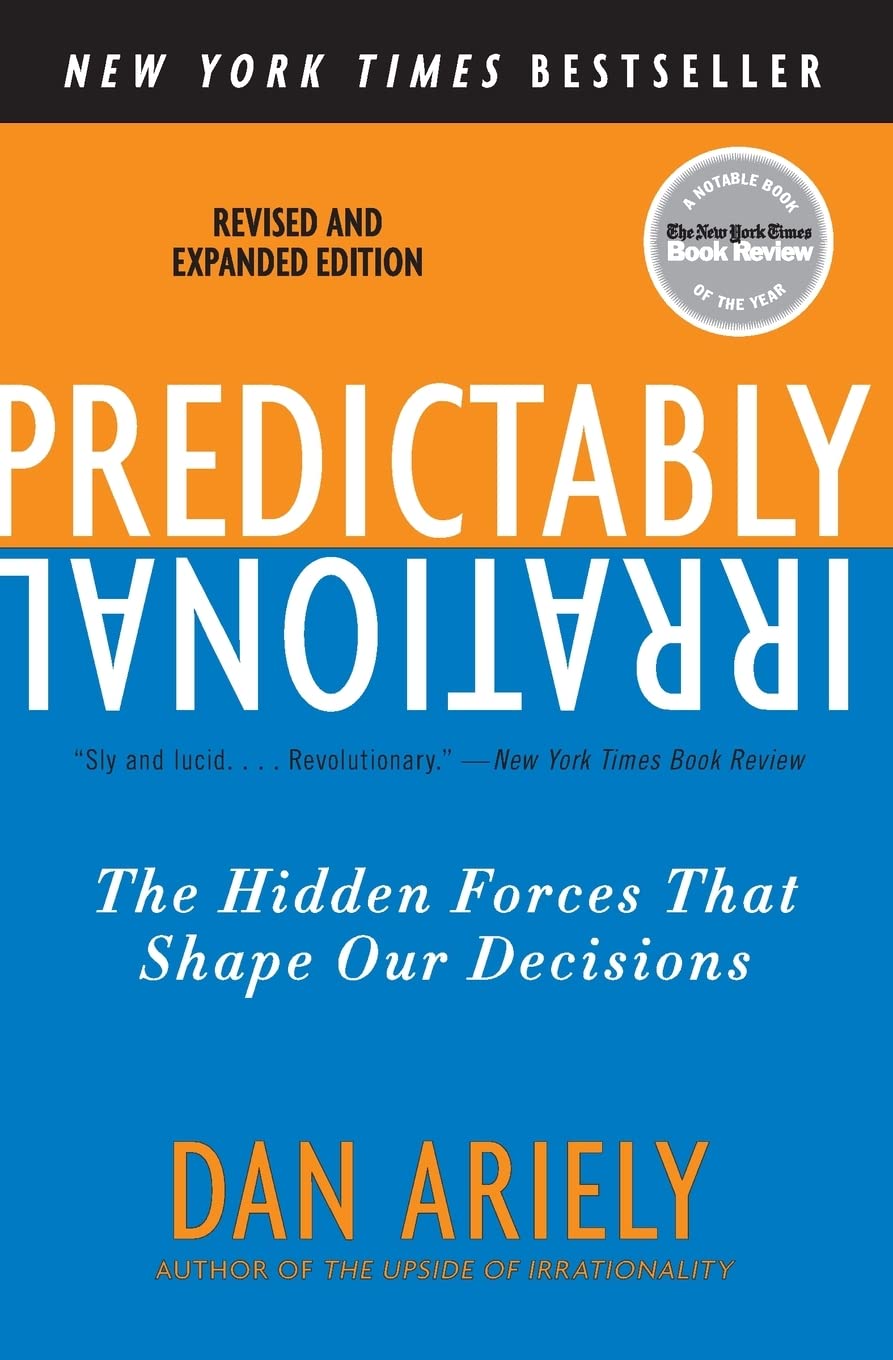
About Predictably Irrational: The Hidden Forces That Shape Our Decisions by Dan Ariely — Discover Why Smart People Make Surprising Choices
You visit a shop for one thing and leave with three. You promise yourself that you will start studying tonight, but tomorrow suddenly feels better. A free offer seems impossible to refuse, even when you do not need what is being offered. Why do these things happen when you know what would be sensible? Predictably Irrational: The Hidden Forces That Shape Our Decisions by Dan Ariely explores the small, often hidden influences behind everyday choices. Through stories, questions, and experiments, Ariely argues that our mistakes are not always random. We often respond to prices, feelings, other people, and the way choices are shown to us in familiar patterns. This book invites you to notice those patterns instead of assuming that every decision comes from clear and careful thought.
You Are Not Always Choosing for the Reason You Think
Imagine seeing two similar products at different prices. You might believe you are comparing their quality, but the first price you see can affect what seems fair for everything that follows. Or imagine accepting a free gift that sends you on an extra trip you never planned to make. Ariely explores why people can focus on one exciting detail while forgetting the full cost of a choice. His larger point is not that people never think clearly. It is that the setting around a decision can change how we think, even when we feel confident. The book uses simple situations to make this idea easy to follow. Once you start noticing how a choice is presented, an ordinary shopping trip or daily habit can look different.
The Surprising Power of Comparing One Thing With Another
One of the book's opening ideas is that we judge things by comparing them. A price may look cheap beside a higher price and expensive beside a lower one, even when the product has not changed. Ariely discusses choices such as magazine subscriptions to show how an extra option can make another offer appear more attractive. This is useful to remember when you see different subscription plans, meal sizes, phone packages, or online deals. A company may display several options together, but that does not mean all of them are equally useful to you. The book invites you to separate the question of which offer looks best from the more important question of what you actually want. That is a small change in thinking with many possible uses.
When the Word Free Makes an Offer Hard to Ignore
Free samples, bonus items, and delivery offers can feel like gifts. But an item with no price can still take your time, fill your space, or lead you to spend money on something else. In a chapter about zero cost, Ariely examines why a free option can have an unusually strong pull. Think about adding an extra product to reach a free shipping amount, even though the added product costs more than the delivery fee. This is a simple everyday example of the question the chapter raises, not a claim that every promotion is a trick. Some free offers truly are useful. The point is to judge the whole deal, including what you must do to receive it, rather than letting one attractive word make the decision for you.
The Strange Difference Between Helping and Getting Paid
You may be happy to help a friend move a chair for free, but feel uncomfortable if the friend offers you a tiny amount of money for the same favor. The task has not changed, yet the meaning of the moment has. Ariely uses situations like this to explain the difference between social relationships and market exchanges. Kindness, friendship, work, and payment do not always mix in the way we expect. This part of the book can interest team leaders, volunteers, business owners, and anyone who has wondered why a reward sometimes changes the mood of a group. It invites readers to think about whether a situation calls for a friendly gesture, a fair payment, or a clear agreement before people begin.
Why We Keep Leaving Important Work Until Tomorrow
A student has a week to prepare but waits until the final night. A worker knows that an early start would reduce stress yet keeps opening another tab. Most people have seen some version of this struggle. In his discussion of procrastination and self-control, Ariely considers why people can want one outcome for the future while choosing something more pleasant in the present. He also discusses deadlines and ways of arranging commitments. You do not need to be a psychology student to connect with these ideas. As you read, you can think about the tasks you postpone and whether a clearer plan, smaller steps, or a commitment made in advance might help. The book offers ideas to examine, not a guaranteed cure for procrastination.
Why We Often Value Our Own Things More
A mug on a store shelf is easy to ignore. The same mug may suddenly feel special after it becomes yours. In a chapter about ownership, Ariely explores why people can place a higher value on possessions simply because they own them. This idea can help you think about selling an old phone, deciding what to keep, or arguing over the worth of something you made. Memories and personal meaning may be real, so the goal is not to say that every attachment is wrong. The interesting question is how much of your price comes from the object's usefulness and how much comes from the feeling of calling it yours. Seeing that difference can make a difficult choice easier to understand.
How Expectations Can Change the Experience Itself
If someone tells you a drink tastes wonderful before you try it, will you notice the same flavors you would have noticed without that comment? Ariely investigates how expectations influence what people report and experience. He also discusses the link between price and expectations in examples involving pain relief. These chapters ask you to look beyond the simple idea that we see a product first and form an opinion second. Sometimes the story we hear comes before the experience and shapes it. This is one reason reviews, brand names, and labels deserve careful attention. The book presents particular experiments and interpretations; it should not be read as proof that a higher price always makes something work better or that expectation can replace medical care.
A Look at Honesty, Temptation, and Everyday Behavior
Later chapters explore why people may bend rules and how the setting around an opportunity can affect honesty. The subject is uncomfortable because it asks readers to think about ordinary choices, not just dramatic cases of wrongdoing. The book discusses experiments on cheating and the distance between people and money. These examples are useful as questions about human behavior, although individual study findings should not be taken as universal rules for every person or workplace. The wider reading experience encourages curiosity: what makes a rule feel important, and when might someone excuse a choice they would criticize in another person? Readers interested in ethics, workplaces, and consumer behavior will find material here to discuss rather than a simple formula for judging others.
A Premium Reading Copy for Your Personal Bookshelf
At Bookish Wonderland, this title is offered as a premium physical reading copy with eye-soothing cream paper, crystal-clear printing, and high-quality stitched and glue binding. The comfortable page color and sharp text make it pleasant to follow examples, pause at an idea, and return to an earlier chapter. The binding is designed for regular reading and long-term shelf use. These features describe Bookish Wonderland's offered copy, not every edition available from other sellers. If you enjoy taking notes in a separate notebook or returning to highlighted ideas during a later project, having a printed book nearby can be convenient. Please check the product listing or contact the store if you need to confirm the exact format or edition before ordering.
Who Will Enjoy Reading Predictably Irrational?
This book may appeal to students who want to understand their study habits, shoppers who enjoy thinking about prices, and professionals who make choices about products or customers. Entrepreneurs and marketers can use its examples to ask better questions about offers and how choices are displayed, while readers interested in psychology can explore a friendly introduction to behavioral economics. It is also suitable for someone who simply wonders why ordinary people sometimes act against their own plans. The book is nonfiction written for general readers, not a children's story or a promise of instant self-improvement. Younger readers with an interest in psychology may enjoy it with guidance, but some chapters discuss adult subjects. Readers should treat the experiments as ideas to examine, alongside newer research, rather than rules that explain every person.
Find the Right Price Without Forgetting the Reading Experience
If you are comparing the Book price in Bangladesh for Predictably Irrational by Dan Ariely, check the current amount on the Bookish Wonderland product page rather than relying on an old price in a description. Stock, format, and offers can change. Think about what you want from the purchase: an accessible introduction to a topic, a printed copy you can revisit, or a gift for someone who enjoys questioning everyday habits. You can also ask the store about customization or edition details before ordering. Buying a book is itself a decision, which makes this title a fitting reminder to compare your options carefully and choose a copy that suits your own reading plans.
Delivery Options for Readers Across Bangladesh
Bookish Wonderland offers nationwide delivery, including addresses inside and outside Dhaka, so you can order this English nonfiction book without visiting a physical shop. Cash on Delivery is available across Bangladesh. If you live in Dhaka and need your copy sooner, ask about the fast or urgent delivery option and confirm what is available for your address. The store's large English book collection also gives you room to explore other topics when planning future reading. Delivery times and stock should be confirmed at checkout rather than assumed from a general description. For special requests, message Bookish Wonderland before you place your order.
Turn Everyday Choices Into Questions Worth Asking
The next time a free offer catches your eye, a price seems like a bargain, or an important task gets pushed to tomorrow, you may remember a question from this book. Predictably Irrational invites you to see daily decisions from a new angle and to notice how the world around you may influence what feels right. It is an engaging choice for people who enjoy ideas they can discuss with friends and revisit in real life. Order Predictably Irrational: The Hidden Forces That Shape Our Decisions by Dan Ariely from Bookish Wonderland after checking the current price and availability. Choose the delivery option that works for your location, and message the store on Facebook or Instagram if you need help with your order. Your next thought-provoking read can begin with a simple question: why did I choose that?
If you require any customization or have any questions, please inbox us via FB or Insta.
| Primary Specification | |
| Author | Dan Ariely |
| Narrator | Simon Jones |
| Genre | Behavioral Economics, Psychology, Decision-Making, Business & Economics |
| ISBN-13/ISSN | 978-0061353246 |
| ISBN-10 | 0061353248 |
| Publisher | Harper Perennial |
| Publishing Date | April 27, 2010 |
| Language | English |
| Reading Age | 16+ |
| Format | Printed Book |
| Physical Specification & Quality | |
| Paper Quality | Premium eye-soothing cream paper |
| Binding Quality | High quality stitched and glue binding (for longevity) |
| Print Quality | Crystal-clear print |
| Pages | 384 pages |
| Country | USA |
| Logistics Information | |
| Weight | 414 gm |
| Length | 8.5 inches |
| Width | 5.6 inches |
| Height | 0.86 inch |