Skip to product information
1 of 1

Bookish Wonderland

Predictable Revenue by Aaron Ross & Marylou Tyler

Predictable Revenue by Aaron Ross & Marylou Tyler

Regular price Tk 246.00 BDT
Regular price Sale price Tk 246.00 BDT
Sale Sold out
Book cover type
Quantity

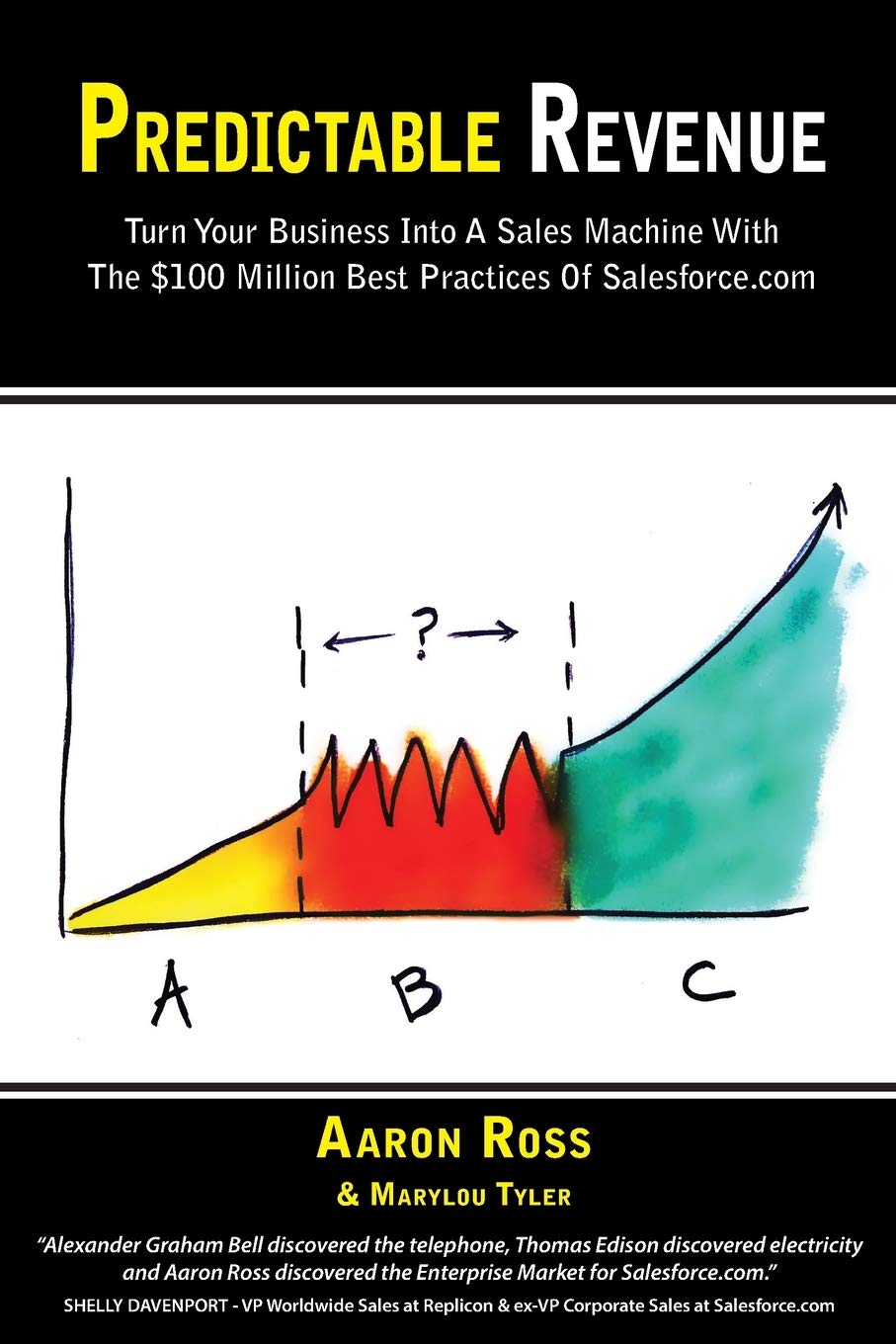
Predictable Revenue explains how businesses can build a reliable sales system instead of depending on salespeople or unpredictable deals. Drawing on Aaron Ross’s experience at Salesforce, the authors show how a specialized outbound process helped the company generate recurring revenue. Their approach, called Cold Calling 2.0, replaces random telephone pitches with targeted outreach designed to start useful conversations. They recommend separating prospecting, qualifying, closing, and customer management so each team can focus on its responsibilities. The book also identifies three sources of leads: Seeds from relationships and referrals, Nets from broader marketing, and Spears from focused outbound campaigns. Readers learn how to define qualified opportunities, measure conversion rates, avoid common sales management mistakes, and develop repeatable workflows. Written for founders, executives, and sales leaders, the book offers practical guidance for building teams that can grow without relying on supervision. Its central message is that dependable revenue starts with dependable processes. Read More

View full details

About Predictable Revenue by Aaron Ross & Marylou Tyler — Build a Reliable Sales Pipeline and Grow Beyond Guesswork

Some months, orders arrive. Other months, your sales team works hard but cannot find enough customers. You hire a salesperson, send more messages, and hope next month will be better. But hope is not a sales plan. Predictable Revenue by Aaron Ross & Marylou Tyler explains how a business can build a system for finding the right people, starting conversations, and moving buyers toward a sale. Its main promise is not a magic script that makes everyone buy. It is a way to replace scattered effort with repeatable steps you can see, measure, and improve.

What Is Predictable Revenue Actually About?

This is a practical nonfiction book about building a business-to-business sales process. Business-to-business, often called B2B, means that one company sells a product or service to another company. Ross and Tyler explain why sales growth becomes difficult when every salesperson must search for contacts, answer every new enquiry, run meetings, and close deals at the same time. They describe a system that gives people clear jobs and moves potential customers through clear stages. The book's full subtitle refers to sales practices linked to $100 million in additional recurring revenue at Salesforce.com; that figure describes the historical experience behind the method, not an income promise for readers. You will meet ideas such as lead generation, qualification, focused outreach, sales roles, and simple ways to check whether your process is working.

Busy Salespeople, Empty Calendars: Why More Effort Is Not Enough

Imagine having a good product but no clear way to find the next buyer. On Monday, a salesperson searches for new contacts. On Tuesday, a promising customer asks for a meeting. By Wednesday, the salesperson is preparing a proposal, so nobody is searching for next week's customers. When that deal ends, the search begins again. The result is a cycle of very busy days followed by quiet weeks. The authors argue that hiring more people without fixing this problem can simply create a larger, confused team. Their answer starts with finding the weak point in the journey from stranger to customer. Does the business lack new conversations, suitable leads, or a clear handoff? Once you can name the problem, you can work on the right stage instead of asking everyone to try harder.

Cold Calling 2.0: Start a Conversation Without Pushing a Stranger

One of the best-known ideas in the book is Cold Calling 2.0. Despite its name, the approach does not depend on repeatedly phoning people who have never heard of you. It focuses on thoughtful outbound contact, including short emails that can help you reach the right person inside a company. An early message may ask who handles a certain problem instead of demanding a meeting or sending a long sales pitch. If the right contact is interested, the team can then arrange a proper conversation. The method tries to make the first step more useful for both sides. It is not permission to flood inboxes or ignore local marketing rules. The book was originally published in 2011, so readers should adapt specific outreach tactics to today's customer expectations, communication tools, and applicable requirements.

Find Your Ideal Customer Before You Build a Contact List

A long list of names is not automatically a good list. A small software company that serves hospitals may waste time writing to restaurants, schools, and every shop it can find. The book recommends defining an ideal customer profile: a simple picture of the kind of business most likely to need and benefit from your offer. Think about its size, industry, common problems, and ability to purchase. Then build a focused list instead of contacting everyone. This step makes the rest of the process easier because your message can speak to a real need. It also helps you notice when a lead is not suitable. Saying no to a poor fit may feel strange, but it can protect time for customers who could genuinely use your product or service.

Give Different Sales Jobs to Different People

A central lesson is sales specialization. Finding new companies requires different work from answering enquiries or guiding an interested buyer through a final decision. The book proposes dedicated prospectors for outbound leads, people who respond to incoming interest, and account executives who work with qualified opportunities and close deals. In a large team, these may be separate roles. In a small company, the same person might handle several tasks but can still set aside clear blocks of time for each one. The goal is to stop prospecting from disappearing whenever meetings become busy. Clear roles also make training easier: a new worker knows what success looks like and when to pass a customer to a colleague. You do not need to copy a big company's staffing chart overnight to understand the idea.

Stop Chasing Every Lead and Learn to Qualify

Someone opening an email is not the same as someone ready to buy. A person may be curious, have no budget, or be looking for a product you do not sell. Predictable Revenue places strong importance on qualification, which means finding out whether a possible customer is a good fit before asking the closing team to spend hours on a deal. A useful conversation can uncover the buyer's problem, the people involved, and what would need to happen next. The purpose is not to pressure someone into saying yes. It is to learn whether moving forward would make sense for both sides. When a lead is ready, the person who found it can pass on the important details. That gives the next salesperson a clearer starting point and can save the customer from repeating everything.

Turn a Messy Sales Journey Into Steps You Can Follow

A pipeline is a simple picture of how a possible buyer moves toward a sale. It might begin with identifying a suitable company, continue through contact and a first conversation, and then move to a qualified opportunity, proposal, and decision. Predictable Revenue explains why these stages should be clear enough that two coworkers can understand them in the same way. If your team calls every friendly reply a deal, the forecast will look much healthier than reality. Clear stages help you spot where customers get stuck and where you need better questions or follow-up. The point is not to collect endless numbers for a report. It is to make decisions using information you trust, while accepting that even a careful forecast cannot tell you exactly what every buyer will do.

A Real Example of How You Could Apply the Ideas

Suppose you run a small company in Dhaka that sells inventory software to other businesses. Your team currently messages any company it can find and has no clear way to follow up. After reading, you might begin by choosing a suitable customer group, such as retailers with several outlets. You could write a short, respectful message about a common stock problem, then track which businesses ask to learn more. One person could research contacts, another could check whether the software fits their needs, and a closer could show the product to interested buyers. This is an example of how a reader might use the framework, not a case study from the book or a promise of results. The value lies in seeing where a customer comes from and learning what to improve next.

A Premium Edition for Your Business Bookshelf

Bookish Wonderland offers this title as a premium reading copy for people who like to keep useful business ideas close at hand. It features eye-soothing cream paper, crystal-clear printing, and high-quality stitched and glue binding designed for regular reading and long-term use. The soft page tone and clear letters make it easier to settle into a detailed chapter, while the binding helps the book stay together when you open it again for a meeting or planning session. These are the features of Bookish Wonderland's offered copy; page count and format can differ between other publishers' editions. A printed copy is convenient when you want to pause, write down an idea in your notebook, or compare a chapter with the way your own team currently works.

Is This Book Right for You?

Predictable Revenue is written mainly for business owners, founders, sales managers, sales representatives, and people building business-to-business teams. It may also help marketing staff understand why sending more names to sales does not always create more sales. Students interested in entrepreneurship can use its examples to see how a company moves beyond relying on one talented seller. You do not need to be an expert to follow the main ideas; terms such as leads, pipeline, and qualification become clearer through the explanations. However, this is not primarily a guide to shop-floor retail selling or a promise of overnight income. Readers working in small consumer businesses can borrow ideas about focus and process, but should check whether the authors' B2B examples fit their own type of customer.

Check the Book Price in Bangladesh Before You Order

If you are searching for the Book price in Bangladesh for Predictable Revenue by Aaron Ross & Marylou Tyler, check the current amount on the Bookish Wonderland product page. A fixed price is not listed here because offers and availability can change. Think about how you plan to use the book: you may want a printed copy for your office desk, a reference for a new sales teammate, or a gift for a friend starting a business. If you need to confirm the exact edition, stock, or a customization request, contact the store before buying. A thoughtful purchase starts with knowing what you will receive, not just choosing the first price that appears in a search result.

Get Your Copy Delivered Inside or Outside Dhaka

Bookish Wonderland makes it possible to order this English business book from anywhere in Bangladesh. Nationwide delivery is available for addresses inside and outside Dhaka, and Cash on Delivery is offered across the country. If you live in Dhaka and need the book sooner, ask the store about its fast or urgent delivery option and confirm the service available for your area. You can arrange your order without spending the day searching through physical shops. The store also carries a large English book collection, so you can explore other topics when you are ready for another read. Check stock and delivery details at the time of purchase, particularly if you are buying the book for a class, meeting, or gift.

Make Your Next Sales Decision With a Clearer Plan

You cannot control every customer's decision, but you can build a better way to find suitable buyers and understand what happens after first contact. Predictable Revenue gives you a starting point for doing that work with more care. Its lessons about focused outreach, clear roles, qualified leads, and useful numbers can help turn a vague sales problem into questions your team can actually answer. If you are ready to examine the way your business finds new opportunities, order Predictable Revenue by Aaron Ross & Marylou Tyler from Bookish Wonderland. Check the current price and availability, choose the delivery option for your address, and message the store on Facebook or Instagram with any questions or book customization requests. Read a chapter, discuss one idea with your team, and decide what is worth testing in your own business.

If you require any customization or have any questions, please inbox us via FB or Insta.

Primary Specification
AuthorAaron Ross, Marylou Tyler
NarratorMary Jane Wells
GenreBusiness, Sales, Marketing, Entrepreneurship
ISBN-13/ISSN‎ 978-0984380244
ISBN-100984380248
PublisherPebblestorm
Publishing Date‎ September 8, 2020
LanguageEnglish
Reading Age18+
FormatPrinted Book
Physical Specification & Quality
Paper QualityPremium eye-soothing cream paper
Binding QualityHigh quality stitched and glue binding (for longevity)
Print QualityCrystal-clear print
Pages‎ 208 pages
CountryUSA
Logistics Information
Weight228 gm
Length8.5 inches
Width5.6 inches
Height0.63 inch
What is Predictable Revenue by Aaron Ross and Marylou Tyler about?

Predictable Revenue: Turn Your Business Into a Sales Machine with the $100 Million Best Practices of Salesforce.com is a practical B2B sales book about creating a repeatable system for generating qualified opportunities instead of depending on individual “star” salespeople or unpredictable bursts of prospecting. Aaron Ross and Marylou Tyler explain how companies can separate prospecting, inbound qualification, and closing into specialised roles, define an Ideal Customer Profile, build targeted prospect lists, qualify prospects before sending them to closers, and measure pipeline creation more systematically. The methodology grew from the outbound sales-development process Ross helped build at Salesforce. The book's broader argument is that predictable lead generation creates the foundation for predictable revenue. It is aimed primarily at CEOs, founders, sales leaders, SDR teams, and B2B companies trying to scale sales without relying entirely on referrals or founder-led selling.

How many books are in the Predictable Revenue series by Aaron Ross and Marylou Tyler, and what are they?

There is no officially numbered Predictable Revenue book series by Aaron Ross and Marylou Tyler. Predictable Revenue is a standalone book.

What is “Cold Calling 2.0” in Predictable Revenue, and does it mean making lots of cold phone calls?

Despite its name, “Cold Calling 2.0” was designed as an alternative to traditional high-volume cold calling. The methodology begins by identifying companies that fit an Ideal Customer Profile and then using targeted outbound contact—historically especially short emails—to find or receive a referral to the appropriate decision-maker. Once the right person is identified, the salesperson moves into qualification rather than immediately trying to close a deal. The official Predictable Revenue summary describes the process as building an ICP, creating a target list, running outbound outreach, qualifying for mutual fit, and then passing a qualified opportunity to an Account Executive. The central idea is therefore not “call more people.” It is to make prospecting more systematic and relevant so closers spend their time with better-qualified opportunities.

Why does Predictable Revenue recommend separating SDRs, inbound reps, and Account Executives?

One of the book's most influential ideas is sales specialization. Instead of asking one salesperson to prospect, qualify, follow up, negotiate, and close every deal, the methodology divides those activities among roles with different responsibilities. Outbound Sales Development Representatives focus on generating and qualifying new opportunities from cold or inactive accounts. Market Response Representatives handle inbound leads, while Account Executives concentrate mainly on qualified opportunities and closing. The reasoning is practical: a closer with several active deals will naturally spend more time on those deals than on difficult prospecting work, causing outbound activity to become inconsistent. Specialization is intended to make prospecting continuous while allowing experienced closers to focus on the part of the process where they add the most value. Companies should still adapt role design to their size, deal value, market, and sales cycle rather than copying the structure mechanically.

What are “Seeds, Nets, and Spears” in Predictable Revenue?

“Seeds, Nets, and Spears” are three categories for understanding where leads come from. Seeds are relationship-driven opportunities such as referrals, word of mouth, partnerships, and results created through strong customer success. They often develop slowly but can produce high-quality opportunities. Nets are broad one-to-many marketing efforts such as content, advertising, events, and inbound campaigns that attract prospects into the funnel. Spears are targeted outbound efforts in which a company deliberately identifies specific accounts or types of buyers and reaches out to them. The framework matters because these lead sources can have different conversion rates, costs, sales cycles, and growth patterns. Ross and Tyler argue that companies should not treat every lead as if it came through the same process. Understanding the mix helps leaders decide where pipeline is actually coming from and how predictable each channel can become.

How does Predictable Revenue help companies choose the right prospects instead of contacting everyone?

The methodology places strong emphasis on defining an Ideal Customer Profile, or ICP, before scaling outbound activity. Instead of buying a huge list and sending the same message to everyone, a company should identify the types of customers most likely to have the right problem, budget, size, environment, and potential deal value. It can then build a more focused account list and search for the appropriate contacts inside those organisations. The original process often used short referral-oriented emails designed to reach the person responsible for the relevant business area. Importantly, the official methodology advises salespeople to behave like explorers rather than assuming every contacted company is automatically a good prospect. The goal of early conversations is to discover whether there is genuine mutual fit before moving the opportunity to an Account Executive.

What should a sales team measure if it wants truly predictable revenue?
Predictable Revenue argues that activity alone does not equal useful pipeline. Counting calls, emails, or other outbound touches can tell managers whether work is happening, but those numbers do not automatically show whether the team is creating valuable sales opportunities. The methodology places more importance on outcomes such as qualified conversations, accepted opportunities, pipeline created, conversion rates, and the movement of prospects through clearly defined stages. This makes forecasting more meaningful because leaders can see how many qualified opportunities a process produces and how those opportunities eventually convert into revenue. The book also encourages companies to understand different lead sources separately because referrals, inbound leads, and targeted outbound can behave differently. The practical lesson is to build a measurable funnel rather than assuming that more prospecting activity will automatically produce proportionally more sales.
Is Predictable Revenue still relevant today, or are its sales tactics outdated?
The book remains influential because concepts such as an Ideal Customer Profile, specialised SDR roles, systematic qualification, lead-source segmentation, clear handoffs, and measurable pipeline are still widely used in B2B sales. Sales communities continue to recommend Predictable Revenue to SDRs and prospecting teams. However, the book was originally published in 2011, and outbound selling has changed substantially since then. Buyers receive far more automated email, modern teams use sales-engagement platforms and AI, and deliverability and privacy requirements have become increasingly important. Even Predictable Revenue's own company describes its current methodology as having evolved from the original book. Modern readers should therefore treat the book as a foundational framework rather than blindly copying old outreach volumes or templates. Its strongest value today is understanding the architecture of a repeatable outbound system and then adapting execution to the present market.
Is Predictable Revenue by Aaron Ross and Marylou Tyler available in a premium edition at Bookish Wonderland?

Bookish Wonderland offers Predictable Revenue within its premium English business-book collection, with physical specifications intended for comfortable reading and repeated professional use. The store's supplied books feature premium eye-soothing cream paper, crystal-clear printing, and high-quality stitched and glue binding. These qualities can be useful for a practical sales book because readers may repeatedly return to sections on sales roles, Ideal Customer Profiles, outbound prospecting, pipeline metrics, and Seeds, Nets, and Spears while building or managing a sales team. The original PebbleStorm edition from 2011 is listed at 198 pages with ISBN 9780984380213, although later formats and printings can differ. Bookish Wonderland's term premium edition refers to the physical quality it supplies rather than an officially designated collector's edition from the original publisher.

What are the paper and print quality of Predictable Revenue from Bookish Wonderland?

Bookish Wonderland's premium copy uses eye-soothing cream paper together with crystal-clear printing to make a practical business book comfortable to read and easy to reference. The softer cream-toned page background provides a less bright visual surface than stark white paper, while sharp printing helps diagrams, headings, sales terminology, examples, and process explanations remain clear. This is particularly useful with Predictable Revenue because readers may move between sections rather than reading only from beginning to end. A founder may return to the Ideal Customer Profile discussion, an SDR may review outbound guidance, while a sales manager may revisit specialization or pipeline metrics. Exact paper thickness, font size, margins, and pagination can vary by supplied edition, so customers with specific physical-format requirements can confirm those details with Bookish Wonderland before ordering.

How durable is the binding of Predictable Revenue from Bookish Wonderland for regular business use?

Bookish Wonderland uses high-quality stitched and glue binding for its premium printed books. Stitching gives the page sections additional structural support, while adhesive reinforces the spine and helps keep pages securely attached during normal repeated handling. This construction can be valuable for Predictable Revenue because the book is often used as a working sales reference rather than read only once. Founders, SDR managers, Account Executives, and sales leaders may repeatedly revisit frameworks while designing roles, onboarding team members, reviewing pipeline, or improving outbound processes. Long-term condition still depends on care, so readers should avoid forcing the spine completely flat, repeatedly folding the cover backward, exposing the book to moisture, or storing it in prolonged direct sunlight. Sensible handling can help preserve the book for ongoing professional reference.

Why should I buy Predictable Revenue from Bookish Wonderland, and is Cash on Delivery available across Bangladesh?

Bookish Wonderland gives entrepreneurs, sales professionals, business students, and company leaders throughout Bangladesh convenient access to specialised English business books such as Predictable Revenue by Aaron Ross and Marylou Tyler. The store combines its large English book collection with premium eye-soothing cream paper, crystal-clear printing, and durable stitched and glue binding, making the book suitable for sales training, personal learning, professional reference, or gifting. Nationwide delivery is available both inside and outside Dhaka, so customers from different districts can order without depending on a nearby specialist business bookstore. Cash on Delivery is available across Bangladesh, allowing customers to pay when the order arrives. Customers in Dhaka can also request fast or urgent delivery when that service is available. Before ordering, readers can confirm current stock, supplied edition, final book price, delivery charge, and expected delivery time with Bookish Wonderland.