

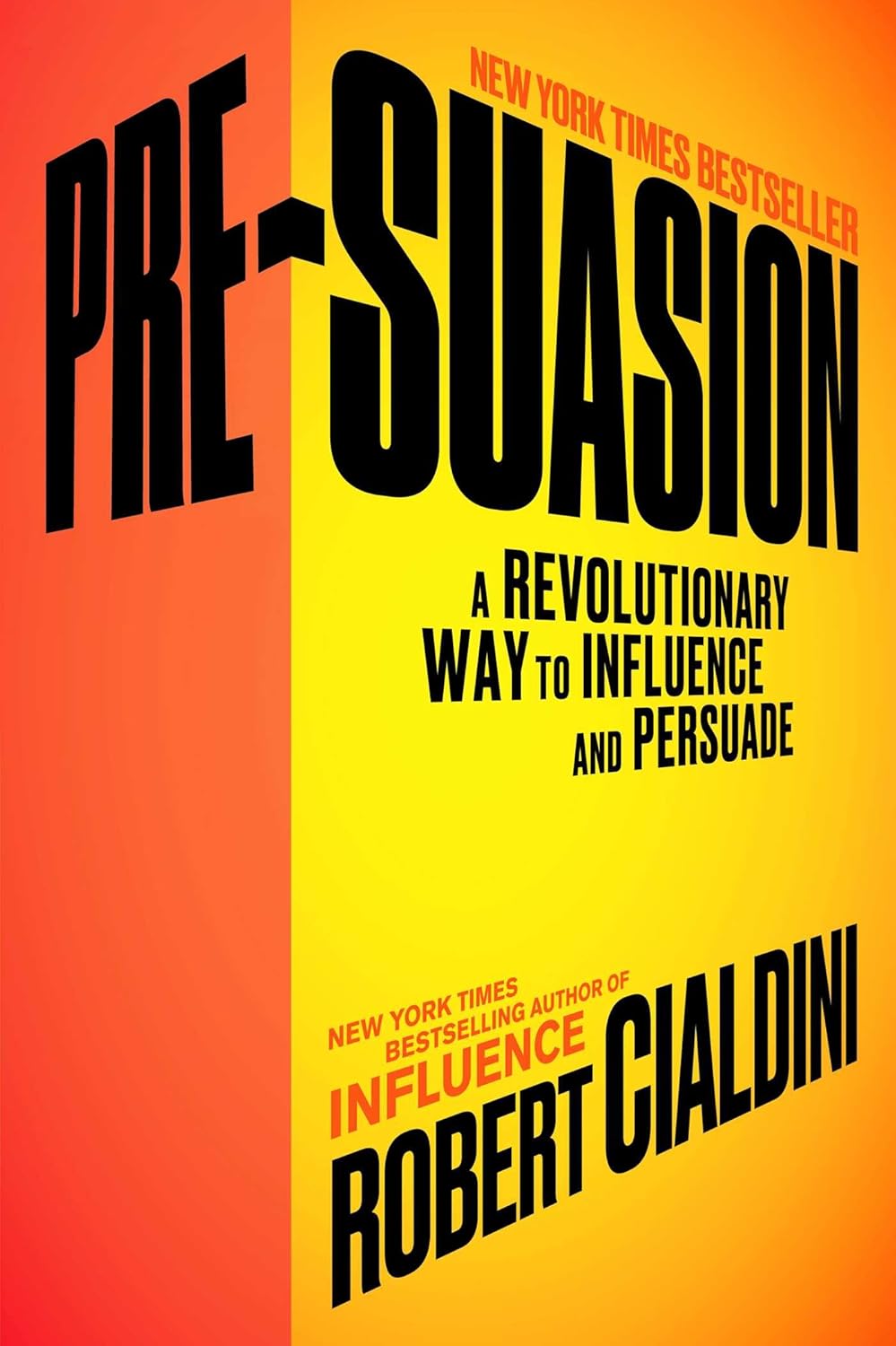
About Pre-Suasion: A Revolutionary Way to Influence and Persuade by Robert Cialdini – Learn What Happens Before the Message Begins
Why do two people hear the same message but react in very different ways? Robert Cialdini argues that the answer often begins before the main request is made. In Pre-Suasion: A Revolutionary Way to Influence and Persuade, he explores how attention, timing, context, and the first idea placed in someone's mind can shape how that person understands what comes next.
Cialdini calls this process pre-suasion. The idea is simple: good persuasion is not only about finding the perfect words. It is also about creating the right mental starting point before those words arrive. A question, image, topic, environment, or moment of attention can make one idea feel more important than another.
The book brings together psychology research, business examples, advertising, communication, and stories from Cialdini's own work. It is useful for readers who want to communicate more clearly, understand why certain messages feel convincing, and recognize the techniques other people may use on them.
Persuasion Can Start Before You Make the Request
Many people think persuasion begins when someone says, "Here is what I want you to do." Cialdini asks readers to look earlier.
Imagine a salesperson asking a customer to think about safety before presenting a product. The customer may then notice safety-related features more strongly. Imagine a manager beginning a meeting by asking the team to think about cooperation. That first focus may influence how later comments are understood.
The important point is not that one opening sentence can control another person's mind. Human decisions are more complicated than that. Cialdini's argument is that what receives attention can affect which ideas become mentally available when a person evaluates a later message.
Attention Is Limited, So What We Notice Matters
At any moment, many things are happening around us, but we can focus on only a small part of them. A speaker, advertisement, website, or conversation can direct attention toward one feature and away from others.
Pre-Suasion examines this simple fact and asks what it means for influence. When an idea is brought to the front of the mind, people may temporarily give it more weight.
For example, a customer thinking about convenience may respond differently from a customer thinking about cost, even when both look at the same product. A job candidate may appear differently depending on which quality an interviewer considers first.
The book encourages readers to notice these shifts in attention. That can improve communication, but it can also make you more alert when someone else is trying to frame a choice for you.
The Right Question Can Change the Starting Point
Questions do more than collect answers. They can also direct attention.
If you ask someone what they enjoy about a service, their mind begins searching for positive examples. If you ask what worries them, a different set of thoughts becomes easier to access. The question does not force an answer, but it changes the mental path the person begins walking.
Cialdini uses research and examples to show why this matters in surveys, sales, marketing, negotiation, and ordinary conversation.
For ethical use, the goal should not be to trap someone into a choice. A better use is to make the relevant issue clear before asking for a decision. If a question hides important information or pushes a person toward something harmful, it may be persuasive but not responsible.
Context Can Give a Message More Power
A message never appears in empty space. It arrives in a room, on a screen, after another sentence, beside an image, or during a particular mood.
Cialdini explores how these surrounding details can influence interpretation. A website background, a word used in an introduction, or the order of information may change which ideas feel most noticeable.
For marketers and designers, this can mean checking whether visual and verbal cues support the real value of an offer. For teachers, it can mean preparing students to focus on the main idea before presenting difficult material. For everyday readers, it can mean noticing when context is quietly shaping judgment.
Pre-Suasion Is Not the Same as Mind Control
The title may make the book sound as if it teaches a secret way to control people. That would be an inaccurate reading.
Cialdini studies patterns that can influence attention and decision-making, but people still have their own goals, knowledge, values, and ability to say no. A persuasive technique can fail. A person may notice the attempt, disagree with the message, or choose something else.
This is important because readers should not expect a guaranteed script that makes everyone agree. The book is better understood as a guide to conditions that can increase or decrease receptiveness.
Cialdini Connects Pre-Suasion with His Earlier Work
Robert Cialdini is best known for Influence, his earlier book about principles such as reciprocity, commitment and consistency, social proof, authority, liking, and scarcity. Later editions of Influence also discuss unity.
Pre-Suasion asks a different question: what happens immediately before those influence principles are used?
A person may be more responsive to social proof if attention has already been directed toward what similar people are doing. Authority may matter more when expertise has first been made relevant. The books therefore connect naturally, but you do not need to read Influence before starting Pre-Suasion.
The Book Uses Research Alongside Real Examples
One reason the book feels different from a simple motivational guide is that Cialdini repeatedly connects his advice with psychological research.
The publisher notes examples involving advertising imagery, Berkshire Hathaway letters, addiction treatment, online marketing, and wartime propaganda. These cases show how attention and framing can appear in very different settings.
Readers should still think critically about every example. A study can have limits, and an effect found in one setting may not appear with the same strength everywhere. Psychology also develops as new research tests earlier findings.
The useful habit is to ask what evidence supports a claim, how strong the effect seems, and whether the situation resembles your own.
Ethical Influence Matters More Than Clever Tricks
Persuasion can be used to help people understand a good option, but it can also be used to hide weaknesses or pressure someone unfairly.
Cialdini's professional work places strong emphasis on ethical influence. That idea is worth keeping beside every technique in the book.
If you sell a useful service, pre-suasion might help you bring the customer's real problem into focus before explaining your solution. It should not be used to hide fees, create false urgency, or make claims you cannot support.
If you lead a team, you might begin a discussion by focusing attention on shared goals. That is different from manipulating employees into agreeing with a decision that has already been made.
Useful for Marketing, Sales, Leadership, and Everyday Communication
A marketer can use the book to think about what a customer sees before reading an offer. A salesperson can improve the opening of a conversation. A manager can consider how a meeting question changes the tone of discussion. A teacher can prepare students to notice a key idea before introducing a difficult topic.
The same principles can also help outside work. You may become more careful about the order in which you explain a request, the examples you choose first, or the environment in which an important conversation happens.
The book does not replace professional training in any of these fields. It gives readers a psychological lens they can combine with their own experience.
It Can Also Help You Notice Persuasion Around You
Learning influence is not only about becoming more convincing. It can also make you a more careful audience member.
Advertisements may direct attention toward one benefit before showing a price. A political message may focus attention on fear, identity, or security before presenting a policy claim. A salesperson may ask questions that make one problem feel especially important.
Recognizing these techniques does not tell you automatically whether the message is true or false. It gives you a reason to slow down and ask what else deserves attention.
Who Is Robert Cialdini?
Robert Cialdini is a social psychologist known for research and writing on influence and persuasion. Simon & Schuster identifies him as Regents' Professor Emeritus of Psychology and Marketing at Arizona State University and president and CEO of Influence at Work.
The publisher released Pre-Suasion on September 6, 2016. Its ebook listing gives 432 pages, and the later Simon & Schuster trade paperback is also listed at 432 pages. The exact page count of another printing can differ, so check the edition offered before ordering.
Simon & Schuster describes the book as a New York Times and Wall Street Journal bestseller. It was also named among the Financial Times' Best Business Books of 2016.
A Premium Edition for Focused Reading
Bookish Wonderland offers this title as a physical copy for readers who want to study ideas, mark useful examples, and return to important sections. The supplied features of the offered edition are:
- Premium eye-soothing cream paper with a warm page tone for comfortable reading.
- Crystal-clear printing that keeps the text sharp and easy to follow.
- High-quality stitched and glue binding designed to help the pages stay secure through regular use.
These specifications describe Bookish Wonderland's offered edition, not every edition available from other sellers.
A printed copy can be useful for a research-based business book because you may want to underline an experiment, compare two chapters, or keep notes beside a practical idea.
Who Will Get the Most from This Book?
Pre-Suasion may suit marketers, sales professionals, managers, entrepreneurs, teachers, negotiators, students, content creators, and readers interested in psychology.
The book is not a magic formula. It will not make every customer buy, every employee agree, or every negotiation succeed. Readers who approach it as a collection of research-backed ideas to test thoughtfully are likely to get more value than readers looking for guaranteed tricks.
Check the Book Price in Bangladesh Before Ordering
To find the Book price in Bangladesh for Pre-Suasion by Robert Cialdini, check the current amount shown on the Bookish Wonderland product page. Price, stock, cover, and edition details can change, so the live listing is the best place to confirm availability before ordering.
Bookish Wonderland delivers inside and outside Dhaka and offers Cash on Delivery nationwide. Customers in Dhaka can ask about fast or urgent delivery, depending on location and service availability.
If you want to confirm the edition, customization, or delivery details before ordering, contact Bookish Wonderland through Facebook or Instagram.
Improve What Happens Before You Ask
The biggest idea in Pre-Suasion is easy to remember: communication begins before the main message.
Where attention goes can shape what feels important next. A question, image, opening topic, or moment of focus can change how a later request is understood in practice. Cialdini uses psychology research and real examples to explain why those early moments deserve careful thought.
Read the book if you want to improve sales conversations, marketing messages, presentations, leadership communication, or your own ability to recognize influence.
Use the ideas ethically. Help people notice information that truly matters instead of hiding information they need.
Order Pre-Suasion: A Revolutionary Way to Influence and Persuade by Robert Cialdini from Bookish Wonderland if you want a practical, research-based guide to the psychology of attention and persuasion.
If you require any customization or have any questions, please inbox us via FB or Insta.
| Primary Specification | |
| Author | Robert Cialdini |
| Translator | María Serrano Giménez |
| Narrator | José Manuel Vieira |
| Editor | Lewelin Polanco |
| Genre | Nonfiction, Psychology, Business, Marketing, Self-Help |
| ISBN-13/ISSN | 978-1501109805 |
| ISBN-10 | 1501109804 |
| Publisher | Simon & Schuster |
| Publishing Date | June 5, 2018 |
| Language | English |
| Reading Age | 18+ |
| Format | Printed Book |
| Physical Specification & Quality | |
| Paper Quality | Premium eye-soothing cream paper |
| Binding Quality | High quality stitched and glue binding (for longevity) |
| Print Quality | Crystal-clear print |
| Pages | 432 pages |
| Country | USA |
| Logistics Information | |
| Weight | 454 gm |
| Length | 8.5 inches |
| Width | 5.6 inches |
| Height | 0.96 inch |