

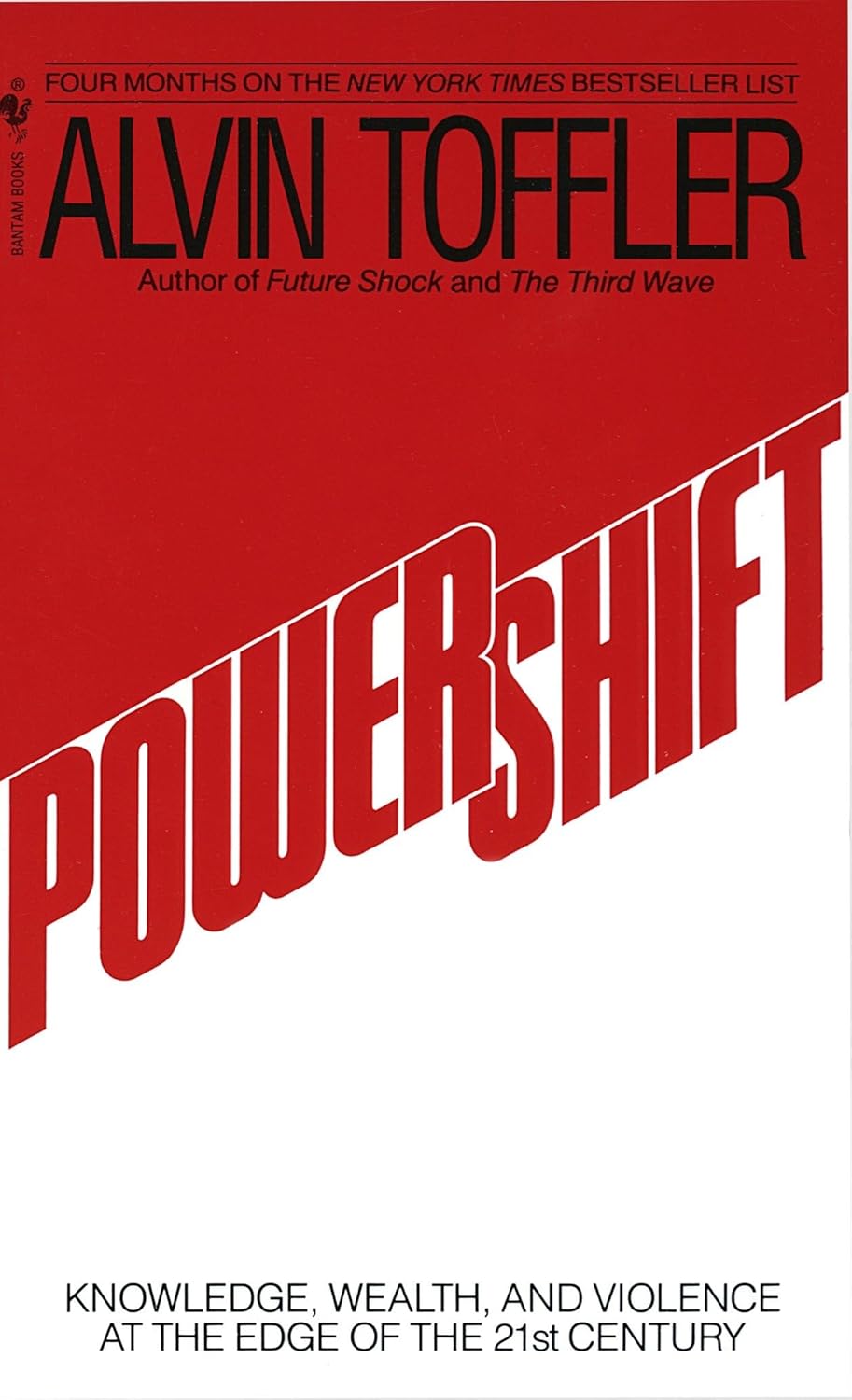
About Powershift: Knowledge, Wealth, and Violence at the Edge of the 21st Century by Alvin Toffler — Discover How Power Changes When Information Changes the World
Who has power, and why do some people seem to have more of it than others? Is it the person with the most money, the leader who can give orders, or the person who knows something everyone else needs? Powershift: Knowledge, Wealth, and Violence at the Edge of the 21st Century by Alvin Toffler explores these questions by looking at the changing worlds of business, politics, technology, and everyday life. Originally published in 1990, this nonfiction book examines a world approaching the twenty-first century and asks how old ways of gaining influence might change as information becomes more important. Read it as a bold historical argument about change, not as a report describing every fact of the world today. Questions about power remain.
The Big Question Behind This Book: What Is Power?
Power is not only about presidents, soldiers, or wealthy business owners. A manager can decide who gets a job, a shop can influence what customers see, and a person with important information can change a discussion. Toffler asks readers to look at power as something that runs through everyday relationships. His book considers three broad sources: violence or force, wealth, and knowledge. These sources do not work in exactly the same way. Force can make someone obey through fear. Money can reward people or pay for a service. Knowledge can help someone understand a problem, design a new process, or influence what others believe. Toffler argues that the balance among these forms of power was changing as information technology spread. His explanation gives readers a simple framework for asking better questions about the institutions and decisions around them.
Force, Money, and Knowledge: Three Ways to Influence Others
Toffler's framework begins with three kinds of power. Violence, or the threat of force, can compel behavior. Wealth can offer rewards, create dependence, or give access to resources. Knowledge works differently because information can be shared, improved, combined with other information, and used to create new tools. Toffler presents knowledge as an increasingly important source of influence in an information-rich society. That is his argument, not a rule proving that expertise always defeats money or force. In real situations, these sources can support one another: someone may use money to buy information, while a government or company may control access to it. Thinking about the three together helps readers see why power cannot be understood by counting bank accounts or looking at official titles alone.
When Information Becomes a Business Advantage
Imagine two stores selling similar goods. One orders stock by guessing what people want. The other tracks which items customers buy, checks what runs out, and uses those records to plan its next order. The second store may make more informed choices, although good data does not guarantee success. This everyday example shows the sort of change Toffler examines. In his account, knowledge can become an important resource alongside machines, property, and money. He explores how information changes competition among businesses, affects financial decisions, and allows new kinds of organizations to emerge. Readers interested in entrepreneurship can use these ideas to ask whether their own decisions depend on habit or on information they can explain and test. The book offers a way to think, not a step-by-step business manual.
The Hidden Struggle Over Who Controls Information
Toffler describes coming conflicts over data and access to information as information wars. He discusses competition involving electronic networks, customer records, financial organizations, and the media. When information helps one group make decisions, the question of who can collect, keep, or use that information becomes important. A retailer may know what shoppers purchase; a bank may hold records that customers cannot easily see; a broadcaster may decide which stories reach an audience. Those examples come from the context Toffler studied, not from a claim that every modern company follows the same model. For readers today, the chapters provide historical context for asking questions about privacy, control, and trust, while newer research is needed to establish how specific technologies and rules now work.
From Large Companies to More Flexible Ways of Working
The book looks at the way large organizations respond when their old structures no longer match a changing environment. Toffler discusses the idea of the flexible firm, a business that can change its organization and working methods instead of relying only on a strict chain of command. In his account, expertise may sit far from the top office, and workers may need room to share ideas across departments. This invites a useful question: who actually understands the problem that needs solving? A senior title can bring authority, but the person closest to a customer or machine may have important facts. Toffler's discussion is an interpretation of economic change, not a promise that any particular management style is suitable for every company or employee.
Look Beyond World Leaders and Watch Daily Life
It is easy to imagine power only on a world map, moving between major countries as alliances and economies change. Toffler argues that important shifts also happen in familiar places. He looks at hospitals, workplaces, supermarkets, banking, television, and personal life to show how authority can be challenged or shared in new ways. A patient may ask more questions about treatment; a customer may compare information before buying; an employee may question an instruction instead of following it without discussion. These examples help make a broad subject easier to picture. They also remind readers that changes in technology and institutions can affect daily choices without making the news. The book is most useful here as an invitation to examine relationships rather than assume every historical example describes today's conditions.
The Fast and the Slow: An Idea About Uneven Change
One of Toffler's arguments is that societies and organizations may change at different speeds. He uses the contrast between the fast and the slow to explore how access to information, innovation, and new ways of making wealth can create differences among groups. The idea offers a question for readers: what happens when one organization adapts quickly while another struggles to keep up? It is not a reliable label for judging a whole country, culture, or person. Different communities may move quickly in one field and slowly in another, and a broad claim written decades ago needs fresh evidence before being applied to present conditions. Read this section to understand Toffler's argument about uneven change while keeping the real world's variety in view.
Why the Book Still Makes an Interesting Historical Read
Powershift was written as the Cold War was ending and computers, electronic networks, and new business methods were changing public discussion. Toffler was trying to interpret an uncertain moment and describe possibilities for the century ahead. Some examples now belong clearly to history, and his predictions should be checked rather than treated as established outcomes. That does not make the book a current news report. Instead, it gives readers a chance to compare a past view of the future with the world they know. You might underline a question about information, then look for more recent evidence before deciding whether it applies today. This approach makes reading more active and helps separate an author's argument from a proven fact. It is particularly appealing to readers who enjoy the history of ideas.
A Premium Copy for Readers Who Return to Their Books
Bookish Wonderland offers Powershift as a premium reading copy for people who enjoy keeping thought-provoking nonfiction on their shelves. The offered copy features premium eye-soothing cream paper, crystal-clear printing, and high-quality stitched and glue binding designed for regular reading and long-term use. The gentle page color and sharp text make it comfortable to follow longer explanations, while the binding helps the pages stay together when you return to an earlier idea. These features describe Bookish Wonderland's offered copy, not every edition from another seller. The original 1990 edition and later editions can differ in subtitle, page count, and format, so confirm the exact version with the store if that matters. A printed copy can be useful for reading slowly and taking notes separately.
Who Should Read Powershift?
This book may interest readers of sociology, business, economics, media studies, technology history, and political science. Students can use its ideas to start discussions about how authority changes. Business readers may appreciate questions about information and competition, while readers interested in technology can compare Toffler's view of electronic networks with later developments. It also suits anyone curious about why influence does not always follow money or formal rank. The language is written for a general nonfiction audience, although the book covers many subjects and may take patience. It is not a guide for gaining control over people and does not provide a guaranteed way to become wealthy or powerful. Approach it as an author's ambitious interpretation, with room to agree, disagree, and investigate further.
Check the Book Price in Bangladesh Before Choosing Your Copy
When comparing the Book price in Bangladesh for Powershift by Alvin Toffler, check the live amount on the Bookish Wonderland product page. No local price was provided for this listing, and stock or offers can change, so this description does not promise a number. If you are choosing the book for study, a personal collection, or a gift, confirm which subtitle and edition you will receive. Different editions have appeared over time, and their page counts are not identical. Ask the store about the available copy or customization if you have a specific preference. Knowing what you are buying helps you choose with confidence without relying on an old price or an unverified format.
Order English Nonfiction from Dhaka or Anywhere Else
Bookish Wonderland provides nationwide delivery across Bangladesh, including addresses inside and outside Dhaka. Cash on Delivery is available throughout the country, giving you a simple way to pay when your order arrives. If you live in Dhaka and need your book sooner, ask about the fast or urgent delivery option and confirm what is available for your area. You can order without searching through several physical shops for a title about social change and the history of ideas. Before buying for a class, event, or gift, confirm stock and the expected delivery details. For questions about the edition or a customization request, contact Bookish Wonderland through Facebook or Instagram.
See Power From a New Angle with Powershift
Who gains influence when information becomes easier to create and share? What happens when money, force, and knowledge pull in different directions? Powershift by Alvin Toffler gives you a way to explore these questions through examples from the world as he saw it around 1990. It connects everyday institutions with bigger changes and asks readers to look beneath job titles, headlines, and familiar assumptions. Read it to understand one influential historical perspective, then bring your own questions and newer evidence to the discussion. If you enjoy nonfiction that stretches your thinking, check the current price and availability at Bookish Wonderland and order your copy. Choose the delivery option for your address, or message the store on Facebook or Instagram for details or customization. Make space on your shelf for a book that invites careful questions long after the last page.
If you require any customization or have any questions, please inbox us via FB or Insta.
| Primary Specification | |
| Author | Alvin Toffler |
| Genre | Nonfiction, Futurology, Social Science, Politics, Economics |
| ISBN-13/ISSN | 978-0553292152 |
| ISBN-10 | 0553292152 |
| Publisher | Bantam |
| Publishing Date | November 1, 1991 |
| Language | English |
| Reading Age | 18+ |
| Format | Printed Book |
| Physical Specification & Quality | |
| Paper Quality | Premium eye-soothing cream paper |
| Binding Quality | High quality stitched and glue binding (for longevity) |
| Print Quality | Crystal-clear print |
| Pages | 640 pages |
| Country | USA |
| Logistics Information | |
| Weight | 665 gm |
| Length | 8.5 inches |
| Width | 5.6 inches |
| Height | 1.65 inch |