

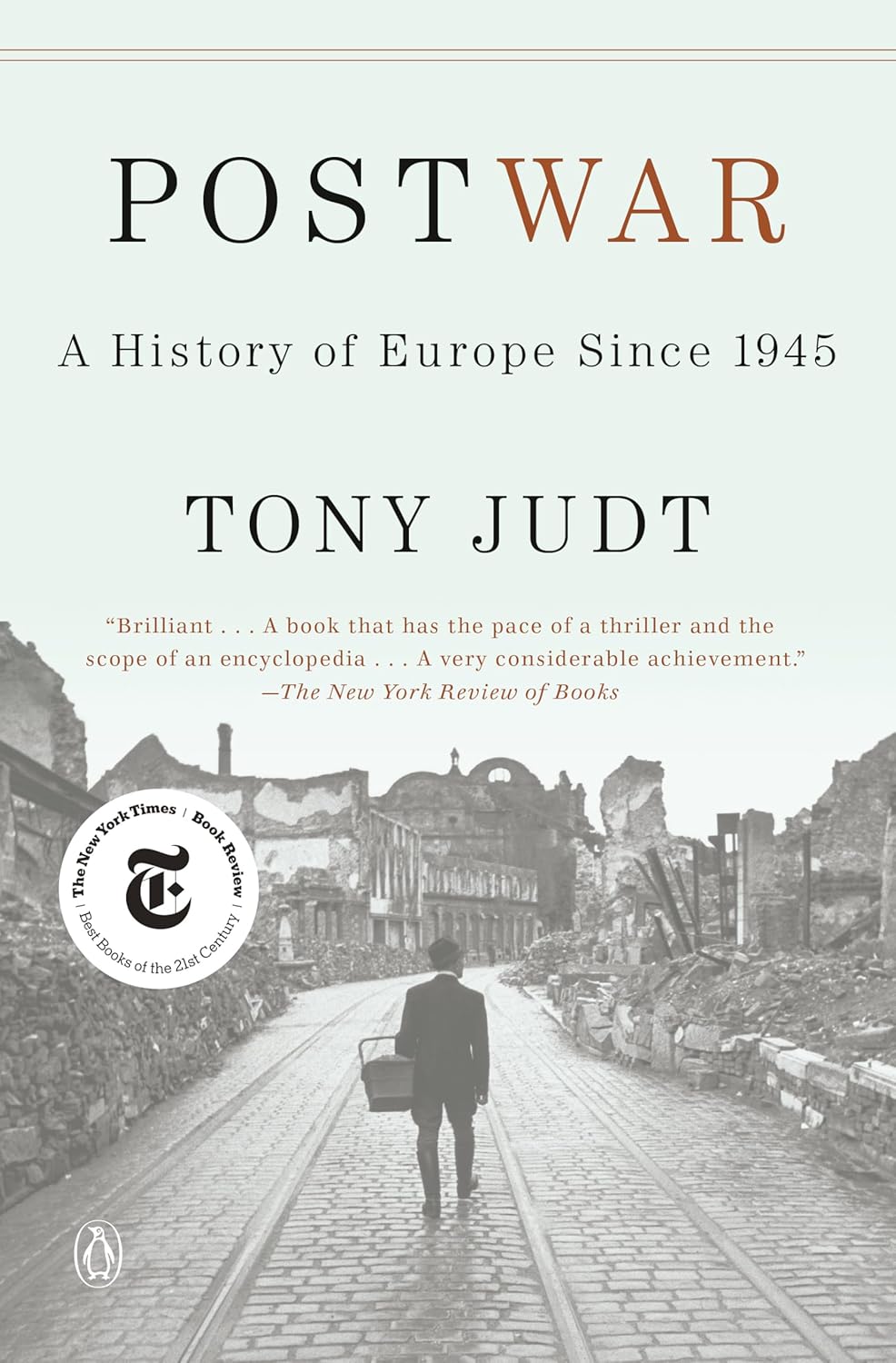
About Postwar: A History of Europe Since 1945 by T. Judt — Understand How Europe Rebuilt, Divided, Changed, and Remembered the War
Europe in 1945 was coming out of a devastating war, but peace did not mean that every problem was solved. Cities had been damaged, millions of people had been displaced, political systems were changing, and the continent soon became divided by the Cold War. Postwar: A History of Europe Since 1945 by T. Judt, better known as historian Tony Judt, tells the story of how Europe moved from the wreckage of the Second World War into a political, economic, social, and cultural world. Judt looks at both Eastern and Western Europe instead of treating them as separate stories. Penguin describes the book as an integrated history covering thirty-four nations and roughly sixty years, drawing on research in six languages. It is a book, but its purpose is simple to understand: to show how the Europe people know was shaped by what happened after 1945.
A Huge Story Made Easier to Follow
Modern European history can feel difficult because so many countries, leaders, wars, elections, economic changes, and social movements appear at the same time. Reading separate short accounts can make it hard to see how one event connects with another. Judt tries to solve that problem by bringing the continent into one long narrative. He moves between large political events and smaller details from daily life, showing how changes in government, work, housing, consumption, culture, and public memory affected ordinary people as well as states. The publisher describes Postwar as a history of both Eastern and Western Europe, while contemporary reviews also noted the book's wide geographical range and attention to social detail. Readers therefore get more than a timeline of presidents and treaties. They get a picture of Europe as a changing society whose countries often faced very different problems while still influencing one another.
Begin in the Ruins of 1945
The book starts from the difficult conditions left by the Second World War. Judt examines destruction, displacement, political uncertainty, collaboration, resistance, and the problem of rebuilding states after years of occupation and violence. He also pays close attention to memory: how countries explained what had happened during the war, which stories became part of public life, and which uncomfortable subjects were pushed aside for years. This is one of the book's important themes, but it is also an area where Judt offers interpretation as well as description. Later commentary on his work highlighted his interest in the myths and silences that helped shape postwar national stories. For a new reader, this opening section gives the background needed to understand why recovery was not only about repairing roads and buildings. European societies also had to decide how to live with the political and moral consequences of the recent past.
See Why Europe Split Into East and West
A major part of the book follows the Cold War division of Europe. Judt traces how political systems, alliances, economies, and public life developed differently on the two sides of the continent after 1945. Western European states rebuilt under democratic systems and mixed economies, while much of Eastern Europe came under communist governments aligned with the Soviet Union. Rather than presenting the Cold War only as a contest between Washington and Moscow, Postwar keeps its focus on European societies and the different ways people experienced the division. Judt also examines tensions and changes within each side, so the story does not become a simple picture of two identical blocks. The publisher's description emphasizes that this is an all-Europe history, and reviewers praised its ability to move across both large and small countries. That broad view helps readers understand why postwar Europe cannot be explained through only Britain, France, Germany, or the Soviet Union.
Follow the Long Road From Shortage to Greater Prosperity
Politics is only one part of Postwar. Judt also looks at how daily life changed as many European economies recovered and living standards rose during the decades after the war. Housing, cars, shopping, work, television, education, travel, and changing consumer habits all become part of the story. These details help make history feel less distant because they show what large economic changes could mean inside a home or on an ordinary street. Reviewers repeatedly noted Judt's use of small facts alongside large arguments, and the publisher describes the book as covering both political and cultural change. The result is useful for readers who want to understand not only what governments decided but also how Europe became more urban, more consumer-oriented, and more connected. Economic growth was uneven and did not erase every social difference, so Judt's account is best read as a history of change rather than a simple story of constant progress.
Understand 1989 and the End of Europe's Cold War Division
The later chapters move toward the weakening of communist rule in Eastern Europe and the political changes around 1989, followed by the end of the old East-West division. Judt places these events inside the longer history he has already built, so they do not appear suddenly or without background. He also continues beyond the fall of communist governments, examining the difficult transition that followed and the changing relationship between Eastern and Western parts of the continent. Because the book was completed in the early 2000s, its discussion reflects the evidence and debates available at that time. It should not be treated as a complete history of Europe after its publication. Its strength is that readers can follow a long sequence from the immediate postwar period through the end of the Cold War and into the new questions that appeared after it.
Memory May Be the Book's Most Powerful Long-Term Theme
Judt repeatedly returns to the question of how Europeans remembered the Second World War, the Holocaust, collaboration, resistance, dictatorship, and political violence. His argument is not simply that people forgot the past. He examines how public memory changed over time and how societies sometimes preferred stories that made rebuilding easier before later generations reopened difficult questions. Reviewers identified this treatment of memory as one of the book's major themes, especially its attention to stories that were hidden, softened, or reconsidered decades later. This gives Postwar an emotional and intellectual depth beyond a standard political history. It asks readers to think about who tells a national story, what is left out, and why later evidence or new generations can change the way a society sees its own past. These questions remain valuable even when readers disagree with particular judgments in Judt's account.
Why Tony Judt's Background Matters
Tony Judt was a historian of modern Europe who studied at King's College, Cambridge, and the École Normale Supérieure in Paris. He taught at Cambridge, Oxford, Berkeley, and New York University, where he became the Erich Maria Remarque Professor of European Studies and founded the Remarque Institute. Penguin describes Postwar as the result of almost a decade of work, and the book draws on research in six languages. Its scale helps explain why readers often use it as both a continuous history and a reference work to revisit later. Postwar was also a finalist for the 2006 Pulitzer Prize in General Nonfiction, a fact confirmed by the Pulitzer organization itself. Awards do not prove that every interpretation in a history book is correct, but the recognition helps explain the book's lasting place in discussions of twentieth-century European history.
A Premium History Book Made for Long Reading Sessions
A book of this size is likely to spend many hours in your hands, so the physical reading experience matters. Bookish Wonderland offers this title with premium eye-soothing cream paper, crystal-clear printing, and high-quality stitched and glue binding designed for regular reading and long-term shelf use. The soft page tone helps create a comfortable background for dense historical text, while sharp printing makes names, dates, and longer paragraphs easier to follow. The binding is intended to help the pages remain secure as you work through the book slowly or return to earlier chapters for study. These details describe the Bookish Wonderland copy and should not be assumed for every edition sold elsewhere. If you need a specific edition, page count, or format, contact the store before ordering so you can confirm exactly which copy is currently available.
Who Should Read Postwar?
Postwar is well suited to university students, history readers, teachers, researchers, and anyone who wants a broad introduction to Europe after the Second World War. It can be especially useful if you have read separate books about Germany, Britain, France, the Soviet bloc, or the Cold War and now want to see how those stories fit together. Penguin lists the widely available paperback at 960 pages, so this is not a quick weekend overview. It rewards steady reading, note-taking, and occasional checking of unfamiliar names or places. Because Judt combines factual narrative with interpretation, students should compare important arguments with other historians when using the book for academic work. The scale may look intimidating at first, but the clear structure lets you move through the period step by step instead of trying to understand sixty years of European change all at once.
Check the Book Price in Bangladesh Before Ordering
When comparing the Book price in Bangladesh for Postwar: A History of Europe Since 1945 by T. Judt, check the latest amount on the Bookish Wonderland product page. Different editions can vary in format, page count, cover, and availability, so an old price from another listing may not match the copy currently offered. If you are buying the book for a university course, research project, personal history collection, or gift, confirm the available edition before checkout if that detail matters to you. You can also contact Bookish Wonderland about stock or book customization. A large history book is often something readers keep for years, so it makes sense to check the copy as carefully as the price.
Order This European History Book Anywhere in Bangladesh
Bookish Wonderland provides nationwide delivery across Bangladesh, including addresses inside and outside Dhaka. Cash on Delivery is available throughout the country, making it easier to order a large English history title without visiting several physical shops. If you live in Dhaka and need the book sooner for a class, exam, research task, or gift, ask about the fast or urgent delivery option and confirm availability for your location. For a time-sensitive order, check current stock and expected delivery details before checkout. Bookish Wonderland also carries a large collection of premium English books, giving readers access to history, politics, social science, literature, and other subjects from one place.
Read the Story of How Postwar Europe Became a New Europe
Postwar: A History of Europe Since 1945 by T. Judt gives readers a wide view of a continent rebuilding after catastrophe, living through Cold War division, changing its economies and societies, confronting old memories, and entering a new period after 1989. Judt's account is ambitious, detailed, and interpretive, which means it can inform you while also giving you arguments to question and compare. The book was a finalist for the 2006 Pulitzer Prize in General Nonfiction and remains available from Penguin in a 960-page paperback edition. If you want one substantial volume that can guide you through decades of modern European history, check the current price and availability at Bookish Wonderland. Choose the delivery option that suits your address, or message the store through Facebook or Instagram for edition details, customization requests, or help with your order.
If you require any customization or have any questions, please inbox us via FB or Insta.
| Primary Specification | |
| Author | Tony Judt |
| Narrator | Ralph Cosham |
| Genre | History, European History, Political History, Nonfiction |
| ISBN-13/ISSN | 978-0099542032 |
| ISBN-10 | 0099542032 |
| Publisher | Random House UK Ltd. |
| Publishing Date | January 1, 2010 |
| Language | English |
| Reading Age | 18+ |
| Format | Printed Book |
| Physical Specification & Quality | |
| Paper Quality | Premium eye-soothing cream paper |
| Binding Quality | High quality stitched and glue binding (for longevity) |
| Print Quality | Crystal-clear print |
| Pages | 960 pages |
| Country | UK |
| Logistics Information | |
| Weight | 980 gm |
| Length | 8.5 inches |
| Width | 5.6 inches |
| Height | 1.69 inch |