

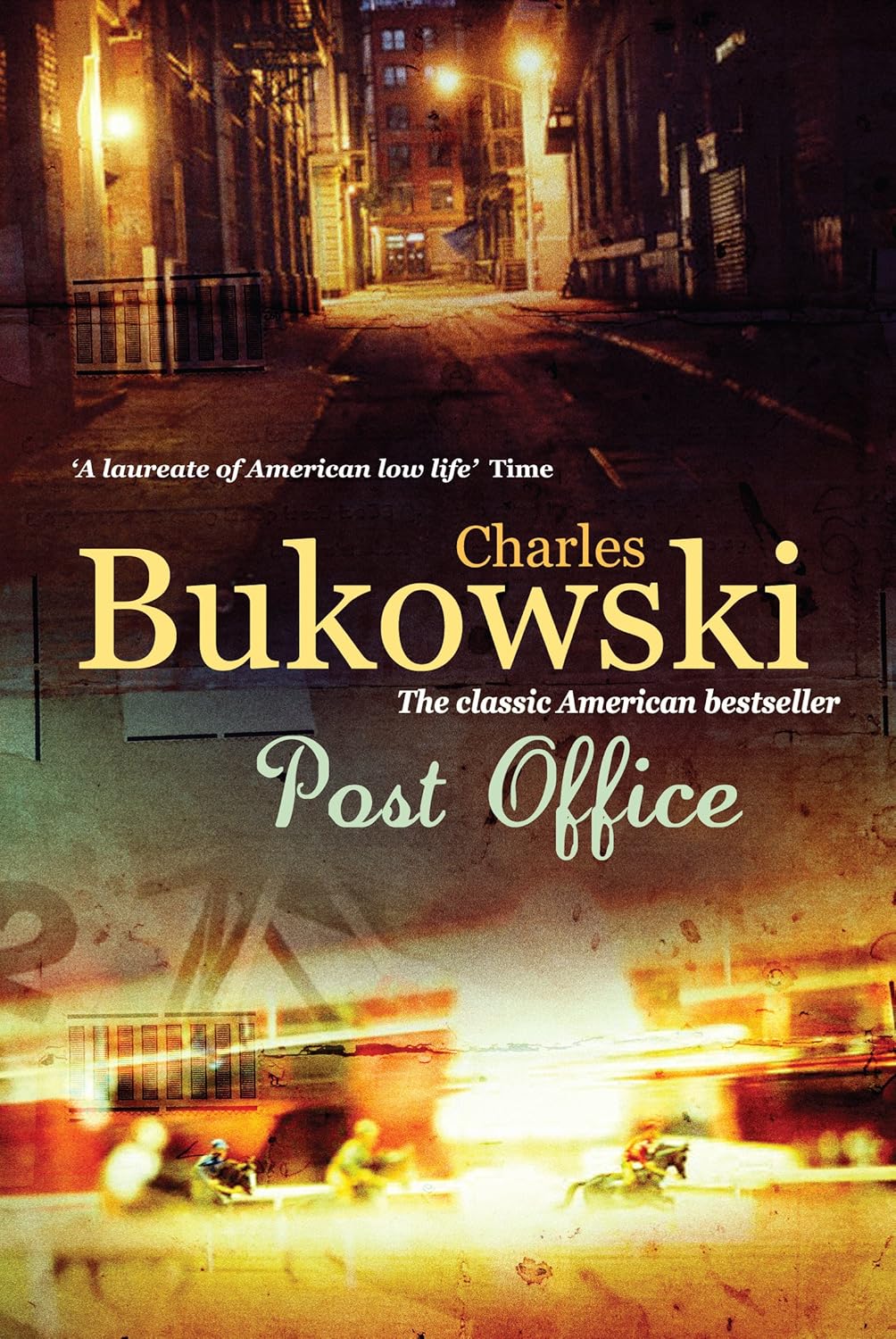
About Post Office by Charles Bukowski — A Darkly Funny Novel About Work, Survival, and a Man Who Refuses to Fit In
Henry Chinaski needs money, so he takes a job delivering mail in Los Angeles. It sounds straightforward until heavy bags, impossible routes, angry dogs, unpredictable weather, and demanding bosses turn each day into another battle. At night, Henry tries to escape through drinking, gambling at the racetrack, and messy relationships. The next morning, the same job is waiting. Post Office by Charles Bukowski follows this sharp-tongued outsider through years of postal work and the life he builds around it. Based loosely on Bukowski's own experience, his first novel turns the dull routine of a workplace into a story filled with anger, dark jokes, disappointment, and moments of surprising honesty. If you like fiction about imperfect people and the parts of everyday life that polite stories often hide, Henry's voice gives you a reason to keep reading. The novel raises a difficult question: how much of a person's life should belong to a job that pays the bills but leaves little room to breathe? Bukowski offers no easy answer. He gives you Henry's messy, sometimes offensive perspective and leaves you to decide what it means.
Meet Henry Chinaski, the Unlikely Hero of an Ordinary Job
Henry is not the kind of main character who wakes up ready to inspire his coworkers. He complains, drinks too much, chases pleasure, and makes decisions that can leave him worse off. Still, he notices the strange things other people accept without question. He sees supervisors who seem more interested in control than fairness and rules that make an already hard job harder. His thoughts can be funny precisely because he refuses to dress them up. The novel does not ask you to admire every choice he makes. Instead, it lets you spend time with someone who is tired of pretending that work is always meaningful or that a steady paycheck fixes every problem. You may laugh at Henry in one chapter and strongly disagree with him in the next. That uneasy mix is central to Bukowski's storytelling.
Why Does a Simple Postal Job Feel Like a Daily War?
The story begins with Henry working as a temporary mail carrier, walking difficult routes and trying to keep up with the demands of the postal service. Delivering letters might seem like a quiet job from the outside. From Henry's point of view, it means carrying weight, dealing with unpleasant weather, finding unfamiliar addresses, and facing dogs that do not welcome visitors. Supervisors add another kind of trouble, especially when their orders feel more important than the conditions workers face. Bukowski turns these repetitive tasks into scenes of physical discomfort and absurd humor. You begin to understand why a job can look safe to someone watching from a distance while feeling endless to the person doing it. The tension comes from ordinary days, each one testing how long Henry can continue.
Tired of Stories That Pretend Every Job Is a Dream?
Some books tell you that hard work always leads to respect, success, and a better life. Post Office offers a different kind of fictional experience. Henry works because he needs to survive, not because delivering mail fulfills a childhood dream. His frustration makes room for questions about boredom, authority, and the distance between having a job and enjoying it. The novel will not teach you how to apply for a better position or become an ideal employee. What it offers is a voice that openly describes the parts of working life people may be embarrassed to discuss. For readers who enjoy realistic fiction about ordinary jobs, that honesty can be more absorbing than another story about a brilliant hero. It is also a reminder that Henry's view is one man's bitter perspective, not a complete picture of every postal worker or workplace.
From Mail Routes to the Sorting Room
Henry's working life changes over the course of the novel. After leaving his carrier job for a period and trying to support himself through horse-race betting, he eventually returns to the postal service as a clerk sorting mail. The new position does not turn him into a happy employee. Different duties bring different pressures, and the repeated hours still shape the way he spends the rest of his life. The shifts between jobs help the book cover more than one bad day at work. They let you see how routines gather weight across the years, even when a person keeps trying to break away. Instead of building toward one dramatic mystery, Bukowski links episodes into a portrait of a man who alternates between needing stable income and resenting the system that provides it.
The Racetrack, the Bar, and Henry's Search for an Exit
Outside the post office, Henry spends time drinking and betting on horse races. These activities offer excitement and the chance to forget work for a while, but they also bring risk and instability. The book presents his behavior in a blunt, often comic way without making it a sensible plan for coping with stress. Henry can seem certain that one lucky day will change everything, only to find himself facing familiar problems. This contrast keeps the story moving even when its basic pattern repeats. You follow a man who wants freedom but sometimes makes that freedom harder to reach through his own choices. The novel's humor grows out of that contradiction, making it possible to enjoy Henry's outrageous observations without treating his habits as advice.
Relationships That Are Messy Rather Than Romantic
Henry's life includes relationships with women, but this is not a romance with a charming hero and an easy promise of lasting love. His encounters can be tender, careless, selfish, or painful, and his first-person account reveals his limitations as much as it describes other people. Bukowski writes about sex and drinking in direct, sometimes crude language, so readers should expect an adult novel rather than a gentle love story. The relationships also prevent the workplace plot from feeling sealed off from everything else. Henry brings the frustration of one part of his life into another, and personal loss or conflict affects how he returns to work. Readers who enjoy flawed narrators may find these scenes interesting precisely because Henry cannot always recognize his own responsibility.
Why Bukowski's Own Experience Matters
Charles Bukowski worked for the United States Postal Service before becoming known for his novels, and Post Office uses that background as the basis for Henry Chinaski's fictional life. The book first appeared in 1971 and was Bukowski's debut novel, though he had already written poetry and short stories. Henry is an alter ego, not a reason to treat every scene as a verified event from the author's biography. Bukowski uses fiction to turn remembered work, frustration, and pleasure into a strong narrative voice. Knowing the connection helps explain why routine duties can feel unusually specific, but you can enjoy the story without studying the author's life first. It also makes this a natural starting point if you want to discover his longer fiction and see how the Chinaski character developed.
Choose a Book That Matches Your Reading Mood
Post Office is an adult literary novel with semi-autobiographical elements, workplace satire, and dark comedy. It includes heavy drinking, gambling, sexual material, crude language, and troubling attitudes toward women. Those elements are part of Henry's characterization, not habits that readers are encouraged to copy. There is no detective case to solve, no tidy self-help plan, and no conventional happy romance at its center. Instead, you get a difficult narrator whose choices and daily routines are the story. Readers who enjoy candid, uncomfortable fiction about work and personal failure may find much to discuss. If you want a comforting book or a role model who behaves kindly in every scene, knowing this in advance can prevent the wrong purchase. An honest description helps you pick a book for its actual content.
A Premium Copy for Readers Who Return to Their Favorites
Bookish Wonderland offers this title with premium eye-soothing cream paper, crystal-clear printing, and high-quality stitched and glue binding. The cream pages provide a comfortable background for reading, while sharp text makes Henry's quick exchanges and short scenes easy to follow. The binding is designed for regular use, whether you finish the novel over a few evenings or keep it on your shelf for another read. These physical specifications describe Bookish Wonderland's offered copy, not every publisher's edition. Page counts can differ between editions, so ask the store to confirm the available format if you need a particular version. A physical copy also lets you return to a favorite passage without searching through saved screenshots or old notes.
Check the Book Price in Bangladesh Before You Order
For readers comparing the Book price in Bangladesh, Post Office by Charles Bukowski is available to check on the Bookish Wonderland product page. No fixed amount appears here because current stock, editions, and offers may change. Consider whether you are buying for yourself, adding a short American novel to your collection, or looking for a gift for someone who already enjoys gritty literary fiction. Because the content is explicitly adult, it is sensible to consider the recipient's taste before choosing it as a present. If a particular cover, format, or edition matters to you, contact Bookish Wonderland to check the copy offered. You can also ask about book customization before checkout instead of assuming that every request is available.
Order Across Bangladesh, with Convenient Payment Options
Bookish Wonderland delivers nationwide, including addresses inside Dhaka and in other districts across Bangladesh. Cash on Delivery is available throughout the country, so customers can select that option when placing an order. Readers living in Dhaka can ask about fast or urgent delivery and confirm whether it is offered for their address. If you need the novel for a class, book-club meeting, or gift, check stock and delivery details before planning around a particular date. The store also carries a large selection of premium English books, making it easier to explore other literary titles when you finish this one. For questions about availability or a special request, you can message the store through Facebook or Instagram.
Meet a Narrator Who Will Not Pretend Everything Is Fine
Henry Chinaski never turns his postal years into a neat success story. He carries the mail, takes orders, leaves, returns, drinks, gambles, and keeps looking for a life he can stand. Post Office by Charles Bukowski draws its energy from that restless cycle and from the sharp, often uncomfortable humor with which Henry tells it. If you want a novel that looks at work without pretending every shift has a higher purpose, this is a book to explore. Read it for its unusual voice, its portrait of a working outsider, and the questions it raises about freedom and responsibility. Check the current price and availability at Bookish Wonderland, choose a delivery option for your address, and contact the store on Facebook or Instagram for edition details or customization. Add it to your shelf when you are ready for a story that refuses to sound polite.
If you require any customization or have any questions, please inbox us via FB or Insta.
| Primary Specification | |
| Author | Charles Bukowski |
| Narrator | Christian Baskous |
| Genre | Autobiographical Fiction, Dirty Realism, Literary Fiction, Dark Comedy |
| ISBN-13/ISSN | 978-0061177576 |
| ISBN-10 | 0061177571 |
| Publisher | Ecco |
| Publishing Date | February 27, 2007 |
| Language | English |
| Reading Age | 18+ |
| Format | Printed Book |
| Physical Specification & Quality | |
| Paper Quality | Premium eye-soothing cream paper |
| Binding Quality | High quality stitched and glue binding (for longevity) |
| Print Quality | Crystal-clear print |
| Pages | 208 pages |
| Country | USA |
| Logistics Information | |
| Weight | 228 gm |
| Length | 8.5 inches |
| Width | 5.6 inches |
| Height | 0.47 inch |