Skip to product information
1 of 1

Bookish Wonderland

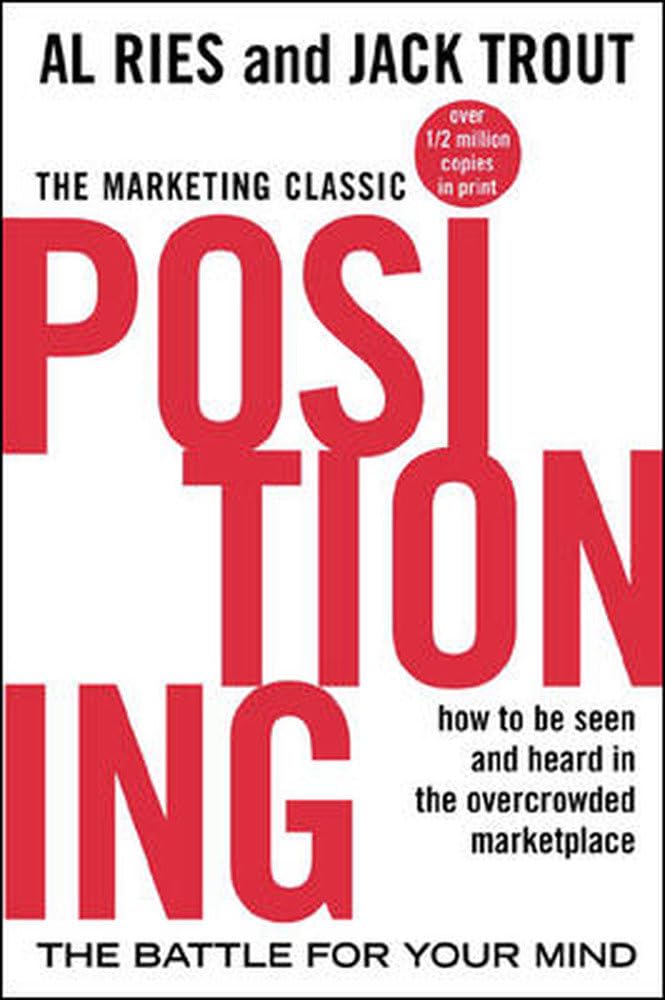
Positioning: The Battle for Your Mind by Al Ries and Jack Trout

Positioning: The Battle for Your Mind by Al Ries and Jack Trout

Regular price Tk 190.00 BDT
Regular price Sale price Tk 190.00 BDT
Sale Sold out
Book cover type
Quantity

Positioning: The Battle for Your Mind explains why marketing begins not with changing a product, but with shaping how customers perceive it. Al Ries and Jack Trout argue that people face excessive advertising, so brands must communicate one clear, memorable idea. Using examples from companies and campaigns, they show how market leaders protect their position while challengers find openings competitors have overlooked. The authors explore the power of names, the risks of confusing brand extensions, and the value of repositioning rivals. They also explain why copying a category leader rarely works and why a focused message can outperform complicated promotion. Practical discussions cover positioning businesses, services, products, and personal careers. Rather than promising that clever advertising can fix every weakness, the book urges readers to understand existing perceptions and build strategies around them. Its central lesson is simple: occupy a distinctive place in the customer's mind before competitors claim it. Read More

View full details

About Positioning: The Battle for Your Mind by Al Ries and Jack Trout — Learn How to Make Your Brand Stand Out and Stay Remembered

A customer opens a shopping app and sees dozens of similar products. Every seller claims to offer great quality, fair prices, and excellent service. Why does the customer remember one name and forget the rest? Positioning: The Battle for Your Mind by Al Ries and Jack Trout explores that question from the customer's point of view. Instead of asking businesses to talk louder, the authors ask them to think about the simple idea people already connect with a brand. They explain how crowded markets make attention hard to earn and why a clear position can help a product become easier to recognize. This is a nonfiction guide to marketing strategy, filled with older advertising examples and questions that remain useful for examining a business today. It is not a promise that one clever sentence will make every company successful.

Why Good Products Still Get Lost in a Crowded Market

You might sell a useful product, post regularly, and offer helpful customer service, yet find that buyers struggle to explain what makes your shop different. The problem may not be the number of posts. Customers see countless messages every day and cannot give each one careful attention. Ries and Trout call attention to this crowded communication environment and argue that a business needs a clear place in the customer's mind. Imagine asking a buyer to describe your brand in a few words. Would they name a particular strength, or would they give the same answer for five competing shops? This book helps you investigate that gap between what a company wants to say and what people actually remember.

What Does Positioning Mean in Simple Words?

Positioning means deciding what you want people to associate with your brand when they think about a particular need. It is not merely a logo, a slogan, or a bright advertisement. It involves understanding what a customer already believes about the available choices and finding a relevant idea your product can support. A small café might want to be remembered for quick breakfast near an office, while another might offer a quiet place to sit for an hour. Those are examples for understanding the concept, not cases claimed to appear in the book. Neither café has to claim it is the best at everything. The authors' approach asks you to choose a clear position that makes sense beside the alternatives customers already know. You can then align your message and actual service with that idea.

Can a Smaller Brand Compete with a Famous Leader?

A small company may not have the budget or recognition of the largest name in its market. Trying to copy every message from that leader can make the smaller business seem even less distinct. Positioning discusses leaders and followers as different strategic situations. One of its famous historical examples is Avis, which built a memorable message around its position behind Hertz in car rentals. The important idea is not that every second-place business should announce a ranking. It is that acknowledging the market people already know can create room for a different promise. Readers can use this discussion to examine what their competitors are known for and where a genuine gap may exist. The right response depends on the market and on what the business can actually provide.

Find a Different Place Instead of Making Bigger Claims

Another familiar example is 7-Up's historical positioning as an alternative to cola drinks. Rather than claiming to beat every cola at its own game, the brand connected itself to a category shoppers already understood and offered a different choice. The book uses cases like this to illustrate how a product can stand apart by changing the comparison. Think about what buyers are looking for when they enter your category. Is there an overlooked use, audience, or benefit you can serve truthfully? A different position should be supported by the real product, not created through a misleading label. These older campaigns are useful teaching material, but they are not proof that the same advertising tactic will perform equally well in today's digital market. Test any new idea with your own customers.

Why a Simple Name Can Make a Big Difference

Have you ever heard a business name once and forgotten it immediately? The book devotes attention to the power of names and to problems that arise when a name is confusing or hard to connect with a product. A name can provide a helpful clue about what something is, but it cannot repair a poor service or replace genuine customer trust. Ries and Trout examine naming as part of the larger position, not as decoration added after all other decisions are finished. If you are building a new brand, this chapter offers questions about clarity and recognition. If you already operate a business, it may help you think about whether people understand the connection between your name and your offer.

Learn Why Too Many Products Can Confuse One Brand

Suppose a company becomes known for one clear kind of product and then uses the same brand name for many unrelated offers. Customers may no longer know what the original name stands for. Ries and Trout explore this risk in their discussion of line extensions and the free-ride trap. Their argument is that stretching a familiar name too far can weaken its distinct meaning. The book also considers circumstances in which extensions may work, so the subject is more useful than a simple ban on launching new products. For a growing business, these chapters encourage a practical check: will the new offer strengthen the promise people already associate with us, or make that promise harder to understand? The answer requires evidence from your market, not only a rule remembered from a book.

Use the Lessons for Your Own Shop or Online Business

Imagine you run an online bookstore in Bangladesh. Buyers can compare many shops, and almost every listing says the books are good and prices are attractive. You could start by asking actual customers what matters to them and which promises they believe. Perhaps they care most about readable printing, easy ordering, a carefully selected collection, or delivery to their district. This is a hypothetical exercise, not an example reported by the authors. The next step is to choose a clear and truthful idea that your business can consistently deliver. Put it into product pages, customer messages, and the ordering experience rather than changing the promise with every campaign. If feedback shows the position is not memorable or credible, refine it. The book gives you a framework for asking these questions, not a ready-made answer for your particular shop.

What Can Students and New Marketers Learn?

Positioning is suited to marketing students, business owners, founders, brand managers, advertisers, and curious readers who want an introduction to competitive brand strategy. The concepts do not require advanced mathematics, but they ask readers to think carefully about markets and human perception. A student might compare the book's classic advertisements with current campaigns as part of a class. A founder might use its questions to describe a new offer. A product manager could use it to clarify how a product differs from alternatives. Because this is a historical marketing text, readers should combine its frameworks with recent customer research, current platform rules, and their own business results.

A Premium Reading Copy Made to Be Revisited

Bookish Wonderland offers this title with premium eye-soothing cream paper, crystal-clear printing, and high-quality stitched and glue binding. These features are intended to make the printed copy comfortable to read and suitable for returning to its examples over time. The soft page color provides a gentle background, the sharp text keeps case studies easy to follow, and the binding helps the pages remain secure through repeated use. These specifications describe the Bookish Wonderland copy and should not be assumed for every edition from another seller. You might read the entire book once and later reopen a chapter when choosing a name, reviewing a campaign, or planning a new product. If you require a particular cover, page count, or edition, confirm what is currently offered before ordering.

Is This a New Digital Marketing Handbook?

No. The original book appeared in 1981, and McGraw-Hill published a twentieth-anniversary edition in 2001. Its case studies come largely from earlier advertising and business environments. It does not give step-by-step instructions for current advertising dashboards, social media algorithms, search engine settings, or modern AI tools. What it offers is a foundation for thinking about how customers remember and compare brands. You can apply the questions while planning a digital campaign, but you still need current information to choose channels, measure performance, and follow advertising requirements. This distinction makes the product easier to buy with the right expectation: you are choosing a strategy book that explores an enduring marketing question, not a software tutorial that promises to stay updated automatically.

Check the Book Price in Bangladesh Before Ordering

When comparing the Book price in Bangladesh for Positioning by Al Ries and Jack Trout, look at the current amount on the Bookish Wonderland product page. The exact local price was not provided, and offers or stock may change. Different editions can also have different page counts and covers, so check those details if you need a particular version for your class, business library, or gift. Consider whether you want to study the whole framework or keep a reference copy beside your desk for occasional planning. Contact the store if you have questions about edition details, availability, or customization. Choosing the correct copy is more useful than relying on an old price or an unverified claim about what is included.

Get Your Marketing Book Delivered Anywhere in Bangladesh

Bookish Wonderland provides nationwide delivery to addresses inside and outside Dhaka, with Cash on Delivery available across the country. You can order this English business book from home rather than visiting several shops in search of a specific marketing title. Customers in Dhaka can ask about fast or urgent delivery and confirm whether it is available for their address. If you are purchasing it for a course, meeting, or gift, check current stock and estimated delivery details before making time-sensitive plans. For questions about an order or a special request, reach the store through Facebook or Instagram.

Give Your Next Brand Message a Clearer Purpose

You do not need to promise everything to everyone to make a brand worth remembering. Positioning: The Battle for Your Mind by Al Ries and Jack Trout encourages readers to understand the market as customers see it, choose a distinct and believable idea, and communicate that idea with care. Its examples invite you to reconsider names, competition, product extensions, and crowded advertisements before committing to another campaign. If these are the questions you face in work or study, carefully check the latest price and availability at Bookish Wonderland and order your copy. Choose the delivery option for your location, or message the store on Facebook or Instagram for edition details and customization requests. Read it with your own customers in mind, and use the lessons to develop questions worth testing rather than accepting any marketing formula without evidence.

If you require any customization or have any questions, please inbox us via FB or Insta.

Primary Specification
Author Al Ries, Jack Trout
GenreBusiness, Marketing, Advertising, Branding
ISBN-13/ISSN‎ 978-0071373586
ISBN-100071373586
PublisherMcGraw Hill
Publishing DateDecember 13, 2000
Edition1st
LanguageEnglish
Reading Age18+
FormatPrinted Book
Physical Specification & Quality
Paper QualityPremium eye-soothing cream paper
Binding QualityHigh quality stitched and glue binding (for longevity)
Print QualityCrystal-clear print
Pages224 pages
CountryUSA
Logistics Information
Weight244 gm
Length8.5 inches
Width5.6 inches
Height0.51 inch
What is Positioning: The Battle for Your Mind by Al Ries and Jack Trout about?

Positioning: The Battle for Your Mind by Al Ries and Jack Trout is a marketing and business strategy book that explains how brands can establish a distinctive place in customers' minds. Rather than focusing only on product features or advertising creativity, the authors argue that successful marketing begins with understanding how customers already perceive products and competitors. The book explores how businesses can communicate a clear message, identify opportunities in crowded markets, and build recognition around a memorable idea. Through real advertising campaigns and corporate examples, Ries and Trout explain concepts such as market leadership, competitive positioning, brand naming, and product line extension. It is particularly useful for entrepreneurs, marketers, business owners, and students who want to understand how customers form brand perceptions and why some marketing messages are easier to remember than others.

How many books are in the Positioning series by Al Ries and Jack Trout, and what are they?

There are no books in a series for Positioning: The Battle for Your Mind by Al Ries and Jack Trout. It is a standalone Business & Marketing non-fiction book.

What is the main concept of positioning, and why do Al Ries and Jack Trout say marketing happens in the customer's mind?

The central idea of Positioning is that a brand's competitive position depends heavily on how customers perceive it relative to other available choices. Ries and Trout argue that people are exposed to more information than they can comfortably process, so they simplify their decisions by associating brands with particular qualities, categories, or ideas. The authors describe these mental arrangements using the concept of ladders, where customers organize competing brands within a product category. Instead of overwhelming people with numerous product features, businesses should communicate a focused message that connects with an existing perception or establishes a distinctive association. This approach encourages marketers to think about what customers actually remember rather than assuming that a company's preferred description automatically determines its reputation. The book illustrates how customer perception can influence brand recognition and purchasing decisions.

How does Positioning explain the difference between marketing a market leader and positioning a smaller competing brand?

Positioning explains that market leaders and smaller competitors face different communication challenges. According to Ries and Trout, a leading brand can reinforce the position it already occupies in customers' minds, while a smaller competitor often needs to identify an available position rather than directly imitate the leader. The authors examine how companies can present themselves through a distinctive benefit, a specific customer group, or a different way of interpreting an established product category. One famous example is Avis, which developed advertising around its position behind Hertz in the car rental market. By acknowledging its competitive situation, Avis created a message that gave customers a reason to consider the alternative. The broader lesson is that businesses should understand existing customer perceptions before developing advertising campaigns, rather than assuming that every company can compete effectively through the same message.

What does Positioning teach about brand names, product line extensions, and common marketing mistakes?

Al Ries and Jack Trout explain that brand names influence how customers identify, remember, and categorize products. They argue that a suitable name should communicate clearly and support the intended market position rather than create unnecessary confusion. The book also examines product line extension, where a company uses an established brand name to introduce additional products. According to the authors, expanding a recognizable brand into too many unrelated categories can weaken its original meaning in customers' minds. They discuss situations where line extension may work, so the principle should not be understood as an unconditional prohibition. Another recurring mistake is attempting to communicate too many different benefits simultaneously. The book encourages businesses to maintain a recognizable identity and evaluate whether their marketing decisions strengthen or dilute the position they want customers to remember.

Is Positioning: The Battle for Your Mind still relevant in 2026 for digital marketing, SEO, and social media branding?

Positioning remains a useful framework for thinking about brand identity and customer perception, although its historical examples require context. First published in 1981, the book concentrates largely on traditional advertising, established corporations, and marketing conditions from earlier decades. It does not provide current instructions for Google Ads, search engine optimization, TikTok campaigns, artificial intelligence tools, or modern social media algorithms. However, marketers can apply its central questions when developing digital strategies: What makes a brand different? Which customers should it serve? What message should people remember? Reader opinions vary. Some appreciate the underlying concepts, while others criticize the outdated case studies and argue that certain recommendations are too absolute. Readers should therefore combine the book's strategic ideas with contemporary research, customer feedback, and current digital marketing practices rather than treating every historical example as a prediction of present-day results.

Is Positioning by Al Ries and Jack Trout suitable for beginners, marketing students, and small business owners in Bangladesh?
Yes. Positioning introduces fundamental marketing concepts through straightforward explanations and business examples, making it accessible to readers who do not have advanced marketing qualifications. McGraw Hill's 20th-anniversary edition contains 21 chapters covering topics such as positioning leaders, competing brands, product names, services, individual careers, and practical steps for developing a position. The book is particularly relevant to marketing students, entrepreneurs, brand managers, and small business owners who need to understand differentiation before spending money on advertising. A clothing business in Bangladesh, for example, could use its principles to consider whether customers associate its brand with affordable everyday wear, specialized designs, or another clearly defined offering. However, the book is a strategic guide rather than a complete practical course on launching advertisements or running an online store. Readers should supplement its concepts with current marketing techniques and research into their own customers.
Is Positioning: The Battle for Your Mind available in a premium edition at Bookish Wonderland?
Yes. Bookish Wonderland offers Positioning: The Battle for Your Mind with premium physical-book specifications designed for readers who value comfortable reading and durable construction. The store focuses on providing well-made English books with quality paper, clean text reproduction, and secure binding. This physical presentation is particularly suitable for a business book that readers may return to while studying marketing concepts or developing their own brand strategies. A premium-quality copy also makes a practical addition to a business or academic bookshelf. The term premium edition refers to the physical quality supplied by Bookish Wonderland and does not automatically mean the copy is McGraw Hill's official 20th-anniversary edition or contains newly updated marketing material. Customers who require a particular publication year, ISBN, or edition should confirm those details before ordering.
What type of paper is used in Positioning by Al Ries and Jack Trout at Bookish Wonderland?

Bookish Wonderland provides Positioning with premium eye-soothing cream paper, offering a gentle page appearance for readers who spend extended periods studying business and marketing books. The cream-colored sheets provide a softer visual surface than bright white pages, which many readers prefer when working through detailed explanations and case studies. This is particularly useful for Positioning because its chapters encourage readers to examine advertising examples, compare marketing strategies, and reflect on how the ideas relate to their own businesses. The premium paper also gives the physical copy a comfortable feel during regular handling. Whether someone reads a chapter each evening or uses the book as part of a marketing course, the page quality is intended to support an enjoyable reading experience without relying on a digital screen.

Does Positioning: The Battle for Your Mind have crystal-clear printing and easy-to-read text at Bookish Wonderland?

Yes. Bookish Wonderland provides Positioning with crystal-clear printing designed to produce sharp lettering, consistent text reproduction, and readable pages. Clear printing is particularly important in an educational business book because readers need to follow explanations, examine brand examples, and distinguish important marketing terms without struggling with faded or blurred text. The book's discussions of customer perception, competitive positioning, and advertising strategies require careful attention, so a clean physical presentation helps keep the focus on the material. Well-defined letters and properly reproduced paragraphs also make the book convenient for readers who revisit particular sections while working on assignments or developing marketing plans. Combined with the store's quality paper, the printing supports a smooth reading experience for both students and professionals.

How durable is the binding of Positioning by Al Ries and Jack Trout, and can the book withstand repeated study?

Positioning from Bookish Wonderland features high-quality stitched and glue binding designed to keep its pages securely attached and improve the book's overall longevity. This construction is especially useful for a marketing reference book because readers may frequently return to chapters about brand naming, positioning strategies, and competitive advertising. Students may revisit individual sections during coursework, while entrepreneurs and professionals may consult the book when reviewing their branding decisions. The combination of stitching and adhesive provides additional structural support during normal handling, although the actual lifespan of any book depends on proper care. Avoid forcing the spine completely flat, exposing the pages to moisture, or storing the book in excessive heat. With careful use, the durable construction is intended to help maintain the book's physical condition for long-term reading and reference.

Why should I buy Positioning by Al Ries and Jack Trout from Bookish Wonderland, and is Cash on Delivery available across Bangladesh?

Bookish Wonderland offers a convenient way to buy Positioning: The Battle for Your Mind by Al Ries and Jack Trout online in Bangladesh. The store maintains a large collection of premium English books, making it a suitable shopping destination for readers interested in marketing, entrepreneurship, management, and professional development. Customers purchasing Positioning can benefit from the store's focus on quality physical materials, including premium cream paper, crystal-clear printing, and durable stitched plus glue binding. These specifications are particularly valuable for a business book that readers may keep for reference rather than read only once.