

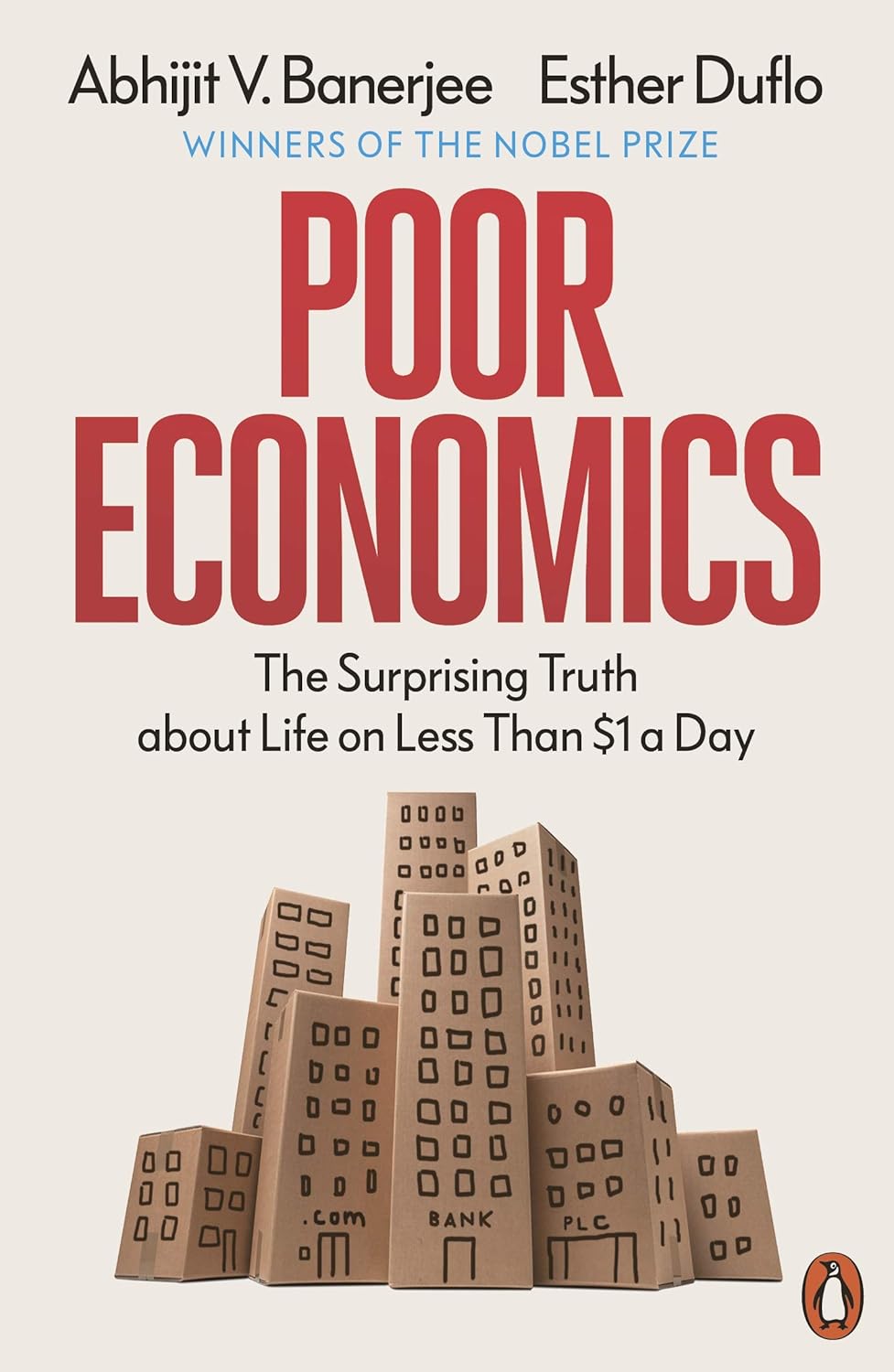
About Poor Economics: The Surprising Truth about Life on Less Than $1 a Day by Abhijit V. Banerjee & Esther Duflo — Understand Poverty Through Real Evidence and Everyday Choices
Why do people with very little money sometimes spend on things outsiders call unnecessary? Why can free health services remain unused? Why do families borrow at high cost or start tiny businesses that never grow very large? Poor Economics: The Surprising Truth about Life on Less Than $1 a Day by Abhijit V. Banerjee & Esther Duflo looks closely at questions like these instead of starting with big slogans about poverty. The authors study how people make choices when money, time, information, health, and opportunity are limited. Their aim is not to describe poor people as one group with one way of thinking. Instead, they use evidence from many settings to show that small details can change what people are able to do.
Start with a Simple Idea: Look Closely Before You Judge
It is easy to talk about poverty from far away. Someone may see a family buying a television and ask why they did not spend that money on food. Another person may assume that free schooling or medicine will automatically solve a problem. Banerjee and Duflo ask readers to slow down before making those judgments. A choice that looks strange can make more sense when you know what information people had, what risks they faced, and what other options were available. The book replaces quick assumptions with careful questions.
Learn Why Hunger Is Not Only About Buying More Calories
Poor Economics asks why people with very little money do not always spend every extra amount on the cheapest possible food. The authors examine food choices, nutrition, taste, and the way people balance need with enjoyment. Their discussion challenges the idea that poverty can always be understood by counting calories. Human beings care about flavor, dignity, celebration, and variety as well as survival. Poor nutrition can also reduce energy and make work harder, creating another barrier. The book shows why food policy can fail when it ignores how people actually choose.
See Why Free Health Care May Still Go Unused
A clinic may offer a useful service at little or no cost, yet people may still not use it. The book looks at health decisions and shows that price is only one part of the problem. Distance, trust, waiting time, information, habits, and future benefits can all shape a choice. Banerjee and Duflo discuss preventive care, including immunization, and ask why small incentives sometimes change behavior. A service can exist on paper and still be difficult to use in real life.
School Enrollment Is Not the Same as Learning
Sending children to school sounds like an obvious path to a better future, but the book asks another question: are children actually learning once they get there? Banerjee and Duflo examine education through evidence on attendance, teaching, expectations, and learning levels. A classroom can be full while many students still struggle with basic skills. The authors discuss programs designed to improve learning rather than only increase enrollment. Putting a child in a seat is visible and easy to count. Learning is harder to measure. The book encourages readers to ask whether a school system is helping different students make real progress.
Why Family Size Cannot Be Explained by One Simple Rule
Population and family size are often discussed as if one cause explains every household decision. Poor Economics takes a more careful path. The authors ask how parents think about children, education, health, work, and future security. Access to contraception, information, social expectations, and the costs and benefits of children can differ across places and households. Instead, it shows why good policy needs to understand the choices people are making and the limits around them. This turns a sensitive topic into questions that can be studied with evidence rather than blame.
Risk Feels Different When One Bad Event Can Change Everything
People with low incomes often face serious risk. A failed crop, illness, lost job, broken tool, or unexpected bill can damage a household with almost no financial cushion. The book explains why this changes decision-making. A choice that looks too cautious to a wealthier observer may be reasonable when failure could leave a family without food or income. The authors also examine insurance and why useful products may be difficult to sell or trust.
Borrowing and Saving Can Look Strange from the Outside
Why would someone borrow at a high interest rate while also trying to save? Poor Economics explores how people manage money when formal banks, safe savings tools, and low-cost loans are not always easy to reach. The authors look at credit, savings, and microfinance without presenting one product as a magic answer. Borrowing can create opportunity, but debt can also become a burden. Saving is useful, but saving regularly may be difficult when every week brings urgent needs.
Small Businesses Do Not Always Become Big Businesses
Many people living on low incomes run small businesses, from shops and food stalls to farms and services. It is tempting to call every owner a future large entrepreneur, but the book asks what these businesses actually look like. Some provide necessary income without having a realistic path to rapid growth. Others may lack capital, customers, skills, or a large enough market. Banerjee and Duflo examine entrepreneurship without claiming that a small loan automatically creates a successful company.
Randomized Evaluations Ask What Actually Caused a Change
Much of the research behind Poor Economics uses randomized evaluations. In simple terms, researchers compare groups that receive a program with similar groups that do not, using random assignment when appropriate. This can help estimate whether a specific program caused a measurable change rather than merely happening at the same time. Banerjee and Duflo helped make this approach influential in development economics through their work with J-PAL. The method has strengths, limits, and debates about where results can be applied, so it is not a machine that produces a perfect answer to every policy question.
Small Details Can Decide Whether a Good Program Works
A program may have a sensible goal yet fail because it is inconvenient, confusing, badly timed, or based on wrong assumptions about behavior. Something as small as distance to a service, a reminder, a default choice, or a minor reward can sometimes change participation. Poverty is also connected to institutions, markets, public services, and unequal opportunities. Still, the authors show that careful design can improve some programs even when larger problems remain.
Poor People Are Not One Type of Person
The title can sound as if the book will explain how “the poor” think, but one important message is almost the opposite. People with low incomes have different families, goals, fears, skills, and opportunities. They may make different choices even when their incomes look similar on a chart. Banerjee and Duflo examine the conditions around decisions instead of assuming one personality explains poverty. Poverty changes the choices people can realistically make, but it does not remove individual preferences or human variety.
Who Will Learn the Most from Poor Economics?
This book is useful for economics students, development studies learners, NGO workers, policymakers, researchers, teachers, and general readers who want a clearer understanding of global poverty. You do not need advanced mathematics to follow the main ideas. The authors explain many questions through stories, examples, and evidence rather than filling every page with formulas. Students can use it alongside development economics or public policy courses. NGO professionals can use it to think about program design and evaluation.
A Premium Economics Book for Study and Long-Term Reading
Bookish Wonderland offers this title with premium eye-soothing cream paper, crystal-clear printing, and high-quality stitched and glue binding designed for regular reading. The soft page tone gives long chapters a comfortable background, while sharp text helps examples, names, and explanations remain easy to follow. These specifications describe the Bookish Wonderland copy rather than every edition sold elsewhere. Different editions of Poor Economics exist, including a fully updated Penguin edition released in 2026 with two new chapters and 400 pages. If the exact edition matters for your course or research, confirm the copy currently available before ordering.
Check the Book Price in Bangladesh Before Ordering
When comparing the Book price in Bangladesh for Poor Economics by Abhijit V. Banerjee & Esther Duflo, check the current amount on the Bookish Wonderland product page. Price can vary with edition, stock, cover, and current store offers, so this description does not invent a fixed amount. If you need the book for a university course, research project, economics club, or professional reading, confirm the edition before checkout. The 2026 fully updated edition includes new material that is not identical to older editions. You can also contact Bookish Wonderland about stock, format, or customization before ordering.
Order from Dhaka or Anywhere Else in Bangladesh
Bookish Wonderland provides nationwide delivery to customers inside and outside Dhaka, with Cash on Delivery available across the country. That makes it easier to order an English economics title without searching through several physical shops. Customers in Dhaka can ask about fast or urgent delivery and confirm whether that option is available for their area. If you need the book for a class, exam, seminar, or gift, check stock and expected delivery details before planning around an exact date. For order questions or book customization, message the store through Facebook or Instagram.
Read the Evidence and Think More Carefully About Poverty
Poor Economics: The Surprising Truth about Life on Less Than $1 a Day by Abhijit V. Banerjee & Esther Duflo does not ask readers to believe that poverty has one cause or one perfect cure. Its value comes from looking closely at how people make choices under difficult limits and asking which interventions really improve outcomes. If you want an economics book that moves from big debates to practical questions about daily life, this title offers plenty to think about. Check the latest price and availability at Bookish Wonderland, choose the delivery option for your address, and contact the store through Facebook or Instagram if you need edition details or customization.
If you require any customization or have any questions, please inbox us via FB or Insta.
| Primary Specification | |
| Author | Abhijit V. Banerjee, Esther Duflo |
| Narrator | Elisabeth Rodgers |
| Genre | Nonfiction, Economics, Development Economics, Poverty Studies |
| ISBN-13/ISSN | 978-1541706187 |
| ISBN-10 | 1541706188 |
| Publisher | PublicAffairs |
| Publishing Date | September 16, 2025 |
| Language | English |
| Reading Age | 16+ |
| Format | Printed Book |
| Physical Specification & Quality | |
| Paper Quality | Premium eye-soothing cream paper |
| Binding Quality | High quality stitched and glue binding (for longevity) |
| Print Quality | Crystal-clear print |
| Pages | 400 pages |
| Country | USA |
| Logistics Information | |
| Weight | 423 gm |
| Length | 8.5 inches |
| Width | 5.6 inches |
| Height | 0.89 inch |