

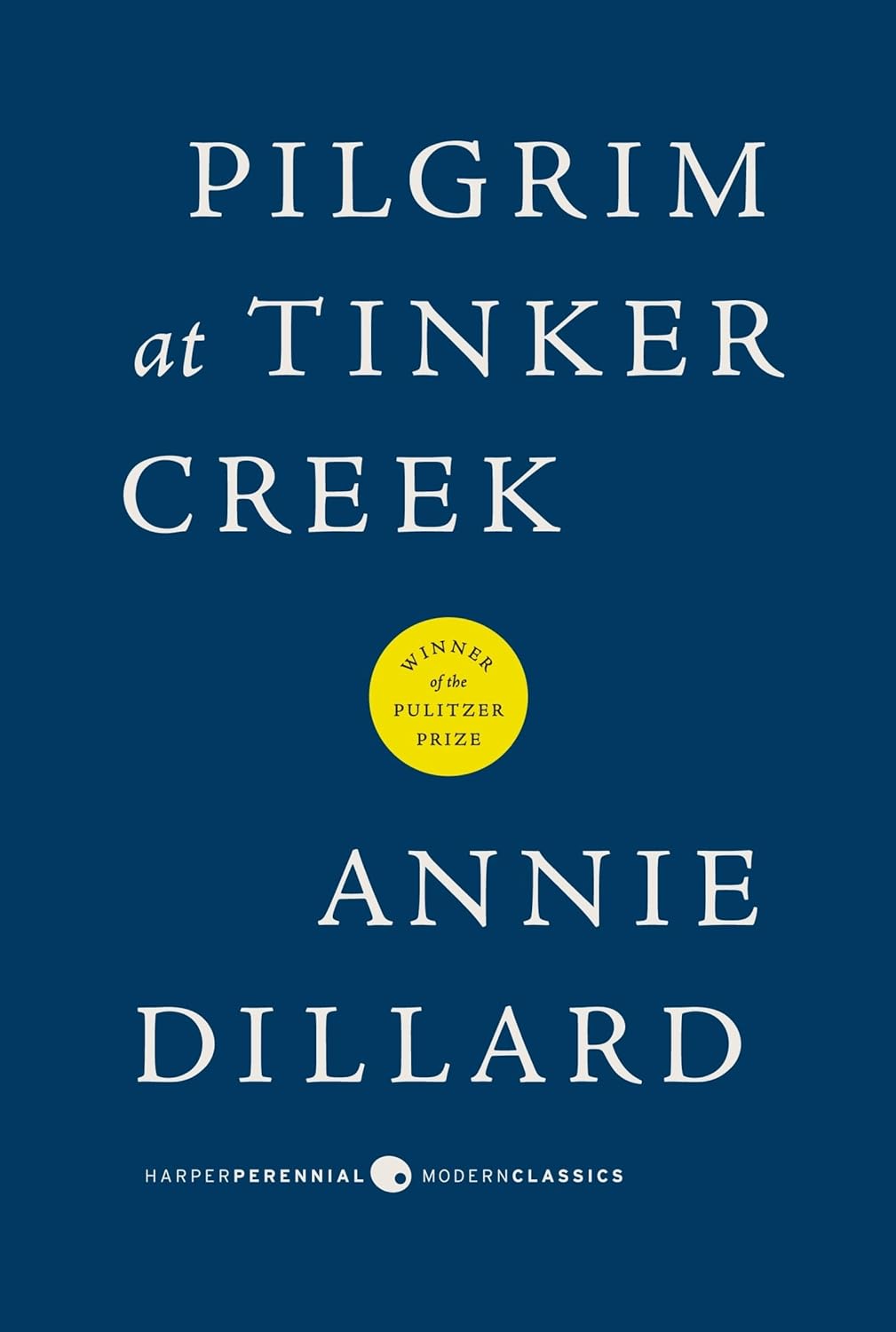
About Pilgrim at Tinker Creek by Annie Dillard – A Powerful Journey Through Nature, Wonder and the Questions of Life
Pilgrim at Tinker Creek by Annie Dillard is a thoughtful nonfiction book about seeing the natural world with full attention. The book follows Dillard as she walks, watches, thinks, and records what she finds around Tinker Creek in Virginia. A small place becomes a huge field of discovery. Water, insects, birds, trees, light, weather, animals, and changing seasons all become part of a larger search for meaning.
This is not a simple nature guide. Dillard does not only tell you what she sees. She asks why the world can be so beautiful and so cruel at the same time. She looks closely at living things, then connects them with questions about life, death, faith, pain, joy, and creation. The result is a book that feels like nature writing, personal reflection, science, philosophy, and spiritual searching all at once.
First published in 1974, Pilgrim at Tinker Creek won the 1975 Pulitzer Prize for General Nonfiction. It has remained an important work of American nonfiction because it encourages readers to slow down and notice the world that is already around them.
Learn to see ordinary nature in a new way
Many people pass trees, birds, water, clouds, and insects every day without looking at them. Dillard begins with a different idea: careful attention can turn an ordinary place into something astonishing.
She walks near Tinker Creek and watches small details that most people might ignore. A movement in the water, an insect on a leaf, the shape of light, a bird in flight, or a change in the weather can become the start of a long thought. Her attention makes the natural world feel larger than it first appears.
This is one reason the book can change the way a reader looks at everyday places. You do not need to travel to a distant jungle or mountain to find wonder. A nearby field, creek, garden, tree, or patch of sky can hold enough mystery to make you stop and think.
For readers who feel busy or distracted, the book offers another way of moving through the world. It asks you to slow down, look carefully, and notice what is happening before you rush to the next thing.
A year of walking, watching and thinking
The book is built around Dillard's exploration of the natural world near Tinker Creek. Her observations move through the seasons, so the landscape keeps changing.
Different times of year bring different animals, plants, weather, light, and questions. The creek is never exactly the same. Life appears, grows, disappears, and returns in new forms. That movement gives the book a natural rhythm.
Dillard studies what she sees, but she also reads widely and brings facts, stories, and scientific ideas into her reflections. A simple moment outdoors can lead to a question about biology, physics, theology, or human understanding.
This gives the book a rich feeling without turning it into a textbook. You learn because Dillard is curious, not because she is trying to give a lesson. Her curiosity pulls the reader forward.
The structure also makes the book useful for slow reading. You can read a section, stop, think, and return later. It does not depend on a fast plot. The reward comes from ideas, images, and connections.
Beauty is only one side of nature
Some nature books show the outdoors as peaceful, gentle, and comforting. Pilgrim at Tinker Creek is more honest and more difficult.
Dillard sees beauty everywhere, but she also sees hunger, death, parasites, predators, injury, and waste. Nature can create something delicate and beautiful, then destroy it without warning. This tension becomes one of the central questions of the book.
How can a world contain both beauty and suffering? How should a person respond to a creation that can feel generous one moment and brutal the next?
Dillard does not give a simple answer. Instead, she stays with the question. She keeps looking.
That makes the book powerful for readers who want more than pretty descriptions of nature. It accepts that wonder and fear can exist together. A creek can be peaceful and dangerous. An animal can be beautiful and still need to kill. Life can feel meaningful even while death is always present.
The book asks readers to face the whole picture rather than choosing only the parts that feel comfortable.
A book for people who ask big questions
Pilgrim at Tinker Creek is rooted in one place, but its questions are much larger.
What does it mean to be alive? Why is there suffering? Is there order in nature, or only chance? Can beauty tell us anything about creation? How much of the world do we fail to see because we are not paying attention?
These questions appear through personal observation rather than formal argument. Dillard may begin with an animal, a plant, or a creek, then move toward an idea about existence.
Readers who enjoy philosophy may like this movement. Readers interested in religion or spiritual thought may also find much to consider. At the same time, you do not need to share one belief system to read the book. The questions are open enough to invite thought rather than demand one answer.
That is part of the book's lasting value. It does not simply tell you what to think. It gives you something to think about.
Why Annie Dillard's writing feels so alive
The subject of the book is nature, but the writing itself is a major reason people continue to read it.
Dillard uses clear observation, strong images, surprising comparisons, and moments of humor. She can move from a tiny creature to a large idea without making the change feel forced. Her language often makes familiar things seem new.
This style rewards readers who like to underline sentences, pause over an image, or reread a paragraph. It is not a book you must race through.
The writing can also help students and writers. It shows how observation can become an essay, how facts can mix with personal thought, and how one small detail can lead into a bigger subject.
For anyone learning creative nonfiction, nature writing, personal essays, or descriptive writing, Pilgrim at Tinker Creek offers a strong example of how careful seeing can become strong prose.
What makes this book different
Pilgrim at Tinker Creek does not fit neatly into one simple category. Annie Dillard herself described it as a nonfiction narrative, and that description suits the book well.
It combines several kinds of reading experience:
- Close observation of animals, plants, water, weather, and changing seasons.
- Personal reflection on what Dillard sees and feels.
- Scientific facts and natural history.
- Questions about faith, creation, pain, and meaning.
- Philosophical thought about life, death, time, and awareness.
- Rich descriptive writing that turns small scenes into memorable images.
- A year-shaped structure that gives the book movement without using a normal plot.
- A quiet reading experience that rewards patience and attention.
Because of this mix, the book can appeal to people who normally read different kinds of nonfiction. A nature reader may enjoy the observation. A philosophy reader may stay for the questions. A writer may study the language. A reflective reader may connect with the search for meaning.
Who should read Pilgrim at Tinker Creek?
This book is a strong choice for readers who enjoy nature writing, literary nonfiction, personal essays, philosophy, science, spiritual reflection, and slow observation.
It may especially suit people who enjoy walking, hiking, birdwatching, gardening, photography, journaling, or simply spending quiet time outdoors. The book can make familiar places feel worth another look.
Students of literature can also find a lot to study in its structure and style. Writers can learn from Dillard's use of detail. Readers interested in environmental thought can see how close attention creates respect for the living world.
This is not the best choice if you only want a fast story with constant action. Its movement comes through thought and discovery. The book asks for patience, but it gives a lot back to readers who enjoy thinking while they read.
A useful book for quiet reading and study
There are many ways to read Pilgrim at Tinker Creek.
You can read it from beginning to end and follow the movement through the seasons. You can read a chapter at a time and keep notes. You can use it for a literature class, an essay topic, a book club, or a personal reading project.
It can also pair well with time outdoors. Read a section, then take a walk and try to notice what you normally miss. Look at how light changes, how birds move, how water flows, or how many living things can be found in one small area.
This kind of reading turns the book into more than information. It becomes a way of practicing attention.
Book clubs can discuss questions about beauty, cruelty, faith, nature, science, and human awareness. Students can examine how Dillard mixes research with observation. Writers can study how she moves from concrete detail to abstract thought.
A premium reading copy from Bookish Wonderland
Pilgrim at Tinker Creek is the kind of book many readers may want to mark, revisit, and read slowly. Bookish Wonderland offers a reader-friendly copy made with premium eye-soothing cream paper, crystal-clear print, and high-quality stitched plus glue binding for better longevity.
The cream-colored pages are comfortable for longer reading sessions, while the clear print helps detailed passages stay easy to follow. The strong binding is designed for repeated reading, making the copy suitable for study, personal notes, or long-term shelf use.
If you are comparing the Book price in Bangladesh for Pilgrim at Tinker Creek by Annie Dillard, Bookish Wonderland gives you a convenient local option for ordering this Pulitzer Prize-winning work of nonfiction.
Nationwide delivery is available across Bangladesh. Orders can be delivered inside and outside Dhaka, cash on delivery is available, and fast or urgent delivery options may be available in Dhaka.
Why this book still matters
Pilgrim at Tinker Creek was first published decades ago, but its central idea remains easy to understand: most of us do not notice enough.
Modern life gives people many reasons to look away. Phones, work, study, traffic, noise, and constant information can make attention feel difficult. Dillard's book offers the opposite experience. It turns attention into a serious act.
She shows that looking closely can lead to wonder, knowledge, discomfort, and better questions. Nature is not made simple. It remains strange.
The book reminds readers that the world is full of details whether we notice them or not.
Start reading with a more curious eye
Pilgrim at Tinker Creek by Annie Dillard is not only about one creek in Virginia. It is about learning how to look at life with patience, curiosity, and courage.
Dillard walks through an ordinary landscape and finds beauty, danger, science, mystery, and questions large enough to last a lifetime. Her writing shows that nature does not need to be simple to be meaningful. The same world can be gentle and violent, familiar and strange, understandable and impossible to explain.
If you enjoy books that slow you down and make you notice more, this title deserves serious attention. It can be read for its nature writing, its ideas, its language, or its spiritual questions. Each approach opens another part of the book.
Order Pilgrim at Tinker Creek by Annie Dillard from Bookish Wonderland and discover why this Pulitzer Prize-winning nonfiction classic continues to invite readers to look more closely at the world around them.
If you require any customization or have any questions, please inbox us via FB or Insta.
| Primary Specification | |
| Author | Annie Dillard |
| Narrator | Nan McNamara |
| Genre | Nature writing, memoir, essays, literary nonfiction, philosophy |
| ISBN-13/ISSN | 978-0061233326 |
| ISBN-10 | 0061233323 |
| Publisher | Harper Perennial Modern Classics |
| Publishing Date | June 12, 2007 |
| Language | English |
| Format | Printed book |
| Physical Specification & Quality | |
| Paper Quality | Premium eye-soothing cream paper |
| Binding Quality | High quality stitched and glue binding (for longevity) |
| Print Quality | Crystal-clear print |
| Pages | 304 pages |
| Country | USA |
| Logistics Information | |
| Weight | 324 gm |
| Length | 8.5 inches |
| Width | 5.6 inches |
| Height | 0.76 inch |