

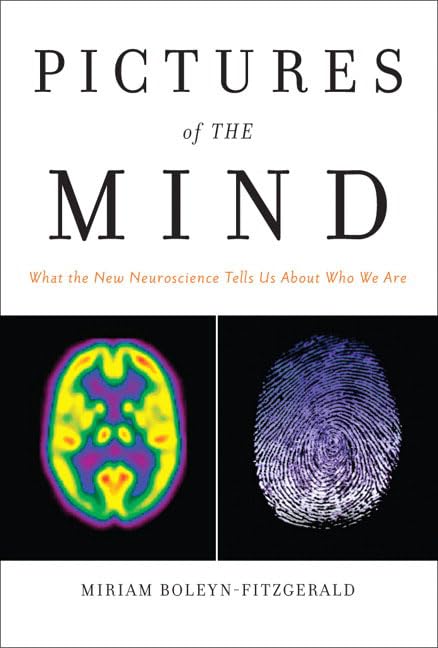
About Pictures of the Mind by Miriam Boleyn-Fitzgerald – A Clear Journey Into Brain Science, Memory, Emotion and Human Behavior
Pictures of the Mind by Miriam Boleyn-Fitzgerald is a readable science book about one of the biggest questions people ask: how does the brain shape who we are? The book looks at modern neuroscience and explains what brain imaging has helped researchers learn about thought, emotion, memory, pain, addiction, morality, meditation, recovery, and the sense of self.
The subject can sound difficult, but the book is written for curious readers rather than only for doctors or scientists. Boleyn-Fitzgerald uses research, real cases, and clear explanations to show how tools such as fMRI and PET scans let researchers study the living brain in ways that were once impossible.
A central idea is that the brain is not simply fixed after childhood. It can change, adapt, and sometimes recover. That idea makes the book hopeful without turning neuroscience into easy promises.
If you want to understand why people remember, feel, change, suffer, recover, make choices, or see themselves in certain ways, this book gives you an accessible place to begin.
Brain science without making every page feel like a textbook
Neuroscience can be hard for beginners because it often comes with technical words, detailed anatomy, and complex research methods. Many readers are interested in the brain but do not want to study a medical manual before they can understand the main ideas.
Pictures of the Mind takes a more human approach. It starts with questions that connect directly with real life. What happens in the brain after serious injury? Why can strong emotions control us? What changes during addiction or chronic pain? How does memory form and break? What happens when people meditate? Where do ideas about right and wrong come from?
These questions make the science easier to enter because readers already understand why the answers matter. Brain scans and experiments become tools for understanding people, not just machines or numbers.
Instead of asking you to memorize every part of the brain, the book focuses on what scientists are learning and how that knowledge may change the way we think about human behavior.
See why brain imaging changed what scientists could study
For a long time, scientists had limited ways to study a working human brain. Modern brain imaging gave researchers another option.
Techniques such as functional magnetic resonance imaging, usually called fMRI, and positron emission tomography, or PET, can help researchers observe patterns of activity while people perform tasks or experience different mental states.
Researchers can compare what happens during memory, emotion, pain, meditation, decision making, and other experiences. The images do not answer every question, but they can provide evidence about how brain systems work together.
The book helps readers see that a brain scan is not just a colorful picture. It can be part of a larger investigation into consciousness, behavior, illness, recovery, and identity.
The brain may be more flexible than people once believed
One of the most encouraging ideas in modern neuroscience is neuroplasticity, the ability of the brain to change through experience, learning, injury, and repeated activity.
Older views often treated the adult brain as far more fixed. Research over time created a more complex picture. Pictures of the Mind explores how the brain can sometimes reorganize, adapt, and build new patterns.
This does not mean every injury can be repaired or every problem can be solved. It means the brain can be more dynamic than earlier models suggested.
For readers, this idea has direct meaning. Learning changes us. Practice matters. Habits matter. Recovery can involve the brain as well as the body. Experience can shape neural pathways over time.
Emotion is not separate from the brain
People often talk about emotion as if it comes from the heart while thinking comes from the brain. Neuroscience shows a much closer connection.
The book looks at strong emotions and the brain systems involved in them. Fear, anger, sadness, joy, and other feelings can influence attention, memory, behavior, and decisions.
A strong emotional reaction is not simply a sign that someone is weak or unreasonable. It may involve fast brain processes that help humans respond to threats, rewards, relationships, and important events.
The book also discusses research that connects mental practice, attention, and meditation with changes in how the brain responds.
Addiction and chronic pain become easier to understand
Addiction and chronic pain are often misunderstood because people may judge them only from the outside.
A person with addiction may be told to simply stop. A person with long-term pain may be questioned when no clear injury explains the level of suffering. Neuroscience gives a deeper view.
Pictures of the Mind looks at how brain research can help explain these experiences. Addiction can involve reward, learning, craving, memory, and repeated patterns. Chronic pain can continue because the nervous system itself may become part of the problem.
Seeing these conditions through brain science can reduce simple blame. It does not make every case the same, but it helps readers ask better questions about why change can be difficult and why pain can remain powerful.
Memory is powerful, useful and sometimes unreliable
Memory feels personal because it helps create the story we tell about ourselves. We remember people, places, pain, success, lessons, and important moments. Those memories guide later choices.
Yet memory is not a perfect recording.
Pictures of the Mind explores how memories can be made, changed, lost, or broken. Brain research shows that remembering is an active process. Different systems help store and recover information, and injury or disease can affect those systems in different ways.
This topic can change how readers think about identity. If memory helps make us who we are, what happens when memory changes? Why can two people remember the same event differently? Why do emotional experiences often stay strong? How does repetition help learning?
Students may think about study. Families may think about brain injury or disease. Writers and psychology readers may think about how memory shapes the self.
What does neuroscience say about morality?
People make decisions every day about fairness, harm, responsibility, cooperation, punishment, and helping others. We often think of these choices as philosophical or cultural. Neuroscience adds another question: what is happening in the brain while people make them?
Pictures of the Mind explores this area without reducing morality to one simple spot in the brain.
Research can examine patterns connected with emotion, empathy, reasoning, and decision making. These findings add information to long debates about human nature.
Why do some choices feel wrong before we can explain why? How do emotion and reason work together? What happens when brain injury changes judgment?
These questions matter beyond a laboratory because they connect with law, education, parenting, mental health, and social life.
Meditation becomes a scientific question
Meditation was once discussed mainly in spiritual or religious settings. Modern neuroscience also studies it as a mental practice.
Brain imaging gives researchers ways to examine what may happen during focused attention, awareness, and repeated meditation practice. Pictures of the Mind includes this topic as part of its wider look at change and mental life.
It is that a practice involving attention can be studied scientifically. Researchers can ask whether long-term practice is linked with differences in brain activity, emotional response, attention, or stress.
This brings personal experience and measurable research together. It also supports a larger idea in the book: thoughts and mental practices are not completely separate from the physical brain.
What makes Pictures of the Mind useful for general readers
The book works well as an introduction because it combines science with questions people already care about.
Key strengths include:
- Clear explanations of modern brain research for non-specialist readers.
- Discussion of fMRI, PET scans, and what brain imaging can reveal.
- Accessible ideas about neuroplasticity and the brain's ability to change.
- Real-world topics such as brain injury, emotion, addiction, and chronic pain.
- Research on happiness, meditation, and mental habits.
- A thoughtful look at memory and personal identity.
- Questions about morality, cooperation, responsibility, and human behavior.
- A writing style designed to make technical science easier to understand.
- A useful starting point for readers exploring neuroscience or psychology.
You do not need a medical background to begin. Curiosity is more important.
Who should read this book?
Pictures of the Mind is a strong choice for readers who want an introduction to neuroscience without starting with a dense university textbook.
Students can use it to build interest before studying psychology, biology, medicine, cognitive science, or neuroscience in more depth. Teachers can use its ideas to explain why brain research matters. General readers can use it to understand discussions about brain scans, memory, mental health, meditation, and behavior.
It may also appeal to people interested in self-development who want more science behind ideas about habit, emotion, attention, and change.
Because the book was published in 2010, it is best read as an accessible picture of neuroscience research and discussion from that period, not as a complete summary of every discovery made since.
A premium reading copy from Bookish Wonderland
Science books often become reference books. You may read a chapter, return to an earlier idea, mark an important section, or reopen the book when another topic makes you curious.
Bookish Wonderland offers a reader-friendly copy with premium eye-soothing cream paper, crystal-clear print, and high-quality stitched plus glue binding for better longevity.
The cream paper provides a softer reading surface for longer study sessions. The durable binding is designed for regular use and repeated reading.
For readers comparing the Book price in Bangladesh for Pictures of the Mind by Miriam Boleyn-Fitzgerald, Bookish Wonderland offers a convenient local option for ordering this accessible neuroscience title.
Nationwide delivery is available across Bangladesh, including inside and outside Dhaka. Cash on delivery is available, and fast or urgent delivery options may also be available in Dhaka.
A smart choice when you want to understand the brain better
The human brain is involved in almost everything we do, yet most people know very little about how it works.
Pictures of the Mind helps close that gap. It shows how brain imaging has allowed scientists to ask new questions about recovery, emotion, happiness, pain, addiction, memory, morality, meditation, and the self.
The value of the book comes from connection. Science is linked with real people and real questions. Research becomes easier to understand because the reader can see why it matters.
If you have ever wondered whether the brain can change, why memories fail, how addiction affects behavior, why meditation interests scientists, or how biology connects with identity, this book gives you a useful starting point.
Explore the science behind who we are
Pictures of the Mind by Miriam Boleyn-Fitzgerald invites readers to look at the mind through the evidence of neuroscience. It turns brain scans, research findings, and medical questions into a wider discussion about what makes human beings think, feel, remember, choose, change, and recover.
The book is especially useful for people who want science explained in direct language. You can learn without needing to be an expert while still meeting ideas that may lead you toward deeper study.
Read it for the neuroscience, the questions about behavior, and the clearer view it gives of how researchers study the human mind.
Order Pictures of the Mind by Miriam Boleyn-Fitzgerald from Bookish Wonderland and begin exploring memory, emotion, identity, recovery, and human behavior through an accessible introduction to brain science.
If you require any customization or have any questions, please inbox us via FB or Insta.
| Primary Specification | |
| Author | Miriam Boleyn-Fitzgerald |
| Genre | Neuroscience, Psychology, Popular Science, Brain Science |
| ISBN-13/ISSN | 978-0137155163 |
| ISBN-10 | 0137155166 |
| Publisher | Ft Pr |
| Publishing Date | January 1, 2010 |
| Edition | 1st |
| Language | English |
| Reading Age | 18+ |
| Format | Printed book |
| Physical Specification & Quality | |
| Paper Quality | Premium eye-soothing cream paper |
| Binding Quality | High quality stitched and glue binding (for longevity) |
| Print Quality | Crystal-clear print |
| Pages | 177 pages |
| Country | United States |
| Logistics Information | |
| Weight | 198 gm |
| Length | 8.5 inches |
| Width | 5.6 inches |
| Height | 0.75 inch |