

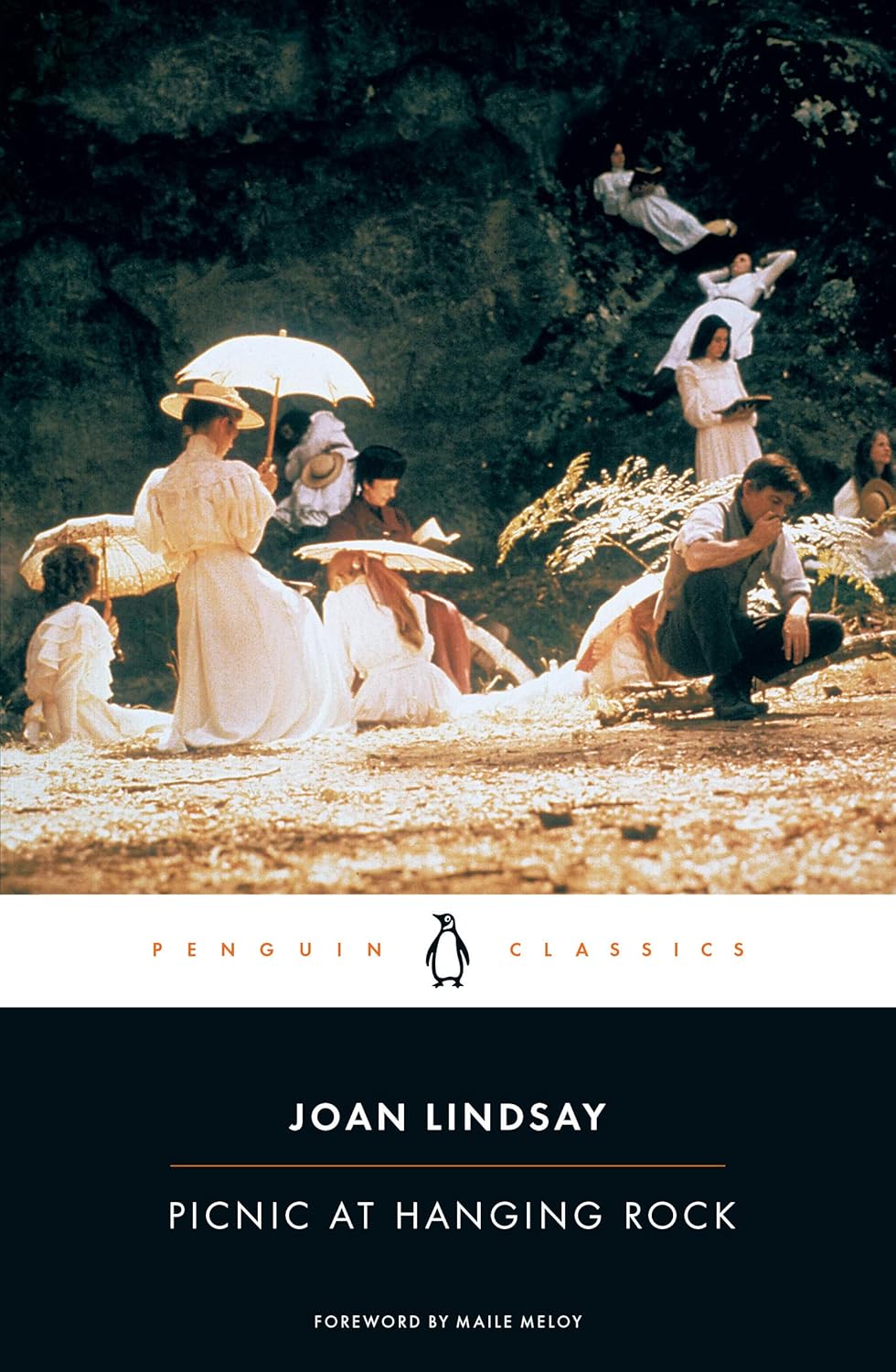
About Picnic at Hanging Rock by Joan Lindsay – A Haunting Australian Mystery of Disappearance, Time and Secrets
Picnic at Hanging Rock by Joan Lindsay is a strange, beautiful, and unsettling novel about a school picnic that becomes a mystery no one can fully explain. Set in Australia in 1900, the story follows students and teachers from Appleyard College for Young Ladies as they visit Hanging Rock on Valentine’s Day. The day begins with sunshine, food, conversation, and the promise of a pleasant trip. Then several members of the group move toward the great rock formation, and the ordinary afternoon changes forever.
Three girls climb higher into the rocks and vanish. A teacher also disappears. Search parties look for answers, but the mystery spreads far beyond the picnic ground. Families suffer, the school changes, rumors grow, and people begin to question what they saw, what they remember, and what may have happened.
First published in 1967, Picnic at Hanging Rock became a major work of Australian literature. Joan Lindsay writes with a dreamlike calm that makes the story feel both real and unreal. The result is a mystery that stays powerful because it refuses to become simple.
A peaceful picnic becomes something impossible to forget
The opening idea is easy to understand. A group of schoolgirls leave their strict boarding school for a day outside. Hanging Rock looks beautiful, wild, and different from the ordered world of Appleyard College. The girls eat, rest, talk, and enjoy the summer heat.
Then the mood changes.
Miranda, Marion, Irma, and Edith move toward the rock. As they climb, normal rules seem to weaken. Time feels strange. The landscape becomes harder to read. Some of the girls continue upward while Edith turns back in fear.
From that point, the story grows through absence. People are missing, but there is no clear answer waiting for the reader. The lack of certainty creates the tension. Every search, memory, rumor, and small clue becomes important because everyone wants an explanation.
Readers who enjoy mysteries may find this especially gripping because the book does not behave like a normal detective story. There is no neat line from crime to clue to solution. The mystery feels larger than any one person.
Hanging Rock feels like more than a setting
The rock formation is central to the novel. It is not simply a place where the girls disappear. It shapes the entire mood of the book.
Hanging Rock is ancient, physical, silent, and difficult to understand. Against it, the rules of the school and the habits of polite society begin to look small. The girls arrive in carefully arranged clothes from a controlled institution, but the landscape does not follow their rules.
Joan Lindsay uses heat, stone, insects, plants, light, shadow, and silence to make the setting feel alive. The natural world is beautiful, but it is not friendly in a simple way. It does not explain itself.
This creates a strong Gothic feeling without needing a dark castle or a monster. The fear comes from uncertainty. Something may have happened, but the landscape gives nothing back.
For readers who love atmospheric fiction, this is one of the book’s greatest strengths. You do not only read about Hanging Rock. You begin to feel its weight over the story.
A mystery built from what is missing
Most mysteries give readers information so they can solve a problem. Picnic at Hanging Rock often works through missing information.
People search, ask questions, remember details, and build theories, but certainty remains difficult. The novel shows how quickly a lack of answers can affect a whole community.
When people do not know what happened, they begin to create stories. Some stories come from fear. Some come from hope. Some come from gossip. Others come from the need to make a terrible event feel understandable.
This makes the novel interesting even when no new physical clue appears. The mystery changes people. Parents worry. Students become frightened. Teachers struggle. The reputation of Appleyard College begins to suffer. The school that once looked controlled and respectable becomes less stable.
The disappearances create an empty space, and everyone around that space reacts differently.
That is why the novel can stay in a reader’s mind long after the final page. The unanswered parts are not a weakness. They are part of the design.
The strict school and the wild landscape pull in opposite directions
Appleyard College is built on rules, manners, order, and control. The girls are expected to behave properly. Their clothes, lessons, movements, and social lives are shaped by adults.
Hanging Rock represents something very different. It is old, wild, and outside the school’s control.
The contrast gives the novel another layer. The picnic is supposed to be a safe school event, but once the students enter the landscape, the normal system cannot protect them.
The book does not need to explain this contrast in difficult words. Readers can feel it. Inside the school, time is measured and behavior is watched. At the rock, time seems less certain and the girls move beyond normal boundaries.
This tension also helps explain why the novel has remained popular with readers of Gothic and literary fiction. The story is not only about missing people. It is also about what happens when strict human rules meet a world that does not care about those rules.
Time itself feels strange
Time is one of the quiet mysteries inside Picnic at Hanging Rock.
Clocks matter in the story, but they do not always seem reliable. The hot afternoon feels slow and dreamlike. Moments appear to stretch. People later try to rebuild the order of events, but memory and time do not fit together perfectly.
Joan Lindsay was interested in the idea of time, and the novel uses that interest to make ordinary events feel uncertain. A picnic should be easy to place on a schedule: leave the school, arrive, eat, explore, return. Instead, the day becomes difficult to understand.
This makes the mystery more disturbing. If people cannot fully trust time, memory, or observation, then solving the disappearance becomes much harder.
The story reaches far beyond the missing girls
The disappearances are the center of the novel, but the effects spread outward.
Students who remain at the school are changed. Teachers carry fear and responsibility. Families must deal with uncertainty. People connected to the search become part of the story. Even the future of Appleyard College is affected.
This gives Picnic at Hanging Rock emotional weight. A disappearance does not happen only to the missing person. It changes everyone who waits for an answer.
The novel also shows how public mystery can become private pain. Newspapers, rumors, and community attention may turn the event into a story, but the people closest to it have to live with the loss.
Why the book feels true even though it is a novel
One of the most famous qualities of Picnic at Hanging Rock is how real it can feel.
Joan Lindsay places the story in a specific historical setting, uses realistic details, and writes about the disappearance with a calm voice. The novel can feel like an old case that someone has carefully recorded.
That realistic surface makes the mystery stronger. Readers may begin asking whether the events really happened, even though the work is a novel.
The effect comes from style. Lindsay does not constantly tell readers how shocked they should feel. She often describes strange events with control. That calmness makes the missing information more disturbing.
What makes Picnic at Hanging Rock worth reading
The novel has several qualities that continue to attract readers:
- A famous mystery centered on the disappearance of schoolgirls at Hanging Rock.
- A striking Australian setting that feels beautiful, ancient, and threatening.
- A dreamlike style that creates tension without constant action.
- A strong contrast between strict school life and the wild natural world.
- Themes of time, memory, control, freedom, fear, class, and social rules.
- A mystery that invites theories instead of giving easy answers.
- A compact story that can be read quickly but discussed for a long time.
- A place in Australian literary history since its first publication in 1967.
- A story that inspired Peter Weir’s acclaimed 1975 film and later screen adaptations.
- Strong appeal for readers of Gothic fiction, literary mystery, and atmospheric classics.
Who should read Picnic at Hanging Rock?
This book is a strong choice for readers who enjoy Gothic fiction, literary mysteries, Australian classics, boarding-school stories, historical settings, and novels where atmosphere matters as much as plot.
It may also appeal to fans of stories about missing people that focus on uncertainty rather than police procedure. If you like to create your own theories, notice small details, and discuss possible meanings after finishing, this novel gives you plenty to work with.
Book clubs can talk about the girls, the school, the meaning of Hanging Rock, the strange treatment of time, the limits of memory, and why the lack of a simple answer can feel so powerful.
The book is especially suitable for readers who do not need every question closed. If you prefer a mystery that explains every clue, it may feel unusual. If you enjoy ambiguity, it can be unforgettable.
A premium reading copy from Bookish Wonderland
A classic with this much atmosphere deserves a comfortable reading experience. Bookish Wonderland offers a reader-friendly copy with premium eye-soothing cream paper, crystal-clear print, and high-quality stitched plus glue binding for better longevity.
The cream paper provides a softer surface for longer reading sessions, while the sharp printing keeps every line clear. The durable binding is designed for repeated reading and long-term collection.
For readers comparing the Book price in Bangladesh for Picnic at Hanging Rock by Joan Lindsay, Bookish Wonderland offers a convenient local option for ordering this Australian literary classic.
Nationwide delivery is available across Bangladesh, including delivery inside and outside Dhaka. Cash on delivery is available, and readers in Dhaka can also ask about fast or urgent delivery options.
A classic for readers who like mysteries that stay mysterious
Some books are satisfying because every question is answered. Picnic at Hanging Rock creates a different kind of satisfaction. It lets uncertainty become part of the experience.
The missing girls are important, but so are the people left behind, the strict world of the school, the ancient landscape, and the strange feeling that ordinary rules have stopped working.
The novel asks readers to look closely without promising that looking closely will solve everything.
That can make the story feel more personal. Each reader may notice different clues or form a different idea about what the rock, the disappearances, and the changes at Appleyard College mean.
Step into one of Australian literature’s most haunting mysteries
Picnic at Hanging Rock by Joan Lindsay begins with a school outing and turns it into a mystery filled with beauty, fear, silence, and unanswered questions.
Its power comes from contrast. A bright summer day becomes frightening. A respectable school begins to lose control. A beautiful landscape becomes a place of uncertainty. A simple picnic becomes an event that changes many lives.
The novel is short enough to read without a huge time commitment, yet its mood can remain with you for much longer. It works as a mystery, a Gothic classic, a study of social rules, and a story about what happens when people cannot find the answers they desperately want.
Order Picnic at Hanging Rock by Joan Lindsay from Bookish Wonderland and experience the Australian classic that has fascinated readers for generations with its eerie setting, unforgettable disappearances, dreamlike tension, and lasting mystery.
If you require any customization or have any questions, please inbox us via FB or Insta.
| Primary Specification | |
| Author | Joan Lindsay |
| Narrator | Jacqueline McKenzie |
| Genre | Literary Fiction, Classic Fiction, Gothic Fiction, Horror, Mystery |
| ISBN-13/ISSN | 978-0143132059 |
| ISBN-10 | 0143132059 |
| Publisher | Penguin Classics |
| Publishing Date | October 3, 2017 |
| Language | English |
| Format | Printed book |
| Physical Specification & Quality | |
| Paper Quality | Premium eye-soothing cream paper |
| Binding Quality | High quality stitched and glue binding (for longevity) |
| Print Quality | Crystal-clear print |
| Pages | 224 pages |
| Country | Australia |
| Logistics Information | |
| Weight | 244 gm |
| Length | 8.5 inches |
| Width | 5.6 inches |
| Height | 0.59 inch |