

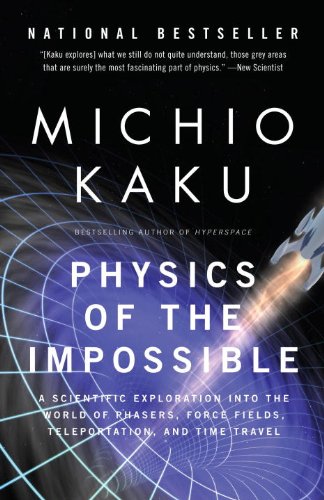
About Physics of the Impossible by Michio Kaku – A Clear Journey Through Science Fiction, Future Technology and the Limits of Physics
Physics of the Impossible by Michio Kaku is a popular science book that asks a fun but serious question: which ideas from science fiction could one day become real? Instead of laughing at ideas such as teleportation, time travel, force fields, invisible objects, robots, faster space travel, and parallel worlds, Kaku looks at them through the laws of physics.
The result is a book that makes difficult science feel exciting. Kaku explains what scientists already know, what experiments have shown, what technology may become possible in the future, and which ideas would require a major change in our understanding of nature.
The book is inspired by the worlds of science fiction, but its purpose is not fantasy. Kaku uses real physics to test the limits of imagination. He shows that some things once called impossible later became normal parts of life, while other ideas remain far beyond present technology.
For curious readers, students, science lovers, and fans of futuristic stories, this is an inviting way to explore the border between imagination and scientific possibility.
When science fiction becomes a serious science question
Many inventions looked impossible before they became real. People once imagined flying machines, communication across great distances, trips to the Moon, and computers that could fit into ordinary life. Later, science and engineering turned versions of these dreams into reality.
That history gives Kaku a starting point.
Instead of asking whether every science-fiction idea is silly, he asks what known physics actually allows. Could matter be moved from one place to another without travelling through the space between? Could a person become invisible? Could a spacecraft travel between stars? Could time itself be changed?
These questions sound huge, but Kaku breaks them into smaller ideas. He explains the science behind each topic, shows where current technology stands, and describes the problems that scientists would have to solve.
The impossible is divided into different levels
One of the most helpful ideas in the book is Kaku’s way of grouping impossible technologies.
Some ideas do not break the known laws of physics. They may be far beyond today’s technology, but science does not clearly forbid them. Other ideas may be possible only in a very distant future or under unusual conditions. A final group would require a major change in our current understanding of physics.
Something may be impossible today because we do not have the machines, energy, materials, or knowledge needed to build it. That is different from an idea that appears to break a basic law of nature.
Kaku encourages readers to ask which kind of impossible they are dealing with. That simple question turns fantasy into a scientific problem.
Teleportation is stranger and more real than it sounds
Teleportation is one of the most famous ideas in science fiction. A person disappears in one place and appears somewhere else.
Real physics is much more complicated, but quantum mechanics has made the word teleportation part of actual scientific discussion.
Kaku explains how quantum information can be transferred in ways that sound surprising to everyday thinking. This does not mean scientists can place a human being inside a machine and instantly send that person across the world. The gap between quantum experiments and human teleportation is enormous.
This is one of the book’s strongest qualities. It does not simply say “yes” or “no.” It shows what part of a dream has some scientific support, what part remains extremely difficult, and what new discoveries would be needed.
Force fields and invisibility move from fiction toward physics
Force fields appear everywhere in science fiction. They protect spaceships, cities, or people behind an invisible wall. Invisibility is another old dream, from myths and magic stories to modern films.
Kaku asks whether physics offers any path toward these ideas.
He discusses how electromagnetic forces, plasma, materials, and the behavior of light can create effects that resemble pieces of science-fiction technology. Scientists have studied ways to guide light around objects and create unusual material properties.
That does not mean a perfect invisible cloak or a giant protective shield is ready for ordinary use. It means the basic question can be studied instead of dismissed.
For readers, this is exciting because it shows how science develops. A strange idea may begin as fiction. Researchers then ask what physical effect would be required. Small experiments follow. Those experiments may lead to technology that looks very different from the original fantasy but still changes the world.
Robots and artificial intelligence raise a different kind of problem
Some impossible technologies depend on energy or materials. Intelligent machines create another challenge: understanding intelligence itself.
Kaku looks at robots, computers, and artificial intelligence as part of a wider discussion about what future machines may be able to do. Machines can already perform tasks that once required human effort, but creating flexible intelligence is much harder than making a fast calculator.
A robot may beat humans at a narrow task while still struggling with everyday understanding that a child finds easy.
This part of the book helps readers see why intelligence is not one simple ability. Vision, movement, language, memory, learning, judgment, and common sense all involve different problems.
The topic is especially interesting today because artificial intelligence has become a much larger part of daily life. Readers can compare Kaku’s earlier discussion with technologies that now exist and see how quickly some fields can change.
Space travel is possible, but distance is a giant enemy
Science fiction often makes travel between stars look easy. A ship leaves one world and soon reaches another.
Real space is much bigger.
Kaku explains why interstellar travel is difficult. Even light takes years to travel between nearby stars. Ordinary spacecraft move far more slowly. A journey that feels short in a film could take generations with present technology.
The problem is not only speed. Spacecraft need energy, protection, supplies, navigation, and systems that can survive for long periods.
Still, physics offers ideas worth studying. Advanced propulsion, antimatter, solar sails, nuclear systems, and other concepts may one day change what is possible.
For readers who love space, this section gives a useful balance between hope and reality. The universe is open to exploration, but nature does not make the journey easy.
Time travel is where the questions become even stranger
Few science-fiction ideas are more exciting than travelling through time.
Modern physics makes the subject complicated because time is not as simple as everyday life makes it seem. Einstein’s theory of relativity shows that time can pass at different rates depending on speed and gravity.
This means a form of travel into the future is already part of accepted physics. Move fast enough, or experience very different gravity, and your time can pass differently from someone else’s.
Going backward in time is much harder.
Kaku discusses ideas such as wormholes and unusual space-time structures while also explaining the serious problems they create. Paradoxes appear quickly. If someone changed the past, what would happen to the events that led them to travel back?
The chapter turns a famous fantasy into a lesson about relativity, space, time, and the limits of what scientists can say with confidence.
Parallel universes push imagination to its edge
Physics has developed theories in which our visible universe may not be the whole story. Some models include extra dimensions, many possible universes, or realities with different conditions.
These ideas are difficult to test and should not be confused with proof that every imagined parallel world is real. Kaku presents them as areas where modern theoretical physics opens surprising possibilities.
For many people, this is where the book becomes most mind-stretching. The world we see every day may be only a small part of what nature allows.
What makes Physics of the Impossible easy to enjoy
The book works because Kaku connects advanced science with ideas people already know from movies, television, and popular culture.
Key strengths include:
- Clear explanations of difficult physics for general readers.
- Famous science-fiction ideas tested against real scientific laws.
- Discussions of teleportation, force fields, invisibility, robots, space travel, and time travel.
- A useful system for separating different kinds of “impossible.”
- Real scientific research mixed with informed future thinking.
- Examples that help readers understand relativity, quantum physics, and modern technology.
- A style that encourages curiosity instead of making readers feel lost.
- Strong appeal for students, science fans, and science-fiction readers.
- A way to see how ideas can move from imagination toward research.
The publisher describes the book as an exploration of what current physical laws may permit in the near and distant future, which captures the book’s main purpose well.
Who should read this book?
Physics of the Impossible is a strong choice for readers who enjoy science, astronomy, technology, futurism, engineering, physics, and science fiction.
Students can use it to build interest in scientific ideas before moving into more technical books. Teachers may find its examples useful for showing why physics matters outside the classroom. Science-fiction fans can enjoy seeing famous ideas examined with real scientific tools.
It is also a good choice for readers who often think science is too difficult. Kaku writes for a wide audience and focuses on ideas before equations.
A premium reading copy from Bookish Wonderland
Popular science books are often read slowly, marked, and revisited, so a comfortable physical copy can make the experience better.
Bookish Wonderland offers a reader-friendly edition with premium eye-soothing cream paper, crystal-clear print, and high-quality stitched plus glue binding for better longevity. The cream paper helps make longer reading sessions more comfortable, while the sharp print keeps scientific terms and normal text easy to follow.
For readers comparing the Book price in Bangladesh for Physics of the Impossible by Michio Kaku, Bookish Wonderland offers a convenient local option for ordering this engaging science title.
Nationwide delivery is available across Bangladesh, including delivery inside and outside Dhaka. Cash on delivery is available, and fast or urgent delivery options may also be available in Dhaka.
A science book that makes impossible ideas useful
Instead of saying an idea is impossible because it sounds strange, ask which law of physics stops it. If no known law clearly stops it, ask what technology, energy, materials, or discoveries would be required.
That way of thinking is scientific and creative at the same time.
The book reminds us that imagination can be useful when it meets evidence. Science fiction can suggest questions. Physics can test them. Engineering may eventually turn some answers into machines.
Explore where imagination meets the laws of nature
Physics of the Impossible by Michio Kaku turns some of science fiction’s biggest dreams into an accessible tour of modern physics.
Teleportation becomes a doorway into quantum mechanics. Time machines lead to relativity. Invisible objects lead to questions about light and materials. Interstellar travel reveals the huge scale of space. Parallel universes open the door to the strangest ideas in theoretical physics.
The book does not ask you to believe every futuristic dream. It asks you to understand what science currently allows and where the true barriers remain.
If you enjoy looking at the future and asking “could this really happen?”, this is a strong book to choose. It can entertain you while also giving you a clearer sense of how physicists think about difficult problems.
Order Physics of the Impossible by Michio Kaku from Bookish Wonderland and discover how real science can make even the wildest ideas more interesting, more understandable, and sometimes more possible than they first appear.
If you require any customization or have any questions, please inbox us via FB or Insta.
| Primary Specification | |
| Author | Michio Kaku |
| Narrator | Feodor Chin |
| Genre | Science, Physics, Popular Science, Futurism |
| ISBN-13/ISSN | 978-1607510086 |
| ISBN-10 | 1607510081 |
| Publisher | Doubleday |
| Publishing Date | January 1, 2008 |
| Edition | Bound Galley Proof |
| Language | English |
| Reading Age | 14+ |
| Format | Printed book |
| Physical Specification & Quality | |
| Paper Quality | Premium eye-soothing cream paper |
| Binding Quality | High quality stitched and glue binding (for longevity) |
| Print Quality | Crystal-clear print |
| Pages | 352 pages |
| Country | USA |
| Logistics Information | |
| Weight | 374 gm |
| Length | 8.5 inches |
| Width | 5.6 inches |
| Height | 0.78 gm |