Skip to product information
1 of 1

Bookish Wonderland

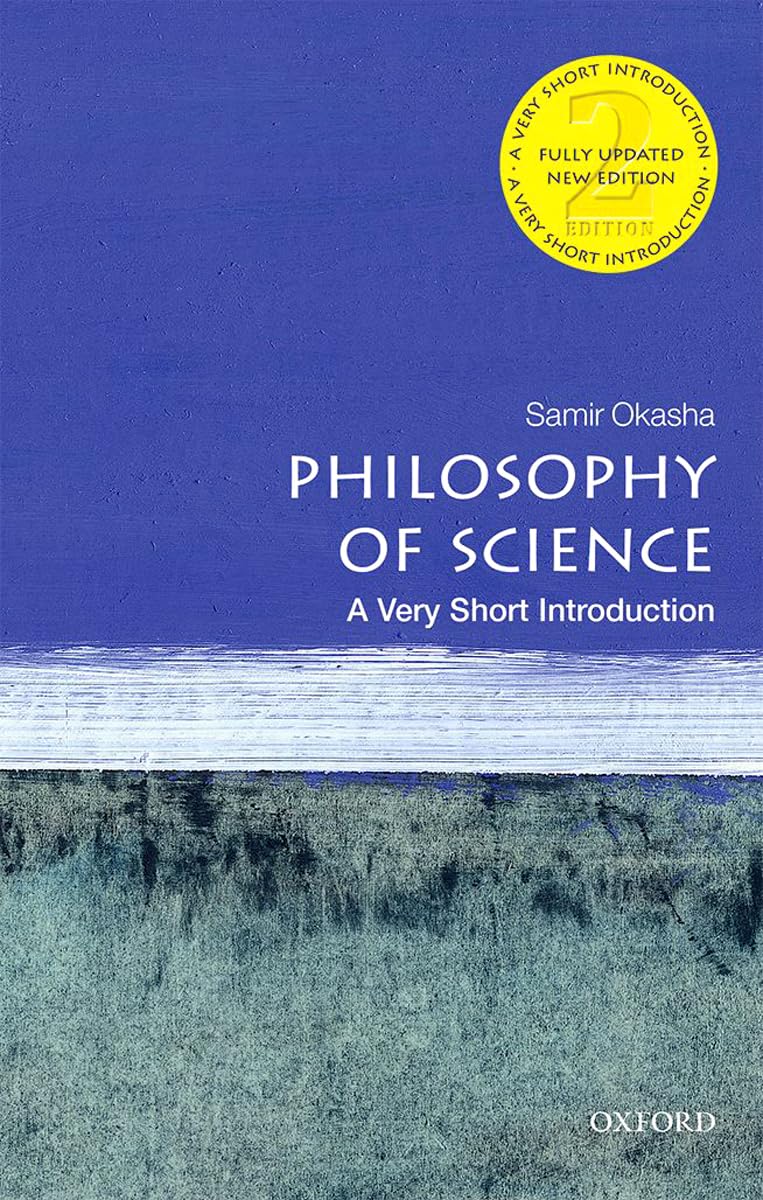
Philosophy of Science: A Very Short Introduction by Samir Okasha

Philosophy of Science: A Very Short Introduction by Samir Okasha

Regular price Tk 174.00 BDT
Regular price Sale price Tk 174.00 BDT
Sale Sold out
Book cover type
Quantity

Philosophy of Science: A Very Short Introduction by Samir Okasha offers an accessible introduction to the central questions and debates in the philosophy of science. It examines what distinguishes science from other forms of knowledge, how scientific reasoning and explanation work, and whether scientific theories accurately describe reality. Okasha discusses induction, causation, realism and anti-realism, scientific revolutions, and the way scientific ideas change over time. The book also explores philosophical problems arising in physics, biology, and psychology, before considering the relationship between science, society, criticism, and ethics. Written for readers without specialist philosophical training, it provides a compact framework for understanding how scientific knowledge is produced, justified, challenged, and interpreted. Read More

View full details

About Philosophy of Science: A Very Short Introduction by Samir Okasha – A Clear Guide to How Science Works, Reasons, Explains and Changes

Philosophy of Science: A Very Short Introduction by Samir Okasha is a compact guide to the big questions behind science. It does not teach one branch of science. Instead, it asks how science itself works. What makes a claim scientific? Why should we trust evidence? How do scientists move from facts to theories? What makes one explanation better than another? Can science tell us what the world is really like, or does it only give us useful models?

Okasha explains these questions in simple steps. He looks at the history of modern science, scientific reasoning, explanation, realism, scientific revolutions, and debates in physics, biology, and psychology. He also asks how science fits into society and whether scientific work can ever be fully free from values.

Understand what makes science different

Most people use the word science every day, but defining it is harder than it looks.

Science uses observation, experiments, measurement, theory, and reasoning. Yet not every claim that uses numbers or technical words is scientific. Okasha begins by asking what separates science from other ways of thinking.

The book looks at important moments in the rise of modern science, including the work of Copernicus, Kepler, Galileo, and Newton. These thinkers changed how people understood the universe because they did more than make claims. They connected ideas with observation, mathematics, and tests.

Okasha also introduces Karl Popper and the idea of falsifiability. Popper argued that a scientific theory should take risks. It should make claims that could, in principle, be shown false by evidence.

Learn how scientists reason from evidence

Science often moves from what we can see to ideas about things we cannot directly see.

A scientist may observe many cases and then form a general rule. This is called induction. It is useful, but it creates a famous problem. Just because something happened many times before does not prove that it must happen the same way next time.

Okasha introduces David Hume’s problem of induction in a clear way. Science depends on patterns, yet proving that future patterns must match past ones is not simple.

The book then looks at other forms of reasoning, including deduction, inference to the best explanation, causal reasoning, randomized experiments, probability, and Bayesian thinking.

See why a good explanation needs more than a correct fact

Science does more than collect facts. It tries to explain why things happen.

Okasha introduces the idea that an explanation may connect an event with a wider law. He then shows why this approach can fail if the information is not truly relevant to what happened.

The book also looks at causal explanation. In many cases, saying what caused an event feels more useful than simply showing that the event fits a rule.

This section is helpful because it shows that explanation is not the same as description. Knowing that something happened is different from knowing why it happened.

Realism asks whether scientific theories describe the real world

A major question in philosophy of science is whether successful theories tell us what reality is actually like.

Scientific realism says that our best scientific theories should often be taken seriously as descriptions of a real world, including things we cannot directly see, such as electrons or genes.

Anti-realism is more careful. A theory may be useful and make correct predictions without proving that every hidden thing in the theory exists exactly as described.

Okasha explains this debate without making it feel like a fight between simple right and wrong answers.

The issue matters because science often talks about things outside direct human sight. We trust instruments, models, equations, and effects to tell us about them.

Scientific knowledge can change in big jumps

Science does not always grow by adding one small fact after another.

Okasha discusses Thomas Kuhn and his famous work on scientific revolutions. Kuhn argued that scientists often work inside a shared framework, or paradigm. A paradigm guides what questions matter, what methods are normal, and what counts as a good answer.

When serious problems build up, a field may go through a scientific revolution. A new framework can replace the old one.

This idea helps explain why science has a history. Theories are not created outside time. Scientists work in communities, use accepted tools, and inherit ideas from earlier generations.

Physics raises questions about space and time

The book does not stay only at a general level. It also shows how philosophy appears inside individual sciences.

In physics, one example is the old debate between Newton and Leibniz about space.

Is space something that exists on its own, like a container in which objects move? Or is space only a way of describing relations between objects?

This may sound abstract, but it shows why physics and philosophy often meet. Scientists can measure motion, distance, and time, yet deeper questions remain about what those ideas mean.

Okasha uses examples like this to show that philosophy is not outside science looking in. It can help make scientific concepts clearer.

Biology shows that even simple labels can be difficult

People learn words such as species early in school, but defining a species is not always easy.

Okasha looks at biological classification and the problem of deciding how living things should be grouped.

Older systems focused on visible features. Modern biology can also use reproduction, ancestry, evolution, and genetic relationships. Different methods can produce different answers.

This creates a philosophical problem as well as a biological one. Are species fixed groups that exist clearly in nature, or are they partly ways humans organize a complex living world?

The book uses this problem to show why scientific categories matter. A label can shape research, explanation, and communication.

Psychology asks whether the mind has separate parts

The book also enters psychology through questions about how the mind is organized.

One idea is that the mind may contain different systems or modules that handle different kinds of tasks. Language, vision, memory, and other abilities may not all work in exactly the same way.

The example helps readers see how philosophy can work with psychology. Researchers can study behavior and the brain, while philosophers can ask what kind of explanation a theory gives and what assumptions it makes.

Science can be powerful without answering every question

Science has transformed medicine, transport, communication, agriculture, energy, and our picture of the universe.

That success can create another problem: should science be treated as the only reliable way to understand every important question?

Okasha discusses criticism of scientism, a word often used when people think science is being given too much authority outside the areas where its methods work best.

The book also examines debates involving science and religion and asks whether science can ever be fully value-free.

These topics matter because science exists inside society. People choose which research to fund, which risks to accept, and how discoveries should be used.

Why this short introduction is useful

Philosophy of Science: A Very Short Introduction gives readers a wide view without demanding a long academic commitment.

Its main strengths include:

  • A clear introduction to what makes science scientific.
  • Simple explanations of deduction, induction, probability, and inference.
  • A useful look at scientific explanation and causation.
  • An accessible guide to realism and anti-realism.
  • Discussion of Thomas Kuhn, paradigms, and scientific revolutions.
  • Examples from physics, biology, and psychology.
  • Questions about science, society, ethics, religion, and values.
  • A compact structure that works well for students and beginners.
  • Enough depth to prepare readers for more advanced philosophy of science.
  • Writing from a specialist who explains major debates without assuming expert knowledge.

Who should read this book?

This title is a strong choice for students of philosophy, science, physics, biology, psychology, history of science, and research methods.

It is also useful for people who read science news and want to judge claims more carefully. Understanding evidence, explanation, uncertainty, and theory can help readers ask better questions.

University students may use the book before a course or as a quick overview during study. Teachers can use it to introduce debates. General readers can use it as an entry point before reading longer works by Popper, Kuhn, Hume, or other thinkers.

The book can also help readers who work with data, technology, medicine, or research but have never studied philosophy. It gives them language for questions they may already ask at work: What counts as good evidence? When does a model explain rather than only predict? How much confidence should we place in a result? Can two theories explain the same facts? These questions matter whenever people must judge research or communicate uncertainty. The book does not replace specialist training, but it can make later study easier because readers learn the main problems, names, and debates before meeting them in academic texts.

Part of Oxford’s Very Short Introductions series

Oxford University Press publishes the book in its Very Short Introductions collection, a large academic series designed to make complex subjects clear and approachable.

The first edition of Samir Okasha’s book was published in 2002. Oxford published the second edition in 2016. The newer edition keeps the short format while covering scientific inference, explanation, realism, scientific change, problems in particular sciences, and criticism of science.

Because the series includes hundreds of subjects written by different experts, it is not a numbered sequence by Samir Okasha. Readers can choose individual Very Short Introductions without reading earlier volumes.

A premium reading copy from Bookish Wonderland

Bookish Wonderland offers a reader-friendly copy with premium eye-soothing cream paper, crystal-clear print, and high-quality stitched plus glue binding for better longevity. The cream paper gives the pages a softer reading surface, while the sharp print helps key terms and longer explanations remain easy to follow.

For readers comparing the Book price in Bangladesh for Philosophy of Science: A Very Short Introduction by Samir Okasha, Bookish Wonderland offers a convenient local option for ordering this Oxford philosophy title.

Nationwide delivery is available across Bangladesh, including inside and outside Dhaka. Cash on delivery is available, and fast or urgent delivery options may also be available in Dhaka.

A better way to think about scientific claims

Instead of accepting or rejecting a claim too quickly, you can ask what evidence exists, what kind of reasoning connects the evidence to the conclusion, whether another explanation fits, and how certain the result really is.

These habits are useful far beyond a philosophy class. They can help with news, education, research, health claims, technology debates, and everyday discussions about evidence.

Start asking deeper questions about how science works

Philosophy of Science: A Very Short Introduction by Samir Okasha shows that science is not only a collection of facts. It is also a way of reasoning, explaining, testing, changing ideas, and debating what evidence can support.

The book takes large questions and makes them manageable. You can learn why induction is difficult, why scientific explanations need care, why theories can change, and why even words such as species, space, and objectivity may contain philosophical problems.

Order Philosophy of Science: A Very Short Introduction by Samir Okasha from Bookish Wonderland and explore the questions that sit behind experiments, theories, evidence, explanation, and the changing world of science.

If you require any customization or have any questions, please inbox us via FB or Insta.

Primary Specification
AuthorSamir Okasha
NarratorLiam Gerrard
GenrePhilosophy, Philosophy of Science, Science & Philosophy
ISBN-13/ISSN 978-0198745587
ISBN-100198745583
PublisherOxford University Press
Publishing Date ‎ September 28, 2016
Edition2nd
LanguageEnglish
Reading Age16+
FormatPrinted book
Physical Specification & Quality
Paper QualityPremium eye-soothing cream paper
Binding QualityHigh quality stitched and glue binding (for longevity)
Print QualityCrystal-clear print
Pages160 pages
CountryUK
Logistics Information
Weight185 gm
Length8.5 inches
Width5.6 inches
Height0.35 inch
What is Philosophy of Science: A Very Short Introduction by Samir Okasha about?

Philosophy of Science: A Very Short Introduction by Samir Okasha explains the major philosophical questions that arise when we ask how science actually works. Instead of simply presenting scientific discoveries, the book asks deeper questions such as: What distinguishes science from pseudoscience? Can scientific theories ever be proven with certainty? Why should we trust induction? What makes one scientific explanation better than another? Does science describe reality as it truly exists, or does it merely provide useful models for predicting observations? Okasha introduces these questions through important ideas from philosophers such as Karl Popper, David Hume, and Thomas Kuhn, while also drawing examples from physics, biology, and psychology. The book is designed as a concise introduction rather than a specialist academic treatise, making it particularly useful for students and general readers interested in science, philosophy, epistemology, scientific reasoning, and the foundations of scientific knowledge.

How many books from the Very Short Introductions series by Samir Okasha are in the provided list, and what are they?

There are no books in a series for Philosophy of Science: A Very Short Introduction by Samir Okasha. It is a standalone Non-fiction book.

Is Philosophy of Science: A Very Short Introduction suitable for beginners?

Yes. The book is widely recommended as an accessible starting point for readers who have little or no previous experience with philosophy of science. Okasha introduces difficult questions in relatively concise language and does not assume that readers already possess advanced knowledge of philosophy, physics, biology, or formal logic. Discussions in philosophy communities frequently recommend the book to newcomers because it is organized around the major debates of the field rather than overwhelming readers with excessive historical detail. However, “short introduction” does not mean completely effortless reading. Subjects such as induction, scientific realism, falsifiability, causation, probability, and theory change require careful thought. Readers may occasionally need to reread a paragraph or pause to consider an argument. That intellectual challenge is part of the book’s value, making it useful for university students, science enthusiasts, philosophy beginners, and anyone who wants to think more critically about how scientific knowledge is produced.

What philosophy of science topics and concepts are covered in the book?

The book introduces a broad range of foundational topics, including scientific reasoning, induction, deduction, probability, explanation, falsifiability, realism and anti-realism, scientific revolutions, theory change, observation, evidence, and the relationship between science and society. Okasha also examines philosophical problems arising within particular sciences, including questions about space and time in physics, biological classification and species, and problems concerning the mind in psychology. Readers are introduced to figures such as David Hume, Karl Popper, Thomas Kuhn, Isaac Newton, Gottfried Leibniz, Charles Darwin, and other thinkers whose ideas shaped debates about science. Rather than merely listing philosophical theories, the book explains why each problem matters. For example, if scientific reasoning relies heavily on observations from the past, philosophers must ask what justifies expecting similar patterns in the future. This makes the book useful for understanding both scientific practice and the philosophical assumptions beneath it.

What does Samir Okasha explain about Karl Popper, falsifiability, and the difference between science and pseudoscience?

One of the important questions discussed in the book is the demarcation problem: how can we distinguish genuine science from claims that only appear scientific? Okasha introduces Karl Popper’s famous idea of falsifiability. Popper argued that a scientific theory should expose itself to the possibility of being shown false by evidence. According to this view, simply accumulating observations that agree with a theory is not enough; a strong scientific theory must make claims that could potentially fail. Okasha uses this discussion to show both why Popper’s proposal became influential and why distinguishing science from pseudoscience is more complicated than applying a single simple rule. The discussion is valuable for readers interested in evaluating scientific claims, understanding how theories are tested, or recognizing why debates about evidence matter. It also encourages readers to think critically about claims that present themselves as scientific without accepting meaningful possibilities of refutation.

What is the problem of induction, and how does Philosophy of Science explain it?

The problem of induction asks how we can justify reasoning from observed cases to unobserved ones. For example, scientists repeatedly observe patterns in nature and then use those observations to make predictions about future events or situations they have not directly examined. David Hume famously argued that there is a philosophical problem here: we cannot justify induction simply by saying it has worked successfully in the past without using induction itself. Okasha explains the difference between deductive and inductive reasoning and shows why this issue matters to scientific methodology. Science depends heavily on drawing general conclusions from limited evidence, so the problem is not merely an abstract philosophical puzzle. The book also introduces related ideas such as probability and inference to the best explanation. This section is particularly useful for readers who want to understand why scientific knowledge can be highly reliable without necessarily amounting to absolute logical certainty.

What are scientific realism and anti-realism in Philosophy of Science: A Very Short Introduction?
Scientific realism and anti-realism concern what we should believe about the entities and structures described by successful scientific theories. A scientific realist generally argues that successful science aims to describe the world as it actually exists, including unobservable entities such as electrons or other theoretical structures. Anti-realists are more cautious, often arguing that a theory may be valuable because it predicts observable phenomena successfully without requiring us to believe that every unobservable entity described by the theory literally corresponds to reality. Okasha introduces arguments on both sides, including discussions about the success of science, observation, underdetermination, and the distinction between observable and unobservable entities. This debate is one of the most important parts of modern philosophy of science because it asks what scientific success really tells us about reality. Readers interested in physics, scientific truth, epistemology, or the limits of human knowledge may find this section particularly engaging.
Does the book discuss Thomas Kuhn and scientific revolutions?
Yes. Philosophy of Science: A Very Short Introduction examines scientific change and the influential ideas associated with Thomas Kuhn. Kuhn challenged the simple picture of science progressing only through the steady accumulation of facts. His work emphasized periods of “normal science,” during which researchers largely operate within a shared framework or paradigm, followed by crises and potentially revolutionary changes in scientific thinking. Famous historical shifts—such as major changes in astronomy or physics—raise questions about whether newer theories simply add more knowledge or sometimes reorganize how scientists interpret evidence itself. Okasha uses this debate to examine whether there is a clear pattern to scientific development and whether competing scientific frameworks can always be compared in a straightforward way. This discussion helps readers understand that science has a history shaped not only by experiments and discoveries but also by conceptual changes in how researchers understand problems, evidence, and acceptable explanations.
Is Philosophy of Science: A Very Short Introduction a premium edition at Bookish Wonderland?

Yes. Bookish Wonderland offers Philosophy of Science: A Very Short Introduction as a premium edition intended for readers who want a comfortable and durable physical copy for study, reference, and personal collection. This type of book benefits particularly from good physical production because philosophical arguments are often reread rather than absorbed in one continuous pass. Students may return repeatedly to sections on induction, falsifiability, scientific realism, Kuhn, explanation, or the philosophy of particular sciences when preparing assignments or revising concepts. Clear printing keeps arguments and terminology easy to follow, while quality pages create a more pleasant study experience. The edition is suitable for philosophy students, science students, teachers, researchers, critical thinkers, and general readers who want a concise but intellectually substantial introduction to questions about scientific knowledge, evidence, truth, and reasoning.

What is the paper and print quality of Philosophy of Science: A Very Short Introduction from Bookish Wonderland?

The Bookish Wonderland edition features premium eye-soothing cream paper combined with crystal-clear printing. Cream-toned paper offers a softer background than extremely bright white pages, which can make sustained academic reading more comfortable for many readers. Clear printing is especially valuable in a philosophy book because readers need to distinguish arguments, terminology, names, examples, and conceptual distinctions without being distracted by unclear text reproduction. Students may spend extended periods working through sections on induction, explanation, realism, scientific revolutions, or philosophical problems within physics and biology, so comfortable paper can improve the overall reading experience. The clean physical presentation also makes it easier to revisit important sections during revision or discussion. Combined with durable construction, the paper and print quality make the book suitable for regular academic use as well as long-term placement in a personal philosophy or science library.

How durable is the binding of Philosophy of Science: A Very Short Introduction from Bookish Wonderland?

The book comes with high-quality stitched and glue binding designed for longevity. Combining stitching with adhesive helps keep the pages firmly secured during repeated opening, study, transport, revision, and long-term storage. This is particularly useful for an academic reference book because readers may repeatedly return to specific chapters rather than reading it once and placing it permanently on a shelf. A university student might revisit the chapter on scientific inference before an examination, while another reader may return to realism and anti-realism or the discussion of scientific revolutions months later. Repeated use places additional pressure on poorly constructed books, so stronger binding provides meaningful practical value. The durable structure makes this edition appropriate for students, educators, researchers, book clubs, and readers developing a permanent collection of philosophy, science, epistemology, and critical-thinking books.

Why should I buy Philosophy of Science: A Very Short Introduction by Samir Okasha from Bookish Wonderland in Bangladesh?

Bookish Wonderland provides a convenient option for readers looking to buy Philosophy of Science: A Very Short Introduction by Samir Okasha and other premium English academic books in Bangladesh. The edition combines premium eye-soothing cream paper, crystal-clear printing, and high-quality stitched and glue binding, creating a comfortable physical copy for study, revision, personal reading, and long-term reference. Cash on Delivery is available across Bangladesh, allowing customers to place an order and pay when the book arrives. Delivery is available both inside and outside Dhaka, while customers in Dhaka can also request fast or urgent delivery when available. Bookish Wonderland maintains a large collection of premium and durable English books covering philosophy, science, psychology, economics, business, literature, technology, self-development, and many other subjects, making it easier for students and general readers throughout Bangladesh to build a high-quality personal or academic library.