

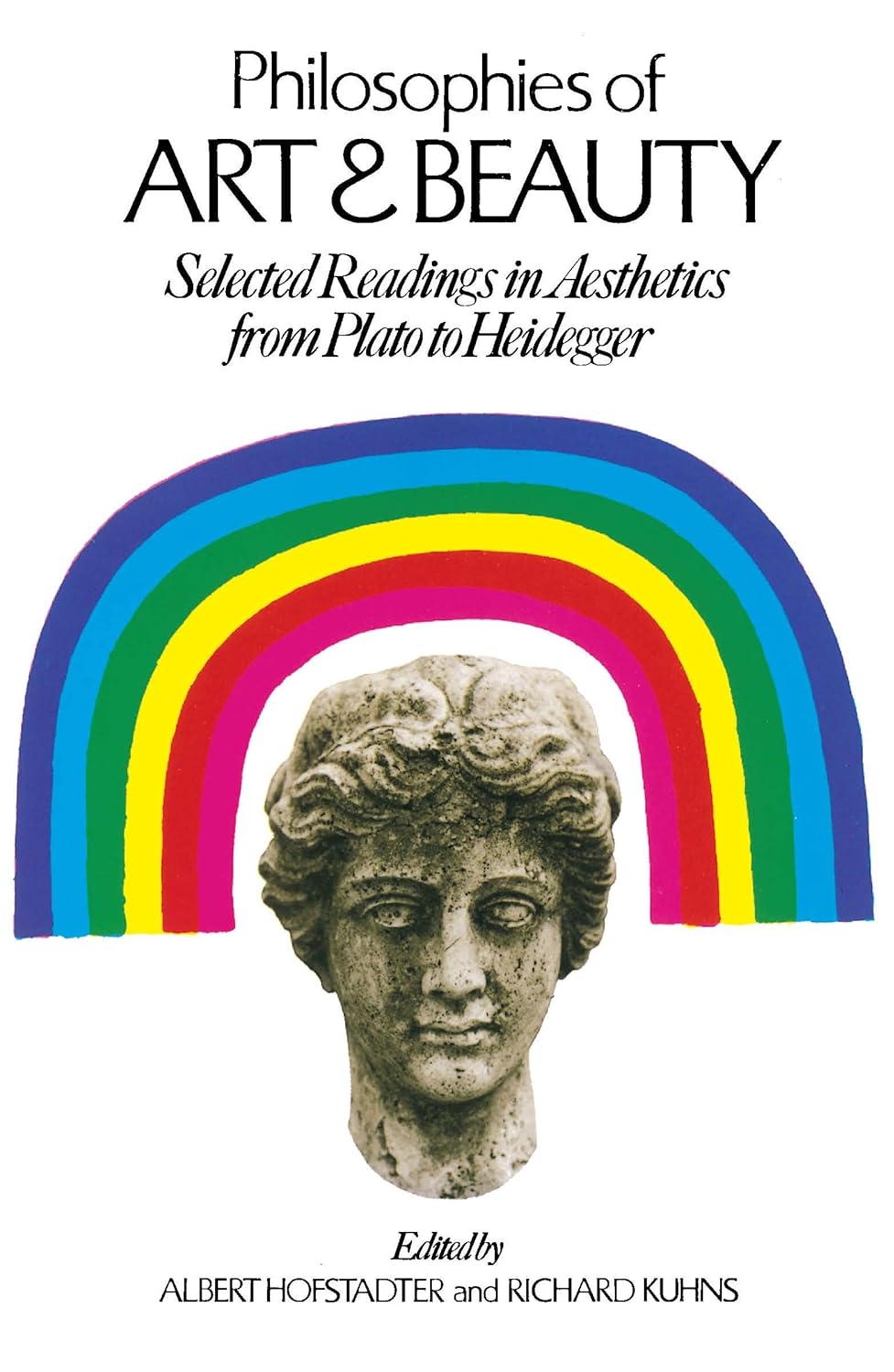
About Philosophies of Art and Beauty: Selected Readings in Aesthetics from Plato to Heidegger Edited by Albert Hofstadter & Richard Kuhns – A Major Guide to Art, Beauty, Representation and Aesthetic Thought
Philosophies of Art and Beauty: Selected Readings in Aesthetics from Plato to Heidegger, edited by Albert Hofstadter and Richard Kuhns, is a wide-ranging anthology for readers who want to understand how major philosophers have thought about art, beauty, creativity, imitation, taste, representation, and artistic experience. Instead of giving only one modern explanation, the book lets readers meet important thinkers directly through selected primary texts.
The collection moves from ancient Greek philosophy to twentieth-century thought. It includes selections from Plato, Aristotle, Plotinus, Augustine, Marsilio Ficino, the Earl of Shaftesbury, Immanuel Kant, Friedrich Schelling, G. W. F. Hegel, Arthur Schopenhauer, Friedrich Nietzsche, Benedetto Croce, John Dewey, and Martin Heidegger. The editors also provide an overall introduction and short introductory essays that help place each selection in context.
For students of philosophy, art history, literature, criticism, design, or cultural studies, this book offers a strong foundation. It shows that questions about art are never only about whether something looks beautiful. They can also involve truth, knowledge, society, emotion, imagination, skill, religion, history, and the way human beings understand the world.
Start with the biggest question: what is art?
The question sounds simple, but philosophers have answered it in very different ways.
For Plato, art can raise concerns about imitation and truth. If a painting, poem, or performance copies the visible world, and the visible world itself is already separate from ideal truth, then art may seem several steps away from reality. Yet Plato also writes about beauty, inspiration, and the powerful effect art can have on the soul.
Aristotle takes another path. He thinks seriously about imitation, craft, form, and the way art can represent human action. His ideas became central to later thinking about drama, poetry, and artistic structure.
By placing these early thinkers near later philosophers, the anthology lets readers see how one basic question keeps changing. Is art imitation? Expression? Form? Experience? Revelation? A way of knowing? A social act?
The book does not force one final answer. It gives readers the materials needed to compare different positions and build their own understanding.
See how ideas about beauty change across history
Beauty is one of the oldest subjects in aesthetics, but its meaning is never fixed.
Ancient thinkers often connect beauty with order, proportion, harmony, goodness, or higher forms of reality. Later Christian and Renaissance thinkers connect beauty with spiritual order, divine creation, and the relation between earthly and higher forms.
By the time readers reach modern philosophers such as Kant, the discussion becomes more focused on judgment. Why do people call something beautiful? Is beauty only personal preference, or does a judgment of beauty make some claim that others should agree?
These questions are still familiar today. Two people can look at the same painting, film, building, song, or design and react differently. Yet people also argue as if some judgments are better informed, more sensitive, or more reasonable than others.
The anthology helps readers understand where these debates came from and why they remain difficult.
Read the philosophers instead of only reading about them
One of the main strengths of this volume is that it is an anthology of primary texts.
A short textbook can summarize what Kant, Hegel, Nietzsche, Dewey, or Heidegger thought. That can be useful, but a summary always passes through another writer. This book lets readers encounter substantial selections from the philosophers themselves.
That makes it especially useful for university study. Students can compare an instructor's explanation with the original argument. They can quote from primary sources in essays, examine how a philosopher builds a claim, and notice details that a short summary may leave out.
The editors do not leave readers completely alone. Their introductions help explain the place of each thinker and the role of the selected text. This creates a balance between guidance and direct reading.
For beginners, that structure can make difficult philosophy more manageable. For advanced readers, it provides a convenient sourcebook that gathers major texts in one volume.
Plato and Aristotle show why imitation became a major debate
Plato worries that imitation can move people emotionally while taking them away from truth. Aristotle gives imitation a more positive role, showing how art can represent human action in meaningful forms. Reading them together helps explain why representation became one of aesthetics' oldest problems. Modern debates about film, advertising, social media, games, and political images still ask a related question: does art merely copy reality, or can representation shape how people understand reality?
Kant makes aesthetic judgment a serious philosophical problem
Kant is one of the most influential thinkers in the history of aesthetics.
His writing asks how judgments of beauty are possible. When someone says, “This is beautiful,” the statement seems different from saying, “I like this food.” A judgment of beauty often carries an expectation that other people should be able to see the beauty too, even though beauty is not measured like height or weight.
Kant explores pleasure, judgment, purpose, and the relation between personal experience and claims that feel universal.
These ideas can be challenging, but they are highly useful for understanding later aesthetics. They help readers think more carefully about taste, criticism, and why arguments about art are not always settled by saying that everyone simply has a different opinion.
The anthology gives readers a direct route into these questions while the editors provide enough context to help with the difficult language.
Hegel and Schelling connect art with larger philosophical systems
Schelling and Hegel treat art as part of wider accounts of mind, nature, history, and spirit. Art can express ideas that ordinary statements cannot fully capture, while different forms of art can belong to different cultural moments. This approach is useful for art history and cultural studies because it connects individual works with larger beliefs, conflicts, and historical structures rather than treating art as an isolated object.
Nietzsche asks what art can do for life
In selections from The Birth of Tragedy, Nietzsche studies Greek tragedy through the tension between Apollonian form and Dionysian intensity. Art, for him, is not merely decoration; it can help people face suffering and contradiction. His writing is especially useful for readers of literature, theatre, music, psychology, and cultural theory because it asks why tragic art can give meaning or pleasure even when its subject is painful.
Dewey brings aesthetic experience into everyday life
John Dewey shifts attention from the isolated artwork to aesthetic experience. Art grows from the ways people act, feel, make, observe, and interact with their surroundings. This makes aesthetics less remote from ordinary life and is especially useful for readers in education, design, performance, communication, and visual culture. Dewey encourages readers to ask not only what an artwork is, but what happens when a person experiences it.
Heidegger asks what a work of art reveals
Martin Heidegger's “The Origin of the Work of Art” asks what a work of art is and how it can disclose a world. An artwork, on this view, may reveal ways of living, believing, working, or understanding that ordinary statements cannot fully capture. The University of Chicago Press notes that the Schelling and Heidegger essays received special translation attention in this volume, making the anthology an important English-language route into influential continental aesthetics.
What makes this anthology useful for serious study
The collection is designed as more than a casual overview. It gives readers substantial material for comparison, coursework, essays, and long-term reference.
Its strongest features include:
- Primary readings from major philosophers rather than only secondary summaries.
- A historical range from Plato and Aristotle to Dewey and Heidegger.
- Editorial introductions that help readers understand each selection.
- Major debates about beauty, imitation, representation, taste, creativity, and experience.
- Connections between aesthetics and larger philosophical systems.
- Material useful for philosophy, art history, literary criticism, cultural studies, and design.
- A large 728-page sourcebook published by the University of Chicago Press.
- English translations gathered into one convenient academic volume.
- Strong value for students who need primary sources for essays or classroom discussion.
- A structure that makes it possible to compare thinkers across different historical periods.
Who should read Philosophies of Art and Beauty?
This book is best suited to university students, teachers, researchers, artists, designers, writers, critics, and serious general readers who want to understand aesthetics at a deeper level.
Philosophy students can use it as a sourcebook for courses on aesthetics. Art-history students can study the ideas that shaped ways of interpreting art. Literature students can connect theories of representation, expression, tragedy, and beauty with poems, novels, and drama.
The book is demanding in places, but readers do not need to understand every philosopher immediately. It can be read slowly, one thinker at a time, with notes and discussion.
A premium reading copy from Bookish Wonderland
A 728-page academic anthology is likely to be opened many times, so physical reading quality matters. Bookish Wonderland offers a reader-friendly copy with premium eye-soothing cream paper, crystal-clear print, and high-quality stitched plus glue binding for better longevity.
The cream paper gives long philosophical readings a softer surface, while the sharp print helps dense passages remain clear. The durable binding is useful for repeated study, highlighting, note taking, and reference.
For readers comparing the Book price in Bangladesh for Philosophies of Art and Beauty: Selected Readings in Aesthetics from Plato to Heidegger edited by Albert Hofstadter & Richard Kuhns, Bookish Wonderland offers a convenient local option for ordering this major aesthetics anthology.
Nationwide delivery is available across Bangladesh, including inside and outside Dhaka. Cash on delivery is available, and fast or urgent delivery options may also be available in Dhaka.
A long-lasting reference for understanding art and beauty
The value of this book comes from comparison. A reader can place Plato beside Aristotle, Kant beside Hegel, Nietzsche beside Dewey, or ancient ideas beside twentieth-century thought.
Those comparisons show that art has never had one simple philosophical meaning.
Sometimes art is treated as imitation. Sometimes it is connected with truth. Sometimes beauty becomes the central problem. Sometimes experience, history, expression, or existence becomes more important.
That variety is exactly why the anthology remains useful. It does not simplify two thousand years of debate into one answer. It gives readers a map of the arguments and lets them see how later thinkers respond to earlier ones.
Explore the ideas behind the art we create and value
Philosophies of Art and Beauty: Selected Readings in Aesthetics from Plato to Heidegger edited by Albert Hofstadter and Richard Kuhns is a substantial guide to the philosophical questions behind artistic creation and aesthetic experience.
Across its selections, readers encounter different answers to basic but difficult questions: What is art? What is beauty? Why do human beings create? Can an artwork contain truth? Is taste personal or shareable? How does art relate to history, society, religion, emotion, and human existence?
If you study philosophy, art history, literature, criticism, or design, this volume can serve as both a course companion and a long-term reference.
Order Philosophies of Art and Beauty edited by Albert Hofstadter and Richard Kuhns from Bookish Wonderland and explore major ideas about art, beauty, representation, experience, and creativity through the words of the philosophers who shaped the debate.
If you require any customization or have any questions, please inbox us via FB or Insta.
| Primary Specification | |
| Author | Plato |
| Editor | Albert Hofstadter & Richard Kuhns |
| Genre | Philosophy, Aesthetics, Art Theory |
| ISBN-13/ISSN | 978-0226348124 |
| ISBN-10 | 0226348121 |
| Publisher | University of Chicago Press |
| Publishing Date | August 15, 1976 |
| Edition | 1st |
| Language | English |
| Reading Age | 18+ |
| Format | Printed book |
| Physical Specification & Quality | |
| Paper Quality | Premium eye-soothing cream paper |
| Binding Quality | High quality stitched and glue binding (for longevity) |
| Print Quality | Crystal-clear print |
| Pages | 728 pages |
| Country | USA |
| Logistics Information | |
| Weight | 750 gm |
| Length | 8.5 inches |
| Width | 5.6 inches |
| Height | 1.36 inch |