Skip to product information
1 of 1

Bookish Wonderland

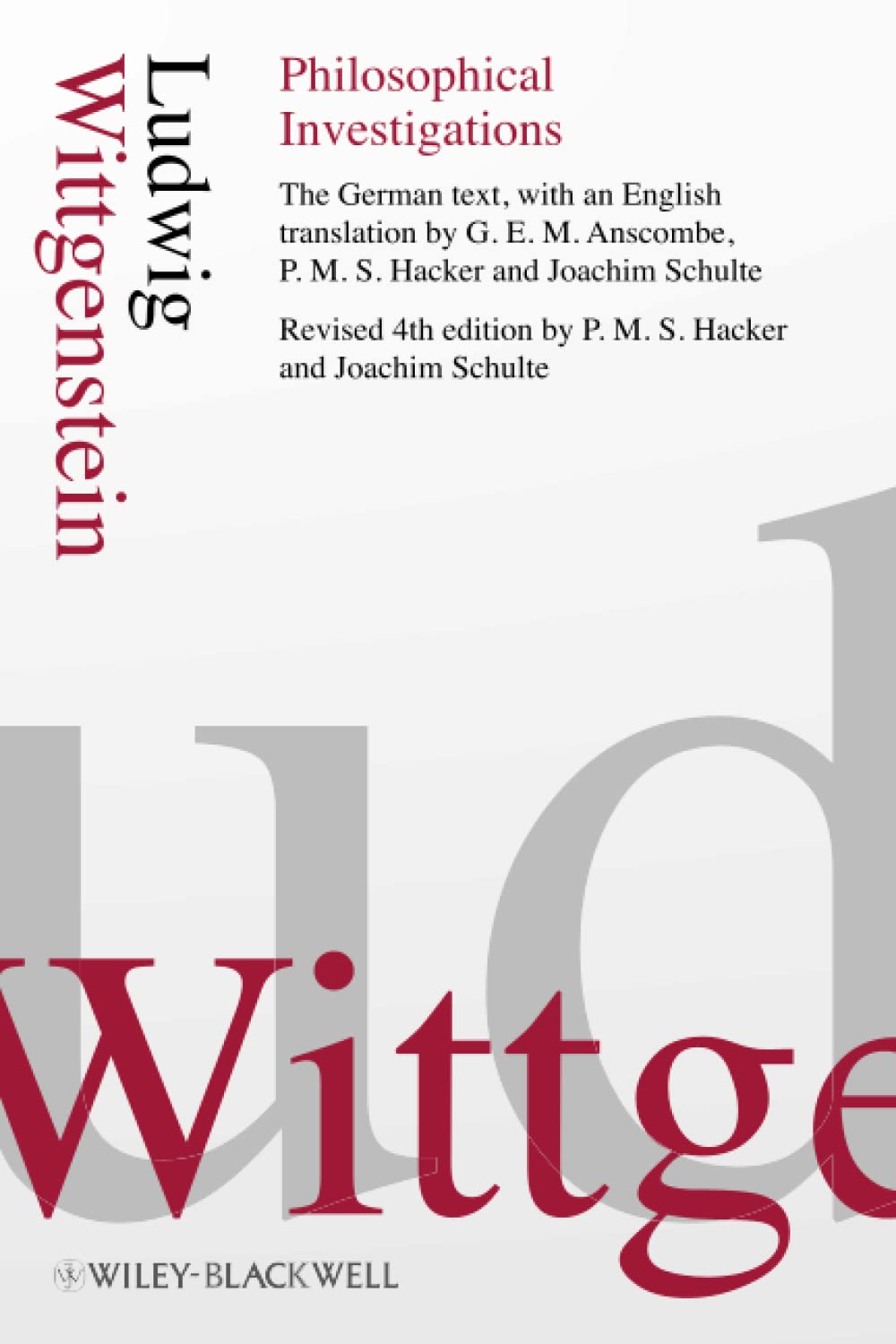
Philosophical Investigations by Ludwig Wittgenstein

Philosophical Investigations by Ludwig Wittgenstein

Regular price Tk 456.00 BDT
Regular price Sale price Tk 456.00 BDT
Sale Sold out
Book cover type
Quantity

Philosophical Investigations is Ludwig Wittgenstein’s influential examination of language, meaning, understanding, and the way philosophical problems arise. Moving away from many ideas in his earlier work, Wittgenstein argues that the meaning of a word is closely connected to how it is used within particular human activities or “language-games.” Through short remarks, examples, questions, and thought experiments, he explores rule-following, private language, sensation, thinking, consciousness, and communication. Rather than constructing a conventional philosophical theory, Wittgenstein attempts to dissolve philosophical confusion by examining how language actually functions in everyday life. Published posthumously, the work became a foundational text in twentieth-century analytic philosophy and remains especially important in philosophy of language and philosophy of mind. Read More

View full details

About Philosophical Investigations by Ludwig Wittgenstein – A Major Guide to Language, Meaning, Rules and the Problems Philosophy Creates

Philosophical Investigations by Ludwig Wittgenstein is one of the most influential works of twentieth-century philosophy. Instead of building one large theory, Wittgenstein examines many small puzzles about words, meaning, understanding, thought, rules, sensation, and the way people use language in everyday life. His central message is simple to state but deep to explore: words get much of their meaning from how they are used.

The book was published after Wittgenstein’s death in 1953. It marked a major shift from the approach of his earlier work, Tractatus Logico-Philosophicus. In Philosophical Investigations, he often writes in short numbered remarks, examples, questions, imagined conversations, and thought experiments. This unusual style asks the reader to slow down and notice how ordinary language actually works.

For students of philosophy, language, logic, psychology, linguistics, and critical thinking, this book offers a powerful way to question assumptions that seem obvious until we examine them closely.

Meaning becomes clearer when you look at use

One of the most famous ideas connected with Philosophical Investigations is that the meaning of a word is often found in its use in language.

Think about the word “game.” Football, chess, hide-and-seek, and card games are all called games, but they do not all share one single feature. Some have winners. Some do not. Some need skill. Some depend on chance. Some are played alone. Others need teams.

Wittgenstein uses examples like this to challenge the idea that every word must have one hidden essence behind it.

Instead, he asks us to look at how people actually use words in different situations.

This change is important. Many philosophical problems begin when we remove a word from normal life and then ask what it must mean in every possible case. Wittgenstein’s method is to return the word to the situations where people really use it.

Language-games show that words can do many jobs

Wittgenstein uses the idea of “language-games” to show that speaking is not one single activity.

People use language to ask questions, give orders, tell jokes, pray, report facts, make promises, describe objects, solve problems, thank others, warn someone, and much more.

The same word can behave differently in different language-games. A sentence that makes sense in a classroom may work differently in a courtroom, family conversation, scientific paper, or shop.

This idea helps readers see language as an activity rather than a box of labels attached to things.

Words work because people share practices and understand what counts as using them correctly in a situation. Meaning is therefore connected with action, context, and shared human life.

Family resemblance explains categories without one perfect rule

Another well-known idea in the book is family resemblance.

Members of a family may look alike without every person sharing one exact feature. One child has the father’s eyes. Another has the mother’s smile. Two siblings may share the same hair. The similarities overlap without creating one feature found in everyone.

Wittgenstein suggests that many concepts work like this.

The word “game” is the classic example. We recognize a network of similarities rather than finding one definition that covers every case perfectly.

This idea can help readers think about categories in everyday life. Not every useful concept needs a strict border. Sometimes we understand a word because we have learned many examples and can see how they are related.

Rules do not apply themselves

A rule can look clear on paper, but someone still has to know how to follow it.

Wittgenstein asks what it means to follow a rule correctly. If a person continues a number series, uses a word, or follows an instruction, how do we know that the next step fits the rule?

A written rule cannot explain every possible future case by adding endless extra rules. At some point, people act within shared practices.

This leads to one of the book’s important lessons: understanding a rule is not only having a private idea in your head. It is shown in what you can do.

Learning a language works the same way. Children do not normally learn every word through formal definitions. They learn through correction, examples, repetition, shared activities, and life with other people.

Private language raises questions about inner experience

Pain feels deeply personal. Only you directly feel your own pain.

This can make it tempting to think that words for sensations get their meaning from private objects hidden inside each person’s mind.

Wittgenstein challenges that picture.

He asks how a completely private language could have rules if no public standard could ever show whether a word was used correctly. If only one person could understand a sign and there were no way to distinguish remembering correctly from merely thinking one remembered correctly, the idea of a rule becomes difficult.

This does not mean pain is unreal or that everyone feels the same thing. The point is about language.

Words such as “pain” belong to public human practices. We learn them through behavior, situations, reactions, teaching, and shared forms of life.

The mind is not a hidden machine behind every action

Philosophical Investigations often questions the picture of the mind as a private inner place where meanings, thoughts, and intentions sit like objects.

Wittgenstein asks readers to pay attention to how mental words are actually used.

This approach does not deny mental life. It asks us not to create extra mysteries by using misleading pictures.

For readers interested in psychology and philosophy of mind, this part of the book can be especially valuable.

Philosophy becomes a way of clearing confusion

Wittgenstein does not present philosophy as a science that discovers hidden objects.

He often treats philosophy as work that clears up confusion created by language.

A philosophical problem may feel impossible because we are using a word outside the setting where it normally has a clear job. We then become trapped by a picture created by grammar.

The solution is not always a new theory. Sometimes the solution is to look carefully at the ordinary use of the words involved.

This is why Wittgenstein’s style contains so many examples and questions. He wants readers to see a problem from another angle.

The goal is not to make language perfectly simple. It is to stop being controlled by a misleading picture.

The book asks you to participate rather than only receive answers

Philosophical Investigations is not written like a normal textbook.

Wittgenstein frequently asks questions and leaves space for readers to work through them. He introduces a picture, challenges it, changes the example, and then asks what has gone wrong.

This can make the book difficult at first. It can also make it rewarding.

Instead of memorizing conclusions, readers practice a method of thinking. You learn to slow down, test an idea against examples, notice how a word changes across contexts, and question assumptions hidden inside a sentence.

That is one reason the book is still widely studied. It does not only give arguments. It trains attention.

What makes Philosophical Investigations important

The book has influenced philosophy of language, philosophy of mind, logic, psychology, linguistics, social theory, and many later debates about meaning and rules.

Key reasons readers study it include:

  • The idea that meaning is closely connected with use.
  • The concept of language-games and the many functions of speech.
  • The idea of family resemblance for understanding categories.
  • Deep questions about rule-following and correct use.
  • The private-language discussion and its impact on philosophy of mind.
  • A new way of thinking about understanding, intention, memory, and sensation.
  • A philosophical method focused on clearing conceptual confusion.
  • Short numbered remarks that allow slow, careful reading.
  • Major influence on later analytic philosophy and ordinary-language philosophy.
  • Strong value for students who want to understand twentieth-century thought.

Who should read this book?

Philosophical Investigations is best suited to philosophy students, teachers, researchers, and serious general readers who are willing to read slowly.

It is especially useful for people studying philosophy of language, philosophy of mind, logic, linguistics, cognitive science, or analytic philosophy.

Writers and readers interested in language may also find it valuable because it changes the way familiar words look. The book asks us to notice how much meaning depends on context, practice, and shared habits.

Beginners can read it, but they should not expect every remark to feel easy on the first attempt. It often helps to read a small section, think about the examples, and return later.

The fourth edition gives readers a major scholarly text

Wiley-Blackwell’s fourth edition was published in 2009 and runs to 592 pages in the listed hardcover edition.

It was edited by P. M. S. Hacker and Joachim Schulte. The edition revises and updates G. E. M. Anscombe’s English translation and presents German and English facing each other.

The editors also made changes intended to reflect Wittgenstein’s manuscripts more closely, including the treatment of notes and the section now titled Philosophy of Psychology – A Fragment.

This makes the fourth edition especially useful for students and researchers who want a carefully prepared scholarly text.

A premium reading copy from Bookish Wonderland

A demanding philosophy book is often read slowly and returned to many times, so physical reading comfort matters.

Bookish Wonderland offers a reader-friendly copy with premium eye-soothing cream paper, crystal-clear print, and high-quality stitched plus glue binding for better longevity. The cream paper gives long reading sessions a softer surface, while the clear print helps dense passages and numbered remarks remain easy to follow.

For readers comparing the Book price in Bangladesh for Philosophical Investigations by Ludwig Wittgenstein, Bookish Wonderland offers a convenient local option for ordering this major work of twentieth-century philosophy.

Nationwide delivery is available across Bangladesh, including inside and outside Dhaka. Cash on delivery is available, and fast or urgent delivery options may also be available in Dhaka.

Why this book still matters

Many modern debates about language, mind, rules, artificial intelligence, interpretation, and social meaning still touch questions Wittgenstein explored.

When people ask whether a word has one fixed meaning, whether an intelligent system truly understands, whether rules can cover every possible case, or how private experience becomes public language, they are close to problems found in Philosophical Investigations.

The book remains relevant because language remains central to human life.

We think through words, teach with words, argue with words, write laws with words, make promises with words, and build social practices through language. Confusion about words can therefore become confusion about larger problems.

Wittgenstein teaches readers to examine those problems carefully before building a complicated theory around them.

Read a philosophy classic that changes how ordinary language looks

Philosophical Investigations by Ludwig Wittgenstein can make familiar things feel strange in a useful way.

A simple word such as “game,” “pain,” “rule,” “understand,” or “remember” becomes the start of a deeper question. Wittgenstein then asks you to look at what people actually do with that word instead of searching immediately for an invisible essence behind it.

The result is a book that can change how you think about language and philosophy itself.

It is not designed to be rushed. Read a few remarks, test the examples against everyday life, and allow the questions to work slowly.

For students and serious readers who want to understand one of the major turning points in modern philosophy, this is an essential title.

Order Philosophical Investigations by Ludwig Wittgenstein from Bookish Wonderland and explore a landmark work about language, meaning, rules, thought, understanding, and the ways philosophical confusion can begin with the words we use.

If you require any customization or have any questions, please inbox us via FB or Insta.

Primary Specification
AuthorLudwig Wittgenstein
EditorP. M. S. Hacker and Joachim Schulte
GenrePhilosophy; Philosophy of Language; Philosophy of Mind
ISBN-13/ISSN 978-1405159289
ISBN-101405159286
PublisherWiley-Blackwell
Publishing DateOctober 19, 2009
Edition4th
LanguageEnglish
Reading Age18+
FormatPrinted book
Physical Specification & Quality
Paper QualityPremium eye-soothing cream paper
Binding QualityHigh quality stitched and glue binding (for longevity)
Print QualityCrystal-clear print
Pages‎ 592 pages
CountryUK
Logistics Information
Weight612 gm
Length8.5 inches
Width5.6 inches
Height1.4 inch
What is Philosophical Investigations by Ludwig Wittgenstein about?

Philosophical Investigations is Ludwig Wittgenstein’s major work of later philosophy and one of the most influential books in twentieth-century philosophy. Rather than presenting a single philosophical theory in a conventional sequence, Wittgenstein investigates how language actually functions in ordinary human life. He examines meaning, understanding, rules, naming, thought, sensations, consciousness, intention, reading, mathematics, and the relationship between language and human practices. One of the book’s central insights is that words do not all acquire meaning in the same way; understanding a word often depends on understanding how it is used within a particular activity or “language-game.” Wittgenstein also challenges the temptation to assume that every meaningful word must correspond to a hidden object, mental state, or abstract essence. The book is especially important in philosophy of language and philosophy of mind and has also influenced epistemology, psychology, linguistics, cognitive science, literary theory, and other disciplines.

How many books are in the Philosophical Investigations series by Ludwig Wittgenstein, and what are they?

There are no books in a series for Philosophical Investigations by Ludwig Wittgenstein. It is a standalone philosophical work.

Is Philosophical Investigations suitable for beginners, or is it difficult to understand?

A determined beginner can read Philosophical Investigations, but it is not an easy introductory philosophy book. Wittgenstein writes in short numbered remarks, examples, questions, imagined conversations, objections, comparisons, and thought experiments rather than presenting a standard chapter-by-chapter argument. This makes individual passages appear simple while their philosophical significance can be difficult to grasp. Reader discussions frequently ask for introductory guides precisely because concepts such as language-games, rule-following, private language, family resemblance, and grammatical investigation can require considerable reflection. Some readers find Philosophical Investigations more approachable than the Tractatus, while others recommend first studying basic twentieth-century analytic philosophy or using a secondary introduction alongside the text. The best approach is usually to read slowly, revisit examples, and avoid treating every paragraph as an isolated quotation. The book rewards repeated reading more than rapid completion.

Do I need to read Tractatus Logico-Philosophicus before Philosophical Investigations?

No, reading the Tractatus Logico-Philosophicus first is helpful but not absolutely required. This is one of the most frequently discussed questions among readers of Wittgenstein. Philosophical Investigations partly reacts against ways of thinking associated with Wittgenstein’s earlier work, particularly the idea that language can be understood through a relatively unified logical structure connecting propositions with reality. Reading the Tractatus first can therefore make the intellectual transformation between “early Wittgenstein” and “later Wittgenstein” much clearer. However, many readers begin directly with Philosophical Investigations because it is the later work that interests them most, and some find its examples and ordinary-language approach easier to engage with. Beginners who skip the Tractatus may simply benefit from reading a short introduction explaining the contrast between Wittgenstein’s earlier and later philosophy before starting the book itself.

What does Wittgenstein mean by “language-games” and the idea that meaning depends on use?

“Language-games” are one of the most famous ideas associated with Philosophical Investigations. Wittgenstein asks readers to look at the many different things people actually do with language: giving orders, describing objects, reporting events, telling stories, joking, asking questions, calculating, translating, thanking, greeting, praying, and countless other activities. His point is that language is not one single mechanism performing one universal function. Different expressions operate within different human activities, practices, and expectations. Meaning therefore cannot always be understood by asking, “What object does this word stand for?” Instead, we often understand meaning by examining how an expression functions within a form of life. This shift from searching for hidden definitions to examining actual linguistic practice became enormously influential in philosophy of language. It also explains why Wittgenstein repeatedly gives ordinary examples rather than attempting to construct one abstract theory capable of explaining every possible use of language.

What is the private-language argument in Philosophical Investigations?

The so-called private-language argument concerns whether there could be a meaningful language whose words refer exclusively to experiences that only one individual could ever identify or verify. Wittgenstein asks readers to imagine a language in which a person privately names inner sensations in a way that no public criteria could confirm as correct or incorrect. His discussion challenges the idea that meaning can be secured entirely through an individual’s private act of attaching a word to an inner experience. For a linguistic sign to function meaningfully, Wittgenstein emphasizes the importance of rules, practices, and standards of correctness that distinguish using a word correctly from merely thinking that one is doing so. The issue has generated enormous philosophical debate and is closely connected with questions about sensation, consciousness, the mind, and our ability to talk meaningfully about pain or other subjective experiences. Scholars disagree about exactly how the argument should be interpreted, which is one reason this section remains heavily discussed.

What is the rule-following problem in Philosophical Investigations?
Wittgenstein’s discussion of rule-following asks what makes a particular action count as following a rule correctly. Suppose someone learns a mathematical sequence or the use of a word: what determines how the rule should be applied in a new situation? Simply appealing to another interpretation can create an endless regress because that interpretation would itself need to be interpreted. Wittgenstein therefore directs attention toward shared practices, training, customs, and established ways of acting. Sections roughly 138–242 of Philosophical Investigations have produced an enormous philosophical literature, including Saul Kripke’s influential but controversial interpretation of Wittgenstein’s rule-following remarks. The discussion matters far beyond mathematics because language itself depends upon standards governing how expressions are used. Questions about rules therefore become questions about meaning, understanding, intention, and human agreement. Readers interested in philosophy of language, philosophy of mind, or theories of meaning often find this one of the book’s most important but challenging sections.
Which edition or translation of Philosophical Investigations should I read?
Edition choice matters because Philosophical Investigations was written in German and published posthumously. The influential English translation was originally produced by G. E. M. Anscombe. Wiley-Blackwell’s fourth edition, edited by P. M. S. Hacker and Joachim Schulte, substantially revises that translation, making hundreds of modifications and corrections. It also presents German and English on facing pages, restores Wittgenstein’s marginal remarks to their intended locations, corrects parts of the German text, and renames what earlier editions called “Part II” as Philosophy of Psychology – A Fragment, with numbered remarks for easier reference. Detailed editorial endnotes also explain translation decisions and references. For serious academic study, the fourth edition is particularly valuable because it allows readers to compare the German and English text and consult extensive editorial material. Other editions can still be useful, but page numbers and wording may differ when comparing scholarly commentary.
Is Philosophical Investigations a premium edition at Bookish Wonderland?

Yes. Bookish Wonderland offers Philosophical Investigations as a premium edition for readers who want a comfortable and dependable physical copy for serious philosophical study. Wittgenstein’s writing frequently requires rereading because a short remark may connect with examples many sections earlier or later. For that reason, a clearly printed physical edition can be particularly useful for students, teachers, researchers, and independent readers who regularly return to particular passages. The clean presentation supports careful study of concepts such as language-games, rule-following, family resemblance, private language, sensations, and meaning. The edition is suitable for university coursework, personal philosophy collections, academic reference, or gifting to someone interested in analytic philosophy, philosophy of language, philosophy of mind, or twentieth-century intellectual history. Its premium construction is intended to provide a better long-term reading experience than a weakly printed or poorly bound study copy.

What is the paper and print quality of Philosophical Investigations from Bookish Wonderland?

The Bookish Wonderland edition features premium eye-soothing cream paper with crystal-clear printing. The cream-toned page surface provides softer visual contrast than very bright white paper, which can make prolonged philosophical reading more comfortable. This is especially relevant for Philosophical Investigations, where readers often spend considerable time concentrating on individual numbered remarks and moving backward and forward through the text to compare related discussions. Clear printing keeps philosophical terminology, numbered sections, punctuation, examples, and longer arguments sharp and easy to distinguish. A clean page layout is useful when readers annotate passages, study for university courses, or revisit difficult concepts several times. The combination of readable text and premium paper therefore serves a practical study purpose as well as improving the overall physical appearance of the book.

How durable is the binding of Philosophical Investigations from Bookish Wonderland?

Philosophical Investigations comes with high-quality stitched and glue binding designed for longevity. This construction helps keep the pages securely attached during repeated opening, annotation, study, transport, and long-term shelving. Philosophical works are often used differently from ordinary novels: a student may repeatedly return to §§1–43 when studying meaning and use, §§138–242 for rule-following, or later remarks dealing with sensations, psychology, and private language. Constantly reopening selected parts of the book can place significant stress on weak binding. A stitched-and-glued structure provides stronger support for this type of repeated reference. The durable construction therefore makes the edition appropriate for university students, philosophy teachers, researchers, reading groups, and collectors who expect to retain the book for many years rather than use it only for a single reading.

Why should I buy Philosophical Investigations by Ludwig Wittgenstein from Bookish Wonderland in Bangladesh?

Bookish Wonderland provides a convenient way to buy Philosophical Investigations by Ludwig Wittgenstein and other premium English philosophy books in Bangladesh while receiving a physical copy intended for sustained reading and study. The edition combines premium eye-soothing cream paper, crystal-clear printing, and high-quality stitched and glue binding, making it suitable for philosophy students, academics, independent learners, and readers building a serious personal library. Cash on Delivery is available across Bangladesh, so customers can place an order and pay when the book arrives. Delivery is available both inside and outside Dhaka, while customers in Dhaka can also request fast or urgent delivery when available. Bookish Wonderland maintains a large collection of premium and durable English books across philosophy, psychology, science, literature, business, economics, technology, and many other subjects, helping readers throughout Bangladesh access important international titles more conveniently.