

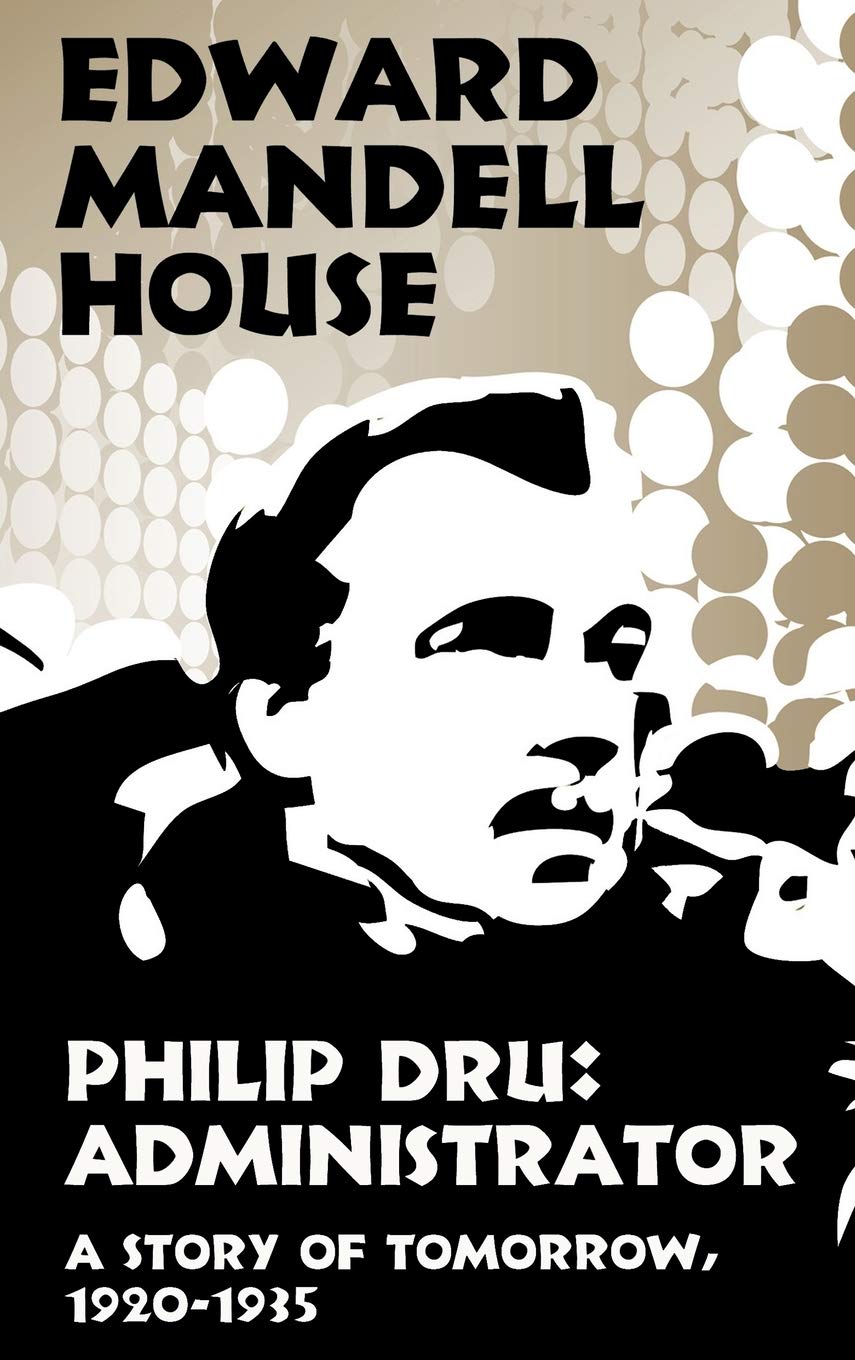
About Philip Dru: Administrator: A Story of Tomorrow, 1920-1935 by Edward Mandell House – A Political Future Novel About Power, Reform, Conflict and Government
Philip Dru: Administrator: A Story of Tomorrow, 1920-1935 by Edward Mandell House is a political novel first published in 1912. House imagines the United States several years into the future, beginning in 1920, when social, financial, and industrial tensions are moving toward civil conflict. At the center is Philip Dru, a West Point graduate who becomes a military leader and later takes control of the national government.
The novel mixes political fiction, military drama, social criticism, reform ideas, and romance. It follows Dru from his early life and friendship with Jack Strawn and Gloria Strawn through political organizing, civil war, victory, and a period in which he serves as the Administrator of the Republic.
Rather than focusing only on one adventure, the book uses its story to explore questions about wealth, labor, taxation, law, corporations, public services, constitutional change, voting, government power, and international affairs. Readers are not asked to accept every proposal. The interest lies in seeing how an early twentieth-century writer imagined a future political crisis and a sweeping response to it.
A future America imagined from the worries of 1912
The subtitle calls the book A Story of Tomorrow, 1920-1935. That is important because House was writing before the dates in the story had arrived.
He takes concerns from his own period and pushes them into an imagined future. The opening presents a country divided by economic and political tension. Wealth and organized power have become major sources of conflict, while many ordinary people feel that the existing system does not represent them well.
For a modern reader, this future is now a historical future. We can read the book in two ways at once: as a political adventure and as a record of what one American writer in 1912 thought the coming decades might look like.
That makes the novel especially interesting for readers who enjoy old futurism, political history, and books that imagine tomorrow from the fears of yesterday.
Philip Dru begins as a soldier but becomes a political figure
Philip Dru is introduced as a graduate of the National Military Academy at West Point. He is intelligent, disciplined, serious, and strongly interested in public questions.
His military training matters later, but the novel does not keep him only inside army life. Dru studies social problems, writes about conditions around him, and becomes involved in political organizing.
As the national crisis grows, he moves from observer to leader.
The story presents him as someone who believes the political system has been captured by powerful interests. His answer is not a small adjustment. He supports a complete change in direction and eventually leads forces in a civil war.
After military victory, Dru becomes the central authority in the country. This shift from soldier to ruler gives the novel its most important question: what happens when one person gains enough power to redesign a political system?
The book presents Dru's program in detail, allowing readers to examine both the scale of his ambitions and the concentration of power required to carry them out.
The civil war turns ideas into open conflict
The political struggle eventually becomes military.
The book divides the country into opposing forces and follows Dru as he organizes an army in the West. The conflict reaches a decisive point in the Battle of Elma, where the scale of the fighting is enormous.
House writes the battle as both a military turning point and a human tragedy. The novel describes victory, heavy casualties, wounded soldiers, and the cost paid by people on both sides.
After the battle, Dru understands that military success gives him the ability to reshape the government.
This section changes the pace of the book. Earlier chapters contain discussion, organizing, social observation, and political planning. The war chapters add movement, strategy, risk, and violence.
Readers interested in military fiction may find these chapters especially notable, while readers focused on politics can see how the story moves from persuasion to force.
The Administrator chapters contain the book's main political program
After victory, Philip Dru assumes extraordinary authority and becomes the Administrator of the Republic.
From that point, the novel moves through a long series of reforms. The chapter titles themselves show the range: the judiciary, a new code of laws, taxation, federal incorporation, railroads, suffrage, constitutions, government structure, and other public questions.
House uses Dru as a vehicle for discussing how institutions might be redesigned.
The proposals are part of the fictional program of the novel, not neutral facts about how government must work. Readers can agree, disagree, compare them with other systems, or study why such ideas appealed to some reformers of the early twentieth century.
This is where the book becomes especially useful for political history and political thought. It gives readers a direct example of how reform, executive power, economic regulation, and social policy could be imagined in American political fiction before the First World War.
Power is one of the book's biggest questions
Dru says he wants to repair institutions and then create a better system, but he reaches that goal by taking concentrated control.
That creates a tension at the heart of the novel.
Can a leader use extraordinary power to create a system that later limits power? Can political freedom be protected through temporary dictatorship? Who decides when the emergency is over? What happens if a ruler believes strongly that his program serves the public?
The novel presents Dru as confident in his mission, but modern readers can examine the structure critically.
This makes the book more interesting than a simple list of reforms. It also becomes a story about political authority itself.
Students can ask whether the means fit the ends, whether institutions are safer than personal rule, and how political fiction can make concentrated power look efficient even when it creates serious risks.
Those questions remain useful for studying political theory without requiring readers to accept the novel's own answers.
Economic questions appear throughout the story
House gives substantial attention to wealth, labor, corporations, taxation, railroads, and the cost of living.
These themes reflect the period in which the book was written, when industrial growth, large corporations, labor conflict, and economic inequality were major subjects of American public debate.
Inside the novel, Dru's government considers changes to taxation, corporate law, transportation, labor conditions, and other parts of economic life.
The book therefore works as more than political adventure. It is also a fictional laboratory for economic policy ideas.
Readers studying the Progressive Era may find this especially useful because the novel gathers many reform concerns into one imagined program.
The key is to read these sections historically and critically. The text shows what House chose to emphasize and how he framed the problems. It does not provide a final answer to modern policy questions, but it offers evidence about one influential reform-minded vision from its time.
What makes Philip Dru: Administrator worth reading
The book offers several reasons to explore it:
- A political future imagined in 1912 and set mainly between 1920 and 1935.
- A main character who moves from West Point graduate to military leader and national administrator.
- A story that combines political fiction, military conflict, social questions, and romance.
- Detailed fictional debates about taxation, law, corporations, labor, railroads, suffrage, and constitutional design.
- A major civil-war storyline that changes the political order inside the novel.
- Questions about concentrated executive power and institutional reform.
- A historical view of early twentieth-century American reform concerns.
- Chapters that move from domestic policy into international affairs.
- A useful primary text for readers interested in political fiction and the Progressive Era.
- A standalone work that can be read without any companion volume.
The novel is especially valuable when read as both fiction and historical political writing.
Who should read this book?
Philip Dru: Administrator is a strong choice for readers interested in political fiction, American history, utopian and dystopian writing, early futurism, government, political theory, and the Progressive Era.
Students may find it useful when studying how fiction can carry political ideas. History readers can compare the imagined 1920s and 1930s with the real events that later occurred. Political-theory readers can examine the tension between reform and concentrated authority.
It may also interest readers of older speculative fiction. House imagines social and political change rather than advanced machines or distant planets, but the method is still speculative: take current trends, move them forward, and ask what might happen next.
The language and attitudes come from the early twentieth century, so some passages reflect assumptions of their period. Reading with historical context can help modern readers separate the book's documentary value from the positions expressed by its characters and narrator.
A premium reading copy from Bookish Wonderland
A historical political novel with long discussions of law, institutions, and public policy is often read slowly and revisited for reference.
Bookish Wonderland offers a reader-friendly copy with premium eye-soothing cream paper, crystal-clear print, and high-quality stitched plus glue binding for better longevity. The cream paper supports comfortable reading, while clear printing helps older prose and detailed political passages remain easy to follow.
For readers comparing the Book price in Bangladesh for Philip Dru: Administrator: A Story of Tomorrow, 1920-1935 by Edward Mandell House, Bookish Wonderland offers a convenient local option for ordering this unusual work of American political fiction.
Nationwide delivery is available across Bangladesh, including inside and outside Dhaka. Cash on delivery is available, and fast or urgent delivery options may also be available in Dhaka.
A book that works as fiction and as a historical document
Philip Dru can be read for its plot, but part of its value comes from the ideas surrounding the plot.
The novel shows what political fears and hopes could look like when turned into a story before the First World War. It imagines class tension, civil conflict, constitutional change, social policy, concentrated leadership, and international strategy inside one future narrative.
That makes it useful for comparison.
A reader can ask which parts belong clearly to 1912, which ideas continued to appear later, and which parts now feel distant. The answers will differ depending on the reader's historical knowledge and political perspective.
The book does not need to be treated as a blueprint. It can instead be read as evidence of how one writer imagined political change.
Explore an unusual American future imagined more than a century ago
Philip Dru: Administrator: A Story of Tomorrow, 1920-1935 by Edward Mandell House offers a rare mix of political argument, military drama, romance, social criticism, and speculative history.
The story begins with a country moving toward crisis and follows Philip Dru as he becomes a reformer, army commander, victor, and finally Administrator of the Republic. From there, the novel opens into debates about law, taxation, corporations, labor, transportation, voting, constitutions, and international power.
Readers do not need to agree with Dru's solutions to find the book interesting. Its strongest value comes from seeing how political ideas are turned into narrative and how a writer from 1912 imagined the near future.
Order Philip Dru: Administrator by Edward Mandell House from Bookish Wonderland and explore a distinctive political novel about conflict, authority, reform, institutions, and the uncertain future of a nation.
If you require any customization or have any questions, please inbox us via FB or Insta.
| Primary Specification | |
| Author | Edward Mandell House |
| Genre | Political Fiction, Utopian Fiction, Speculative Fiction |
| ISBN-13/ISSN | 979-8710526446 |
| ISBN-10 | 8710526446 |
| Publisher | Independently published |
| Publishing Date | June 7, 2021 |
| Language | English |
| Format | Printed book |
| Physical Specification & Quality | |
| Paper Quality | Premium eye-soothing cream paper |
| Binding Quality | High quality stitched and glue binding (for longevity) |
| Print Quality | Crystal-clear print |
| Pages | 175 pages |
| Country | USA |
| Logistics Information | |
| Weight | 195 gm |
| Length | 8.5 inches |
| Width | 5.6 inches |
| Height | 0.4 inch |