Skip to product information
1 of 1

Bookish Wonderland

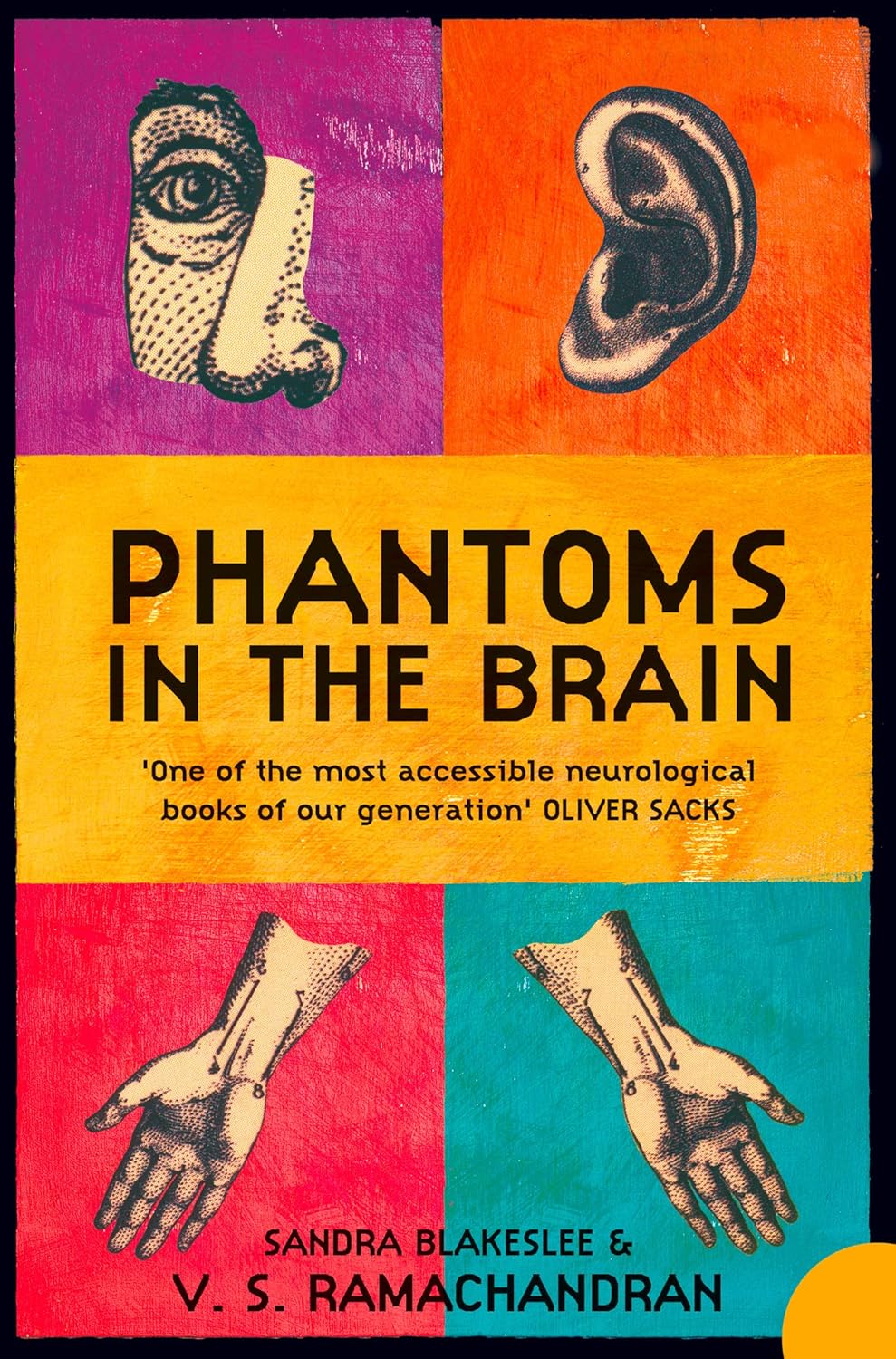
Phantoms in the Brain by V.S. Ramachandran & Sandra Blakeslee

Phantoms in the Brain by V.S. Ramachandran & Sandra Blakeslee

Regular price Tk 299.00 BDT
Regular price Sale price Tk 299.00 BDT
Sale Sold out
Book cover type
Quantity

Phantoms in the Brain by V.S. Ramachandran and Sandra Blakeslee explores some of the most fascinating mysteries of the human brain through unusual neurological cases. Ramachandran examines patients experiencing phantom limbs, paralysis, delusions, unusual perceptions, and disorders of body awareness to reveal how the brain constructs our sense of reality, identity, and consciousness. Using accessible explanations and inventive experiments, the book shows how studying damaged or altered brains can provide important insights into normal brain function. Blending neuroscience, psychology, medicine, and engaging case studies, it offers general readers an illuminating introduction to how the mind works and why neurological disorders can profoundly change perception and behavior. Read More

View full details

About Phantoms in the Brain by V.S. Ramachandran & Sandra Blakeslee – A Fascinating Journey Through Phantom Limbs, Brain Maps, Perception and the Human Mind

Phantoms in the Brain by V.S. Ramachandran and Sandra Blakeslee is an accessible neuroscience book built around unusual neurological cases that reveal how the brain creates our sense of body, identity, reality, memory, and self. Instead of beginning with heavy theory, the authors begin with real patients whose experiences seem impossible: a man feels an arm that is no longer there, a woman with paralysis insists that she can still move, and other patients see, believe, or experience things that challenge ordinary ideas about the mind.

Ramachandran uses these cases like clues in a scientific mystery. By studying what happens when part of the brain is injured or reorganized, he asks what normal brain function must be doing every day. Sandra Blakeslee helps present these ideas in a clear form for general readers.

The result is a book about more than neurological disorders. It asks a bigger question: how does the brain create the world we think we know? Each case becomes a window into perception, body image, belief, emotion, consciousness, and the strange but organized ways the brain tries to make sense of experience.

Strange patients become guides to normal brain function

Many science books explain the brain by describing healthy anatomy first. Phantoms in the Brain often takes the opposite path.

Ramachandran studies people whose brains are doing something unusual after injury, amputation, or neurological change. This method makes the book feel like detective work. Each patient presents a puzzle. The researchers test simple ideas, compare reactions, and use the results to understand larger principles.

Phantom limbs show that the body also exists inside the brain

The best-known topic in the book is the phantom limb.

After an arm or leg is amputated, some people continue to feel the missing part. They may feel fingers, movement, pressure, itching, or pain even though the physical limb is gone.

The brain contains maps of the body. When a limb disappears, those maps do not instantly vanish. Nearby areas of the brain may begin to affect the region that once represented the missing limb.

Ramachandran describes experiments in which touching a patient's face could produce sensations that seemed to come from a missing hand. Findings like this suggest that the brain can reorganize itself.

This idea, now commonly discussed as neuroplasticity, becomes easy to understand through the patient's experience. The case turns a difficult scientific concept into something vivid and memorable.

The mirror box turns a simple reflection into a powerful experiment

One of Ramachandran's most famous approaches involved a simple mirror.

Some people with phantom limbs feel that the missing arm or hand is painfully frozen in one position. Because the limb is gone, they cannot actually move it to relieve the feeling.

Ramachandran used a mirror arrangement that allowed a patient to look at the reflection of the healthy hand and see what appeared to be two intact hands. When the healthy hand moved, the reflection created the visual experience that the missing hand was moving too.

For some patients, this changed the phantom sensation and reduced painful feelings.

The experiment is memorable because it does not require a huge machine. It shows how the brain combines vision, movement, expectation, and body maps.

The brain can protect a belief even when evidence says otherwise

Another striking topic in the book is denial of paralysis, known as anosognosia in some neurological cases.

A patient may have a paralyzed arm yet insist that the arm works normally. If asked to perform a task with both hands, the person may explain away the failure rather than accept the paralysis.

Ramachandran uses such cases to explore how the brain creates a stable story about the self and the world. We like to imagine that our beliefs are direct copies of reality, but the brain is always interpreting, selecting, and fitting information together.

When the systems that update those beliefs are damaged, a person can hold a view that seems obviously false to everyone else.

These cases make the book especially interesting for readers of psychology and philosophy because they raise questions about self-knowledge, certainty, and how the mind decides what counts as real.

Perception is not a camera recording the outside world

The book repeatedly challenges the idea that seeing is like taking a photograph.

The brain does not simply receive a complete picture from the eyes. It interprets signals, fills gaps, compares patterns, and uses earlier knowledge to create a useful model of the world.

Neurological patients make this easier to see because damage can separate abilities that normally appear to work together.

A person may respond to visual information without being fully conscious of seeing it. Another person may see objects but fail to recognize what they mean in the usual way.

These examples show that perception has layers.

Unusual cases open questions about identity and the self

Who are you if your brain can change your sense of your own body?

That question appears again and again behind the individual case histories.

Our identity feels stable. We usually wake up feeling that we are the same person we were yesterday. We recognize our body as ours. We trust our memories and basic beliefs.

Neurological disorders show that some of these feelings depend on particular brain systems.

When those systems change, body ownership, recognition, belief, emotion, or perception can change too.

That makes Phantoms in the Brain valuable for readers interested in consciousness, philosophy of mind, psychology, and questions about what the word “self” really means.

Simple experiments make difficult neuroscience easier to follow

A major strength of the book is the way Ramachandran approaches difficult questions with surprisingly simple tools.

The publisher description highlights experiments using items such as cotton swabs, water, and inexpensive mirrors. The clever part is not the cost of the equipment. It is the question being asked.

A good experiment isolates a possibility and gives the researcher information that can support or challenge an explanation.

This makes the book encouraging for readers who think science always requires giant laboratories and complicated machinery. Modern neuroscience certainly uses advanced technology, but careful observation and creative experimental design can also reveal important things.

What makes Phantoms in the Brain worth reading

The book offers a strong mix of neuroscience, psychology, medical mystery, and philosophical questions.

Key reasons to read it include:

  • Real neurological case histories that make complex ideas easier to understand.
  • Clear explanations of phantom limbs and changing brain maps.
  • Memorable experiments involving mirrors and sensory stimulation.
  • Discussion of paralysis, denial, hallucination, perception, and body image.
  • Questions about consciousness, belief, identity, and the sense of self.
  • An accessible style for readers without formal medical training.
  • A strong connection between unusual disorders and normal brain function.
  • Examples showing how the brain reorganizes itself after physical change.
  • A scientific detective-story feeling that keeps difficult material engaging.
  • Ideas that connect neuroscience with psychology, philosophy, medicine, and everyday experience.

The book is not a simple anatomy guide. Its focus is what unusual cases can teach us about how the mind is built.

Who should read this book?

Phantoms in the Brain is a strong choice for readers interested in neuroscience, psychology, medicine, consciousness, cognitive science, philosophy of mind, and human behavior.

Medical and psychology students can use it as an accessible companion to more technical study. General readers can enjoy the cases without needing advanced knowledge of anatomy.

It may also appeal to people who enjoy books built around strange true stories. Each neurological condition creates a mystery, and the scientific explanation often changes how an ordinary human ability looks.

Teachers and book clubs can use the cases to start discussions about perception, identity, free will, body image, belief, and the limits of self-knowledge.

Readers should remember that neuroscience has continued to develop since the book first appeared in 1998. The book is best read as an influential popular account of research and ideas from its period, not as a replacement for current medical guidance or a modern neuroscience textbook.

Published in editions with different subtitles and page counts

Phantoms in the Brain first appeared in 1998. A Fourth Estate edition is cataloged at 328 pages under the subtitle Human Nature and the Architecture of the Mind.

A HarperCollins edition published in 1999 appears under the subtitle Probing the Mysteries of the Human Mind and is listed at 352 pages.

This difference is useful for buyers because page count and subtitle can vary by edition. The core work remains the same title by V.S. Ramachandran and Sandra Blakeslee.

Readers shopping for a specific edition should therefore check the edition details attached to the copy being offered rather than assuming every printing has identical pagination or subtitle wording.

A premium reading copy from Bookish Wonderland

A science book filled with case histories and ideas is often read slowly, revisited, and discussed, so a comfortable physical copy can improve the experience.

Bookish Wonderland offers a reader-friendly copy with premium eye-soothing cream paper, crystal-clear print, and high-quality stitched plus glue binding for better longevity. The cream paper supports comfortable reading, while the sharp print keeps scientific terms and longer explanations easy to follow.

For readers comparing the Book price in Bangladesh for Phantoms in the Brain by V.S. Ramachandran & Sandra Blakeslee, Bookish Wonderland offers a convenient local option for ordering this influential popular neuroscience title.

Nationwide delivery is available across Bangladesh, including inside and outside Dhaka. Cash on delivery is available, and fast or urgent delivery options may also be available in Dhaka.

A book that makes the ordinary brain feel extraordinary

The most memorable effect of Phantoms in the Brain is that everyday experience begins to look less simple.

Moving an arm, recognizing your body, believing what you see, understanding where a sensation comes from, and feeling like one continuous person all seem automatic.

The case histories show that these abilities depend on complex systems working together.

When one part changes, the result can reveal the hidden structure underneath normal experience.

That is why the book remains interesting even for readers who never plan to study neurology professionally. The subject is not only unusual patients. The subject is every human brain, for curious readers.

Explore the mysteries hiding inside everyday experience

Phantoms in the Brain by V.S. Ramachandran and Sandra Blakeslee turns neurological case studies into an inviting journey through the architecture of the human mind.

A missing limb can still hurt. A paralyzed person can deny being paralyzed. A simple mirror can change a phantom sensation. A damaged brain can alter what a person sees, believes, or recognizes.

Each mystery leads to a larger idea about how the brain builds experience.

If you enjoy popular science that combines real cases, clever experiments, psychology, and big questions about consciousness, this book offers an absorbing place to begin.

Order Phantoms in the Brain by V.S. Ramachandran & Sandra Blakeslee from Bookish Wonderland and explore a remarkable work about phantom limbs, perception, brain plasticity, body maps, belief, identity, and the hidden systems that make the human mind feel whole.

If you require any customization or have any questions, please inbox us via FB or Insta.

Primary Specification
AuthorV.S. Ramachandran & Sandra Blakeslee
Narrator Neil Shah
GenreNeuroscience, Psychology, Popular Science, Medical Science
ISBN-13/ISSN978-0688172176
ISBN-100688172172
Publisher Mariner Books
Publishing Date‎ August 18, 1999
EditionPaul Chevannes
LanguageEnglish
Reading Age16+
FormatPrinted book
Physical Specification & Quality
Paper QualityPremium eye-soothing cream paper
Binding QualityHigh quality stitched and glue binding (for longevity)
Print QualityCrystal-clear print
Pages352 pages
CountryUnited States
Logistics Information
Weight374 gm
Length8.5 inches
Width5.6 inches
Height0.88 inch
What is Phantoms in the Brain by V. S. Ramachandran & Sandra Blakeslee about?

Phantoms in the Brain: Probing the Mysteries of the Human Mind is a popular neuroscience book that uses unusual neurological case studies to explore how the human brain creates our sense of body, identity, perception, memory, belief, and consciousness. Neuroscientist V. S. Ramachandran and science writer Sandra Blakeslee examine patients with conditions such as phantom-limb sensations, anosognosia, visual disturbances, unusual beliefs, and other neurological syndromes. Rather than presenting neuroscience only through laboratory terminology, the book follows real clinical puzzles and shows how relatively simple experiments can reveal important principles about brain organization. Ramachandran also uses these cases to investigate broader questions: Why does a person continue to feel an amputated limb? How does the brain construct body image? Why can brain damage radically alter awareness of reality? The result combines neurology, psychology, philosophy of mind, medical case studies, and accessible scientific storytelling.

How many books are in the Phantoms in the Brain series by V. S. Ramachandran & Sandra Blakeslee, and what are they?

There are no books in a series for Phantoms in the Brain by V. S. Ramachandran & Sandra Blakeslee. It is a standalone popular-science work.

Is Phantoms in the Brain suitable for beginners with no neuroscience or medical background?

Yes. Phantoms in the Brain was written as popular science rather than a medical-school textbook, so a general reader can understand most of its central ideas without having studied neurology. Ramachandran explains brain function through patients, observations, experiments, and memorable clinical puzzles instead of relying mainly on equations or highly technical neuroanatomy. That approach is one reason the book remains popular among psychology students, neuroscience beginners, and readers interested in the human mind. However, some sections still introduce neurological terminology and detailed explanations of how different brain regions function, so readers may occasionally benefit from looking up an unfamiliar term. Recent reader discussion reflects this balance: people commonly describe it as fascinating and readable, while noting that a few passages require extra concentration. It therefore works especially well as an introductory bridge between general-interest psychology and more formal neuroscience.

What does Phantoms in the Brain explain about phantom limbs and the famous mirror-box experiment?

Phantom limbs are one of the book’s best-known subjects. Some people who lose an arm or leg continue to experience vivid sensations—as if the missing limb were still present—and those sensations can sometimes include severe pain or the feeling that the phantom limb is stuck in an uncomfortable position. Ramachandran investigated these experiences as evidence that the brain maintains an internal representation of the body that does not instantly disappear after amputation. His experiments included the well-known use of mirrors to create the visual impression that the missing limb was present and moving. These observations helped stimulate wider scientific interest in body maps, cortical reorganization, and the relationship between vision and bodily sensation. The book presents this work in an accessible detective-story style, making phantom-limb research one of its most memorable demonstrations of how the brain constructs our experience of the body.

What is anosognosia, and why is it important in Phantoms in the Brain?

Anosognosia is a neurological condition in which a person may be unaware of, or strongly deny, a significant impairment caused by brain damage. Phantoms in the Brain discusses striking cases in which patients with paralysis behave as though the affected limb is functioning normally. One example described by the publisher involves a woman whose left side is paralyzed but who believes she can use both hands. Ramachandran uses such cases to investigate how the brain constructs a coherent story about the body and reality, even when that story conflicts with obvious physical evidence. These observations raise deeper questions about self-awareness, denial, belief, and consciousness. Instead of treating awareness as a single ability located in one simple “consciousness center,” the book illustrates how damage to particular neural systems can selectively disrupt a person’s understanding of his or her own condition.

Does Phantoms in the Brain discuss strange disorders such as Capgras syndrome, hallucinations, and altered body awareness?

Yes. One of the book’s major strengths is its use of unusual neurological conditions to reveal how ordinary perception works. Ramachandran discusses patients whose brains produce experiences that appear bizarre from the outside but become informative when examined neurologically. The book considers disturbances involving recognition, visual perception, body image, denial of paralysis, hallucination-like experiences, and the connection between emotion and familiar faces. These cases demonstrate an important principle of behavioral neurology: studying what happens when one component of perception fails can reveal how the intact brain normally integrates recognition, emotion, memory, and bodily awareness. Publisher descriptions also highlight a patient who sees cartoon-like figures and another whose neurological condition raises questions about denial and awareness. Readers who enjoy Oliver Sacks-style neurological case histories are often drawn to Phantoms in the Brain for precisely this combination of human stories and scientific investigation.

Does Phantoms in the Brain discuss consciousness, religion, the self, and other philosophical questions?
Yes. The book begins with clinical neurology but gradually expands into broader questions about consciousness, personal identity, belief, religious experience, decision-making, dreams, emotion, creativity, and the sense of self. Ramachandran uses neurological disorders as clues for investigating how the mind may emerge from brain activity. Publisher material highlights cases involving religious experiences, hallucinations, depression, decision-making, deception, dreams, and even questions about philosophy, music, and art. These sections are among the most debated parts of the book because the evidence for some broader interpretations is less direct than the clinical observations involving phantom limbs or body awareness. Reader discussions similarly tend to praise the neurological case studies while treating some of the later philosophical and spiritual speculation more cautiously. For that reason, the book is best read as a combination of established clinical observation, experimental reasoning, and provocative hypotheses rather than as a final scientific answer to every question about consciousness.
Is Phantoms in the Brain still worth reading even though it was first published in 1998?
Yes, especially as a historically influential and highly readable introduction to behavioral neurology, but readers should remember that neuroscience has advanced considerably since the book first appeared in 1998. Research on neuroplasticity, phantom-limb pain, body representation, consciousness, imaging, and rehabilitation has continued to develop, and some hypotheses discussed in older popular-science books are now understood with greater nuance. The book remains valuable because of the clinical cases, experimental creativity, and the way it teaches readers to reason from neurological abnormalities toward broader principles of brain function. It is best approached as an important popular-neuroscience work from its period rather than as a completely up-to-date textbook representing every current scientific consensus. Readers who become especially interested in one condition should use newer neuroscience sources alongside it for the latest research.
Is Phantoms in the Brain a premium edition at Bookish Wonderland?

Yes. Bookish Wonderland offers Phantoms in the Brain as a premium edition for readers who want a comfortable and well-finished physical copy for study, personal reading, and long-term reference. The book contains detailed case histories, neurological explanations, experiments, and philosophical discussions, so readers may frequently return to earlier chapters while thinking about topics such as phantom limbs, body image, anosognosia, consciousness, or the brain’s ability to reorganize itself. Clear text reproduction makes those sections easier to follow without unnecessary visual distraction. The physical format is particularly suitable for psychology students, neuroscience enthusiasts, medical readers, educators, and general nonfiction readers who enjoy books about the brain and human behavior. It can also serve as a thoughtful gift for someone interested in neuroscience, psychology, consciousness, or unusual medical case studies.

What is the paper and print quality of Phantoms in the Brain from Bookish Wonderland?

The Bookish Wonderland edition uses premium eye-soothing cream paper combined with crystal-clear printing. The cream-toned page surface offers softer contrast than very bright white paper, which can make long nonfiction reading sessions more comfortable. This is especially useful for Phantoms in the Brain because readers often move between clinical stories, scientific explanations, neurological terminology, and extended discussions about consciousness or perception. Sharp printing keeps paragraph text, headings, technical terms, and case descriptions clean and easy to distinguish. A comfortable page surface also helps readers who use the book for university study or who prefer to reread individual chapters rather than finish the entire book in one continuous session. Together, the premium paper and clear printing provide a smoother physical reading experience suitable for both casual science readers and more focused academic use.

How durable is the binding of Phantoms in the Brain from Bookish Wonderland?

Phantoms in the Brain features high-quality stitched and glue binding designed for longevity. The stitched construction adds structural support, while adhesive helps keep the pages securely attached through repeated opening, studying, transporting, lending, and long-term storage. This matters for a neuroscience book because readers may repeatedly revisit individual sections—for example, the phantom-limb chapters, discussions of anosognosia, visual perception, consciousness, or the philosophical material toward the end. Constantly returning to selected passages can place more stress on the spine than reading a book once from beginning to end. Stronger binding therefore makes the copy more suitable for students, researchers, teachers, book clubs, and readers who want to maintain a permanent psychology or neuroscience collection. Combined with premium pages and sharp print, the durable construction supports long-term practical use.

Why should I buy Phantoms in the Brain by V. S. Ramachandran & Sandra Blakeslee from Bookish Wonderland in Bangladesh?

Bookish Wonderland provides a convenient way to buy Phantoms in the Brain by V. S. Ramachandran & Sandra Blakeslee and other premium English neuroscience and psychology books in Bangladesh. This edition combines premium eye-soothing cream paper, crystal-clear printing, and high-quality stitched and glue binding, making it suitable for students, medical readers, psychology enthusiasts, neuroscience beginners, and anyone curious about consciousness and the human brain. Cash on Delivery is available across Bangladesh, allowing customers to order and pay when the book arrives. Delivery is available both inside and outside Dhaka, while customers in Dhaka can also request fast or urgent delivery when available. Bookish Wonderland maintains a large collection of premium and durable English books across neuroscience, psychology, science, medicine, philosophy, business, literature, and many other categories, helping readers throughout Bangladesh build a stronger personal and academic library.