Skip to product information
1 of 1

Bookish Wonderland

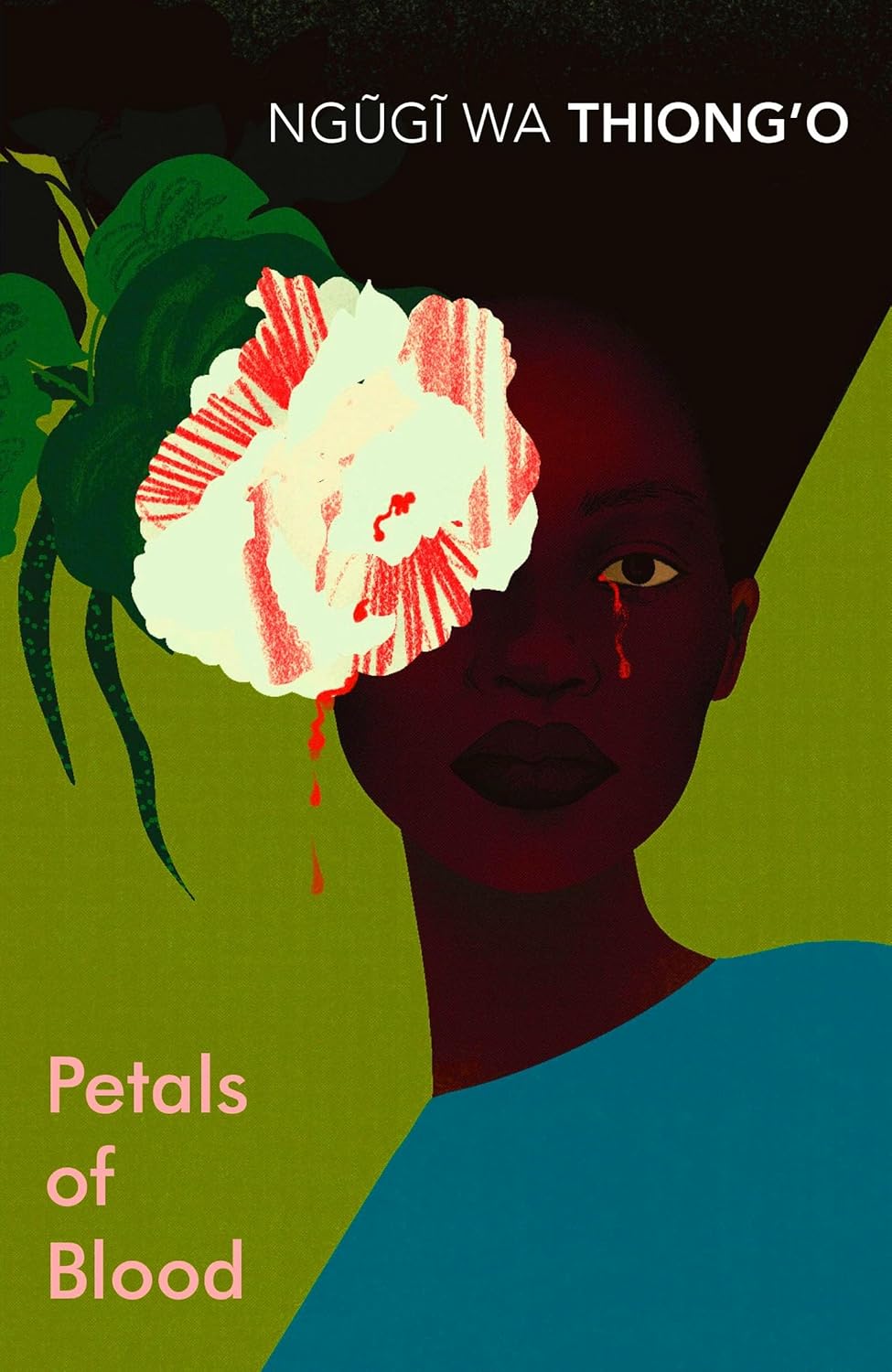
Petals of Blood by Ngugi wa Thiong'o (Penguin African Writers Series, Book 1 of 5)

Petals of Blood by Ngugi wa Thiong'o (Penguin African Writers Series, Book 1 of 5)

Regular price Tk 320.00 BDT
Regular price Sale price Tk 320.00 BDT
Sale Sold out
Book cover type
Quantity

Petals of Blood by Ngũgĩ wa Thiong'o is a powerful postcolonial novel set in Kenya after independence. The story follows four central characters—Munira, Abdulla, Wanja, and Karega—whose lives become intertwined in the village of Ilmorog. As the isolated community develops into a commercial center, the characters witness growing inequality, exploitation, corruption, and the effects of capitalism on ordinary people. A mysterious triple murder frames the narrative and gradually reveals the characters’ histories and struggles. Through personal tragedy and social conflict, Ngũgĩ examines the unfulfilled promises of independence, class divisions, political power, and the continuing impact of colonialism on Kenyan society. Read More

View full details

About Petals of Blood by Ngugi wa Thiong'o – A Powerful Kenyan Classic About Independence, Inequality, Memory and the Price of Change

Petals of Blood by Ngugi wa Thiong'o is a major African novel set in post-independence Kenya. It begins with a crime: three wealthy men connected with business and public power are found dead after a fire in Ilmorog. Police question four people whose lives have become deeply tied to the town: Munira, a teacher; Karega, a young activist and former teacher; Wanja, a determined woman trying to survive a difficult past; and Abdulla, a shopkeeper and veteran of the anti-colonial struggle.

From that mystery, the novel moves backward through years of friendship, disappointment, love, political change, drought, economic pressure, and the transformation of Ilmorog from a quiet rural village into a place shaped by banks, roads, companies, and new forms of power.

The story is both personal and national. Ngugi asks what independence means when ordinary people still face poverty, land loss, exploitation, and leaders who seem distant from their struggles. The result is a rich literary novel that combines suspense with social history, memory, romance, anger, and hope.

A murder mystery opens the door to a much larger story

The novel begins with three deaths, but it does not stay inside a normal detective structure.

Munira, Karega, Wanja, and Abdulla are drawn into the investigation because each has a connection to the dead men. As the police ask questions, the story opens into long memories of Ilmorog and the years that brought everyone to this moment.

That structure creates curiosity from the start. Readers want to know who died, why the fire happened, and how the four central characters became involved.

But Ngugi uses the mystery for something larger. The crime becomes a way to explore the history of the town and the forces that changed it.

Instead of asking only who committed a crime, the novel asks what kinds of social conditions can create anger, desperation, and conflict.

Ilmorog begins as a quiet village left behind

When Munira arrives in Ilmorog to work as a teacher, the place feels isolated and forgotten.

The village has poor resources, few opportunities, and a school that struggles to function. Drought and poor harvests make daily life hard. Many people have left to search for work elsewhere.

Munira hopes that moving away from the city will give him a simpler life, but Ilmorog does not allow him to escape difficult questions.

As Wanja, Abdulla, and Karega become part of his world, the village becomes a meeting place for people carrying different kinds of pain.

Ilmorog is not only a setting. It becomes one of the novel's most important symbols. Its transformation over time shows what happens when development arrives without equal protection for the people who already live there.

Four main characters carry different parts of Kenya's history

Munira, Karega, Wanja, and Abdulla are not copies of one another.

Munira is a teacher searching for meaning and stability. Karega is younger, restless, and increasingly interested in workers, education, and social change. Wanja is resourceful and intelligent but has survived exploitation and painful relationships. Abdulla carries the physical and emotional marks of the anti-colonial struggle.

Their lives cross in Ilmorog, but each sees the country differently.

This gives the novel several points of view on the same changes. A road, a new business, or a loan may look like progress to one person and danger to another.

The long journey to Nairobi becomes a turning point

One of the most memorable parts of the novel begins when Ilmorog faces a severe drought.

The villagers decide to walk to Nairobi and ask their political representative for help.

The journey is physically difficult, especially for children and older people. Yet it also becomes a journey through different parts of society.

The group meets people who refuse to help, people who judge them, and people who treat their suffering as a problem that belongs somewhere else.

When they finally reach the city, their experience shows the distance between rural citizens and institutions that are supposed to represent them.

Development arrives, but its benefits are unequal

At first, development can look like opportunity. Better connections, new buildings, and more trade may seem like signs that the town is finally moving forward.

But the novel keeps asking who receives the real benefit.

Farmers take loans and may lose land when they cannot repay them. Traditional products can become commercial goods controlled by larger interests. People who once built something themselves may watch others profit from it.

This tension is central to the novel. Ngugi does not present change as simply good or bad. He shows how development can improve some things while also creating new forms of dependence and inequality.

Wanja is one of the novel's most complex characters

She is practical, energetic, and able to see opportunities that others miss. She helps improve Abdulla's business and later plays an important role in the sale of Theng'eta, a traditional drink.

At the same time, she has been hurt by men, by poverty, and by social conditions that repeatedly limit her choices.

Wanja is not written as a simple victim. She makes decisions, takes risks, builds businesses, falls in love, becomes angry, and sometimes acts in ways that readers may find difficult.

Her story raises questions about survival. What choices are available to a woman who has been exploited? How does someone protect herself in a system that often treats people as objects or tools?

Abdulla carries the memory of the freedom struggle

Abdulla fought during Kenya's anti-colonial struggle and lost a leg.

People may fight for freedom with great courage, only to discover later that political independence does not automatically create economic justice or personal security.

Abdulla's life allows the novel to connect the past struggle with the present disappointment of Ilmorog.

Karega looks for change through education and workers

His experiences with school, work, politics, and poverty gradually shape his thinking. He becomes interested in the lives of workers and in the way institutions can either support or exploit them.

The novel asks what schools should teach and whose history should be valued. It also questions whether education helps people become freer or simply trains them to fit into systems already built by others.

Karega's path gives the book a strong connection to labor, political organization, and the idea that ordinary people may need collective action to improve their conditions.

Theng'eta shows how culture can become a commodity

When Wanja and Abdulla discover that visitors enjoy it, they see an opportunity to earn money.

The drink becomes popular, but success attracts larger commercial interests.

This change becomes one of the novel's clearest examples of how culture, labor, and profit can become separated. The people who create value are not always the people who keep control of it.

What makes Petals of Blood worth reading

  • A gripping triple-murder mystery that frames the larger narrative.
  • Four central characters with very different histories and motives.
  • A vivid portrait of post-independence Kenya.
  • Strong themes of land, labor, education, class, memory, and power.
  • The transformation of Ilmorog from a rural village into a commercial center.
  • A powerful journey from Ilmorog to Nairobi during a severe drought.
  • Complex relationships involving love, betrayal, loyalty, and survival.
  • A serious look at how independence can fail to improve every citizen's life equally.
  • A literary style that mixes personal stories with national questions.
  • A standalone novel that can be read without any previous Ngugi book.

Who should read Petals of Blood?

This book is a strong choice for readers who enjoy African literature, literary fiction, historical fiction, political novels, social criticism, and character-driven stories.

Students of literature, history, development studies, sociology, politics, and postcolonial studies may also find the novel useful because it connects individual lives with larger questions about society.

Readers who like simple, fast plots should know that Petals of Blood is layered and reflective. It moves through memory, history, relationships, and ideas.

The book rewards patient reading.

Book clubs can discuss whether Ilmorog's development improves life, how the four central characters respond differently to injustice, and how the murder mystery changes the way readers understand everything that came before it.

First published in 1977 and still widely studied

Petals of Blood was first published in 1977 by Heinemann.

A current Penguin Classics edition in the United States was published in 2005 with an introduction by Moses Isegawa and is listed at 432 pages.

The novel also appears within Penguin's African Writers publishing collection, but it is not a numbered narrative sequence in which readers need another Ngugi novel first.

That makes it easy to choose as an individual classic.

Page count can vary by edition, so readers looking for a specific printing should check the details of the copy being offered.

A premium reading copy from Bookish Wonderland

A large literary novel becomes easier to enjoy when the physical copy supports long reading sessions.

Bookish Wonderland offers a reader-friendly copy with premium eye-soothing cream paper, crystal-clear print, and high-quality stitched plus glue binding for better longevity. The comfortable paper helps with extended reading, while the sharp print keeps dense scenes and longer passages clear.

For readers comparing the Book price in Bangladesh for Petals of Blood by Ngugi wa Thiong'o, Bookish Wonderland offers a convenient local option for ordering this major Kenyan novel.

Nationwide delivery is available across Bangladesh, including inside and outside Dhaka. Cash on delivery is available, and fast or urgent delivery options may also be available in Dhaka.

What books are in the Penguin African Writers series by Ngugi wa Thiong'o?:

There are 5 books in the Penguin African Writers series by Ngugi wa Thiong'o. They are:

  1. Petals of Blood by Ngugi wa Thiong'o (Book 1)
  2. Weep Not, Child by Ngugi wa Thiong'o (Book 2)
  3. A Grain of Wheat by Ngugi wa Thiong'o (Book 3)
  4. The River Between by Ngugi wa Thiong'o (Book 4)
  5. Devil on the Cross by Ngugi wa Thiong'o (Book 5)

A novel about what freedom means after independence

One of the deepest questions in Petals of Blood is what happens after a country becomes politically independent.

The novel does not treat independence as the end of history. Instead, it looks at what ordinary people experience afterward.

Who owns land? Who controls businesses? Who has access to education? Who gains from development? Who carries the memory of earlier struggle? Who gets heard when a village is suffering?

Ngugi explores these questions through fiction rather than simple answers.

The novel's characters disagree, change, make mistakes, and struggle to survive. Their experiences show that national freedom and personal freedom do not always arrive at the same time.

That complexity is one reason the book remains important in discussions of African literature.

Enter Ilmorog and discover a story that grows far beyond one crime

Petals of Blood by Ngugi wa Thiong'o begins with a fire and three deaths, but the real story reaches across years of love, loss, drought, political disappointment, business change, memory, and survival.

Munira, Karega, Wanja, and Abdulla each come to Ilmorog carrying a different past. As the village changes, they change with it.

Readers gradually discover how a forgotten rural community becomes part of a larger economic system and how that transformation affects the people who once called it home.

If you enjoy novels that combine mystery with social history and unforgettable characters, Petals of Blood offers a rich reading experience.

Order Petals of Blood by Ngugi wa Thiong'o from Bookish Wonderland and explore a landmark Kenyan novel about independence, inequality, power, memory, love, development, and the difficult question of who truly benefits when a nation changes.

If you require any customization or have any questions, please inbox us via FB or Insta.

Primary Specification
AuthorNgũgĩ wa Thiong'o
GenreLiterary Fiction, Postcolonial Fiction, Political Fiction
ISBN-13/ISSN978-0143039174
ISBN-100143039172
PublisherPenguin Classics
Publishing DateFebruary 22, 2005
LanguageEnglish
Reading Age16+
FormatPrinted book
Physical Specification & Quality
Paper QualityPremium eye-soothing cream paper
Binding QualityHigh quality stitched and glue binding (for longevity)
Print QualityCrystal-clear print
Pages‎ 432 pages
CountryKenya
Logistics Information
Weight453 gm
Length8.5 inches
Width5.6 inches
Height0.91 inch
What is Petals of Blood by Ngũgĩ wa Thiong’o about?

Petals of Blood is a major African literary novel set in post-independence Kenya. The story begins with the deaths of three prominent businessmen and the questioning of four people connected to them: Munira, a schoolteacher; Abdulla, a shopkeeper and former freedom fighter; Karega, a teacher and political activist; and Wanja, a complex and resilient woman whose life becomes closely tied to the changing fortunes of Ilmorog. Through their memories, relationships, disappointments, and political awakening, Ngũgĩ gradually reveals what happened before the deaths while also examining the larger transformation of Kenyan society. The once-isolated village of Ilmorog undergoes dramatic economic “development,” but the benefits do not reach everyone equally. The novel therefore works simultaneously as a murder mystery, social novel, political critique, historical reflection, and examination of how ordinary people experience the promises and failures of independence.

How many books are in the Penguin African Writers series by Ngugi wa Thiong'o, and what are they?

There are 5 books in a series for Penguin African Writers series by Ngugi wa Thiong'o. They are:

  1. Petals of Blood by Ngugi wa Thiong'o (Book 1)
  2. Weep Not, Child by Ngugi wa Thiong'o (Book 2)
  3. A Grain of Wheat by Ngugi wa Thiong'o (Book 3)
  4. The River Between by Ngugi wa Thiong'o (Book 4)
  5. Devil on the Cross by Ngugi wa Thiong'o (Book 5)
Is Petals of Blood a murder mystery, historical novel, or political novel?

It is all three, although the political and social dimensions eventually become more important than the conventional mystery. The opening investigation asks who was responsible for the deaths of three powerful businessmen, giving the novel the structure of a whodunit. However, Ngũgĩ uses that investigation mainly as a framework through which the histories of Munira, Wanja, Karega, Abdulla, and Ilmorog can be reconstructed. As those histories unfold, the novel becomes a critique of political corruption, economic inequality, foreign influence, class exploitation, and the failure of independence to fulfill the hopes of many ordinary Kenyans. It can also be read as historical fiction because its characters and social conflicts are deeply connected with colonialism, the struggle for independence, the Mau Mau era, and postcolonial Kenya. Readers expecting only a fast crime thriller should therefore know that the book is much broader, more political, and more philosophically ambitious.

Who are the four main characters in Petals of Blood, and why are they important?

The four central characters are Munira, Abdulla, Karega, and Wanja, and each represents a different experience of Kenya’s political and social transformation. Munira is a schoolteacher who arrives in Ilmorog attempting to distance himself from his past but becomes increasingly entangled in the lives around him. Abdulla is a shopkeeper and former anti-colonial freedom fighter whose sacrifices contrast sharply with the limited rewards available to ordinary veterans after independence. Karega is an idealistic teacher and activist who becomes increasingly concerned with labor, inequality, political consciousness, and collective action. Wanja is entrepreneurial, emotionally complex, and repeatedly forced to negotiate relationships, poverty, gender expectations, and exploitation. Their personal stories intersect with the three murdered businessmen, but they also allow Ngũgĩ to examine education, revolutionary struggle, sexuality, capitalism, corruption, class, and the difference between political independence and meaningful social freedom.

What happens to Ilmorog in Petals of Blood, and why is the village so important?

Ilmorog functions almost like another major character in the novel. At first it is a poor, drought-stricken rural community largely neglected by political leaders and economic institutions. Its residents struggle with declining agriculture, limited opportunities, and lack of government support. Over time, roads, banks, businesses, tourism, industry, and commercial development reach the area, apparently promising modernization and prosperity. However, Ngũgĩ deliberately questions who actually benefits from that transformation. Land becomes commercial property, wealth becomes increasingly concentrated, and some of the villagers who expected development to improve their lives instead face displacement, debt, exploitation, or poverty. The contrast between old Ilmorog and “New Ilmorog” therefore represents one of the novel’s central arguments: economic growth can be described as progress while still reproducing inequality. Readers interested in development studies, economics, postcolonial history, or African politics often find this transformation especially significant.

What are the main themes and meaning of the title Petals of Blood?

The novel explores colonialism, neocolonialism, capitalism, class inequality, corruption, land ownership, education, exploitation, gender, religion, political betrayal, resistance, memory, and the meaning of independence. The title itself carries multiple symbolic meanings. The phrase “petals of blood” appears in Derek Walcott’s poem The Swamp, which provides an epigraph to the novel, and Ngũgĩ later incorporates the image into the story itself. Early in the novel, a child describes a flower as having “petals of blood,” creating an image in which beauty and violence exist together. Throughout the novel, flowering, land, and the indigenous drink Theng’eta become connected with Kenya’s creative potential, while blood, exploitation, and commercial appropriation reflect the forces that prevent ordinary people from fully benefiting from that potential. The title can therefore suggest both possibility and destruction: something beautiful trying to grow within conditions shaped by violence and exploitation.

Is Petals of Blood difficult to read, and is it suitable for someone new to African literature?
It can be read by someone new to African literature, but it is a substantial and intellectually demanding novel rather than a light introduction. Reader reviews frequently mention its shifting chronology, long political discussions, historical references, symbolism, multiple character histories, and occasional essay-like passages. The murder mystery initially gives readers a clear question to follow, but the book repeatedly moves backward through memory and expands into discussions of colonial history, capitalism, education, nationalism, religion, labor, and political ideology. Some readers find this richness extremely rewarding, while others describe the pacing as slow or challenging. A basic understanding of British colonialism in Kenya and Kenya’s independence in 1963 can make the political context easier to follow, but it is not strictly required. Readers willing to read slowly and think about the arguments behind the characters’ experiences can use Petals of Blood as a powerful introduction to Ngũgĩ and postcolonial African literature.
Is Petals of Blood suitable for younger readers, and does it contain mature content?
Petals of Blood is best suited to mature older teenagers and adult readers, particularly because of its themes rather than simply its vocabulary. The novel contains political violence, murder, death, exploitation, poverty, sexual relationships, prostitution or sex work, abusive power dynamics, references to colonial violence, alcohol, religious conflict, and emotionally difficult experiences. Wanja’s life in particular involves gendered and economic exploitation, while Abdulla’s history connects the story with violent anti-colonial struggle. The novel also expects readers to engage seriously with corruption, inequality, labor politics, capitalism, and postcolonial history. It is frequently studied in university literature and postcolonial studies courses because these subjects reward mature discussion. Readers looking for an uncomplicated murder mystery should know that the book includes difficult social material, while students and serious literary readers may find that complexity one of its greatest strengths.
Is Petals of Blood by Ngũgĩ wa Thiong’o a premium edition at Bookish Wonderland?

Yes. Bookish Wonderland offers Petals of Blood as a premium edition intended for readers who want a comfortable and dependable physical copy of this major African literary work. Because the novel combines narrative, political discussion, symbolism, historical reflection, and interconnected character histories, many readers may want to underline, annotate, revisit earlier passages, or compare different sections while studying its themes. A well-presented physical copy makes that type of reading considerably more practical. The edition is suitable for university students, literature teachers, researchers, book-club readers, collectors of African literature, and anyone interested in postcolonial fiction. Its strong physical presentation also makes it appropriate for readers building a long-term personal collection of twentieth-century world literature rather than purchasing a copy intended only for one quick reading.

What is the paper and print quality of Petals of Blood from Bookish Wonderland?

The Bookish Wonderland edition uses premium eye-soothing cream paper with crystal-clear printing for a smoother and more comfortable reading experience. Cream-toned paper reduces the harsh visual contrast that can come with very bright white pages, which is useful for a substantial literary novel that may require long periods of careful reading. Sharp printing keeps names, dialogue, historical references, political arguments, and descriptive passages clean and easy to follow. This is particularly helpful when studying the relationships among Munira, Karega, Abdulla, Wanja, and the many political and economic forces affecting Ilmorog. The durable page quality also makes the book better suited for annotation, repeated reading, academic study, or long-term storage. Together, the paper and print quality provide a polished physical edition for both casual literary readers and students using the novel more intensively.

How durable is the binding of Petals of Blood from Bookish Wonderland?

Petals of Blood comes with high-quality stitched and glue binding designed for longevity. Stitching reinforces the page block, while adhesive helps keep the pages securely attached during repeated opening, carrying, studying, and shelving. This construction is particularly useful for a literary classic that readers may return to several times, especially when examining specific passages about Ilmorog’s development, independence, education, land, exploitation, or the histories of the four central characters. University students may also repeatedly consult individual chapters while preparing assignments, presentations, or examinations, which can put considerable stress on cheaply produced binding. The stitched-and-glued construction helps the book withstand regular use more effectively. Combined with premium cream paper and clear printing, the durable binding makes the edition suitable for a permanent African-literature, postcolonial-studies, or world-literature collection.

Why should I buy Petals of Blood by Ngũgĩ wa Thiong’o from Bookish Wonderland in Bangladesh?

Bookish Wonderland provides a convenient way to buy Petals of Blood by Ngũgĩ wa Thiong’o and other important English-language African and world literature in Bangladesh. This edition combines premium eye-soothing cream paper, crystal-clear printing, and high-quality stitched and glue binding, making it suitable for literature students, teachers, researchers, book-club readers, and collectors who want a durable physical copy. Cash on Delivery is available across Bangladesh, allowing customers to pay when the order arrives. Delivery is available both inside and outside Dhaka, while customers in Dhaka can also request fast or urgent delivery when available. Bookish Wonderland maintains a large collection of premium and durable English books across African literature, classics, contemporary fiction, philosophy, history, politics, psychology, business, and many other categories, helping readers throughout Bangladesh build a diverse and lasting personal library.