

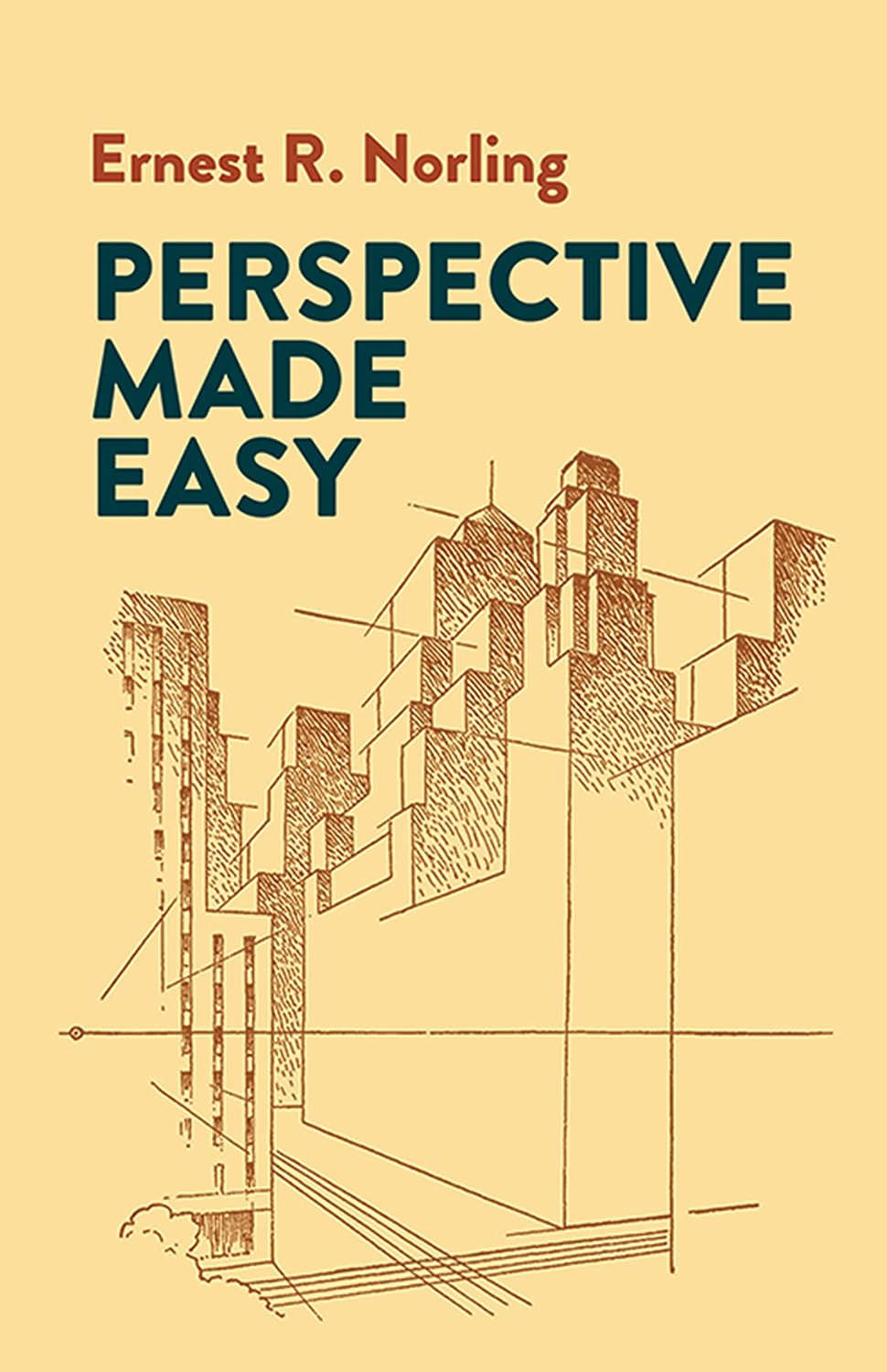
About Made Easy by Ernest R. Norling—Learn to Draw Real Depth with Simple Steps
Do your houses look flat? Do roads, rooms, boxes, and buildings seem wrong even when every line is neat? The problem may not be your hand or your talent. You may simply need to understand perspective. Perspective Made Easy by Ernest R. Norling turns this difficult art skill into a clear set of small lessons that beginners can follow. It shows how lines, eye level, distance, and vanishing points work together to make a flat page look deep and real.
This classic art guide does not bury you under hard words or heavy mathematics. Norling explains each idea in plain language, then supports it with a simple drawing. You learn one rule, see how it works, and use it in the next exercise. This steady method helps you understand why an object looks near, far, high, low, large, or small.
Whether you draw for fun, study art, design rooms, make comics, plan buildings, or create digital scenes, this book gives you a strong base. It helps you stop guessing and start drawing with purpose. With practice, the rules begin to feel natural, so you can focus less on fixing errors and more on creating the picture you imagined.
Why Perspective Can Feel So Hard
Many new artists can draw one object well but struggle when several objects must share the same space. A chair may look fine alone, yet appear too large inside a room. A road may become narrow in the wrong place. Windows may lean in different directions. People in the distance may look as tall as people in the front. These mistakes happen because the scene does not follow one clear point of view.
Perspective is the system that keeps every part of a picture connected. It tells you where the viewer is standing, how high the viewer’s eyes are, and how shapes change as they move farther away. When these ideas are not clear, even a careful drawing can feel strange.
Norling solves this problem by starting with the most useful facts. He explains the horizon, eye level, and vanishing point before moving to harder scenes. Instead of asking you to remember many rules at once, he repeats key ideas in different examples. This makes the lessons easier to recall when you work on your own drawing.
A Clear Path from Flat Shapes to Real Space
The book begins with basic forms because complex scenes are made from simple shapes. A building can begin as a box. A round table can begin as a circle placed in space. A row of posts can be understood as repeated objects becoming smaller with distance. When you learn to control these simple parts, streets, rooms, furniture, and figures become easier to arrange.
You will see how parallel edges seem to move toward a shared vanishing point. You will learn why the horizon is linked to the viewer’s eye level. You will also understand why looking up at an object gives a different result from looking down at it. These facts help you choose a view before you fill the page with detail.
The lessons are practical. Norling shows how to place objects and people so they belong in the same setting. He explains interiors, depth, shade, and shadows. More than 250 simple line drawings let you compare the rule with a visible example. The pictures are clean, so the main idea is easy to notice.
Learn the Rules Without Heavy Mathematics
Some students avoid perspective because they expect difficult geometry. This guide keeps the subject practical. It explains what the artist needs to see and do without turning each page into a long math lesson.
The rules still matter. Lines must move in the right direction, objects must become smaller in a believable way, and every part of the scene must match the chosen eye level. Yet Norling presents these rules through drawings and direct instructions. You can learn by doing instead of spending all your time on theory.
This approach is helpful for a complete beginner. It is also useful for an artist who learned by copying pictures but never understood the structure behind them. The book helps you see why one drawing works while another feels bent or out of balance.
Once you understand the structure, reference images become easier to study. You can look for the horizon, follow receding edges, and judge how objects sit in space. You can also build an imagined scene more carefully because you know which visual clues make it believable.
What You Can Learn from This Guide
Perspective Made Easy covers the ideas an artist needs to create convincing space. The lessons help you understand how the viewer’s position changes the whole picture and how objects relate to one another.
-
Understand the horizon and its link to eye level.
-
Learn how vanishing points guide lines moving into the distance.
-
Place boxes, buildings, furniture, and other objects more accurately.
-
Arrange people and objects so their sizes match their distance.
-
Draw indoor spaces that feel balanced and deep.
-
Add shade and shadows that support the form of an object.
-
Notice and correct common perspective errors before adding detail.
-
Build scenes from simple forms instead of guessing every line.
-
Use repeated examples to make the main rules easier to remember.
-
Apply perspective skills to sketches, paintings, comics, design, and digital art.
These lessons support many kinds of creative work. The book does not force you into one drawing style. It teaches a visual system that can work behind realistic art, cartoons, concept designs, illustrations, and quick sketches.
See the Idea Instead of Only Reading It
Art skills are often easier to understand when you can see the answer. A written rule may sound unclear, but one clean diagram can make it simple. That is why the many line drawings are such an important part of this guide.
Each image focuses on the lesson. There are no busy colours or large decorations pulling your eye away from the structure. You can follow the direction of a line, compare near and far objects, and see how the same form changes from a different view.
This visual method also makes the book useful as a quick reference. If you forget how to place an object in a room or how eye level changes a scene, you can return to the related example. You do not always need to read a long chapter again.
For best results, keep a pencil, ruler, eraser, and sketchbook nearby. Copy the basic examples first. Then change one part: move the object, raise the eye level, add another box, or turn the scene. Small changes help you test whether you truly understand the rule.
Useful for Beginners, Students, and Working Creators
This book is an excellent starting point for anyone learning to draw. A beginner can follow the lessons from the start and build skill in a sensible order. An art student can use it to support classwork or prepare for drawing assignments. A teacher can choose examples for simple practice sessions.
Comic and manga artists can use the rules to create rooms, streets, schools, shops, and action scenes with clearer depth. Illustrators can arrange characters and objects in one believable world. Animation and game-art learners can improve backgrounds and scene planning. Interior design and architecture students can strengthen the drawing skills used to show spaces and forms.
Even experienced artists may keep the guide nearby. Perspective errors can appear when a scene has many objects or an unusual view. A short review of the basic rule may save time and prevent a full redraw.
The book also suits people who enjoy urban sketching. Buildings, roads, doors, windows, walls, and repeated shapes become easier to observe once you know what to look for. Instead of copying each edge without a plan, you can find the larger structure first.
Turn Practice into Visible Improvement
Read one idea and redraw its example. Next, cover the example and try it from memory. Then find a real object with a similar form and sketch it. A table, book, room corner, road, or row of windows can become a useful exercise.
Keep your early drawings instead of throwing them away. After a few weeks, repeat the same subject and compare the two pages. You may notice straighter structure, better size changes, and a clearer sense of distance. This visible progress can keep you motivated.
Do not rush into a huge city scene on the first day. Build control through boxes, simple rooms, repeated objects, and basic shadows. Larger scenes become easier when these small skills are stable.
A Physical Edition Made for Regular Study
An instruction book should be comfortable to read and strong enough for repeated use. This Bookish Wonderland edition is prepared with premium eye-soothing cream paper, which gives the pages a softer look during long study sessions. Crystal-clear print keeps both words and drawing lines sharp, an important feature when small changes in direction carry meaning.
High-quality stitched and glue binding adds strength for regular page turning. You can return to lessons, compare diagrams, and practise from the book without treating it like a one-time read. The printed format also lets you study without phone alerts, battery limits, or screen glare.
These physical features work together to create a calm learning experience. You can place the book beside your sketchpad, follow a diagram, and move between reading and drawing at your own speed. It is a practical choice for home learning, art classes, studio reference, or a thoughtful gift for a new artist.
Why Choose Bookish Wonderland?
Bookish Wonderland serves readers and learners across the country with a large collection of premium and durable English books. We focus on readable print, comfortable paper, and strong binding so customers receive a book that is pleasant to use and made for lasting study.
If you are checking the Perspective Made Easy by Ernest R. Norling Book price in Bangladesh, consider the full value of the edition. Clear diagrams matter in an art book. Comfortable paper matters during practice. Strong binding matters when you return to the same pages many times.
Cash on Delivery is available across Bangladesh. We deliver inside and outside Dhaka, and customers in Dhaka can ask about fast or urgent delivery when the book is needed soon. If you have questions about availability, ordering, or delivery, contact Bookish Wonderland through Facebook or Instagram.
Start Drawing with Greater Confidence
If your scenes look flat, uneven, or confusing, you do not need to stop drawing. You need a clear way to understand space. Perspective Made Easy gives you that path through short explanations, useful diagrams, and rules you can practise at once.
The book helps you move from guessing to planning. It teaches you to see the horizon, follow lines, judge distance, place objects, and build depth. As these ideas become familiar, rooms feel more solid, streets stretch more naturally, and objects sit together with greater balance.
Order Perspective Made Easy by Ernest R. Norling from Bookish Wonderland today. Practise one lesson at a time, watch your drawings improve, and build a skill that can support years of creative work. Nationwide delivery and Cash on Delivery make ordering simple, while fast or urgent delivery may be available inside Dhaka. Start learning the rules that make flat pages feel like real spaces.
If you require any customization or have any questions, please inbox us via FB or Insta.
| Primary Specification | |
| Author | Ernest R. Norling |
| Genre | Art, Drawing, Non-fiction |
| ISBN-13/ISSN | 978-0486404738 |
| ISBN-10 | 0486404730 |
| Publisher | Dover Publications |
| Publishing Date | January 19, 1999 |
| Edition | 31537th |
| Language | English |
| Reading Age | 14+ |
| Format | Printed book |
| Physical Specification & Quality | |
| Paper Quality | Premium eye-soothing cream paper |
| Binding Quality | High quality stitched and glue binding (for longevity) |
| Print Quality | Crystal-clear print |
| Pages | 224 pages |
| Country | USA |
| Logistics Information | |
| Weight | 244 gm |
| Length | 8.5 inches |
| Width | 5.6 inches |
| Height | 0.47 inch |