

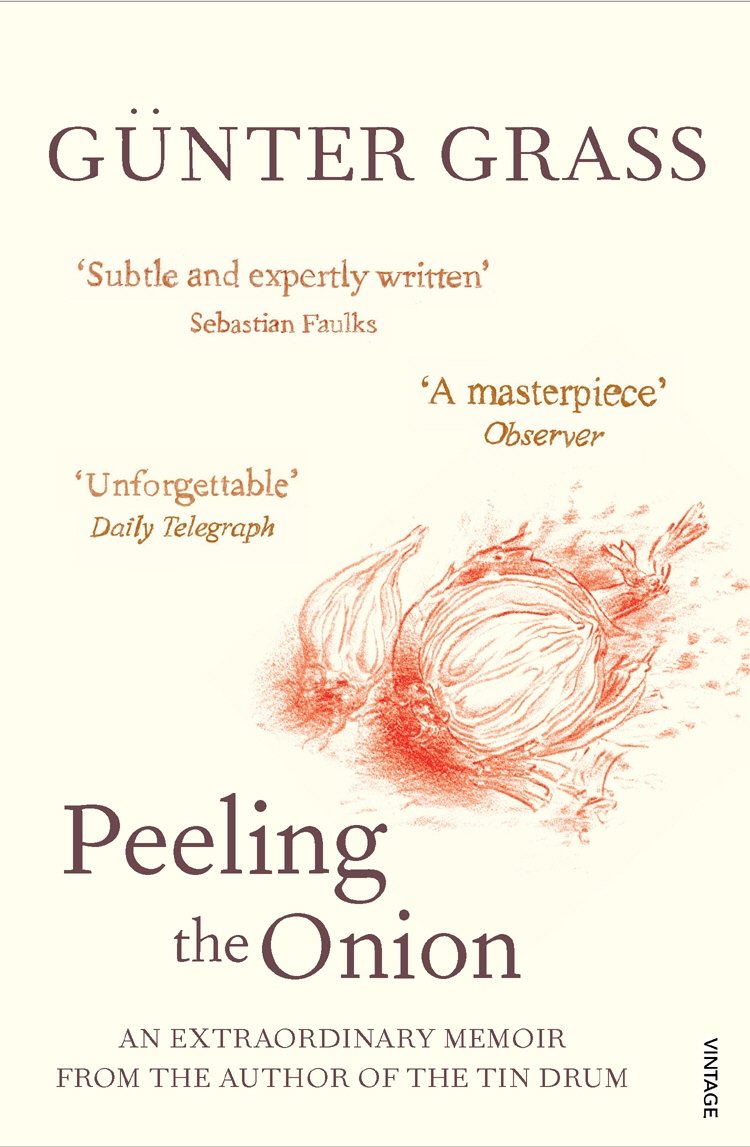
About Peeling the Onion by Gunter Grass – A Memoir of Memory, War, Guilt and a Writer’s Early Life
Peeling the Onion by Gunter Grass is a personal memoir about childhood, war, memory, guilt, art, and the experiences that helped shape one of Germany’s best-known writers. Grass looks back at his younger years in Danzig, now Gdańsk, his experiences during the Second World War, the difficult years after the war, and his early development as an artist and writer.
The memoir covers roughly the first three decades of his life and moves toward the period when he was writing The Tin Drum, the novel that later brought him international fame. Grass does not present his past as a simple list of dates and events. He writes about memory itself and explains how remembering can be incomplete, painful, and uncertain.
The title comes from the idea of peeling an onion layer by layer. Grass treats memory in a similar way. One memory leads to another, and each layer can reveal something that was hidden, forgotten, or difficult to face.
The book became especially discussed because Grass revealed that, as a teenager near the end of the Second World War, he had served in a Waffen-SS unit. This disclosure caused major public debate because Grass had spent much of his later life speaking about Germany’s Nazi past and the need to remember historical responsibility.
Translated from German into English by Michael Henry Heim, Peeling the Onion is a strong choice for readers interested in memoir, German history, literary history, memory studies, war, guilt, and the early life of an important twentieth-century writer.
A Memoir Built Around the Problem of Memory
Memory is at the centre of Peeling the Onion.
Grass does not pretend that every memory from his youth is perfectly clear. He often questions what he remembers, how he remembers it, and what may have changed after many years.
This gives the memoir a different style from a simple autobiography.
A normal autobiography may move from one year to the next and explain what happened. Grass is more interested in the way the past returns to the mind.
Some memories appear clearly.
Others feel incomplete.
Some are painful.
Some have been changed by later knowledge.
Grass uses the image of an onion because memory can have many layers. Removing one layer may reveal another underneath. The process can also hurt, just as cutting an onion can make the eyes water.
This idea helps readers understand the whole structure of the book.
Grass is trying to tell his story, but he is also showing how difficult it can be to tell a completely honest story about yourself.
Childhood in Danzig
The memoir begins with Grass’s early life in Danzig.
He was born in 1927 and grew up during a period when Germany and Europe were moving toward war. His family life, school years, local surroundings, and early interests became part of the world that later influenced his fiction.
Grass writes about the everyday details of youth as well as the political world developing around him.
As a young person, he did not always understand the full meaning of the events happening in Germany.
This becomes important later in the memoir because the adult Grass looks back with knowledge that the younger Grass did not have.
The book therefore shows two views at the same time.
There is the young boy living through events.
There is also the older writer examining the choices and beliefs of that younger person.
This difference allows Grass to explore how people understand their past after history has shown them consequences they could not or would not see at the time.
His Wartime Experience
The Second World War forms one of the most important parts of the memoir.
Grass describes his youth during wartime and his desire, as a teenager, to join military service. Near the end of the war, he became part of a Waffen-SS combat unit.
This disclosure became one of the most widely discussed parts of Peeling the Onion.
Grass had previously spoken publicly about his wartime generation and Germany’s responsibility for the Nazi period, but he had not openly discussed this part of his own military history for decades.
In the memoir, he examines the shame and responsibility connected to that silence.
His account also describes the confusion and fear of the final period of the war.
The young Grass experiences military defeat, danger, uncertainty, and the collapse of the world in which he had grown up.
The book does not present war as an exciting adventure. It looks at how a teenager entered a system he did not fully question and how the older man later had to understand that choice.
Why the Waffen-SS Disclosure Matters
The information about Grass’s Waffen-SS service became important because of the public role he later played in Germany.
Grass became a major novelist, essayist, artist, and public intellectual. He often spoke strongly about German history and the need to face the Nazi past.
Because of this, readers and critics reacted strongly when the memoir revealed that he had hidden an important part of his own history.
Peeling the Onion gives readers direct access to the way Grass chose to explain that period.
The book does not remove the controversy.
Instead, it gives readers material to think about questions of memory, responsibility, silence, guilt, and confession.
Why do people hide parts of their past?
Does admitting something many years later change its meaning?
How should readers judge a person’s younger actions against his later public life?
The memoir allows these questions to remain difficult.
That makes it useful for readers interested in both personal history and the larger problem of how societies remember war.
Life After the War
Grass’s story continues after Germany’s defeat.
The postwar period was difficult for many people. Cities were damaged, families were separated, money and food were limited, and the country had to deal with the results of the Nazi period and the war.
Grass was also trying to decide what kind of life he wanted.
His interests slowly moved toward art.
He studied sculpture and developed his skills as a visual artist. He also wrote poetry and became increasingly interested in literature.
These years are important because they show the early development of the artist who would later become internationally famous.
Readers can see that Grass did not immediately become a successful novelist.
His creative life developed through study, work, relationships, experiments, failures, and changing interests.
This gives the memoir value for readers interested in the life of a writer before success.
From Sculpture to Literature
Grass was more than a novelist.
He worked with drawing, sculpture, poetry, drama, and prose.
Peeling the Onion gives readers a view of these different parts of his artistic development.
His visual art and writing were closely connected. Images, objects, physical details, and strong memories appear throughout his later literary work.
The memoir helps explain where some of those interests came from.
Readers familiar with The Tin Drum, Cat and Mouse, Dog Years, or other works by Grass may recognise places, experiences, and ideas that later entered his fiction in changed forms.
This makes Peeling the Onion especially useful for students of Grass’s literature.
It allows readers to compare the author’s remembered life with the fictional worlds he later created.
The Road Toward The Tin Drum
The memoir moves toward an important point in Grass’s career: the creation of The Tin Drum.
Published in 1959, The Tin Drum became the novel that established his international reputation.
Peeling the Onion helps readers understand some of the experiences behind that creative development.
Grass’s childhood in Danzig, wartime memories, postwar experiences, work as an artist, and observations of German society all contributed to the world from which his writing emerged.
The memoir does not function as a simple guide to The Tin Drum, but readers of the novel can gain useful background.
It becomes possible to see how real experiences may be changed, reshaped, exaggerated, or transformed when they enter fiction.
For literature students, this relationship between life and art can be one of the most rewarding parts of the memoir.
A Book About Guilt and Responsibility
Guilt appears throughout Peeling the Onion in several forms.
There is personal guilt.
There is historical guilt.
There is the guilt of someone looking back at what he did or failed to do when he was young.
There is also the question of silence.
Grass spent decades writing about German history before revealing his own Waffen-SS service.
This does not produce a simple moral conclusion.
Readers have to decide how they understand his explanation.
Some may view the memoir as an important act of confession.
Others may question why he waited so long.
The value of the book is that it gives readers a detailed account from Grass himself and allows them to examine his words closely.
A Useful Book for History Readers
Peeling the Onion can be valuable even for readers who have never read Grass’s novels.
The memoir offers a personal view of a young German growing up during the Nazi era and living through the final years of the Second World War.
It then continues into the difficult postwar period.
Large historical events are shown through personal memory.
Instead of seeing only dates, governments, battles, and political decisions, readers see how history affected one person’s childhood, military service, family life, education, work, and artistic development.
This does not make the memoir a complete history of Germany.
It is one person’s account.
However, personal accounts can help readers understand how major events entered everyday life.
A Strong Choice for Literature Students
Students of literature can use Peeling the Onion to understand Grass as both a writer and a historical figure.
His books often deal with German memory, responsibility, war, and the difficulty of understanding the past.
The memoir shows that these subjects were also connected with his own life.
Readers studying The Tin Drum may find the book especially useful because the memoir ends around the period when Grass was developing the novel that made him famous.
The English translation by Michael Henry Heim also gives English-language readers access to Grass’s memoir without needing to read the original German text.
Who Should Read Peeling the Onion?
Peeling the Onion is suitable for readers interested in memoirs, autobiography, twentieth-century European history, German literature, World War II history, memory studies, Nobel Prize-winning authors, and the lives of major writers.
It is also a useful choice for readers who enjoy books about how artists develop their work.
Fans of Günter Grass may find it particularly important because it connects his early life with themes that later became central to his writing.
Readers interested in difficult questions about guilt and responsibility can also find a great deal to consider.
The book asks readers to think rather than giving them easy answers.
A Book for Serious Discussion
Peeling the Onion works well for university reading, personal study, and book-club discussion.
Readers can discuss whether memory can ever be completely reliable.
They can examine Grass’s decision to reveal his Waffen-SS service so many years later.
They can also discuss the difference between confession, explanation, responsibility, and forgiveness.
Other useful topics include war, childhood, art, German identity, postwar life, literature, and the relationship between personal memory and public history.
Readers familiar with Grass’s fiction can also discuss how his real experiences later appeared in transformed form inside his novels.
Premium Printed Quality from Bookish Wonderland
Bookish Wonderland offers Peeling the Onion in a reader-friendly printed format for readers who want a comfortable and durable copy.
The book uses premium eye-soothing cream paper, giving the pages a softer tone during longer reading sessions.
The crystal-clear print keeps the text sharp and easy to follow.
The high-quality stitched and glue binding is designed for better longevity and helps keep the pages secure through regular reading and study.
This makes the copy suitable for personal libraries, academic reading, research, book clubs, gifting, and long-term collection.
Order Peeling the Onion Across Bangladesh
For readers comparing the Peeling the Onion by Gunter Grass Book price in Bangladesh, Bookish Wonderland offers a convenient way to order a premium printed copy.
Nationwide delivery is available, including delivery inside and outside Dhaka. Cash on Delivery is available for customers who prefer to pay when the order arrives.
Customers in Dhaka can also ask about fast or urgent delivery options when available.
Bookish Wonderland carries a large collection of premium and durable English books, including memoirs, history, biographies, literary fiction, classics, politics, philosophy, war studies, and other important nonfiction titles.
Add Peeling the Onion to Your Memoir and Literature Collection
Peeling the Onion by Gunter Grass is a valuable memoir for readers who want to understand the early life behind one of Germany’s most important modern writers.
Grass looks back at childhood in Danzig, the war years, military service, defeat, postwar hardship, artistic training, relationships, and the beginning of his literary career. These experiences are connected by his larger interest in memory and the difficulty of telling the truth about one’s own past.
The book is especially important because Grass does not write from a position of simple innocence. His disclosure of service in the Waffen-SS forces the memoir to deal directly with uncomfortable questions about silence, responsibility, guilt, and memory.
At the same time, the book shows how a young man living through war eventually became a sculptor, poet, novelist, and Nobel Prize-winning author.
For readers of The Tin Drum, the memoir gives useful background on experiences that later influenced Grass’s fiction. For history readers, it offers a personal view of Germany before, during, and after the Second World War. For students, it provides rich material for studying autobiography, memory, literature, guilt, and the relationship between private life and public history.
Peeling the Onion is best suited to readers who enjoy reflective nonfiction and books that do not simplify difficult subjects. Grass repeatedly questions his own memory and shows how the past can become harder to understand as more layers are uncovered.
Order Peeling the Onion by Gunter Grass from Bookish Wonderland for a premium printed copy with nationwide delivery, Cash on Delivery, and fast or urgent delivery options in Dhaka when available.
If you require any customization or have any questions, please inbox us via FB or Insta.
| Primary Specification | |
| Author | Günter Grass |
| Translator | Michael Henry Heim |
| Narrator | Norman Dietz |
| Editor | Cathy Riggs |
| Genre | Memoir, Autobiography, Literary Nonfiction |
| ISBN-13/ISSN | 978-0156035347 |
| ISBN-10 | 0156035340 |
| Publisher | HarperVia |
| Publishing Date | June 2, 2008 |
| Language | English |
| Reading Age | 18+ |
| Format | Printed book |
| Physical Specification & Quality | |
| Paper Quality | Premium eye-soothing cream paper |
| Binding Quality | High quality stitched and glue binding (for longevity) |
| Print Quality | Crystal-clear print |
| Pages | 425 pages |
| Country | Germany |
| Logistics Information | |
| Weight | 445 gm |
| Length | 8.5 inches |
| Width | 5.6 inches |
| Height | 0.94 inch |