

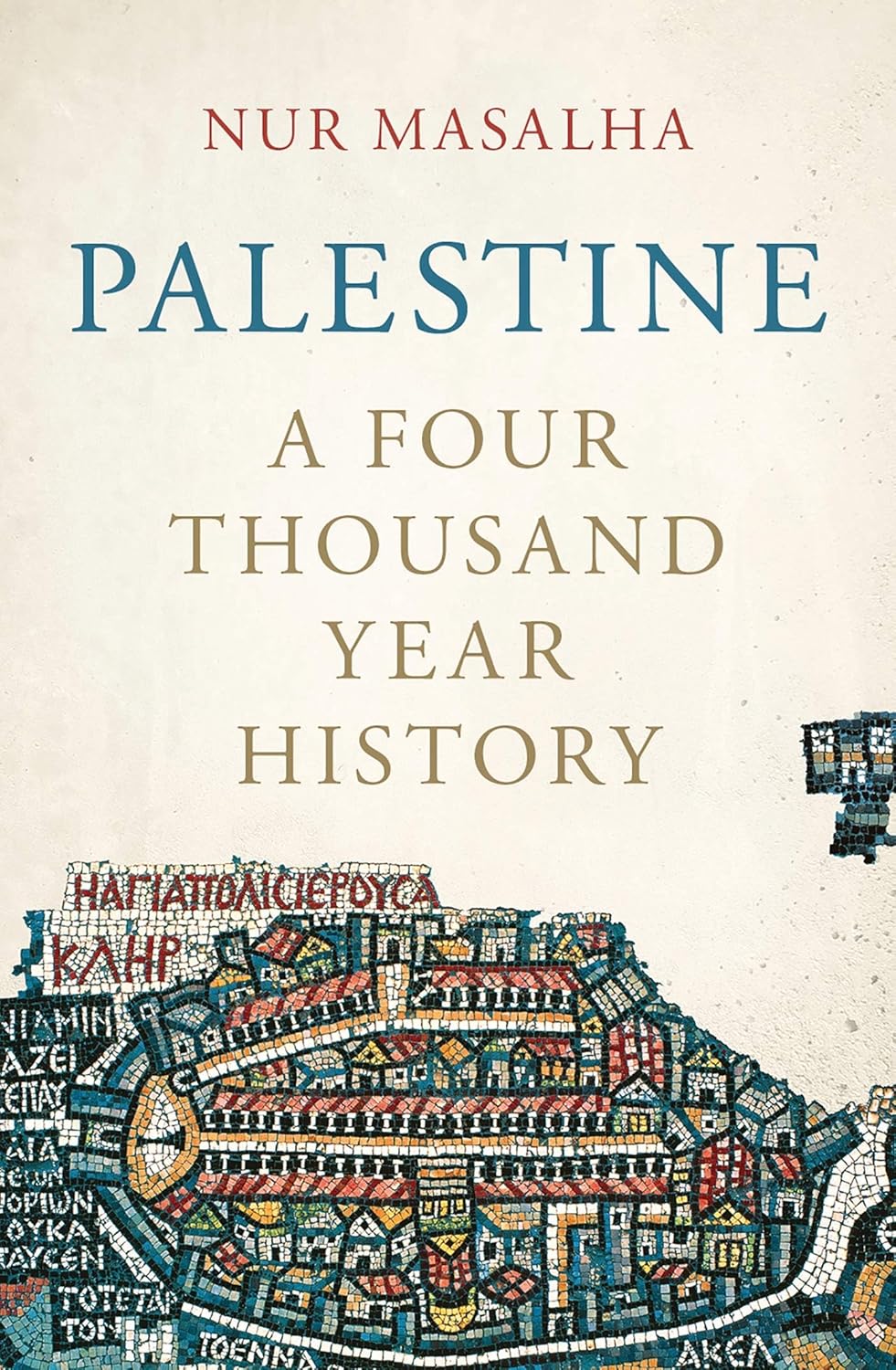
About Palestine: A Four Thousand Year History by Nur Masalha — A Deep Journey Through Land, Names, Memory, and Identity
If you want to understand why the history of Palestine is discussed so strongly today, Palestine: A Four Thousand Year History by Nur Masalha gives you a long, detailed place to begin. This is not a quick political book and it is not a simple timeline. It is a wide historical study that moves across ancient records, classical texts, Roman and Byzantine rule, early Islamic periods, medieval history, Ottoman Palestine, and the modern age. Masalha’s main aim is to examine how the name Palestine, the land connected with that name, and forms of Palestinian identity appeared and changed across a very long span of time. The publisher says the book draws on written sources and archaeological evidence and follows the subject from the Bronze Age to the present. Masalha argues that Palestine has much deeper historical roots than accounts that treat it as a mainly modern idea. That claim is central to the book, and it has also been debated by other historians.
Why this book matters to curious readers
Many readers meet the history of Palestine first through news, conflict, short videos, or strong political arguments. That can make the subject feel broken into small pieces. One person talks about ancient history. Another talks about the Ottoman period. Another begins in the twentieth century. This book tries to connect many of those periods inside one large story.
A long history told through names and places
One of the most important ideas in the book is the history of the name Palestine. Masalha studies references in ancient Egyptian and Assyrian material, then moves through Greek, Roman, Byzantine, Arabic, medieval, Ottoman, and modern sources. The publisher’s table of contents shows chapters on Philistia, classical antiquity, the Roman province of Syria Palaestina, Byzantine administrative provinces, Arab Christian Palestine, Jund Filastin under early Islamic rule, Ayyubid and Mamluk periods, Ottoman history, modern Palestinian identity, and the politics of place names.
This makes the book more than a story of rulers and wars. It also becomes a study of language. A place name can survive, change form, move in meaning, or be used in a new political setting. Masalha uses that idea to build his case that Palestine has a long history as a geographic and cultural idea.
What problem does this book help solve?
A common problem for readers is that the history of this land is often taught in separate boxes. Ancient history may be treated as one subject. Islamic history may be another. Ottoman history may appear far away from modern nationalism. Modern books may start with the late nineteenth or early twentieth century and leave earlier periods behind.
Masalha offers a different method. He places these periods next to one another and asks what changed and what continued. That does not mean every period was the same. It means the reader can compare many eras without losing the wider geographic story. This approach can help students, history lovers, researchers, and general readers build a stronger timeline in their minds.
The author’s main argument, explained simply
Masalha argues that Palestine should not be seen only as a modern political name created in reaction to modern Israel. He traces uses of related names and geographic ideas across many centuries and connects them to the development of Palestinian identity. He also challenges forms of biblical and nationalist history that, in his view, reduce the land to one people, one period, or one story.
This is an important point to understand before buying the book: it is not written from a neutral “view from nowhere.” It has a clear historical argument. Many reviewers have praised its research and its effort to bring Palestinian history and local voices into the center of the story. Other historians have challenged parts of its thesis. Historian G. W. Bowersock, for example, argued that the title suggests a continuity across four thousand years that he does not think the evidence can fully support. That debate is useful for readers because it shows that this book belongs inside a larger field of historical argument, not outside it.
A book built for close reading
This is a serious history book. The publisher lists ten main chapters plus an introduction, and current Bloomsbury editions run more than 450 pages. It uses historical names, old sources, administrative terms, and long time periods. That means it may not feel like a light weekend read for every person.
What you will explore inside the book
The early chapters examine Philistia and the wider question of how names related to Palestine appeared in the ancient world. The book then moves into classical Greek and Roman periods and discusses the Roman administrative name Syria Palaestina. From there, it looks at Byzantine Palestine and at Arab Christian life before the early Islamic conquests.
Later chapters follow Jund Filastin, the early Islamic administrative district, and then move through Ayyubid, Mamluk, and early Ottoman periods. Masalha also discusses local rule and forms of political authority in the eighteenth century. The final parts turn toward modern Palestinian identity, modern representations of the land, and the renaming of places after the creation of the State of Israel.
The scope is large. That is one reason this book can be valuable even for readers who do not agree with every part of the author’s interpretation. It gives many historical periods to investigate further.
Why readers may want this on their shelf
A good history collection needs books that do more than repeat familiar summaries. This book gives readers a strong, clearly argued Palestinian-centered account. It can sit beside other works on Ottoman history, Zionism, Israeli history, Palestinian nationalism, archaeology, and the modern Middle East.
Easy to study, discuss, and revisit
You do not need to read the whole book in one sitting. A practical way to use it is to choose one period and read slowly. You might begin with classical Palestine, early Islamic administration, the Ottoman period, or modern place names. Keep a simple timeline beside you. Mark names that appear in more than one era. Check unfamiliar terms. Compare the author’s claims with other historians when a point is debated.
This method turns a dense book into a useful study tool. It also helps readers avoid treating one author as the final voice on a complex subject. History becomes clearer when sources are compared.
If you are buying for a student, this book is especially useful for research-led reading because it gives a long chronological frame. If you are buying for yourself, it can help you move from headline-level knowledge toward a deeper view of the past.
A premium reading copy from Bookish Wonderland
At Bookish Wonderland, this edition is prepared for readers who want a comfortable physical copy for long reading sessions. The pages use premium eye-soothing cream paper, which gives a softer reading surface than bright white paper. The text is printed with a crystal-clear finish so letters stay sharp and easy to follow.
The book also uses high-quality stitched and glue binding for better longevity. That matters with a long nonfiction title because readers may open the same chapter many times while studying, checking notes, or discussing a point. A durable binding helps the copy stay useful on your shelf for longer.
This quality-focused format makes the book suitable for personal libraries, study desks, reading groups, and gifts for serious history readers.
Who is this book for?
This title is a strong match for readers interested in Palestinian history, Middle Eastern history, historical geography, nationalism, memory, place names, colonial studies, and the political use of history. It can also suit readers who want a Palestinian-centered interpretation to compare with Israeli, Zionist, Ottoman, Arab, biblical, or broader regional histories.
It is especially useful for people who are tired of learning the subject only through short social media posts. The book gives more space for evidence, chronology, and argument. Because the subject is contested, the best reading approach is to stay curious and compare sources.
The writing is academic, so very young readers may find it difficult. Adult readers, university students, advanced school students, teachers, and independent researchers are more likely to get the most from it.
What makes the reading experience useful
The main benefit is context. Instead of beginning with only the latest crisis or the twentieth century, the book makes you look across a much longer span. It shows how one region can carry many names, faiths, rulers, languages, and communities while still remaining connected in historical memory.
Another benefit is source awareness. Masalha’s argument depends heavily on how old texts, administrative names, maps, records, and later scholarship are read. Even when you question his conclusion, you are pushed to ask a valuable question: what kind of evidence is being used, and what does that evidence actually prove?
That habit is useful far beyond this book. It makes you a more careful reader of history in general.
Palestine: A Four Thousand Year History by Nur Masalha — Book price in Bangladesh
If you are searching for Palestine: A Four Thousand Year History by Nur Masalha price in Bangladesh, Bookish Wonderland offers a convenient way to order a premium printed copy for your personal or study library. You can order from inside or outside Dhaka, and nationwide delivery is available. Cash on Delivery is available across Bangladesh, which makes ordering simple for readers who prefer to pay when the book arrives. Fast or urgent delivery options may also be available in Dhaka.
For readers who collect serious English nonfiction, this title adds a deeply researched and clearly argued work to the shelf. It is the kind of book you can read once for the main story, then return to later for dates, names, themes, and references.
Why choose Bookish Wonderland for this title?
A serious history book should feel good to read and strong enough to keep. Bookish Wonderland focuses on a premium reading experience with eye-soothing cream paper, crystal-clear print, and stitched plus glue binding for longevity. That makes a real difference when you are reading hundreds of pages, underlining ideas, or returning to the same chapter later.
You also get a simple buying process. Nationwide delivery makes the book available to readers across Bangladesh. Cash on Delivery gives more flexibility. Readers in Dhaka may choose fast or urgent delivery when available. Bookish Wonderland also carries a large collection of durable English books, making it easier to build a personal library in one place.
Read the argument, test the evidence, build your own view
Palestine: A Four Thousand Year History is best approached as a major historical argument. Nur Masalha asks readers to rethink how the name Palestine, the people of the land, and Palestinian identity are placed inside long history. He brings together evidence from many periods and argues for deep historical roots and continuity. Supportive reviewers see this as an important correction to histories that marginalize Palestinian voices. Critical reviewers question whether the evidence supports continuity across the full four-thousand-year frame.
That disagreement is exactly why the book can be worth reading. It gives you a substantial case to examine instead of a short slogan. You can follow the sources, compare other historians, and decide for yourself what you find convincing.
If you want a book that will make you slow down, think, check claims, and see Palestine through a much longer historical lens, this title deserves a place on your reading list. Order your copy from Bookish Wonderland and add a discussion-rich work of history to your shelf.
If you require any customization or have any questions, please inbox us via FB or Insta.
| Primary Specification | |
| Author | Nur Masalha |
| Narrator | Fajer Al-Kaisi |
| Genre | History, Middle Eastern History, Social & Cultural History, Archaeology, History of Religion |
| ISBN-13/ISSN | 978-0755649426 |
| ISBN-10 | 0755649427 |
| Publisher | I.B. Tauris |
| Publishing Date | October 5, 2023 |
| Language | English |
| Reading Age | 18+ years |
| Format | Printed book |
| Physical Specification & Quality | |
| Paper Quality | Premium eye-soothing cream paper |
| Binding Quality | High quality stitched and glue binding (for longevity) |
| Print Quality | Crystal-clear print |
| Pages | 464 pages |
| Country | United Kingdom |
| Logistics Information | |
| Weight | 486 gm |
| Length | 8.5 inches |
| Width | 5.6 inches |
| Height | 1 inch |