

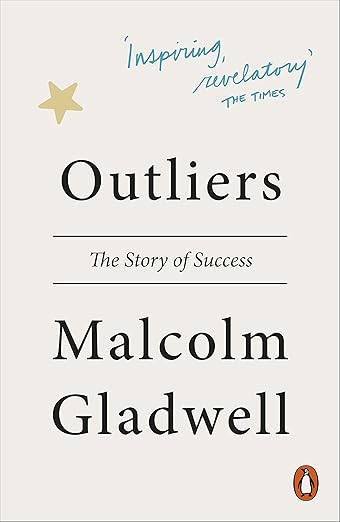
About Outliers: The Story of Success by Malcolm Gladwell – A Clear Look at Practice, Opportunity, Timing, Culture, and Why Success Is Never Just About Talent
Outliers: The Story of Success by Malcolm Gladwell asks why some people achieve much more than others. Instead of giving the usual answer about talent, ambition, or hard work alone, Gladwell looks at the conditions around successful people. He studies family background, culture, timing, education, practice, social rules, and unusual opportunities that helped certain people move ahead.
The book looks at Bill Gates, the Beatles, Canadian hockey players, lawyers, pilots, students, and mathematical high achievers. Gladwell uses their stories to argue that success is often built from many advantages that begin long before the final achievement becomes visible.
This makes Outliers useful for readers who enjoy business, psychology, sociology, self-development, education, and books that challenge familiar ideas.
Success Is More Than Personal Talent
Many success stories sound simple: a talented person works hard, stays focused, and becomes exceptional.
Gladwell asks readers to look again.
He argues that high achievement often depends on circumstances that become easy to ignore once someone is famous. A person may have access to better teachers, more practice time, useful technology, supportive parents, the right location, or a rare chance at the right age.
These advantages do not remove the need for effort. They help explain why two motivated people can still have very different results.
It also gives readers a practical way to notice advantages that may be hidden inside routines and institutions.
The Matthew Effect Shows How Small Advantages Can Grow
One early chapter looks at Canadian hockey players and age cut-off dates.
Children born earlier in the selection year may be slightly older and more physically developed than children born later. Coaches may read that small age advantage as greater talent.
Those children can then be selected for better teams, receive more coaching, play more games, and get more practice.
Over time, a small early advantage can become a larger difference in skill.
Gladwell connects this with the Matthew Effect: advantage can lead to more advantage. The idea encourages readers to ask whether schools, sports, workplaces, and other systems sometimes help create the winners they later celebrate.
The 10,000-Hour Idea Became the Book’s Most Famous Point
Outliers is widely known for the idea that high-level skill often requires a very large amount of focused practice.
Gladwell discusses research on musicians and examples such as the Beatles, who spent long periods performing in Hamburg before becoming globally famous. He also looks at Bill Gates, who had unusually early access to computers.
The larger point is not simply “practice more.” Access to practice matters too. A person cannot spend thousands of hours developing a skill without the time, tools, teachers, or environment needed to begin.
The popular “10,000-hour rule” should not be treated as a magic guarantee. Researcher Anders Ericsson later stressed that the number was an average in one study, not a universal rule for expertise.
The Beatles Example Is About Opportunity as Well as Work
Gladwell uses the Beatles to show how an unusual opportunity can create huge amounts of real experience.
Before international fame, the band played long sets in Hamburg, Germany. They had to repeat songs, try new material, improve timing, and learn how to hold an audience.
Many young musicians work hard. Fewer receive a situation that forces them to perform that much, that often, in front of real crowds.
Gladwell uses the story to show how skill can grow when effort meets an unusual chance.
Bill Gates Had Skill and Rare Early Access
Bill Gates is another major example.
Gladwell does not deny Gates’s intelligence, drive, or technical ability. He asks what opportunities allowed those qualities to develop so early.
As a teenager, Gates attended a school that gained access to a computer terminal when computer time was still rare. He later found more ways to get computer access and spent many hours programming.
That experience arrived before personal computing became a huge industry.
The example supports the book’s central point: talent may create potential, but environment and timing can strongly affect how far that potential develops.
Intelligence Alone Does Not Explain Every Outcome
Gladwell also compares people with very high intelligence who experienced very different levels of success.
One example is Christopher Langan, known for an extremely high IQ. Another involves J. Robert Oppenheimer, who became a major scientific figure.
Gladwell uses these stories to discuss practical intelligence: knowing how to speak to institutions, negotiate, ask for help, handle authority, and make social systems work for you.
Academic intelligence can solve difficult problems, but success in real institutions often requires other skills too.
This section challenges the idea that test scores alone can explain where people eventually end up.
Culture Can Continue to Shape Behaviour
The second half of Outliers looks closely at cultural legacy.
Gladwell argues that habits and values can continue across generations, even when people move to new places or work in different settings.
He explores examples involving family conflict, farming traditions, mathematics, and aviation.
One of the best-known sections examines airline accidents and communication inside cockpit crews. Gladwell discusses how attitudes toward hierarchy may affect whether a junior crew member feels able to challenge a senior pilot clearly during an emergency.
The broader point is that behaviour is shaped by both the person and the culture around that person.
The Book Also Looks at Math, Work, and Persistence
Another section connects mathematical performance with language and agricultural traditions.
Gladwell discusses rice farming as work that historically demanded careful attention, persistence, and repeated effort. He connects this with cultural attitudes toward work and learning.
Some of these broad cultural arguments have been debated, so readers can treat them as ideas to examine rather than fixed laws.
That is part of the appeal of Outliers. Its claims are easy to discuss, question, and compare with personal experience.
The book works well for classrooms and book clubs because readers do not need to agree with every argument to find the questions useful.
Timing Can Matter as Much as Ability
A repeated idea in Outliers is that being born at the right moment can create a special opportunity.
People who entered computing at the right age during major technological change had a different path from equally intelligent people born too early or too late.
Generations can benefit from new industries, social changes, economic conditions, or moments when old rules are changing.
Gladwell asks readers to think about history as part of personal success.
When we call someone self-made, we may forget the teachers, technologies, institutions, and social conditions that made a particular kind of success possible.
Outliers Is Not a Simple Motivation Book
Readers should not expect a step-by-step plan promising wealth.
Outliers is closer to popular psychology, sociology, business thinking, and narrative nonfiction.
Gladwell builds chapters around stories, studies, statistics, biographies, and historical examples. His writing makes complex ideas easy to follow.
The book can motivate readers, but its main purpose is to change how they explain achievement.
Instead of asking only, “What is special about this successful person?” Gladwell encourages readers to ask what opportunities, culture, timing, and support helped that person develop.
Some Ideas Are Best Read as Arguments, Not Rules
Outliers has been highly influential, but not every claim should be treated as settled science.
The 10,000-hour idea is the clearest example. Anders Ericsson later said the popular version was too simple and that there is nothing magical about exactly 10,000 hours.
Practice matters greatly, but quality of practice, teaching, physical traits, motivation, opportunity, and the type of skill matter too.
This actually fits the book’s wider lesson: success usually has more than one cause.
Readers can enjoy Gladwell’s stories while also asking which ideas are strongly supported and which are useful starting points for debate.
Publication and Edition Details
Little, Brown and Company published the original US hardcover on November 18, 2008.
Hachette lists that edition at 320 pages with ISBN 9780316017923.
The Little, Brown Paperbacks trade paperback was released on June 7, 2011 and is listed at 336 pages with ISBN 9780316017930.
A large-print hardcover is listed at 464 pages, showing why pagination varies by edition.
The unabridged English audiobook is narrated by Malcolm Gladwell and runs for about seven hours and eighteen minutes.
Customers who need a particular cover or page count should check the ISBN before ordering.
About Malcolm Gladwell
Malcolm Gladwell is a journalist, author, speaker, and podcast host known for turning research and unusual stories into accessible nonfiction.
Hachette currently describes him as the author of eight New York Times bestsellers.
He is also a cofounder of Pushkin Industries and host of Revisionist History.
Gladwell was born in England, raised in Canada, and built his writing career in the United States.
His work often focuses on hidden patterns in behaviour, decision-making, social systems, communication, and culture.
Who Will Enjoy Outliers?
Outliers is a strong choice for students, professionals, entrepreneurs, teachers, parents, managers, sports readers, psychology readers, and anyone interested in why some people reach exceptional levels of achievement.
It especially suits readers who like nonfiction built around real stories instead of heavy academic language.
The book can also work well for discussion groups because its claims invite questions.
Readers can compare Gladwell’s examples with their own education, career, family, workplace, or community and ask which opportunities helped them and which barriers made progress harder.
Book Quality at Bookish Wonderland
Bookish Wonderland offers this title with premium eye-soothing cream paper, crystal-clear printing, and high-quality stitched plus glue binding.
The cream paper gives the pages a softer tone for comfortable reading. Clear printing keeps examples, statistics, names, and longer explanations easy to follow, while the stronger binding supports repeated reading and shelf storage.
The copy suits personal study, gifting, classroom reading, professional development, book clubs, or a nonfiction collection.
Why Order from Bookish Wonderland?
Bookish Wonderland delivers books across Bangladesh, including inside and outside Dhaka. Cash on Delivery is available nationwide.
Customers in Dhaka can also ask about fast or urgent delivery when available.
If you are checking Outliers: The Story of Success by Malcolm Gladwell Book price in Bangladesh, it is useful to compare the physical quality of the copy along with the listed price.
Book customization is also available. For stock, customization, or delivery questions, you can contact Bookish Wonderland through Facebook or Instagram.
A Book That Changes the Question Behind Success
Outliers: The Story of Success by Malcolm Gladwell asks readers to stop looking only at successful people and start looking at the world around them.
The book shows how practice, family, culture, timing, education, technology, social skills, and opportunity can combine with talent and effort.
You may not agree with every conclusion, but the examples are memorable and the central question remains useful: what had to happen before success became possible?
For readers who want accessible nonfiction that connects psychology, business, education, culture, and real-life stories, Outliers remains an engaging book to read and discuss.
Order your copy from Bookish Wonderland for nationwide delivery, Cash on Delivery, premium cream paper, clear printing, and strong stitched plus glue binding.
If you require any customization or have any questions, please inbox us via FB or Insta.
| Primary Specification | |
| Author | Malcolm Gladwell |
| Genre | Nonfiction, Popular Social Science, Psychology, Success/Business |
| ISBN-13/ISSN | 978-1510724570 |
| ISBN-10 | 1510724575 |
| Publisher | Sky Pony |
| Publishing Date | October 31, 2017 |
| Language | English |
| Reading Age | 16+ |
| Format | Printed Book |
| Physical Specification & Quality | |
| Paper Quality | Premium eye-soothing cream paper |
| Binding Quality | High quality stitched and glue binding (for longevity) |
| Print Quality | Crystal-clear print |
| Pages | 372 pages |
| Country | USA |
| Logistics Information | |
| Weight | 393 gm |
| Length | 8.5 inches |
| Width | 5.6 inches |
| Height | 0.83 inch |