

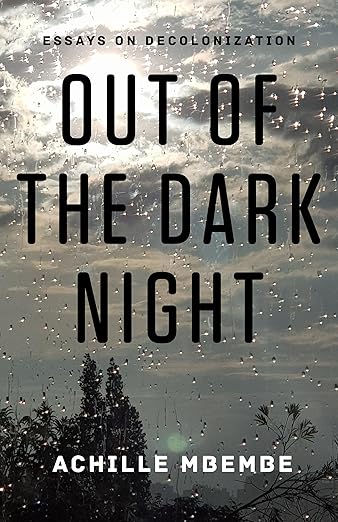
About Out of the Dark Night by Achille Mbembe – A Clear Guide to Decolonization, African Modernity, France, Race, and the Future
Out of the Dark Night by Achille Mbembe is a collection of political and philosophical essays about decolonization, Africa, Europe, race, democracy, modernity, and the possibility of building a different future. Mbembe does not treat decolonization as a finished event that happened when African countries gained formal independence. He asks what decolonization still requires when old structures, habits, borders, forms of knowledge, and racial ideas continue after colonial rule has officially ended.
The book moves between African history, French politics, postcolonial thought, critical theory, and questions about humanity on a global scale. It is written for readers who want to understand how colonialism shaped both Africa and Europe, why political independence did not automatically remove colonial patterns, and what new ideas may be needed to move beyond them.
Rather than offering a simple history, Mbembe asks readers to think about how societies can create new forms of community after violence, domination, and exclusion.
Decolonization Is More Than a Transfer of Political Power
One of the book’s central ideas is that decolonization cannot be reduced to a flag, a new government, or the formal end of foreign rule.
Mbembe looks at decolonization as a deeper process involving political institutions, knowledge, culture, identity, memory, and the way people imagine who belongs to the human community.
A country can become formally independent while still carrying institutions and ideas built during colonial rule.
This is why the book keeps returning to the unfinished nature of decolonization.
The question is not only whether colonial governments left. The larger question is whether the social and intellectual structures created by colonialism were truly transformed.
That makes the book useful for readers studying political theory, African history, postcolonial studies, philosophy, international relations, sociology, and modern debates about race.
The Book Looks at Africa as a Place of New Possibilities
Mbembe does not write about Africa only through crisis, poverty, violence, or loss.
He is interested in the new societies, identities, and cultural forms that have developed through movement, mixing, migration, urban life, and political change.
This is important because many older descriptions of Africa treat the continent mainly as a place that lacks something Europe supposedly possesses.
Mbembe challenges that way of thinking.
He asks readers to see African modernity as something active and creative, shaped by difficult histories but not limited to them.
The future, in his account, does not require copying a European model.
It requires thinking seriously about the forms of life already being created through African experiences, movement, cultural exchange, and new social arrangements.
Afropolitanism Is One of the Book’s Key Ideas
The final chapters develop Mbembe’s idea of Afropolitanism.
Afropolitanism describes a way of being African that is open to movement, mixture, difference, and connection with the wider world.
It rejects the idea that African identity must be pure, fixed, isolated, or defined only by one territory or tradition.
Africa has always been shaped by movement across regions, languages, religions, trade routes, diasporas, empires, and borders.
Mbembe uses Afropolitanism to think about a future where identity is not built mainly through exclusion.
The idea is not simply about being cosmopolitan or travelling internationally.
It is connected to a larger political and ethical question: how can people live with difference without turning difference into a reason for domination?
France Is a Major Part of Mbembe’s Critique
Out of the Dark Night spends significant time examining France and its relationship with its colonial past.
Mbembe argues that France decolonized its empire without fully decolonizing itself.
Formal colonial rule ended, but ideas about race, citizenship, national identity, universalism, immigration, and belonging continued to carry traces of the colonial relationship.
This creates what the book describes as forms of proximity without full reciprocity.
Former colonies and the former colonial power remain connected through language, migration, economics, memory, politics, and culture, but the relationship is not necessarily equal.
Mbembe examines the difficulty France has had in recognizing how colonial history remains present inside contemporary French society.
Readers interested in modern Europe, migration, citizenship, and debates about national identity will find this part especially relevant.
Universalism Can Hide Unequal Treatment
France often presents republican values such as liberty, equality, reason, and universal citizenship as applying to everyone.
Mbembe does not simply reject those ideals.
He asks what happens when universal language is used while racial inequality and colonial memories remain unaddressed.
A society may claim to treat everyone as equal while refusing to examine the historical systems that produced unequal conditions.
The result can be a gap between what a political system says about itself and what some citizens experience in daily life.
This argument connects the book to wider debates about race, democracy, immigration, policing, citizenship, and representation.
The Book Draws Strongly on Frantz Fanon
Frantz Fanon is an important intellectual presence throughout Out of the Dark Night.
Mbembe is interested in Fanon’s understanding of colonialism as something that damages political structures, social relationships, and the inner life of colonized people.
For Fanon, decolonization was not only about replacing one government with another. It involved rebuilding human relationships and creating a new sense of what it means to be a person after colonial domination.
Mbembe develops this idea further.
He treats decolonization as a process connected with healing, becoming, and creating new forms of human community.
Readers who have studied The Wretched of the Earth or Black Skin, White Masks will recognize the influence, but prior knowledge of Fanon is not required to understand the broad argument.
Knowledge Itself Can Carry Colonial Assumptions
Another major theme is the politics of knowledge.
Colonialism did not only control territory and resources. It also shaped which forms of knowledge were considered legitimate, modern, rational, or universal.
African histories, ideas, languages, and ways of understanding the world were often treated as secondary or inferior.
Mbembe asks what decolonization means inside universities, scholarship, philosophy, and public debate.
This does not mean simply replacing European thought with a closed idea of indigenous knowledge.
He is cautious about romanticizing a pure precolonial past.
Instead, he is interested in creating new forms of thought from entangled histories.
Africa and Europe cannot simply return to a time before contact. Their histories have changed each other.
The challenge is to build knowledge without repeating old hierarchies.
Borders Are Political Tools, Not Natural Facts
Mbembe also examines borders and the way they decide who belongs, who can move, and who is treated as an outsider.
Borders may look fixed on a map, but they are political creations.
They can protect states, but they can also produce exclusion.
The book connects borders with migration, citizenship, race, and the question of who is considered a neighbor, a foreigner, or an enemy.
This is one reason Out of the Dark Night speaks beyond African studies.
Its questions also matter for readers thinking about refugees, migration policy, nationalism, Europe, and global inequality.
The Book Is Theoretical but Connected to Real Politics
Out of the Dark Night is not a basic introduction or a simple motivational book.
It is a work of political theory and critical thought.
Some passages are dense because Mbembe works with philosophy, history, postcolonial theory, and major political concepts.
However, the book remains connected to real issues: colonial memory, racial exclusion, democratic failure, migration, national identity, knowledge, capitalism, and the future of Africa.
Readers may need to slow down, reread sections, or look up thinkers and historical events.
That is part of the value for serious students.
The book rewards careful reading rather than speed.
Six Essays Build the Main Argument
The English edition contains an introduction, six main essays, and an epilogue.
The chapters are titled “Planetary Entanglement,” “Disenclosure,” “Proximity Without Reciprocity,” “The Long French Imperial Winter,” “The House Without Keys,” and “Afropolitanism.”
The epilogue is titled “The Politics of the Future World.”
These titles show the movement of the book.
It begins with the meaning of decolonization, looks at the continuing relationship between Africa and Europe, examines France, and then moves toward Afropolitanism and questions about a shared future.
The structure is useful for readers who want to study one theme at a time rather than treat the book as one continuous argument.
Publication, Translation, and Edition Details
Columbia University Press published the English edition in January 2021.
The hardcover is listed at 280 pages with ISBN 9780231160285. The ebook is also listed at 280 pages with ISBN 9780231500593.
Daniela Ginsburg translated the book into English.
The English volume is based on Mbembe’s French work Sortir de la grande nuit: Essai sur l’Afrique décolonisée, originally published by La Découverte in 2010.
The English edition presents the material as Essays on Decolonization and brings Mbembe’s arguments to a wider English-language audience.
Page counts may differ across catalogues and formats, so readers who require an exact edition should check the ISBN before ordering.
About Achille Mbembe
Achille Mbembe is a Cameroonian historian, political theorist, and major scholar of colonialism, postcolonialism, race, sovereignty, and African politics.
Columbia University Press identifies him as Research Professor in History and Politics at the Wits Institute for Social and Economic Research at the University of the Witwatersrand in Johannesburg.
His work has influenced debates in political theory, African studies, postcolonial studies, philosophy, and critical theory.
He has received major international recognition, including the 2018 Ernst Bloch Award and the Gerda Henkel Award.
His writing often connects African political experience with wider questions about democracy, violence, borders, capitalism, and humanity.
Who Will Benefit Most From This Book?
Out of the Dark Night is a strong choice for university students, researchers, teachers, political theory readers, historians, sociology readers, and anyone studying colonialism or decolonization.
It will especially suit readers interested in Africa, France, postcolonial thought, critical theory, race, modernity, citizenship, migration, and political philosophy.
This is not a light beginner’s guide. Readers should expect ideas that may require attention and discussion.
It can work well for university courses, reading groups, research, essays, or readers building a serious collection in African and postcolonial studies.
Book Quality at Bookish Wonderland
Bookish Wonderland offers this title with premium eye-soothing cream paper, crystal-clear printing, and high-quality stitched plus glue binding.
The softer cream paper supports comfortable reading during longer study sessions. Clear printing helps keep dense paragraphs, references, and theoretical terms easy to follow, while strong binding supports repeated reading, annotation, and shelf storage.
The copy is suitable for personal study, university reading, research, gifting, discussion groups, or building a political theory and African studies collection.
Why Order from Bookish Wonderland?
Bookish Wonderland delivers books across Bangladesh, including inside and outside Dhaka. Cash on Delivery is available nationwide.
Customers in Dhaka can also ask about fast or urgent delivery when available.
If you are checking Out of the Dark Night by Achille Mbembe Book price in Bangladesh, it is useful to compare the physical quality of the copy along with the listed price.
Book customization is also available. For stock, customization, or delivery questions, you can contact Bookish Wonderland through Facebook or Instagram.
A Serious Book About What Comes After Colonial Rule
Out of the Dark Night by Achille Mbembe asks what decolonization requires after formal empire ends. It connects Africa, France, race, citizenship, knowledge, and political community while looking toward Afropolitan futures.
For readers who want nonfiction, this is useful.
Order your copy from Bookish Wonderland.
If you require any customization or have any questions, please inbox us via FB or Insta.
| Primary Specification | |
| Author | Achille Mbembe |
| Genre | Postcolonial Studies, Political Philosophy, Critical Theory, Political Science |
| ISBN-13/ISSN | 978-0231160285 |
| ISBN-10 | 0231160283 |
| Publisher | Columbia University Press |
| Publishing Date | January 19, 2021 |
| Language | English |
| Reading Age | 18+ |
| Format | Printed Book |
| Physical Specification & Quality | |
| Paper Quality | Premium eye-soothing cream paper |
| Binding Quality | High quality stitched and glue binding (for longevity) |
| Print Quality | Crystal-clear print |
| Pages | 280 pages |
| Country | France |
| Logistics Information | |
| Weight | 300 gm |
| Length | 8.5 inches |
| Width | 5.6 inches |
| Height | 0.62 inch |