

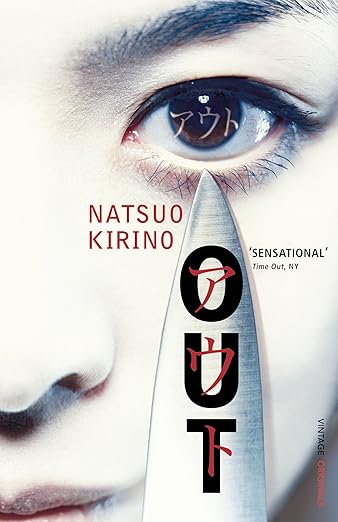
About Out by Natsuo Kirino – A Dark Japanese Crime Novel About Four Women, Murder, Survival, and the Cost of Escape
Out by Natsuo Kirino is a dark crime novel set around four women who work the night shift at a boxed-lunch factory in the Tokyo suburbs. Their lives are already full of pressure before the central crime begins. Masako Katori feels trapped inside a cold marriage and a home where communication has nearly disappeared. Yayoi Yamamoto is exhausted by work, childcare, and an abusive husband who gambles away money the family needs. Yoshie Azuma, known as the Skipper at the factory, struggles with money while caring for her disabled mother-in-law and raising her daughter. Kuniko Jonouchi wants fashionable things and a better life but is buried in debt and insecurity.
One night, Yayoi reaches a breaking point and kills her husband, Kenji. She turns to Masako for help. Masako does not call the police. Instead, she agrees to help hide the crime. Yoshie and Kuniko are pulled into the plan, and the women dismember the body and dispose of the pieces.
What follows is not a simple story about getting away with murder. The crime changes every relationship around them and opens the door to blackmail, suspicion, violence, and people far more dangerous than they expected.
Masako Becomes the Center of the Group
Masako is the calmest and most capable of the four women, which is why Yayoi calls her after killing Kenji.
She does not react like a traditional hero. She makes practical decisions quickly, even when those decisions are morally shocking.
Masako has already become emotionally distant from her husband and teenage son. At home, she feels invisible and disconnected. At the factory, she is reliable and observant. The murder gives her a terrible new problem, but it also gives her something her ordinary life has been missing: a clear task that requires action.
The choices she makes are extreme, but the frustration underneath them is presented in a way readers can understand.
Yayoi’s Crime Begins With Abuse and Desperation
Yayoi is the youngest of the group and the mother of two small children.
Her husband, Kenji, drinks, gambles, cheats, and treats her badly. When he loses money the family needs and returns home after another night out, their argument becomes violent.
Yayoi strangles him with a belt.
Kirino does not present the killing as a clean act of freedom. Yayoi is suddenly left with a body, children, fear of arrest, and the knowledge that everything has changed.
Her first instinct is to call Masako.
Yoshie Has Responsibilities She Cannot Easily Leave
Yoshie is one of the most hardworking women at the factory.
She needs money and cannot simply walk away from her job or family duties. At home, she cares for her disabled mother-in-law and supports her daughter.
Her life leaves little room for rest.
When Masako asks for help with the body, Yoshie joins partly because money matters and partly because loyalty has developed among the women who share the same exhausting night shift.
She is not trapped by one violent husband in the same way as Yayoi, but she is tied down by financial pressure, care work, and the daily need to keep everyone else functioning.
Kuniko Wants a Life She Cannot Afford
She cares about appearance, clothes, status, and the idea of living a more attractive life. She spends beyond her means and carries heavy debt.
When she becomes involved in the disposal of Kenji’s body, money is one of the strongest reasons she stays connected to the plan.
Kuniko can be selfish, careless, and difficult to trust, but the novel does not reduce her to a simple bad person.
Her choices come from insecurity, envy, fear, and the pressure to look successful even when her life is falling apart.
That makes her dangerous to the group because she does not always value secrecy, loyalty, or risk in the same way as Masako.
The Body Disposal Is Deliberately Disturbing
Out is known for graphic and uncomfortable scenes involving the dismemberment and disposal of Kenji’s body.
Kirino does not hide the physical reality of what the women decide to do.
The scenes matter because they destroy any easy fantasy that the murder can be treated like a clever puzzle. Hiding the crime is exhausting, dirty, frightening, and morally ugly.
The women have to work together closely, and every practical step makes them more involved.
Satake Brings a More Dangerous Kind of Violence
Mitsuyoshi Satake is a nightclub and gambling-club owner who becomes connected to the murder investigation.
Police initially suspect him because Kenji had visited his club shortly before his death and because Satake has a violent past.
Satake is not simply another obstacle. His history and capacity for violence make him one of the most frightening characters in the novel.
Through Satake, Kirino pushes the story beyond a crime committed by desperate women and into a much darker world where violence can become power, revenge, and obsession.
The Night-Shift Factory Is More Than a Background
The boxed-lunch factory is one of the most memorable settings in Out.
The women work through the night in repetitive, physically tiring jobs. They stand on an assembly line preparing food that will be sold to people who may never think about who made it.
The routine also creates the friendship that makes the crime possible. They know one another because they spend long nights side by side doing hard work.
Money Keeps Appearing Behind the Violence
Out is a crime novel, but money is involved in almost every major decision.
Yayoi’s conflict with Kenji includes gambling and lost household money. Yoshie needs income because of family responsibilities. Kuniko is trapped by debt. Masako has her own frustration with work and family life.
Later, money creates new criminal possibilities after the women discover that their method of disposing of a body can become a service other people may pay for.
A desperate solution to one murder begins to look like a business opportunity.
Kirino shows how quickly moral boundaries can move when people feel that ordinary work offers no real way out.
The Story Is Also About Gender and Power
Penguin Random House describes Out as both literary suspense and a dark comedy of gender warfare.
The phrase fits because the novel repeatedly shows women dealing with male violence, economic control, marriage, work expectations, and social judgment.
However, the women are not presented as perfect victims.
They lie, betray one another, make selfish decisions, and commit serious crimes.
This complexity is important.
Kirino does not replace one simple stereotype with another. She gives each woman her own motives, strengths, weaknesses, and capacity for harm.
The book asks readers to look at the pressures around them without pretending those pressures excuse everything they do.
Friendship Helps Them Survive and Also Puts Them at Risk
The four women need one another after the murder.
No single person could easily manage every part of the plan.
Masako brings control. Yoshie brings practical strength and loyalty. Kuniko becomes involved through money and opportunity. Yayoi is the reason the group crosses the line in the first place.
But friendship after a crime is unstable.
Fear changes what people are willing to say. Money creates resentment. Different levels of guilt make people behave differently.
The group can protect each other, but any member can also become the point where the secret breaks.
That tension keeps the story moving even when the police are not at the center of every chapter.
This Is Not a Traditional Detective Story
Readers expecting a classic whodunit should know that Out reveals the central murder and killer immediately.
The question is not who killed Kenji.
The suspense comes from what happens after the murder, whether the women can hide what they did, how the crime changes them, and which new dangers appear because of it.
This makes the book closer to noir, psychological suspense, social crime fiction, and literary thriller than to a puzzle mystery.
The reader often knows more than the police.
The tension comes from watching consequences get closer.
Publication and English Translation Details
Out was first published in Japan by Kodansha on July 15, 1997. The original Japanese edition is listed at 448 pages.
The English translation by Stephen B. Snyder appeared through Kodansha International in 2003. Publishers Weekly lists that edition at 359 pages.
Vintage later published a 416-page paperback edition on January 4, 2005.
A Vintage Crime/Black Lizard special edition was released on August 9, 2022. It is also 416 pages and includes an introduction by James Ellroy.
Because the page count changes by edition, customers who need a particular cover, ISBN, or format should check the edition before ordering.
Awards and International Recognition
Out won Japan’s Grand Prix for Crime Fiction in 1998.
The English translation was nominated for the 2004 Edgar Award for Best Novel, making Kirino’s international breakthrough especially important.
Penguin Random House also notes that Out was Kirino’s first novel published in English.
The 2022 special edition identifies the book as one of Time magazine’s 100 best mystery and thriller books of all time.
These recognitions reflect the way the novel works as both a crime story and a wider social portrait.
Who Will Enjoy Out?
Out is a strong choice for adult readers who enjoy Japanese crime fiction, psychological thrillers, noir, literary suspense, morally complicated characters, social criticism, and books about people trapped by money or family pressure.
It may especially appeal to readers who want a crime novel focused on criminals and consequences rather than detectives and clues.
The book contains graphic violence, domestic abuse, murder, dismemberment, sexual violence, threats, gambling, debt, and disturbing psychological material.
It is not suitable for readers looking for a light or cosy mystery.
Book Quality at Bookish Wonderland
Bookish Wonderland offers this title with premium eye-soothing cream paper, crystal-clear printing, and high-quality stitched plus glue binding.
The softer cream paper supports comfortable reading through a long and intense novel. Clear printing keeps dialogue, changing viewpoints, and crime details easy to follow, while the strong binding supports repeated reading and shelf storage.
The copy is suitable for personal reading, gifting, book clubs, Japanese literature collections, or crime and thriller shelves.
Why Order from Bookish Wonderland?
Bookish Wonderland delivers books across Bangladesh, including inside and outside Dhaka. Cash on Delivery is available nationwide.
Customers in Dhaka can also ask about fast or urgent delivery when available.
If you are checking Out by Natsuo Kirino Book price in Bangladesh, it is useful to compare the physical quality of the copy along with the listed price.
Book customization is also available. For stock, customization, or delivery questions, you can contact Bookish Wonderland through Facebook or Instagram.
A Dark Crime Novel About What Happens After the Line Is Crossed
Out by Natsuo Kirino begins with one desperate act and follows the damage that spreads from it.
The women are connected by work, money, exhaustion, secrecy, and the wish to escape lives that feel closed around them.
Their plan may solve one immediate problem, but it creates many more.
For readers who want a crime novel that is brutal, intelligent, socially sharp, and focused on consequences, Out offers a tense and unforgettable story.
Order your copy from Bookish Wonderland for nationwide delivery, Cash on Delivery, premium cream paper, clear printing, and strong stitched plus glue binding.
If you require any customization or have any questions, please inbox us via FB or Insta.
| Primary Specification | |
| Author | Natsuo Kirino |
| Translator | Stephen Snyder |
| Narrator | Emily Woo Zeller |
| Genre | Crime Fiction, Psychological Thriller, Mystery, Literary Suspense, Noir |
| ISBN-13/ISSN | 978-1400078370 |
| ISBN-10 | 1400078377 |
| Publisher | Vintage |
| Publishing Date | January 4, 2005 |
| Language | English |
| Reading Age | 18+ |
| Format | Printed Book |
| Physical Specification & Quality | |
| Paper Quality | Premium eye-soothing cream paper |
| Binding Quality | High quality stitched and glue binding (for longevity) |
| Print Quality | Crystal-clear print |
| Pages | 416 pages |
| Country | Japan |
| Logistics Information | |
| Weight | 436 gm |
| Length | 8.5 inches |
| Width | 5.6 inches |
| Height | 0.94 inch |