

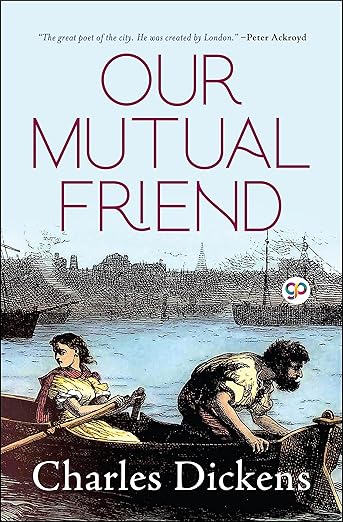
Our Mutual Friend by Charles Dickens – A Dark, Funny Story About Money, Love, and Who People Really Are
Our Mutual Friend by Charles Dickens is a Victorian novel filled with mystery, money, strange people, love, lies, and sharp humor. It begins with a body pulled from the River Thames and a fortune that suddenly changes hands. From there, Dickens builds a wide story about people who want money, status, love, safety, and a better place in society.
At the center is John Harmon, a young man who is expected to inherit his father’s wealth. There is one condition: he must marry Bella Wilfer, a woman he has never properly known. Before that can happen, a body believed to be John’s is found in the Thames. The fortune then passes to Mr and Mrs Boffin, kind people who once worked for the Harmon family.
But nothing stays simple for long.
As the money moves, so do people’s attitudes. Some become greedy. Some become kinder. Some pretend to be better than they are. Others discover that love means more than wealth. Dickens uses all of them to ask a simple question: what happens when money starts deciding how people see one another?
A Mystery That Pulls You Into Victorian London
The opening of Our Mutual Friend has one of Dickens’s darkest settings. Gaffer Hexam makes a living on the Thames, searching the river for anything valuable. One night, he finds a dead man. The body is believed to be John Harmon, the missing heir to a large fortune.
That death creates the mystery that pushes the story forward.
Instead of giving every answer at once, Dickens lets the truth come out slowly. People change names, hide motives, make plans, and watch one another. There are secrets around the inheritance, questions about identity, and people who are not always what they seem.
The city itself adds to the mood. The Thames is dark, dirty, busy, and always present. Dickens uses the river as more than a place. It becomes part of the novel’s ideas about death, money, waste, change, and new beginnings.
Money Changes Everything
Old Mr Harmon made his fortune from dust heaps. In Victorian London, these giant piles of rubbish could still hold useful materials that could be sorted and sold. Dickens turns this strange source of wealth into one of the book’s strongest ideas.
Money in Our Mutual Friend comes from waste, but society still treats it as power.
When Mr and Mrs Boffin receive the Harmon fortune, people who never cared about them become interested. Invitations appear. New friends arrive. Social climbers move closer. Everyone seems to have an opinion about what the Boffins should do with their new position.
Dickens has fun with this world, but the joke has teeth. He shows how quickly people can change when wealth enters the room.
Bella Wilfer Is More Interesting Than She First Appears
Bella Wilfer is one of the key characters in the novel. At first, she is very honest about wanting a comfortable and wealthy life. She does not pretend that money means nothing to her. In fact, she can be funny, selfish, charming, and frustrating all at once.
That makes her feel alive.
Bella’s connection to John Harmon begins before they truly know each other because his father’s will ties them together. After John is believed dead, her future changes. She later becomes close to the Boffins, who take an interest in her and bring her into their new life.
Over time, Bella is forced to think about what she really values.
Her growth is one reason the novel works so well. Dickens does not make her perfect from the start. She has to learn. She has to look at herself. She has to decide whether comfort, status, and a rich marriage are enough to make a life worth living.
The Boffins Bring Warmth to a Dark Story
Mr and Mrs Boffin begin the story as ordinary, kind-hearted people. They are suddenly given a great fortune because John Harmon is believed to be dead.
Mr Boffin, often called the Golden Dustman, becomes one of the most memorable characters in the novel. His new money puts him in a world he did not come from, and that creates both humor and tension.
Mrs Boffin brings warmth too. She cares deeply about people and wants to use their new position in a generous way.
Through the Boffins, Dickens explores whether money must always corrupt. He also shows how difficult it can be to know whether a person has truly changed or is playing a role for a reason.
Lizzie Hexam Brings Another Kind of Strength
Not every important character is connected to wealth. Lizzie Hexam, the daughter of Gaffer Hexam, comes from a much harder life.
She is thoughtful, loyal, and strong without needing to be loud. Her story gives the novel a different view of class and opportunity. She knows how people judge her background, but she also knows her own worth.
Lizzie becomes connected with Eugene Wrayburn, a lawyer from a higher social class. Their relationship brings questions about love, class, pride, and whether society should decide who is allowed to be with whom.
At the same time, schoolmaster Bradley Headstone becomes dangerously obsessed with Lizzie. This creates one of the novel’s darker storylines.
Through Lizzie, Dickens shows the pressure placed on people who have little social power. She cannot simply move through the world without being judged. Yet she remains one of the book’s clearest examples of quiet courage.
Funny, Strange, and Unforgettable Characters
One reason people still read Dickens is his talent for creating characters who are hard to forget.
Our Mutual Friend has many of them.
There is Silas Wegg, a one-legged seller of ballads who sees a chance to improve his own position. There is Mr Venus, who works with bones and human remains. There are the Veneerings, a new-money couple who care deeply about looking important in front of other people.
The Veneerings are especially funny because almost everything around them feels polished but empty. Their friendships are based on status. Their dinner parties are full of people trying to impress one another. Dickens uses them to laugh at a society where appearance can matter more than character.
A Story About Love, but Not Just Romance
There are several love stories in Our Mutual Friend, but Dickens does not treat love as something separate from money or class.
Bella must decide what kind of love she wants. Lizzie faces a different problem because social class stands between her and Eugene. Other relationships show what happens when people choose status, control, or self-interest instead of care.
The novel asks whether love can stay honest when money is involved.
That question still feels modern. People may live differently today, but worries about money, family approval, social position, and choosing the right partner have not disappeared.
Dickens also writes about friendship, loyalty, family love, and the need to be seen for who you really are.
Why the Book Still Matters Today
Our Mutual Friend was published in monthly parts from May 1864 to November 1865 and became Dickens’s last completed novel. He later began The Mystery of Edwin Drood, but died before finishing it.
Because this book came late in his career, it carries many of the ideas Dickens had explored for years: poverty, class, money, work, law, social performance, kindness, and the hidden lives of London.
The novel can also feel surprisingly current.
People still judge others by money. People still build public images that do not match their private lives. People still chase social approval. Wealth can still change friendships. Families still argue about marriage, status, and what counts as success.
A Good Choice for Readers Who Want a Big Classic
This is not a tiny, simple novel. Many editions are more than 800 or 900 pages, so readers should know they are choosing a long classic.
That length gives Dickens room to build a whole world.
You meet many characters, move between different homes and social groups, and watch separate plots slowly come together. Some readers may need time to remember names at first, but the reward is a rich story with many layers.
It is also a strong choice for readers who already enjoy Dickens and want one of his darker, later works. Fans of Bleak House, Great Expectations, or Little Dorrit may especially enjoy its mix of social criticism, mystery, humor, and emotion.
Helpful for Students and Classic Literature Readers
Our Mutual Friend gives students plenty to study. Important themes include wealth, class, identity, marriage, social ambition, death, renewal, education, and the changing city.
The novel is also useful when studying Victorian London. Dickens writes about different levels of society, from people working around the Thames to wealthy dinner tables.
Readers can look at how characters speak, how they treat money, and how they judge one another. They can also study the symbols of the river and the dust heaps.
Because the book was first published in parts, it often uses suspense, changes of scene, and delayed answers to keep readers moving forward.
For a school, university, book club, or personal reading project, there is enough material here for many discussions.
A Comfortable Copy for a Long Reading Journey
A long classic needs a copy that feels comfortable in your hands. Bookish Wonderland offers this edition with premium eye-soothing cream paper, crystal-clear printing, and high-quality stitched plus glue binding.
The softer page tone can make long reading sessions easier on the eyes. Clear printing helps with a book that has many characters and detailed scenes. The strong binding is useful because a long novel will be opened and handled many times before you reach the final page.
Why Buy Our Mutual Friend from Bookish Wonderland?
Bookish Wonderland delivers books across Bangladesh, including inside and outside Dhaka. Cash on Delivery is available nationwide, and customers in Dhaka can ask about fast or urgent delivery when available.
If you are comparing the Book price in Bangladesh for Our Mutual Friend by Charles Dickens, do not look only at the number. A long classic benefits from readable paper, clear print, and a binding that can handle regular use.
Book customization is also available. If you have a special request or want to ask about delivery, you can contact Bookish Wonderland through Facebook or Instagram.
Step Into Dickens’s Darkest London
Our Mutual Friend by Charles Dickens is the kind of classic that gives you more the longer you stay with it. It starts with a dead body and an inheritance, but soon becomes a much larger story about money, identity, class, love, greed, kindness, and second chances.
It is funny in one chapter and dark in the next. Some characters will make you angry. Others will surprise you. Slowly, the different pieces begin to fit together.
If you want a classic you can truly spend time with, this is a strong choice.
Order Our Mutual Friend from Bookish Wonderland and settle into one of Dickens’s richest stories. With premium cream paper, sharp print, durable stitched plus glue binding, nationwide delivery, and Cash on Delivery, you can enjoy this long Victorian novel in a copy made for comfortable reading.
Open the first page, enter the foggy world of the Thames, and see what happens when money reaches everyone it touches.
If you require any customization or have any questions, please inbox us via FB or Insta.
| Primary Specification | |
| Author | Charles Dickens |
| Narrator | Simon Vance |
| Genre | Classic Fiction, Literary Fiction, Social Satire, Mystery |
| ISBN-13/ISSN | 978-0486812458 |
| ISBN-10 | 0486812456 |
| Publisher | Dover Publications |
| Publishing Date | April 19, 2017 |
| Language | English |
| Reading Age | 14+ |
| Format | Printed Book |
| Physical Specification & Quality | |
| Paper Quality | Premium eye-soothing cream paper |
| Binding Quality | High quality stitched and glue binding (for longevity) |
| Print Quality | Crystal-clear print |
| Pages | 864 pages |
| Country | UK |
| Logistics Information | |
| Weight | 884 gm |
| Length | 8.5 inches |
| Width | 5.6 inches |
| Height | 1.9 inch |