

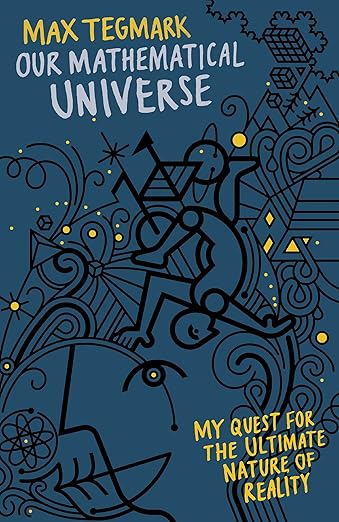
About Our Mathematical Universe by Max Tegmark – A Mind-Opening Journey Through Space, Reality, Mathematics, and the Multiverse
What is the universe made of? Why does mathematics describe nature so well? Could there be other universes beyond the one we can see? Our Mathematical Universe by Max Tegmark takes these huge questions and turns them into a lively journey through modern physics and cosmology.
Tegmark is a physicist who does not only explain what scientists already know. He also asks what our best theories might mean if we follow them as far as they can go. The book moves through the history of the universe, the structure of space, quantum physics, parallel universes, and his own bold idea that physical reality may itself be a mathematical structure.
That may sound difficult, but the book is written for curious general readers. Tegmark uses stories, examples, pictures, thought experiments, and moments from his own life as a scientist to make difficult ideas easier to approach.
You do not need to be a mathematician to begin. You mainly need curiosity and a willingness to ask strange, exciting questions about reality.
Start with the Universe We Can See
The book begins from questions that feel familiar. Where did everything come from? How old is the universe? Why are galaxies spread across space? What can scientists learn from light that has travelled for billions of years?
Tegmark guides readers through the basic story of modern cosmology before moving toward more unusual ideas. This helps because you are not thrown straight into the deepest theory.
You first build a picture of the universe we observe.
From there, the scale becomes much larger. The book looks at how physics tries to explain the beginning, growth, structure, and possible future of the cosmos. It also shows how observation and mathematics work together. Scientists cannot travel to distant galaxies or return to the early universe, so they use evidence, models, measurements, and physical laws to understand what happened.
Why Mathematics Matters So Much
One of the biggest questions in the book is simple to ask but hard to answer: why does mathematics work so well when we describe nature?
Numbers and equations can describe the motion of planets, the behavior of particles, light, gravity, and much more. To Tegmark, this success is not just a useful accident.
He asks whether mathematics is deeper than a language humans use to describe the universe.
His most famous idea in the book is the Mathematical Universe Hypothesis. In simple terms, Tegmark argues that our physical reality may be a mathematical structure.
This is a bold claim, and readers do not have to agree with it. In fact, part of the fun is deciding where you think the argument becomes convincing, uncertain, or too speculative.
The book gives you a chance to think with a scientist rather than simply memorize scientific facts.
The Multiverse Without the Science-Fiction Costume
Parallel universes often appear in movies, comics, and science fiction. Tegmark approaches the subject from physics.
He explains several ways in which modern scientific ideas can lead to forms of a multiverse. Some possibilities come from the enormous scale of space. Others are connected to cosmic inflation or interpretations of quantum mechanics.
The farther the book goes, the stranger the possibilities become.
Tegmark organizes these ideas into different levels of multiverse. This gives readers a map for concepts that could otherwise feel confusing.
Importantly, he does not present every idea as an ordinary, settled fact. The book moves from well-tested science toward more speculative territory. Readers can therefore enjoy the journey while keeping a difference between strong evidence and bold theory.
Quantum Physics Gets Very Strange
Quantum mechanics is one of the parts of physics that can feel impossible at first.
Tiny particles do not always behave like everyday objects. The rules that work for a ball, car, or chair are not enough to explain what happens at very small scales.
Tegmark introduces quantum ideas as part of the larger question of what reality is.
He explores how quantum theory has changed our picture of nature and why its meaning is still debated. The discussion eventually connects with the idea of parallel outcomes and multiple worlds.
You may need to slow down in these chapters. That is normal.
This is not a book that expects every page to feel as easy as a short news article. It is a popular science book that tries to take general readers close to the edge of difficult scientific thinking.
Science Becomes Personal
One reason the book feels different from a textbook is that Tegmark brings his own life into the story.
He writes about the experiences, successes, disappointments, and choices that shaped his work as a scientist. This reminds readers that science is done by real people.
Ideas do not appear from nowhere. Scientists argue, make mistakes, change direction, test theories, face doubt, and sometimes spend years working on questions without a clear answer.
They also make the book useful for students who imagine science only as a list of correct formulas. Research is much messier and more creative than that. Curiosity, persistence, disagreement, and imagination all matter.
Difficult Ideas Explained for Curious Readers
A common problem with books about cosmology is that they can become either too simple or too technical.
If everything is simplified too much, the reader learns very little. If the pages are filled with advanced equations, many general readers give up.
Our Mathematical Universe tries to stay between those extremes.
Tegmark uses accessible language, analogies, diagrams, and thought experiments to carry readers through difficult material. Some sections still require attention, especially when the book moves into quantum theory and higher levels of the multiverse.
But you can understand the main argument without having an advanced degree in physics.
This makes the book a useful step for readers who enjoyed basic astronomy and now want something deeper.
It Is Fine to Disagree with the Author
This is not a book where the author expects you to accept every idea without question.
You can agree with his explanation of established cosmology while questioning his later conclusions. You can enjoy the multiverse discussion without deciding that every possible level must exist.
Good science reading should create questions, not just deliver answers.
Tegmark invites readers toward the frontier, where evidence, theory, mathematics, and philosophy begin to meet. At that frontier, uncertainty matters.
The book is strongest when it makes you stop and ask, “Could that really be true?”
A Big Book for Big Questions
The Vintage paperback edition has 432 pages. That gives Tegmark room to move from familiar science to ideas that are much harder to imagine.
You can read a chapter, think about it, return to a diagram, or look up a scientific term before moving on. In fact, slowing down can make the experience better.
The subject covers enormous scales of time and space. It asks what came before familiar structures, what may exist beyond what we can observe, and how reality might be organized at its deepest level.
Who Will Enjoy Our Mathematical Universe?
This book is a strong choice for readers who love astronomy, physics, mathematics, cosmology, philosophy of science, or big questions about existence.
It also suits people who enjoy writers such as Stephen Hawking, Brian Greene, Carl Sagan, or other popular science authors who try to connect hard science with larger questions.
Students may enjoy it because it shows how scientific subjects connect. Physics is not separated from mathematics, astronomy, or philosophy here. Each field helps open another part of the problem.
You do not need advanced mathematics, but you should be ready to concentrate.
If you want a very light book with quick facts about planets, this may be more demanding than you need. If you want a book that stretches your thinking, it is much more likely to satisfy you.
Useful for Students, Discussions, and Self-Learning
A student can use it to build interest in cosmology before reading more technical material. A science club can discuss one chapter at a time. A curious reader can use the references and ideas as starting points for deeper research.
Is mathematics invented by humans or discovered in nature? What counts as scientific evidence when we discuss regions we cannot observe directly? Should a theory be accepted because it is mathematically elegant? How should we think about possibilities that follow from equations but are difficult to test?
These questions sit between science and philosophy, which is why the book can create long conversations even after the chapter ends.
A Different Way to Look at Everyday Reality
After reading about galaxies, quantum theory, and mathematical structures, ordinary life can feel a little different.
The chair beside you, the light entering a window, your body, Earth, and distant stars all belong to the same physical reality.
Science tries to find the rules beneath that variety.
Tegmark pushes this thought farther by asking whether the deepest layer is mathematical.
Whether you accept his answer or not, the question changes how you look at the world. Mathematics stops being only something written in school notebooks. It becomes a possible key to understanding why reality has the form it does.
A Comfortable Copy for Deep Reading
A science book with 432 pages deserves a physical copy that stays comfortable through long reading sessions.
Bookish Wonderland offers this title with premium eye-soothing cream paper, crystal-clear printing, and high-quality stitched plus glue binding.
The softer page tone can reduce the harsh feel of bright white paper. Clear printing helps when you are reading detailed explanations, while strong binding supports repeated use.
This is especially helpful for a book you may return to when revisiting a difficult idea or discussing a chapter with someone else.
Why Order from Bookish Wonderland?
Bookish Wonderland delivers books across Bangladesh, including inside and outside Dhaka. Cash on Delivery is available nationwide, and readers in Dhaka can ask about fast or urgent delivery when available.
If you are checking Our Mathematical Universe by Max Tegmark Book price in Bangladesh, compare the quality of the copy as well as the listed price. A long science book becomes easier to use when the paper is comfortable, the text is sharp, and the binding can handle regular reading.
Book customization is also available. For special requests or delivery questions, you can contact Bookish Wonderland through Facebook or Instagram.
Take the Biggest Questions Home
Our Mathematical Universe by Max Tegmark is for anyone who has looked at the night sky and wondered what reality really is.
The book begins with science we can observe and gradually moves toward ideas that test the limits of imagination. Along the way, Tegmark explains cosmology, mathematics, quantum physics, and multiverse theories while sharing the human side of scientific work.
You do not have to agree with every conclusion to enjoy the journey.
That is part of the point.
A book like this is valuable because it makes you think, question, argue, and look at familiar reality from a new angle.
Order your copy from Bookish Wonderland and explore the universe through a physicist’s eyes. With premium cream paper, clear printing, strong stitched plus glue binding, nationwide delivery, and Cash on Delivery, you can settle in for a long journey through some of the biggest questions science can ask.
If you require any customization or have any questions, please inbox us via FB or Insta.
| Primary Specification | |
| Author | Max Tegmark |
| Narrator | Rob Shapiro |
| Editor | Kristen Bearse |
| Genre | Popular Science, Cosmology, Physics, Mathematics |
| ISBN-13/ISSN | 978-0307744258 |
| ISBN-10 | 0307744256 |
| Publisher | Vintage |
| Publishing Date | February 3, 2015 |
| Language | English |
| Reading Age | 16+ |
| Format | Printed Book |
| Physical Specification & Quality | |
| Paper Quality | Premium eye-soothing cream paper |
| Binding Quality | High quality stitched and glue binding (for longevity) |
| Print Quality | Crystal-clear print |
| Pages | 432 pages |
| Country | USA |
| Logistics Information | |
| Weight | 453 gm |
| Length | 8.5 inches |
| Width | 5.6 inches |
| Height | 0.95 inch |