

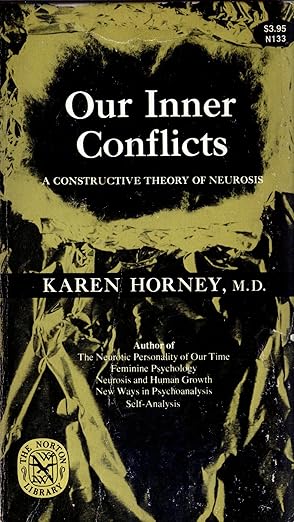
About Our Inner Conflicts: A Constructive Theory of Neurosis by Karen Horney – A Clear Guide to the Struggles We Carry Inside
Why do people sometimes want love but push others away? Why can someone need approval, then suddenly become angry, proud, or distant? Our Inner Conflicts: A Constructive Theory of Neurosis by Karen Horney looks at these kinds of struggles and asks what is happening underneath them.
First published in 1945, this classic work of psychoanalysis explains Horney’s idea that deep inner conflict can grow when a person develops opposing ways of dealing with fear, insecurity, and relationships. She describes three broad movements: moving toward people, moving against people, and moving away from people. A person may depend too much on one pattern, or feel pulled between several patterns at once.
Horney’s goal is not simply to label behavior. She tries to show how these patterns can shape love, work, confidence, fear, anger, and the way a person sees the self.
The book is serious, but its central ideas are easy to recognize in everyday life. That is why readers still return to it when studying personality, psychoanalysis, and human relationships.
When Your Own Needs Pull in Different Directions
Most people know what conflict with another person feels like. Inner conflict is harder to see because both sides are inside the same person.
You may want to be close to someone but fear depending on them. You may want to be kind but also feel a strong need to win. You may want support but hate feeling weak. You may want freedom while also wanting approval.
Horney argues that these clashes can become especially painful when they are rigid, hidden, and difficult to understand.
Instead of treating every problem as a separate weakness, she looks for the deeper pattern that connects them. This can make the book useful for readers who want to understand why the same emotional problem may appear again in different relationships or situations.
Moving Toward People
The first major pattern is moving toward people.
In this pattern, a person may place a very strong value on being liked, accepted, protected, or needed. They may try hard to please others, avoid disagreement, or depend on another person for safety and confidence.
Wanting love is normal. Horney’s concern is not ordinary affection. The problem appears when the need becomes so strong that the person feels unable to act freely.
They may say yes when they want to say no. They may hide anger because they fear rejection. They may believe they are safe only when another person approves of them.
Horney uses this pattern to show how a healthy human need can become rigid when fear controls it.
Moving Against People
The second pattern is moving against people.
Here, life may feel like a contest. A person may believe they must be strong, successful, admired, powerful, or in control so nobody can hurt them.
They may become very competitive. They may distrust softness. They may see other people as rivals, tools, or threats. Winning can feel safer than depending on anyone.
Again, Horney is not saying that ambition or strength is bad. The problem is when the need for power becomes a fixed defense.
A person who always needs to win may struggle with trust. They may hide fear behind pride or anger. They may find it hard to accept mistakes because failure feels like danger.
Moving Away from People
The third pattern is moving away from people.
A person using this pattern may try to become very independent, private, and emotionally distant. They may avoid needing others because needing someone feels risky.
They may value freedom so strongly that closeness begins to feel like pressure. They can pull back from relationships, expectations, or emotional demands.
Solitude itself is not the problem. Many people enjoy being alone, and independence can be healthy.
Horney is interested in the point where distance becomes a shield. If a person avoids closeness mainly because attachment feels dangerous, their freedom may come with loneliness.
Why the Three Patterns Can Clash
The heart of the book is not simply that people can move toward, against, or away from others. Horney is interested in what happens when these directions fight each other.
Imagine wanting love and approval while also wanting total control. Or wanting closeness while also wanting nobody to need anything from you.
Those wishes can create tension because satisfying one side may upset another.
A person may become confused about what they truly want. They may change sharply depending on the situation. They may also build explanations that hide the conflict from themselves.
Horney calls attention to this because a hidden conflict can influence many parts of life at once.
The book encourages readers to look beneath a single reaction and ask whether a larger pattern is working in the background.
The Idealized Image
Another important idea is the idealized image.
When people feel divided or insecure, Horney argues that they may create an imagined version of themselves that seems stronger, better, kinder, more powerful, or more perfect than they really feel.
This image can become something they believe they must live up to.
The problem is not having goals. Goals can help people grow. The problem begins when the ideal self is used to escape the real self.
Then mistakes can feel unbearable. Weakness can feel shameful. Ordinary limits may feel like personal failure.
This can create a painful gap between who someone is and who they believe they must be.
Horney’s discussion of the idealized image is one reason the book still feels relevant. Many readers can recognize the pressure to look perfect, capable, lovable, or successful even when life inside feels very different.
Externalization and Looking Outside for the Problem
Horney also discusses externalization.
In simple words, a person may experience an inner problem as if it belongs mainly outside them. Feelings, expectations, or conflicts that are difficult to face can be placed onto other people or situations.
This does not mean every outside problem is imaginary. Real relationships can be unfair, painful, or unsafe.
Horney’s point is that inner conflict can affect how a person reads what is happening around them.
Someone may believe everyone is judging them when part of the pressure comes from their own harsh self-judgment. Another person may feel controlled everywhere while also carrying strong inner demands.
What Unresolved Conflict Can Cost
The second part of the book looks at the effects of conflicts that remain unresolved.
Horney discusses fear, hopelessness, a narrowing of personality, and other painful outcomes. Her larger point is that a person spends energy keeping conflicting needs under control.
That energy could otherwise go toward work, love, creativity, friendship, or growth.
When a person must always defend one image, avoid one fear, or control one part of the self, life can become smaller.
This is why Horney calls her theory constructive. She believed the aim was not simply to identify what had gone wrong. It was to understand the conditions inside the personality that kept the conflict alive and make deeper change possible.
A Classic Psychoanalytic Book, Not a Modern Diagnosis Guide
Our Inner Conflicts was written in the 1940s, so readers should approach it in its historical setting.
The word “neurosis” belongs to an older psychoanalytic language, and the book should not be used to diagnose yourself or another person.
Its value today is mainly as an influential work in the history of psychology and as a way to think about personality, relationships, defenses, and inner tension.
Some ideas may feel very familiar. Others reflect the language and assumptions of an earlier period.
Reading it with that balance can make the book more useful. You can learn from Horney’s observations without treating every sentence as current clinical science.
How Horney Differed from Freud
Karen Horney became known for challenging parts of classical Freudian theory.
She placed more attention on relationships, culture, social conditions, and the ways people try to handle anxiety.
In Our Inner Conflicts, her focus is not simply on instinct. She looks closely at how people relate to others and how those patterns become part of personality.
That shift is important for anyone studying the history of psychoanalysis.
The book shows a major thinker developing her own model rather than simply repeating Freud.
Students of psychology may find this especially helpful because it shows how theories change through debate.
Who Will Get the Most from This Book?
This book is a strong choice for psychology students, counselors in training, readers of psychoanalytic theory, and people interested in personality and relationships.
It can also appeal to thoughtful general readers who enjoy books that make them examine motives and repeated behavior.
The writing is more academic than a modern self-help book, so it is best for someone willing to read slowly and think about each chapter.
The book can also work well in a reading group focused on psychology, philosophy, or human behavior because the three major patterns are easy to discuss and compare.
Useful for Study and Personal Reflection
Students can use the book to understand Horney’s place in psychoanalytic history and her theory of neurotic conflict.
General readers can use it as a framework for reflection, not as a clinical test.
You might ask which pattern appears most strongly in a character from a novel, a film, or a historical case. You might also notice how people can move differently in different relationships.
The value is in asking better questions rather than quickly attaching labels.
A Comfortable Edition for Focused Reading
Bookish Wonderland offers this title with premium eye-soothing cream paper, crystal-clear printing, and high-quality stitched plus glue binding.
The softer paper tone can feel easier on the eyes during long reading sessions. Clear text is helpful when working through psychological terms and detailed arguments. Strong binding also supports repeated reading, note-taking sessions, and long-term shelf use.
Why Order from Bookish Wonderland?
Bookish Wonderland delivers books across Bangladesh, including inside and outside Dhaka. Cash on Delivery is available nationwide, and customers in Dhaka can ask about fast or urgent delivery when available.
If you are checking Our Inner Conflicts by Karen Horney Book price in Bangladesh, it is worth comparing the reading quality of the copy as well as the listed price.
Book customization is also available. For special requests, availability, or delivery questions, you can contact Bookish Wonderland through Facebook or Instagram.
Read a Classic That Looks Beneath Everyday Behavior
Our Inner Conflicts: A Constructive Theory of Neurosis by Karen Horney asks readers to look beneath behavior and notice the deeper forces pulling a person in different directions.
Its language comes from an earlier period of psychology, but its central questions remain easy to understand. Why do we repeat patterns that hurt us? Why can the need for love, power, or freedom become rigid? What happens when the person we believe we should be moves too far from the person we actually are?
Those questions give this classic its lasting interest.
Order your copy from Bookish Wonderland if you want a serious psychology book that rewards slow reading, notes, and discussion. It is a thoughtful addition to a psychology shelf and a useful introduction to one of Karen Horney’s most important theories.
If you require any customization or have any questions, please inbox us via FB or Insta.
| Primary Specification | |
| Author | Karen Horney |
| Genre | Psychology, Psychoanalysis, Personality Psychology, Mental Health; Neurosis |
| ISBN-13/ISSN | 978-0393309409 |
| ISBN-10 | 0393309401 |
| Publisher | W. W. Norton & Company |
| Publishing Date | October 17, 1992 |
| Language | English |
| Reading Age | 18+ |
| Format | Printed Book |
| Physical Specification & Quality | |
| Paper Quality | Premium eye-soothing cream paper |
| Binding Quality | High quality stitched and glue binding (for longevity) |
| Print Quality | Crystal-clear print |
| Pages | 250 pages |
| Country | USA |
| Logistics Information | |
| Weight | 274 gm |
| Length | 8.5 inches |
| Width | 5.6 inches |
| Height | 0.7 inch |