

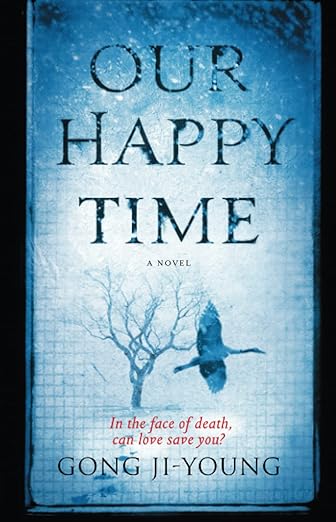
About Our Happy Time by Gong Ji-young – A Moving Korean Novel About Pain, Forgiveness, and Finding a Reason to Live
Our Happy Time by Gong Ji-young begins with two people who seem to have almost nothing in common. Yujeong is wealthy, educated, and once known as a singer, but she is deeply unhappy. After her third suicide attempt, she wakes in a hospital and faces a choice she does not want to make. Her aunt Monica, a nun, asks her to come along on weekly visits to prisoners on death row.
There, Yujeong meets Jeong Yunsu.
Yunsu has been convicted of murder and is waiting to be executed. He grew up in severe poverty and carries years of anger, shame, and pain. At first, neither Yujeong nor Yunsu expects much from the other. Yet their meetings slowly become the one part of the week that both begin to value.
They talk. They listen. They learn what the other has survived.
The story becomes less about the difference between a rich woman and a condemned prisoner, and more about two damaged people discovering what it means to be seen without being reduced to their worst moment.
Two Lives That Should Never Have Crossed
Yujeong and Yunsu come from very different worlds.
Yujeong has money and social privilege, but comfort has not protected her from trauma. She is carrying a painful secret from childhood and has reached a point where she no longer wants to live. The people around her may see success, beauty, and opportunity. Inside, she feels something very different.
Yunsu has known poverty, violence, and neglect. His life has moved toward prison and a death sentence. Society has already given him a final label: murderer.
Gong Ji-young brings these two people together and asks readers to look beyond the labels.
A person can have money and still feel hopeless. A person can commit a terrible crime and still have a human history. Understanding someone does not erase responsibility, but it can change the way we think about punishment, mercy, and what a life is worth.
Aunt Monica Opens the Door
Aunt Monica is the person who brings Yujeong and Yunsu into the same room.
She is a nun who visits prisoners and believes that even people society has rejected should still be treated as human beings. She does not force Yujeong to become cheerful or pretend that pain is simple. Instead, she gives her something to do outside herself.
At first, Yujeong goes because the alternative is a month of hospital treatment. She is not interested in becoming a better person.
That makes her later change feel more believable.
The visits begin as an obligation. Over time, they become meaningful because Yujeong starts to care about the person sitting across from her.
Aunt Monica also gives books to Yunsu and tries to create small spaces where conversation, reflection, and dignity are still possible inside prison.
Yunsu Is More Than His Crime
Yunsu is on death row, and the novel never lets readers forget that fact.
There is a clock around his life. His future is limited, and each visit may be one of the last.
But Gong does not present him only as a case file.
We learn about his childhood, poverty, family, fear, anger, and the path that brought him to prison. None of this turns his crime into something harmless. Instead, it makes the question harder.
Can someone be guilty and still deserve compassion?
Can a person be more than the worst thing they have done?
The novel asks readers to sit with those questions rather than answering them quickly.
That is one reason the story can be emotionally difficult. It does not give the reader the comfort of keeping good people on one side and bad people on the other.
Yujeong Also Has Things She Cannot Say
Yujeong may be free to leave the prison, but she is trapped by her own memories.
Her past has shaped the way she sees herself, other people, and life itself. She carries anger toward members of her family and has struggled for years with pain that others do not fully understand.
Meeting Yunsu gives her a strange kind of safety.
Because he is already judged by the world, she can begin speaking to him without needing to perform the polished version of herself that other people expect.
Their conversations allow both characters to say things they have kept buried.
Sometimes being honestly heard is the first small step toward wanting to remain in the world.
Not a Typical Romance
The publisher describes Our Happy Time as a death-row love story, but readers should not expect a normal romance.
There are no easy dates, future plans, or promise that love will solve everything.
Yujeong and Yunsu meet under the shadow of execution. Their time is controlled by prison rules, visiting hours, guards, and a legal sentence neither of them can simply wish away.
Their bond grows through honesty and shared pain rather than through glamorous romance. They begin to understand each other in a way few people around them do.
The title becomes especially meaningful because their happy time is limited. Happiness does not arrive after every problem is fixed. It appears in small pieces while the problems are still there.
A Novel About Forgiveness Without Easy Answers
Forgiveness is one of the main ideas in the book.
Both Yujeong and Yunsu have people they blame. Both also carry guilt, anger, and memories they would rather escape.
The novel asks what forgiveness really means when the harm is serious.
Does forgiveness mean pretending nothing happened? Does it remove responsibility? Is it something we give another person, or something we sometimes need for ourselves?
Gong does not turn forgiveness into a quick inspirational message.
The characters resist it. They struggle with it. They sometimes want anger because anger can feel safer than grief.
That makes the emotional movement feel earned.
Readers may not agree with every religious or moral idea in the story, but the questions are strong enough to continue after the final page.
Life, Death, and the Death Penalty
Because Yunsu is waiting for execution, the death penalty is impossible to separate from the story.
The novel asks readers to think about what state punishment means when the condemned person is no longer an abstract criminal but someone whose voice we have heard.
This does not mean the book asks readers to ignore victims or excuse violence.
Instead, it explores the tension between punishment and human dignity.
The Korean Literature Translation Institute identifies death penalty, crime and punishment, forgiveness, reconciliation, and compassion for humanity among the work's central themes.
The book became widely discussed in South Korea partly because these questions reach far beyond one fictional prisoner.
What does justice require? Can justice and mercy exist together? Does an execution end suffering, or create new suffering around it?
The novel does not make these questions comfortable.
Christianity and Spiritual Change
Aunt Monica's Christian faith is important to the book.
She believes in forgiveness, repentance, and the value of human life, and she gently brings those ideas into her visits with Yunsu and Yujeong.
Some readers may find the religious side deeply moving. Others may find parts of it stronger or more direct than they prefer.
Publishers Weekly noted this divide in its review, saying the Christian message can feel heavy at times while also recognizing moments of beauty and sincerity.
It is useful to know this before buying.
Our Happy Time is not religious fiction in the simple sense of giving easy answers. Faith is part of the characters' struggle with guilt, anger, forgiveness, and death.
A Korean Bestseller That Reached Readers Far Beyond Korea
Our Happy Time was first published in Korean in 2006 under the title Urideurui haengbokan sigan.
The novel became a major success in South Korea, selling more than one million copies there. It also received recognition connected with Amnesty International.
The English translation by Sora Kim-Russell was published in 2014. The Atria Books/Marble Arch Press trade paperback is listed at 272 pages.
This was Gong Ji-young's first novel translated into English, giving international readers a direct entry into the work of one of South Korea's best-known contemporary novelists.
A Story for Readers Who Want Emotion with Meaning
This is a strong choice for readers who enjoy literary fiction, Korean literature, emotional novels, and stories that deal with difficult moral questions.
It may also appeal to readers who liked books where two unlikely people change each other through conversation rather than action.
The pace is more emotional than thrilling.
The tension comes from knowing that Yunsu's time is limited and from watching Yujeong decide whether she can face the life she once wanted to leave.
Readers should also know that the novel deals directly with suicide, childhood trauma, murder, prison, execution, and grief.
These subjects can be heavy.
Why the Book Can Stay with You
Many sad novels are easy to remember because of what happens. Our Happy Time can stay with readers because of what it asks.
Who deserves compassion?
Can someone forgive without forgetting?
Can a person who wants to die learn to value life by meeting someone who is about to lose his?
What makes a short period of happiness meaningful when it cannot last forever?
These questions make the story larger than its plot.
Yujeong and Yunsu do not meet in a place where anyone expects happiness. Yet their weekly conversations become important precisely because time is limited.
The book reminds readers that happiness is not always a permanent condition. Sometimes it is an hour in which another person listens, understands, or simply stays.
A Comfortable Edition for Slow, Emotional Reading
Bookish Wonderland offers this title with premium eye-soothing cream paper, crystal-clear printing, and high-quality stitched plus glue binding.
The softer page tone is comfortable for longer reading sessions, while sharp print keeps the text clean and easy to follow. Strong binding helps the book stay secure through repeated reading and shelf storage.
Why Order from Bookish Wonderland?
Bookish Wonderland delivers books across Bangladesh, both inside and outside Dhaka. Cash on Delivery is available nationwide, and customers in Dhaka can ask about fast or urgent delivery when available.
If you are checking Our Happy Time by Gong Ji-young Book price in Bangladesh, it is worth comparing the physical quality of the copy as well as the listed price.
Book customization is also available. For stock, customization, or delivery questions, you can contact Bookish Wonderland through Facebook or Instagram.
Spend a Little Time with a Story About Being Human
Our Happy Time by Gong Ji-young is not an easy story, but it is a deeply human one.
Yujeong enters the prison because she wants to avoid treatment. Yunsu is there because the law has decided how his life will end. Neither expects the other person to matter.
Then, week by week, they begin talking.
The woman who has tried to leave life meets a man who is being forced to leave it.
That contrast gives the novel its emotional force.
Their time together cannot erase the past. It cannot undo a crime or remove every wound. What it can do is give two people a place where they are finally honest.
If you enjoy Korean fiction about forgiveness, grief, compassion, and the value of life, this is a book worth making time for.
Order your copy from Bookish Wonderland and discover a moving story about two people finding their happiest hours in the last place either of them expected.
If you require any customization or have any questions, please inbox us via FB or Insta.
| Primary Specification | |
| Author | Gong Ji-young |
| Translator | Sora Kim-Russell |
| Genre | Literary Fiction, Contemporary Fiction, Romance, Korean Literature |
| ISBN-13/ISSN | 978-1476730455 |
| ISBN-10 | 1476730458 |
| Publisher | Marble Arch Press |
| Publishing Date | July 1, 2014 |
| Language | English |
| Reading Age | 18+ |
| Format | Printed Book |
| Physical Specification & Quality | |
| Paper Quality | Premium eye-soothing cream paper |
| Binding Quality | High quality stitched and glue binding (for longevity) |
| Print Quality | Crystal-clear print |
| Pages | 272 pages |
| Country | South Korea |
| Logistics Information | |
| Weight | 294 gm |
| Length | 8.5 inches |
| Width | 5.6 inches |
| Height | 0.68 inch |