

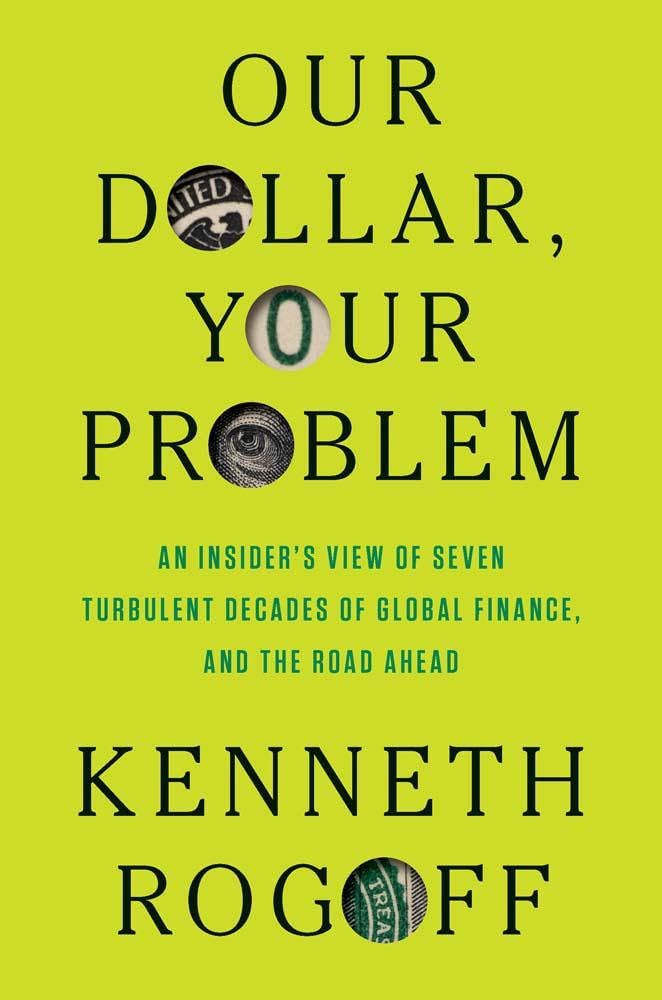
About Our Dollar, Your Problem by Kenneth Rogoff – A Clear Guide to Dollar Power, Global Finance, and What May Come Next
Our Dollar, Your Problem by Kenneth Rogoff explains how the U.S. dollar became the most important currency in the global financial system and why that position should not be taken for granted. Rogoff looks at the dollar’s rise after the Second World War, the advantages the United States receives from its role, and the pressures that could weaken that position over time.
The book mixes economic history with Rogoff’s own experience as an economist, policymaker, and observer of global markets. He discusses the Japanese yen, the Soviet ruble, the euro, the Chinese yuan, cryptocurrencies, inflation, interest rates, debt, and political instability. He also looks at the way dollar dominance affects countries outside the United States.
Why the U.S. Dollar Matters Around the World
The dollar is used far beyond the borders of the United States. Governments hold dollar reserves. Companies borrow and trade in dollars. Banks use dollars in international finance. Many global commodities are priced in dollars.
When the Federal Reserve changes interest rates, the effect can reach other countries. When the dollar becomes stronger, it can make dollar debts harder to repay elsewhere. When U.S. financial policy changes, markets in Asia, Europe, Latin America, Africa, and other regions can feel the impact.
Rogoff explains why the dollar became so central and why that central role gives the United States financial advantages. He also shows why other countries sometimes become frustrated with a system in which American decisions can create consequences far beyond America.
How Dollar Dominance Developed
The book looks back across roughly seven decades of global finance.
Rogoff explains that the dollar did not become dominant simply because one country decided it should. The United States had economic size, deep financial markets, political influence, and institutions that helped support the currency. Historical circumstances also mattered.
The postwar international system gave the dollar an important role. Over time, possible rivals appeared.
The Soviet ruble never became a true global alternative. Japan’s rapid economic rise made the yen look more important for a period. The creation of the euro gave the world another large currency backed by major economies.
Rogoff uses this history to explain why a leading currency can be difficult to replace, while also showing that long periods of dominance do not make that dominance permanent.
The Benefits the United States Receives
A country whose currency is widely used around the world gains important advantages.
The United States can borrow in its own currency. Global demand for dollar assets can help support U.S. financial markets. The dollar also gives American policymakers influence over international finance.
Economists sometimes describe part of this advantage as an “exorbitant privilege.”
Rogoff discusses how that privilege developed and why Americans can easily overlook it. A system that has existed for decades can begin to feel normal, even when it depends on trust, policy choices, and the willingness of other countries to keep using the currency.
The Dollar Also Creates Problems Outside America
The title Our Dollar, Your Problem points to the international effects of American monetary power.
Countries that borrow in dollars can face trouble when the dollar rises sharply. A business may earn money in local currency while owing debt in dollars. If the exchange rate moves against it, repayment becomes more expensive.
Central banks in other countries may also face pressure when U.S. interest rates change.
These problems help explain why many governments want more control over their own financial position. They may try to build reserves, develop local currency markets, increase trade in other currencies, or reduce dependence on the dollar.
China and the Yuan
China is one of the most important countries in any discussion about the future of the dollar.
Its economy is large, its trade links reach around the world, and the Chinese government has taken steps to increase the international use of the yuan.
Rogoff looks at the yuan as a serious long-term factor without treating a quick replacement of the dollar as a simple or certain outcome.
A global reserve currency needs more than a large economy. Investors also care about financial markets, legal systems, capital movement, stability, and trust.
The book helps readers understand why China’s economic size matters and why the international role of a currency depends on many other conditions as well.
The Euro and Other Rivals
The euro was created with a strong economic base and became one of the world’s major currencies.
Rogoff discusses how the euro challenged some expectations about the future of global money. Europe has large economies, deep trade relationships, and major financial institutions.
At the same time, the euro area has its own political and economic limits.
The book places the euro beside earlier and newer alternatives to show how difficult it is to create a currency that can match the dollar across many different uses.
Readers get a wider view of currency competition rather than a simple two-country comparison.
Crypto Changes the Conversation
Cryptocurrencies introduced another challenge to older ideas about money.
Bitcoin and other digital assets are not national currencies in the traditional sense, but they have created new debates about payments, stores of value, regulation, and control.
He looks at the subject from the perspective of international economics rather than from the excitement of short-term price movements.
This is useful for readers who want to understand why digital money matters to governments and central banks even when cryptocurrencies do not replace ordinary currencies.
Inflation and Interest Rates Still Matter
For years, many advanced economies experienced relatively low inflation and low interest rates. That environment influenced governments, investors, and financial markets.
Recent inflation has reminded people that those conditions are not guaranteed.
Rogoff explains why inflation and interest rates matter to the dollar’s future. High debt becomes harder to manage when borrowing costs rise. Financial markets can become less stable. Political pressure on central banks can increase.
The book connects everyday economic topics such as inflation and borrowing costs with the larger question of global currency power.
Politics Can Affect Financial Trust
Investors need to believe that institutions will function, contracts will be respected, debts will be handled, and major policy decisions will remain reasonably predictable.
A country can damage its own financial advantages through poor policy choices, weak institutions, or repeated political conflict.
This part of the book is useful because it shows that currency dominance is connected with more than economic size. Politics, credibility, law, and long-term policy all matter.
Rogoff Brings an Insider’s View
Kenneth Rogoff is a Harvard University economist and a former chief economist of the International Monetary Fund.
His career gives the book a perspective that combines academic economics with direct exposure to international policy discussions.
He has spent decades studying exchange rates, financial crises, central banks, debt, and global macroeconomics. He is also the coauthor, with Carmen Reinhart, of This Time Is Different.
The result is more readable than a standard academic treatment. Policy debates are connected with people, institutions, and decisions that shaped the financial system.
Accessible for Readers Outside Economics
International finance can become technical very quickly.
Terms such as reserve currency, exchange rates, sovereign debt, capital flows, and monetary policy can make a book look difficult before the reader starts.
Some parts still require attention, especially if you are completely new to economics, but the book does not assume that every reader is a professional economist.
Students, business readers, investors, policy readers, and anyone interested in world affairs can use the book as an introduction to the role of the dollar in the global economy.
Useful for Students and Business Readers
The book covers topics that connect directly with economics, finance, international relations, business, and public policy.
Economics students can use it to see how monetary ideas operate in real events.
Business readers can better understand why exchange rates, interest rates, and dollar funding matter to companies working across borders.
The book can also support classroom discussion about reserve currencies, central banks, inflation, international debt, China, Europe, and the future of global finance.
Why the Subject Matters for Emerging Economies
The international role of the dollar can be especially important for emerging markets.
Governments, banks, and companies may borrow in dollars even when most of their income is earned in local currency.
Changes in U.S. interest rates or exchange rates can therefore create pressure far away from the United States.
For readers in countries such as Bangladesh, this makes the subject practical as well as academic. Exchange rates, import costs, foreign debt, reserves, and global financing conditions can affect businesses, government policy, and everyday prices.
Rogoff’s discussion gives readers a broader way to understand why decisions made in Washington or at the Federal Reserve can influence other economies.
A National Bestseller with Strong Recognition
Yale University Press describes Our Dollar, Your Problem as a national bestseller.
The Financial Times included it in its recommended reading for 2025, and the book became a finalist in the economics category of the PROSE Awards.
The hardcover edition was published by Yale University Press in May 2025. The U.S. paperback followed in May 2026.
The publisher lists the paperback at 376 pages with nineteen black-and-white illustrations. The hardcover has a different page count because the format and layout are different.
A Comfortable Edition for Focused Reading
Bookish Wonderland offers this title with premium eye-soothing cream paper, crystal-clear printing, and high-quality stitched plus glue binding.
The softer paper tone can make longer reading sessions more comfortable. Clear printing helps with economic terms, charts, names, and detailed explanations. Strong binding makes the copy suitable for repeated reference and long-term shelf use.
Why Order from Bookish Wonderland?
Bookish Wonderland delivers books across Bangladesh, including inside and outside Dhaka. Cash on Delivery is available nationwide, and customers in Dhaka can ask about fast or urgent delivery when available.
If you are checking Our Dollar, Your Problem by Kenneth Rogoff Book price in Bangladesh, it is worth comparing the quality of the physical copy along with the listed price.
Book customization is also available. For stock, customization, or delivery questions, you can contact Bookish Wonderland through Facebook or Instagram.
Who Should Read This Book?
Our Dollar, Your Problem by Kenneth Rogoff is a good choice for readers who want to understand why the U.S. dollar has so much influence over global finance.
The book explains how that position developed, what benefits it gives the United States, why other countries sometimes dislike the system, and what could challenge dollar dominance in the future.
It covers China, the euro, crypto, inflation, interest rates, financial instability, politics, and the wider international monetary system.
The writing is suitable for readers who want serious economics presented in an accessible way.
Order your copy from Bookish Wonderland if you are interested in economics, finance, global business, public policy, international relations, or the future of money. It is a practical addition to a business or economics shelf and a useful guide to one of the most important parts of the modern financial system.
If you require any customization or have any questions, please inbox us via FB or Insta.
| Primary Specification | |
| Author | Kenneth Rogoff |
| Narrator | Evan Sibley |
| Genre | Economics, International Finance, Monetary Policy, Economic History |
| ISBN-13/ISSN | 978-0300292282 |
| ISBN-10 | 0300292287 |
| Publisher | Yale University Press |
| Publishing Date | May 5, 2026 |
| Language | English |
| Reading Age | 18+ |
| Format | Printed Book |
| Physical Specification & Quality | |
| Paper Quality | Premium eye-soothing cream paper |
| Binding Quality | High quality stitched and glue binding (for longevity) |
| Print Quality | Crystal-clear print |
| Pages | 376 pages |
| Country | USA |
| Logistics Information | |
| Weight | 396 gm |
| Length | 8.5 inches |
| Width | 5.6 inches |
| Height | 1.03 inch |