

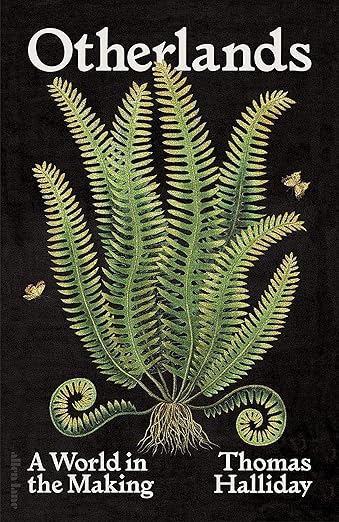
About Otherlands by Dr Thomas Halliday – A Clear Journey Through Earth’s Lost Worlds and Ancient Ecosystems
Otherlands by Dr Thomas Halliday takes readers through sixteen ancient ecosystems from different points in Earth’s history. Each chapter visits a real fossil site and rebuilds the plants, animals, climate, land, water, and relationships that once existed there.
The journey moves backward through time. It starts near the last Ice Age and continues toward the earliest complex life more than 500 million years ago. Halliday visits places that later became Alaska, Kenya, Italy, Antarctica, Australia, and other parts of the world.
The book uses evidence from fossils, rocks, chemistry, climate records, and modern biology. Halliday explains what scientists can learn from these clues and then describes each lost world in a clear, visual way.
Readers meet mammoths, early humans, giant penguins, dinosaurs, strange sea life, ancient forests, and many species that no longer exist. The book also explains how ecosystems change when climate, geography, and living things change together.
Sixteen Ancient Worlds
Otherlands is organized as a series of visits to different periods and places.
Each chapter focuses on one ecosystem. Halliday explains the landscape first and then introduces the plants and animals that lived there. He shows how they found food, avoided danger, reproduced, moved, and responded to their surroundings.
This structure makes a very large subject easier to follow. Earth history covers hundreds of millions of years, so dividing it into individual places gives readers something clear to picture.
Ice Age grasslands, Eocene forests, Jurassic islands, and Ediacaran seas had their own climate, food webs, and physical conditions.
Readers can move from one lost world to another while learning the basic ideas behind palaeontology, evolution, geology, and ecology.
The Journey Moves Backward Through Time
Most history books move from the oldest period toward the present. Halliday takes the opposite direction.
The book begins with a world that feels closer to ours and then travels farther into deep time.
This choice helps readers notice how familiar things slowly disappear. Mammals change. Flowering plants become less common. Continents move. Seas open and close. Entire groups of animals appear in later chapters only because the reader is moving backward toward their beginnings.
The farther the book goes, the less familiar Earth becomes.
Halliday keeps the timeline understandable by focusing on one place at a time. Readers do not need to memorize every geological period to enjoy the journey.
Fossils Provide the Evidence
The scenes in Otherlands are based on scientific evidence.
Fossils can preserve bones, teeth, shells, leaves, pollen, footprints, burrows, and other traces of life. Rocks can provide information about water, temperature, soil, volcanoes, and ancient environments.
Scientists combine these clues to build a picture of a lost ecosystem.
Halliday explains how researchers can make careful conclusions from material that may be millions of years old. A tooth can suggest diet. A limb can suggest movement. Pollen can show which plants grew nearby. Chemical signals can give clues about temperature or rainfall.
The book also makes clear that scientific knowledge can change when new fossils, methods, or evidence appear. Reconstructing the past requires evidence, comparison, and careful interpretation.
Pliocene Kenya and Early Human Relatives
One of the places visited in the book is Pliocene Kenya.
Halliday describes a landscape where early human relatives lived among many other animals. The scene helps place human evolution inside a wider ecosystem rather than treating it as a separate story.
Readers see the kinds of plants, predators, prey, and environmental conditions that shaped life in the region.
The chapter includes australopithecines and shows them as animals living in a real environment with daily risks.
This approach helps make early human history easier to picture. Instead of seeing only a fossil skull in a museum, the reader can think about the climate, trees, food, and other species around that individual.
Human evolution becomes one part of Earth’s much larger biological history.
Eocene Antarctica Was Green
Modern Antarctica is covered by ice, but it has not always looked that way.
Otherlands takes readers into an Eocene Antarctic forest during a much warmer period in Earth’s history.
The continent supported rich plant life and animals that would seem surprising in Antarctica today. Penguin describes the book’s journey through lush Antarctic rainforests and colonies of giant penguins.
It also helps readers understand that the positions of continents and the global climate have never been fixed.
Antarctica’s past shows why fossils are useful when scientists study climate history. Evidence of forests and animals in places that are now frozen tells us that Earth has passed through very different conditions before.
The Mediterranean Has Changed Too
Halliday also visits the region that became the Mediterranean.
At one point in its history, the Mediterranean basin experienced major changes in water level and connection with the Atlantic Ocean.
The book describes a landscape very different from the sea people know today.
Geological events can change habitats on an enormous scale. Water can disappear, return, isolate populations, connect regions, and change the movement of animals and plants.
By placing readers inside these old landscapes, Halliday makes geology easier to understand.
The shapes on a modern map can feel permanent because they change too slowly for a person to notice. Over millions of years, coastlines, mountains, seas, and islands can become completely different.
Dinosaurs Are Part of a Larger Ecosystem
Dinosaurs appear in the book, but Halliday also pays attention to the world around them.
Plants, insects, small animals, climate, water, and geography all matter when explaining how an ecosystem worked.
This wider view is useful because prehistoric books often focus heavily on the largest animals.
Otherlands asks readers to think about food webs and relationships. A predator depends on prey. Herbivores depend on plants. Plants depend on soil, water, light, and sometimes animals. Changes in one part of the system can affect many others.
Halliday also explains how species migrate, adapt, cooperate, compete, and disappear.
This makes the book valuable for readers interested in ecology as well as dinosaurs and fossils.
Extinction Happens More Than Once
Earth’s history includes several major extinction events as well as many smaller losses.
Otherlands shows ecosystems before and after large changes. Species that once filled a landscape can disappear, and other groups can later take their place.
Halliday uses these patterns to explain that ecosystems can be both strong and fragile.
Life often continues after major disruption, but the species and environments that return may be very different from what existed before.
The past gives readers examples of environmental change on a scale much larger than recorded human history.
Deep Time Becomes Easier to Picture
Numbers such as 50 million or 500 million years can be difficult to imagine.
Halliday handles this problem by describing specific places in detail.
A reader can picture a forest, a shoreline, an animal moving through grass, or a group feeding near water. These images give each period a physical setting.
The book still includes dates and scientific information, but the landscape descriptions help prevent the numbers from becoming abstract.
This approach is useful for general readers who want to learn about deep time without reading a textbook.
Climate Change Is Part of Earth’s History
Earth’s climate has changed many times.
Temperatures have risen and fallen. Ice sheets have expanded and disappeared. Sea levels have changed. Atmospheric conditions have also changed over geological time.
Otherlands explains these shifts through particular ecosystems.
Past changes show how strongly climate can affect life, migration, extinction, and geography.
A warmer or cooler world does not simply change the temperature. It can change rainfall, vegetation, oceans, food webs, and where species are able to live.
The Book Connects Past and Present
Halliday frequently brings the reader back to the modern world.
Ancient ecosystems can help explain why current ecosystems deserve careful attention. Places that look permanent today can change or disappear.
Penguin Random House highlights the Great Barrier Reef as one example. A huge ecosystem can seem too large to lose, yet the fossil record shows repeated examples of major environmental change.
The book uses deep history to give context to present concerns about biodiversity, climate, and conservation.
Readers can learn about ancient life while also gaining a wider view of the planet today.
Written for General Readers
Thomas Halliday is a palaeontologist and evolutionary biologist, but Otherlands is written for a broad audience.
The book introduces scientific ideas through places, animals, and clear examples. Readers may meet unfamiliar terms, but they are usually connected to a scene that helps explain them.
This makes the book suitable for people who enjoy popular science, natural history, evolution, geology, palaeontology, climate science, and wildlife.
Students can also use it to build a wider understanding of how these subjects connect.
The writing has enough scientific detail to teach something useful while remaining readable for people who do not work in science.
Recognition and Publication Details
Otherlands was first published by Allen Lane in 2022.
Penguin published the UK paperback in February 2023. Penguin Random House lists a U.S. paperback edition from February 14, 2023, with 416 pages.
The book was longlisted for the Baillie Gifford Prize and shortlisted for the 2022 James Cropper Wainwright Prize for Nature Writing.
Penguin also describes Thomas Halliday as the author of the Sunday Times bestselling Otherlands.
About Dr Thomas Halliday
Thomas Halliday is a palaeontologist and evolutionary biologist.
His research focuses on long-term patterns in the fossil record, especially mammals. Penguin lists him as an Honorary Research Fellow at the Department of Earth Sciences at the University of Birmingham.
His PhD received the Linnean Society’s John C. Marsden Medal, and he won the Hugh Miller Writing Competition in 2018.
Book Quality at Bookish Wonderland
Bookish Wonderland offers this title with premium eye-soothing cream paper, crystal-clear printing, and high-quality stitched plus glue binding.
The softer paper tone can feel comfortable during longer reading sessions. Clear printing helps with scientific names, dates, and detailed descriptions. The stronger binding supports repeated reading and shelf storage.
The copy works well for personal reading, study, gifting, or a science and natural history collection.
Why Order from Bookish Wonderland?
Bookish Wonderland delivers books across Bangladesh, including inside and outside Dhaka. Cash on Delivery is available nationwide.
Customers in Dhaka can also ask about fast or urgent delivery when available.
If you are checking Otherlands by Dr Thomas Halliday Book price in Bangladesh, it is useful to compare the physical quality of the copy along with the listed price.
Book customization is also available. For stock, customization, or delivery questions, you can contact Bookish Wonderland through Facebook or Instagram.
A Good Choice for Science and Nature Readers
Otherlands by Dr Thomas Halliday gives readers a broad view of Earth’s past through sixteen carefully rebuilt ecosystems.
The book covers animals, plants, climate, geology, extinction, evolution, and the way living things depend on their surroundings.
Its chapter structure makes a very large subject easier to understand. Each lost world becomes a clear example of how Earth has changed through deep time.
Readers who enjoy natural history, fossils, evolution, prehistoric life, climate science, or environmental writing should find useful material throughout the book.
Order your copy from Bookish Wonderland for nationwide delivery, Cash on Delivery, premium cream paper, clear printing, and strong stitched plus glue binding.
If you require any customization or have any questions, please inbox us via FB or Insta.
| Primary Specification | |
| Author | Thomas Halliday |
| Narrator | Adetomiwa Edun |
| Genre | Natural History, Paleontology, Evolutionary Biology, Earth Science, Science Nonfiction |
| ISBN-13/ISSN | 978-0593132906 |
| ISBN-10 | 0593132904 |
| Publisher | Random House Trade Paperbacks |
| Publishing Date | February 14, 2023 |
| Language | English |
| Reading Age | 16+ |
| Format | Printed Book |
| Physical Specification & Quality | |
| Paper Quality | Premium eye-soothing cream paper |
| Binding Quality | High quality stitched and glue binding (for longevity) |
| Print Quality | Crystal-clear print |
| Pages | 416 pages |
| Country | UK |
| Logistics Information | |
| Weight | 438 gm |
| Length | 8.5 inches |
| Width | 5.6 inches |
| Height | 0.85 inch |