

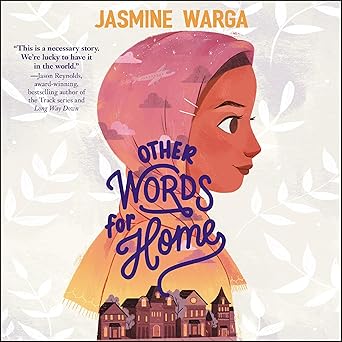
About Other Words for Home by Jasmine Warga – A Middle Grade Novel in Verse About Family, Change, and Finding a New Home
Other Words for Home by Jasmine Warga follows Jude, a twelve-year-old girl from a coastal town in Syria. She loves movies, family time, and the familiar streets around her home. Her life changes when the situation in Syria becomes more dangerous and her family has to make a difficult decision.
Jude and her mother travel to Cincinnati, Ohio, to stay with relatives. Her father and older brother Issa remain in Syria. Jude has to adjust to a new school, a new language environment, new family routines, and a place that feels very different from home.
The book is written in free verse, which gives Jude’s thoughts a clear and personal voice. Her observations are often simple, direct, and easy to follow. Through school, family, friendship, food, language, and the school musical, Jude slowly builds a life in Cincinnati while staying connected to the people and memories she left behind.
Jude Leaves Syria With Her Mother
Jude does not expect to leave Syria.
Her hometown is changing as political unrest and violence move closer. Her older brother Issa becomes interested in the protests, while her parents worry about what may happen next.
When Jude’s mother becomes pregnant, the family decides that Jude and her mother should go to the United States. They travel to Cincinnati to stay with Jude’s uncle, who is a doctor, and his family.
The move gives Jude physical safety, but it also separates her from her father, brother, friends, language, and daily routines.
This part of the story gives young readers a clear view of displacement through one child’s experience. Jude does not explain the war in complicated political terms. She notices what changes around her and what those changes mean for her family.
Cincinnati Feels Fast and Loud
Jude has seen many American movies before moving to the United States.
Real life is different.
School moves quickly. English is everywhere. People ask questions about where she comes from. Foods and habits she knew as normal are given new labels. Jude begins hearing herself described as “Middle Eastern,” a term that feels unfamiliar to her at first.
These small details help show how moving to another country can change the way a person sees ordinary things.
Jude has to learn new routines while also deciding which parts of herself she wants to keep exactly as they are.
The book explains this adjustment through simple moments rather than long explanations about immigration.
Language Is a Big Part of Jude’s New Life
Jude already knows English, but speaking it all day in a new school is still difficult.
She pays attention to words, pronunciation, jokes, and the way people react to her accent.
The free verse format works well here because the page can slow down around individual words and short thoughts.
Jude sometimes knows exactly what she wants to say but has to work harder to say it in the way people around her expect.
This gives the book a useful view of language learning that many students can understand.
It also shows that knowing more than one language can be a strength, even when a new environment makes the learner feel unsure.
Family Changes After the Move
Jude and her mother live with Uncle Mazin, Aunt Michelle, and their daughter Sarah.
Sarah is close to Jude’s age, but the two girls do not become close immediately.
Jude is entering a family that already has its own habits. Sarah is also adjusting to having relatives living in her home.
The relationship between the cousins changes slowly.
Jude has to understand Sarah’s school life and personality, while Sarah has to see Jude as more than the cousin who recently arrived from Syria.
Their home also becomes a place where different parts of Jude’s life meet. Arabic, English, Syrian food, American routines, memories of home, and new experiences all exist in the same space.
Jude Misses Her Father and Brother
Safety does not remove homesickness.
Jude worries about her father and Issa because they remain in Syria while the situation becomes more uncertain.
She thinks about the things she used to do with them and the ordinary family moments she once expected to continue.
Communication helps, but distance still changes the relationship.
Jude’s concern for Issa is especially important because he is interested in political change and wants to take part in protests.
The novel shows how international events can become personal inside one family. News about Syria is not a distant subject for Jude. It affects the people she loves.
School Brings New Friends and New Problems
Starting a new school gives Jude many things to learn at once.
She has to understand classes, classmates, social rules, and the way people talk about Syria, Islam, and the Middle East.
Some people are welcoming. Others make assumptions.
Jude experiences moments of discrimination and Islamophobia, especially when people treat her identity as something unusual or threatening.
The book presents these experiences in language suitable for middle grade readers while still making the harm clear.
Jude also finds people who make school easier. New friendships help her become more comfortable and give her places where she does not have to explain every part of herself.
The School Musical Gives Jude a New Goal
Jude loves movies and has always enjoyed performance.
When her school prepares a musical, she becomes interested in trying out.
This gives her something to work toward that is connected to her own interests rather than only to the difficulties of moving.
Preparing for the musical also pushes Jude to use English, meet more people, and allow herself to be seen.
The stage becomes a place where confidence can grow through practice.
For readers, this part of the story adds a positive school goal alongside the heavier subjects of war and displacement.
Jude gets to be a student with talent and ambition, not only a refugee adjusting to a new country.
The Book Is Written in Free Verse
Other Words for Home is a novel in verse.
The story is told through short lines, open space, and sections that often feel close to Jude’s private thoughts.
This format makes the book accessible to readers who may feel intimidated by long chapters or dense paragraphs.
It also allows important words and ideas to stand alone on the page.
Jude’s observations about language, food, family, identity, and home can be simple while still carrying a lot of meaning.
Readers who are new to verse novels may find this an easy place to start.
The format also makes the book suitable for classroom reading, discussion, and reading aloud.
Identity Becomes More Complicated in America
Before moving, Jude thinks of herself mainly through the life she knows in Syria.
In the United States, other people give her new labels.
She becomes more aware of being Arab, Muslim, Syrian, Middle Eastern, and an immigrant because people around her notice those parts of her identity.
The book shows how a person can feel the same inside while being seen differently by a new community.
Jude slowly learns that she does not have to choose one simple label.
She can care about Syria and build a life in Cincinnati. She can speak Arabic and English. She can miss her old home and enjoy parts of her new one.
Food Helps Keep Home Close
Food appears often in Jude’s thoughts.
Meals connect her to family, culture, memory, and comfort.
Foods that were simply everyday food in Syria are described as “Middle Eastern food” in America. Jude notices the difference immediately.
These small observations help younger readers understand how culture can become more visible when someone moves.
A familiar meal can carry memories of people and places that are far away.
The book uses food naturally rather than turning it into a lesson.
The Story Gives Refugee Characters Everyday Lives
Jude is affected by war, but her whole personality is not built around war.
She likes movies. She notices clothes. She worries about fitting in. She wants friends. She has opinions about family members. She becomes interested in performing.
This makes her feel like a complete young person.
The story gives readers a view of a Syrian refugee that includes humor, ambition, family arguments, school stress, and ordinary happiness.
That representation is one reason the book has been widely used in schools and libraries.
Who Will Enjoy Other Words for Home?
Other Words for Home is a strong choice for middle grade readers who enjoy realistic fiction, novels in verse, school stories, family stories, and books about migration and identity.
Kirkus places the reading range around ages eleven through adult, while many library catalogs target the book to readers around ages eight to twelve.
The language is accessible, but the story includes war, displacement, discrimination, and Islamophobia.
It works well for independent reading, classroom use, book clubs, and family discussion. It can also support lessons about empathy, belonging, cultural identity, migration, and respectful classroom discussion.
Awards and Recognition
Other Words for Home was published by Balzer + Bray, an imprint of HarperCollins, on May 28, 2019.
The first HarperCollins edition is listed at 352 pages.
The book became a New York Times bestseller and received a 2020 Newbery Honor.
It also received a 2020 Walter Award Honor, a Lee Bennett Hopkins Poetry Award Honor, and recognition from many major children’s book organizations.
Jasmine Warga’s official site also lists it among the best books of 2019 from Publishers Weekly, Kirkus Reviews, School Library Journal, NPR, Booklist, and other outlets.
Book Quality at Bookish Wonderland
Bookish Wonderland offers this title with premium eye-soothing cream paper, crystal-clear printing, and high-quality stitched plus glue binding.
The cream paper gives the pages a softer look during longer reading sessions. Clear printing is useful for a verse novel because spacing, short lines, and page layout are important to the reading experience.
The stronger binding supports regular reading, classroom use, rereading, and shelf storage.
Why Order from Bookish Wonderland?
Bookish Wonderland delivers books across Bangladesh, including inside and outside Dhaka. Cash on Delivery is available nationwide.
Customers in Dhaka can also ask about fast or urgent delivery when available.
If you are checking Other Words for Home by Jasmine Warga Book price in Bangladesh, it is useful to compare the physical quality of the copy along with the listed price.
Book customization is also available. For stock, customization, or delivery questions, you can contact Bookish Wonderland through Facebook or Instagram.
A Good Choice for Middle Grade Readers
Other Words for Home by Jasmine Warga gives readers a clear story about Jude’s move from Syria to Cincinnati and the changes that follow.
The book covers family separation, school, language, religion, friendship, discrimination, performance, and the meaning of home.
The verse format keeps the reading pace manageable while giving Jude’s voice plenty of space.
Readers can learn about displacement and immigration while also following a familiar story about a young person starting a new school and trying to understand where she belongs.
Order your copy from Bookish Wonderland for nationwide delivery, Cash on Delivery, premium cream paper, clear printing, and strong stitched plus glue binding.
If you require any customization or have any questions, please inbox us via FB or Insta.
| Primary Specification | |
| Author | Jasmine Warga |
| Narrator | Vaneh Assadourian |
| Genre | Middle Grade, Realistic Fiction, Contemporary Fiction, Immigration/Refugee Fiction, Poetry/Verse |
| ISBN-13/ISSN | 978-0062747815 |
| ISBN-10 | 0062747819 |
| Publisher | Storytide |
| Publishing Date | April 6, 2021 |
| Language | English |
| Reading Age | 8-12 years |
| Format | Printed Book |
| Physical Specification & Quality | |
| Paper Quality | Premium eye-soothing cream paper |
| Binding Quality | High quality stitched and glue binding (for longevity) |
| Print Quality | Crystal-clear print |
| Pages | 368 pages |
| Country | USA |
| Logistics Information | |
| Weight | 392 gm |
| Length | 8.5 inches |
| Width | 5.6 inches |
| Height | 0.75 inch |