

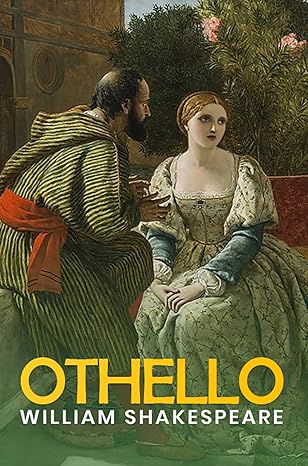
About Othello by William Shakespeare – A Classic Tragedy About Jealousy, Trust, Betrayal, and Manipulation
Othello by William Shakespeare is a tragedy about a respected military commander whose marriage is destroyed by lies and jealousy. The play begins in Venice, where Othello has secretly married Desdemona, the daughter of a Venetian senator named Brabantio. Their marriage causes anger because Brabantio did not approve it and because Othello is an outsider in Venetian society.
At the same time, Othello’s officer Iago is angry that Michael Cassio has been promoted above him. Iago decides to damage both men. He uses lies, half-truths, staged conversations, and a lost handkerchief to convince Othello that Desdemona is unfaithful with Cassio.
Most of the play later takes place in Cyprus, where Othello has been sent to defend the island. Iago continues his plan there. Othello trusts him and slowly begins to doubt Desdemona. The result is a tragedy shaped by manipulation, insecurity, anger, and the failure to ask for clear proof.
Othello as a Military Leader
Othello is a general in the Venetian army.
At the beginning of the play, he is respected for his military skill and experience. The Venetian leaders depend on him when Cyprus faces a threat from the Ottoman Turks.
Othello speaks with confidence when Brabantio accuses him of using magic to win Desdemona. He explains that Desdemona listened to stories about his life, travels, dangers, and military service. Desdemona then confirms that she married him because she loves him.
This early confidence makes his later change important. Othello begins as a man who can speak calmly in front of senators. After Iago starts feeding him false information, he becomes more suspicious and less able to judge events clearly.
Desdemona Makes Her Own Choice
Desdemona is the daughter of Brabantio, a Venetian senator.
She chooses to marry Othello without her father’s permission. When she is called before the Senate, she speaks for herself and confirms her love for her husband.
She later travels with Othello to Cyprus.
Desdemona is loyal to Othello and also tries to help Cassio after he loses his position. She believes she is doing a kind thing by asking Othello to forgive him.
Iago uses this kindness against her.
He tells Othello that Desdemona’s support for Cassio is evidence of an affair. Othello begins to read ordinary actions as signs of betrayal.
Desdemona’s position becomes more dangerous as Othello stops trusting what she says.
Iago Controls the Main Conflict
Iago drives most of the plot.
He is angry because Othello promoted Cassio to lieutenant instead of him. He also gives other reasons for his hatred, but his motives are never reduced to one simple cause.
Iago is effective because he understands what other people want and fear.
He knows Roderigo wants Desdemona. He knows Cassio cares about his reputation. He knows Othello values loyalty. He also knows how to make a suggestion sound like a discovery.
Instead of giving Othello one obvious lie, Iago builds suspicion slowly.
He asks questions, pretends to hold information back, and encourages Othello to reach the wrong conclusion himself.
Cassio Becomes Part of Iago’s Plan
Michael Cassio is the officer Othello chooses as his lieutenant.
Iago wants Cassio’s position, so he arranges for Cassio to get drunk and become involved in a fight. Othello removes Cassio from his rank.
Iago then advises Cassio to ask Desdemona for help.
Cassio follows the advice because he believes Desdemona may persuade Othello to restore his position.
This creates the situation Iago needs.
When Othello sees Desdemona speaking with Cassio, Iago suggests that the meeting may have a hidden meaning.
Cassio has no affair with Desdemona, but Othello begins to see him as a rival.
The plan works because Iago creates ordinary events and then gives Othello a false explanation for them.
The Handkerchief Becomes Important Evidence
A handkerchief plays a major role in the plot.
Othello gave it to Desdemona, and it has personal meaning in their marriage.
Desdemona accidentally drops it. Emilia, Iago’s wife and Desdemona’s attendant, picks it up and gives it to Iago because he has asked for it before.
Iago places the handkerchief where Cassio can find it.
He later uses the object as false proof that Desdemona gave it to Cassio.
For Othello, the handkerchief becomes more important than Desdemona’s own words.
The object shows how physical evidence can be misunderstood when someone already believes a false story.
It also shows how Iago turns small events into larger problems by controlling what people know.
Emilia Has an Important Role
Emilia is Iago’s wife and Desdemona’s attendant.
For much of the play, she does not understand the full purpose of Iago’s plan.
She gives him the handkerchief without knowing how he intends to use it.
Later, Emilia becomes one of the people who reveals the truth.
When she understands that Iago used the handkerchief to convince Othello that Desdemona was unfaithful, she speaks openly even when doing so puts her in danger.
Her final actions are important because they expose Iago’s deception.
Emilia also gives the play another view of marriage, gender, loyalty, and the expectations placed on women.
Jealousy Drives Othello’s Decisions
Jealousy is one of the best-known themes in Othello.
Iago understands that he does not need complete evidence to control Othello. He only needs to create enough doubt.
Once Othello begins to suspect Desdemona, he starts interpreting more events through that suspicion.
A conversation looks secret. A missing handkerchief looks like proof. Desdemona’s support for Cassio looks suspicious.
The play shows how jealousy can change judgment.
Othello becomes more interested in confirming his fear than checking whether the fear is true.
This gives students and general readers a clear example of confirmation bias even though Shakespeare wrote the play centuries before that modern term became common.
Trust Is Just as Important as Jealousy
Othello trusts the wrong person.
He repeatedly believes Iago while doubting Desdemona.
This difference shapes the tragedy.
Iago builds a public image of honesty and loyalty.
Desdemona tells Othello the truth, but his trust in her weakens because Iago has already changed the way he sees her.
The play therefore raises questions about how trust is built and how easily it can be redirected.
A person may trust someone because of reputation, position, confidence, or long friendship. None of those things guarantee that the person is telling the truth.
Race and Outsider Status Matter
Othello is described as a Moor and is treated as an outsider in Venice.
The play contains racist language and attitudes that reflect the society around the characters and the period in which Shakespeare wrote.
Brabantio is especially angry that Desdemona has married Othello and claims that she could not have chosen him freely.
Iago also uses racist language when speaking about the marriage.
Othello’s position is complicated because Venice values his military skill while some people still treat him differently because of race and origin.
Modern readers and students often discuss how this outsider status affects Othello’s insecurity and how race operates in the play.
Venice and Cyprus Create Different Settings
The play begins in Venice, a place of government, law, family authority, and public debate.
Othello and Desdemona’s marriage is discussed before the Senate, and Othello is given military orders there.
The action then moves to Cyprus.
The military threat disappears when the Turkish fleet is destroyed by a storm, but the personal conflict becomes stronger.
Cyprus is more isolated, and Iago has more room to control events around Othello, Desdemona, Cassio, Roderigo, and Emilia.
The Language Rewards Close Reading
Othello is written mainly in verse, with some prose.
Shakespeare changes rhythm, imagery, and sentence structure depending on the speaker and situation.
Iago often uses language to guide other people without appearing to order them directly.
Othello’s speech also changes as jealousy grows.
Students can learn a lot by comparing the calm way he speaks early in the play with the more broken and emotional language that appears later.
Modern editions often include notes, introductions, glossaries, or explanations that make unfamiliar words easier to understand.
Readers buying a specific edition should check whether those study features are included.
Useful for Students and Literature Readers
Othello is widely studied in schools, colleges, and universities.
The play supports discussion of tragedy, character, manipulation, jealousy, race, gender, marriage, military power, language, and dramatic structure.
It is also useful for readers studying Shakespeare’s use of soliloquies and dramatic irony.
The audience often knows more about Iago’s plan than Othello does. This creates tension because readers and viewers can see how badly Othello is misunderstanding events.
Teachers can also use the play for essay questions, character analysis, close reading, performance work, and comparisons with other Shakespeare tragedies.
Written Around 1603 to 1604
Scholars generally date Othello to around 1603 or 1604.
The Folger Shakespeare Library records a court performance at Whitehall in November 1604 and notes that the play may have been performed earlier at the Globe.
Othello was first printed in a quarto edition in 1622.
A different and somewhat longer version appeared in the First Folio in 1623.
The two early texts differ in hundreds of places, which is one reason modern editions can vary slightly.
The main source for Shakespeare’s plot was a story by the Italian writer Giraldi Cinthio.
Edition Details Can Vary
Othello has been published in many editions by many publishers.
Page count, notes, introductions, spelling, and extra study material depend on the edition.
For example, the Signet Classics edition published by Penguin Random House is listed at 320 pages and includes an introduction, background material, and other study features.
A simpler classroom or public-domain edition may be much shorter because it includes only the play.
Customers who need a particular edition, editor, page count, or ISBN should check those details before ordering.
Book Quality at Bookish Wonderland
Bookish Wonderland offers this title with premium eye-soothing cream paper, crystal-clear printing, and high-quality stitched plus glue binding.
The cream paper provides a softer page tone for longer reading sessions. Clear printing is especially useful for a play because character names, dialogue, scene divisions, and notes need to remain easy to follow.
The stronger binding supports repeated study, classroom use, rereading, and shelf storage.
Why Order from Bookish Wonderland?
Bookish Wonderland delivers books across Bangladesh, including inside and outside Dhaka. Cash on Delivery is available nationwide.
Customers in Dhaka can also ask about fast or urgent delivery when available.
If you are checking Othello by William Shakespeare Book price in Bangladesh, it is useful to compare the physical quality of the copy along with the listed price.
Book customization is also available. For stock, customization, or delivery questions, you can contact Bookish Wonderland through Facebook or Instagram.
A Strong Choice for Shakespeare Readers and Students
Othello by William Shakespeare remains widely read because its central problems are easy to recognize: jealousy, false information, broken trust, manipulation, pride, and poor judgment.
The plot is clear enough for new Shakespeare readers to follow, while the language and character relationships provide plenty of material for deeper study.
Othello, Desdemona, Iago, Cassio, and Emilia each give readers a different view of loyalty, power, marriage, and responsibility.
The play works well for classroom study, exam preparation, literature collections, theatre readers, and anyone interested in Shakespearean tragedy.
Order your copy from Bookish Wonderland for nationwide delivery, Cash on Delivery, premium cream paper, clear printing, and strong stitched plus glue binding.
If you require any customization or have any questions, please inbox us via FB or Insta.
| Primary Specification | |
| Author | William Shakespeare |
| Editor | Dr. Barbara A. Mowat, Paul Werstine |
| Genre | Tragedy; drama; psychological tragedy |
| ISBN-13/ISSN | 978-1501146299 |
| ISBN-10 | 1501146297 |
| Publisher | Simon & Schuster |
| Publishing Date | June 13, 2017 |
| Language | English |
| Reading Age | 14+ |
| Format | Printed Book |
| Physical Specification & Quality | |
| Paper Quality | Premium eye-soothing cream paper |
| Binding Quality | High quality stitched and glue binding (for longevity) |
| Print Quality | Crystal-clear print |
| Pages | 416 pages |
| Country | UK |
| Logistics Information | |
| Weight | 436 gm |
| Length | 8.5 inches |
| Width | 5.6 inches |
| Height | 1.04 inch |