

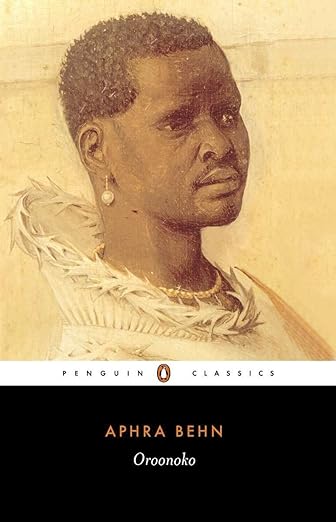
About Oroonoko by Aphra Behn – A Classic Story About Love, Slavery, Power, and Betrayal
Oroonoko by Aphra Behn is a short seventeenth-century work first published in 1688. It tells the story of Oroonoko, an African prince, and Imoinda, the woman he loves. Their lives are changed by jealousy, political power, betrayal, and the Atlantic slave trade.
The story begins in Africa, where Oroonoko is respected for his courage, education, and military skill. He falls in love with Imoinda, but his grandfather, the king, also wants her. The conflict separates the couple and leads to decisions that shape the rest of the story.
Oroonoko is later tricked, enslaved, and transported to Surinam, an English colony in South America. There he is reunited with Imoinda, who has also been enslaved. Their hope for a life together soon becomes tied to Oroonoko’s demand for freedom and his growing anger at the promises made by the colonists.
Oroonoko Is Presented as a Prince and Soldier
Oroonoko begins the story as a young African prince from Coramantien.
Behn presents him as intelligent, brave, disciplined, and experienced in war. He is also described as someone who has learned from European visitors and can speak with people from different backgrounds.
His royal position is important to the story because it shapes the way other characters respond to him.
Even after he is enslaved, people around him recognize his leadership and confidence. He does not accept slavery as a natural part of his identity and continues to think of himself as a prince who has been wronged.
Modern readers may notice that the text often gives Oroonoko special treatment because of his noble birth. This is one reason scholars describe Behn’s treatment of slavery as complicated rather than completely modern or consistent.
Imoinda Is Central to Oroonoko’s Choices
Imoinda is the woman Oroonoko loves.
She is young, admired, and connected to a respected family. Oroonoko wants to marry her, but his grandfather also desires her and uses royal authority to take control of the situation.
Oroonoko and Imoinda continue to love each other despite the king’s actions. Their attempt to remain connected leads to punishment and separation.
Imoinda is later sold into slavery and transported to Surinam.
When Oroonoko eventually arrives there, he discovers that she is still alive. Their reunion gives both characters hope, but their situation remains dangerous because neither of them is free.
Betrayal Leads Oroonoko Into Slavery
One of the most important parts of the plot is the way Oroonoko is captured.
A European slave trader gains his trust and invites him and several companions onto a ship. Oroonoko believes he is being treated as a guest.
Once they are aboard, the crew takes control and prepares to transport them as enslaved people.
The scene is important because the capture depends on deception.
Oroonoko is not defeated in battle. He is betrayed by someone who used hospitality and promises to make him feel safe.
This becomes part of the larger theme of broken promises in the book.
Oroonoko repeatedly discovers that people who speak about honor, religion, and civilized behavior do not always act honestly.
Surinam Changes the Setting and the Conflict
Most of the later story takes place in Surinam.
At the time Behn wrote Oroonoko, Surinam was connected to European colonial competition, plantation labor, and slavery.
The colony gives the book a setting where European power, African enslavement, and Indigenous communities exist close together.
Oroonoko is renamed Caesar by the colonists, although the narrator continues to recognize his original identity.
He is treated with more respect than many other enslaved people because of his appearance, education, and status.
That respect does not give him freedom.
The difference between polite treatment and actual liberty becomes important as Oroonoko grows more frustrated with promises that are never fulfilled.
Oroonoko and Imoinda Want Freedom
After their reunion, Oroonoko and Imoinda begin imagining a future together.
Imoinda becomes pregnant, which makes freedom feel even more urgent.
Oroonoko does not want his child to be born into slavery.
He asks the colonists to release them, and he is given repeated promises that the matter will be handled.
Nothing changes.
The delay increases his anger because he sees that polite words are being used to keep him quiet.
Eventually he decides that waiting is no longer enough.
His decision leads to a larger attempt to escape with other enslaved people.
The Revolt Shows Oroonoko as a Leader
Oroonoko encourages other enslaved people to resist and leave the plantation system.
He speaks about freedom, family, and the humiliation of living under masters.
Many people follow him.
The revolt becomes one of the most important political moments in the story because Oroonoko moves from personal frustration to collective resistance.
He is not thinking only about himself and Imoinda. He tries to persuade others that slavery is unacceptable.
The escape attempt does not succeed.
Colonial forces pursue the group, and negotiations follow. Oroonoko again has to decide whether he can trust promises made by men in power.
The result shows how little control enslaved people have when laws and armed force are controlled by those who own them.
Broken Promises Appear Throughout the Story
Trust is a major theme in Oroonoko.
The prince is betrayed by the slave trader who captures him. In Surinam, he is given promises of freedom that are delayed or broken. Agreements made during the revolt also fail to protect him.
These repeated betrayals help explain why Oroonoko becomes increasingly unwilling to trust colonial authority.
The book often compares what characters say with what they actually do.
People who describe themselves as Christian or civilized can behave with cruelty.
Oroonoko, who is treated as foreign or uncivilized by some Europeans, is repeatedly shown caring deeply about honor.
The Book Has an Ambiguous View of Slavery
Oroonoko is often discussed as an early English text about slavery.
The story clearly presents Oroonoko and Imoinda’s enslavement as cruel and unjust. It also shows violence, betrayal, and the lack of freedom inside the colonial system.
At the same time, scholars warn against reading the book as a simple modern anti-slavery statement.
Behn’s narrator makes distinctions based on rank, education, appearance, and social class. Oroonoko is often described as exceptional because he is a prince.
The book also reflects seventeenth-century colonial attitudes that modern readers may find disturbing.
This complexity makes Oroonoko useful for study.
Race and Colonialism Are Important to Modern Reading
The language of Oroonoko comes from the seventeenth century.
Descriptions of African and Indigenous people can reflect European stereotypes, assumptions, and racial ideas of that period.
Modern readers should expect language and attitudes that may feel offensive today.
These parts are important when studying the book because they show how early English literature represented race and empire.
The work can support discussion about who tells the story, who receives sympathy, how colonial societies are described, and how power affects the narrator’s viewpoint.
Love Gives the Story Its Personal Center
The relationship between Oroonoko and Imoinda gives the larger political story a personal focus.
Their love begins before slavery enters their lives directly.
They are separated by the king, reunited in Surinam, and then forced to think about how slavery will affect their future and their unborn child.
The relationship gives Oroonoko strong personal reasons to seek freedom.
It also increases the tragedy because readers can see what the couple wants and how colonial power limits their choices.
The Ending Is Violent and Tragic
Oroonoko ends in severe violence.
After the failed revolt and further betrayal, Oroonoko believes that he and Imoinda will never be allowed to live freely together.
His decisions in the final section lead to Imoinda’s death and eventually to his own brutal execution.
The ending is intended to show the destruction caused by slavery, broken promises, and colonial power.
Readers should know that the book contains violence, enslavement, racial language, death, and disturbing treatment of human beings.
Aphra Behn Was an Important Early Professional Writer
Aphra Behn lived from the seventeenth century and became one of the first English women known to earn a living through writing.
She wrote plays, poetry, prose fiction, and political material.
Oroonoko is now one of her best-known works.
Behn claimed knowledge of Surinam, and the narrative presents itself in a way that mixes eyewitness-style detail with fiction.
Scholars continue to debate how much of the story comes from personal observation, literary invention, and earlier sources.
Oroonoko Was Published in 1688
Oroonoko: Or, the Royal Slave was first published in 1688.
It appeared near the end of Behn’s life and has remained one of the most frequently studied English prose works from the Restoration period.
The book is often described as one of the early English novels or as an important early prose narrative.
Because the text is short, many editions include introductions, notes, timelines, and historical background.
Penguin’s Little Black Classics edition is only 64 pages, while other editions can be much longer because they include commentary or additional works by Behn.
Useful for Students of Literature and History
Oroonoko is widely studied in courses on Restoration literature, early fiction, women writers, colonialism, race, slavery, and the history of the English novel.
Its short length makes it manageable for classroom reading.
These include Oroonoko’s status as a prince, Imoinda’s role, the narrator’s reliability, the representation of Indigenous people, the slave trade, colonial power, religion, honor, gender, and the difference between freedom and polite treatment.
Readers studying the work may benefit from an edition with notes because some vocabulary and historical references are unfamiliar today.
Who Will Enjoy Oroonoko?
Oroonoko is a good choice for readers interested in classic literature, early novels, historical fiction, colonial history, literary studies, and works about slavery.
It may also suit readers studying Aphra Behn, Restoration England, women’s writing, or the development of prose fiction.
The language is older than modern English novels, so some readers may need notes or a glossary.
Readers should be prepared for violence, racial language, enslavement, and colonial attitudes connected to the period in which it was written.
Book Quality at Bookish Wonderland
Bookish Wonderland offers this title with premium eye-soothing cream paper, crystal-clear printing, and high-quality stitched plus glue binding.
The cream paper provides a softer page tone for longer reading sessions. Clear printing helps with older language, dialogue, and study notes. The stronger binding supports classroom use, rereading, and shelf storage.
Why Order from Bookish Wonderland?
Bookish Wonderland delivers books across Bangladesh, including inside and outside Dhaka. Cash on Delivery is available nationwide.
Customers in Dhaka can also ask about fast or urgent delivery when available.
If you are checking Oroonoko by Aphra Behn Book price in Bangladesh, it is useful to compare the physical quality of the copy along with the listed price.
Book customization is also available. For stock, customization, or delivery questions, you can contact Bookish Wonderland through Facebook or Instagram.
A Good Choice for Classic Literature Readers
Oroonoko by Aphra Behn gives readers a short seventeenth-century story about love, slavery, betrayal, colonial power, and resistance.
Oroonoko and Imoinda’s relationship gives the story its emotional center, while the move from Africa to Surinam places their personal lives inside the wider system of Atlantic slavery.
The book is especially useful for readers who want to study early English fiction, Restoration literature, colonial writing, race, or the history of representations of slavery.
Order your copy from Bookish Wonderland for nationwide delivery, Cash on Delivery, premium cream paper, clear printing, and strong stitched plus glue binding.
If you require any customization or have any questions, please inbox us via FB or Insta.
| Primary Specification | |
| Author | Aphra Behn |
| Narrator | Margaret Melosh |
| Genre | Classic Fiction, Tragedy, Romance, Colonial Literature, Slavery Narrative |
| ISBN-13/ISSN | 978-0140439885 |
| ISBN-10 | 0140439889 |
| Publisher | Penguin Classics ed. |
| Publishing Date | May 25, 2004 |
| Language | English |
| Reading Age | 16+ |
| Format | Printed Book |
| Physical Specification & Quality | |
| Paper Quality | Premium eye-soothing cream paper |
| Binding Quality | High quality stitched and glue binding (for longevity) |
| Print Quality | Crystal-clear print |
| Pages | 144 pages |
| Country | UK |
| Logistics Information | |
| Weight | 164 gm |
| Length | 8.5 inches |
| Width | 5.6 inches |
| Height | 0.31 inch |