

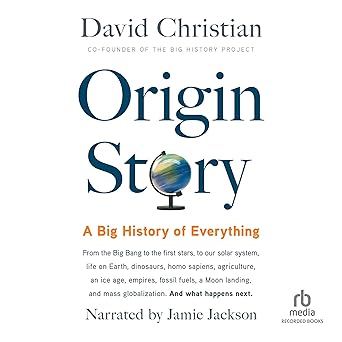
About Origin Story: A Big History of Everything by David Christian – From the Big Bang to Human Civilization and the Future
Origin Story: A Big History of Everything by David Christian looks at history on the largest possible scale. Instead of beginning with kings, wars, nations, or written records, the book begins about 13.8 billion years ago with the origin of the universe.
Christian then follows the development of stars, chemical elements, planets, life, humans, farming, complex societies, industry, and the modern world. He connects ideas from astronomy, physics, chemistry, geology, biology, archaeology, anthropology, and history so readers can see how different parts of the past fit together.
The book is built around eight major “thresholds.” Each threshold marks a point when new forms of complexity became possible. This structure helps turn a very large subject into a clear sequence that readers can follow.
What Big History Means
Most history books focus on a particular country, civilization, war, leader, or period. Big History uses a much wider frame.
It asks what happened before human beings existed, how Earth formed, how life developed, why Homo sapiens became unusually influential, and how agriculture and fossil fuels changed human societies.
David Christian began teaching Big History at Macquarie University in 1989. The approach brings information from the sciences and humanities into one connected story.
This makes Origin Story useful for readers who often study subjects separately and want to understand how they relate.
A lesson about stars may seem far away from a lesson about agriculture. Christian shows that the elements made inside stars later became part of planets, living organisms, tools, buildings, and human bodies.
Threshold One Begins With the Big Bang
The first threshold is the beginning of the universe.
Christian starts with the Big Bang and explains the early conditions that eventually made all later complexity possible.
The first universe was extremely simple compared with the world we know today. There were no planets, plants, animals, oceans, or people.
As the universe expanded and cooled, matter could take new forms.
Christian does not try to turn cosmology into a technical physics textbook. He gives readers enough scientific background to understand why this beginning matters to the larger story.
The main idea is simple: everything that follows depends on earlier conditions.
Stars and Galaxies Create New Possibilities
The next thresholds deal with stars and galaxies.
Gravity pulled matter together, and stars formed. Inside stars, new chemical elements were created through nuclear processes.
When some stars died, they spread those elements into space.
This matters because later planets and living things required elements that did not exist in useful amounts at the earliest stage of the universe.
Christian uses this part of the story to show how complexity builds on earlier complexity.
A star may feel unrelated to human history, but the materials needed for Earth and life came from cosmic processes that happened long before humans appeared.
Earth Becomes a Place Where Life Can Develop
The fourth threshold includes the formation of more complex molecules, the solar system, and Earth.
Our planet formed about 4.5 billion years ago.
Its location, chemistry, temperature, liquid water, and long geological history created conditions where life could eventually appear and survive.
Christian explains Earth as part of a larger cosmic process rather than as an isolated starting point.
The book also introduces geological time, which is difficult to imagine because human lives are so short by comparison.
Thinking in billions of years helps readers see how slowly some changes happened and how quickly modern human changes have happened by comparison.
Life Changes the Story
The appearance of life is the fifth major threshold.
Living organisms can use energy, maintain themselves, reproduce, and pass information forward.
Early life was simple, but evolution produced greater variety over enormous stretches of time.
Christian follows the growth of the biosphere, from small organisms to larger and more complex forms of life.
He also discusses major changes and extinctions that reshaped the planet.
Dinosaurs appear inside this much longer biological story rather than as a separate topic.
Life changes Earth, and Earth also changes the possibilities for life. The relationship between the planet and living organisms becomes an important part of the book.
Humans Bring Collective Learning
The sixth threshold is the appearance of humans and the special importance of collective learning.
Many animals can learn, communicate, and solve problems. Christian argues that human language allowed information to be shared with unusual detail across groups and generations.
People did not have to discover everything again from the beginning.
Knowledge could accumulate.
One person could learn from parents, neighbors, elders, travelers, and earlier generations. Communities could then combine information and improve tools, techniques, stories, and social systems.
This ability helped humans adapt to many environments and build increasingly large networks.
Collective learning becomes one of the central ideas in Christian’s explanation of human history.
Farming Creates Another Major Threshold
The seventh threshold is agriculture.
For most of human history, people lived mainly by hunting, gathering, fishing, and using wild resources.
After the end of the last Ice Age, farming began independently in several parts of the world.
People domesticated plants and animals and began producing food in new ways.
Agriculture could support larger populations and more settled communities.
It also changed work, health, land use, ownership, social organization, and relationships with the environment.
Villages grew, and some later became towns and cities.
Farming created new opportunities, but Christian also shows that greater complexity can bring new costs and inequalities.
Agrarian Civilizations Become Larger and More Organized
As farming societies grew, some developed states, cities, armies, taxation systems, writing, long-distance trade, and organized religions.
These societies could control larger territories and support people who were not directly producing food.
Merchants, officials, soldiers, craftspeople, rulers, priests, and scholars became part of increasingly complex social systems.
Trade routes connected distant regions.
Ideas, crops, technologies, diseases, and beliefs could move through these networks.
Christian treats civilizations as part of a global process rather than as isolated stories.
This wide view helps readers compare patterns across regions and understand how contacts between societies changed historical development.
The Modern World Speeds Up Change
The later chapters move toward the modern era.
Global exchange becomes more intense, scientific knowledge grows, and political and economic systems become more connected.
The use of fossil fuels creates access to huge amounts of stored energy.
Coal, oil, and natural gas allow humans to produce goods, move people, build cities, power machines, and transform landscapes on a scale that earlier societies could not match.
Christian describes this energy shift as a major part of the eighth threshold.
Industrialization increases human power, but it also increases humanity’s ability to damage natural systems.
The Anthropocene Changes the Scale of Human Impact
Christian uses the idea of the Anthropocene to discuss the period when human activity became powerful enough to affect Earth systems on a planetary scale.
Modern societies use enormous amounts of energy and resources.
They have changed rivers, forests, soils, oceans, the atmosphere, and the distribution of many species.
The same networks that support medicine, transport, communication, education, and global trade can also spread environmental damage and create shared risks.
This part of the book connects history with present-day questions.
It asks readers to think about what a species with so much collective power should do next.
The Book Also Looks Toward the Future
Origin Story does not stop with the present.
Christian considers possible futures for humanity, Earth, the solar system, and the universe.
The further the timeline extends, the less certain predictions become.
That uncertainty is part of the point.
Big History gives readers a long view of change, but it also shows that the future is not simply a fixed continuation of the past.
Human choices now matter because our species has become capable of changing planetary conditions.
The final sections encourage readers to think about responsibility, cooperation, technology, energy, and the future of complex societies.
Useful for Students and Curious Readers
Origin Story is a good choice for readers who enjoy history, science, cosmology, evolution, anthropology, world history, environmental studies, or big-picture questions.
A reader studying the Industrial Revolution can see its relationship with energy. A reader studying evolution can place humans inside a much longer biological story. A reader studying climate change can understand why modern energy use represents a major historical change.
The book can also support classroom discussion, essays, general knowledge, and interdisciplinary study.
About David Christian
David Christian is a historian and Professor Emeritus at Macquarie University.
He trained as a historian of Russia and the Soviet Union before developing a strong interest in world history and history across very large timescales.
He began teaching Big History at Macquarie University in 1989.
Christian later became a co-founder of the Big History Project with Bill Gates. He also served as founding president of the International Big History Association and directed Macquarie University’s Big History Institute.
His background helps explain the book’s combination of historical thinking with information from many scientific fields.
Publication and Edition Details
Origin Story: A Big History of Everything was published in 2018.
The first Little, Brown and Company edition was released in May 2018 and is commonly listed at 357 numbered pages, or x plus 357 pages when the preliminary pages are counted separately.
A 2019 Penguin paperback edition is listed at 368 pages.
Page count therefore depends on the edition and format.
The book became a New York Times bestseller and has been published internationally.
Book Quality at Bookish Wonderland
Bookish Wonderland offers this title with premium eye-soothing cream paper, crystal-clear printing, and high-quality stitched plus glue binding.
The cream paper gives the pages a softer tone for longer reading sessions. Clear printing helps keep dates, scientific terms, chapter headings, and historical explanations easy to follow. Strong binding supports repeated reading, study, and shelf storage.
The book is suitable for personal reading, gifting, academic interest, or building a history and science collection.
Why Order from Bookish Wonderland?
Bookish Wonderland delivers books across Bangladesh, including inside and outside Dhaka. Cash on Delivery is available nationwide.
Customers in Dhaka can also ask about fast or urgent delivery when available.
If you are checking Origin Story: A Big History of Everything by David Christian Book price in Bangladesh, it is useful to compare the physical quality of the copy along with the listed price.
Book customization is also available. For stock, customization, or delivery questions, you can contact Bookish Wonderland through Facebook or Instagram.
A Strong Starting Point for Big History
Origin Story: A Big History of Everything by David Christian gives readers one connected framework for understanding the universe, Earth, life, human societies, and the modern world.
Its eight-threshold structure makes an enormous subject easier to follow.
Readers can move from the Big Bang to stars, planets, life, humans, farming, civilization, industry, and the Anthropocene without treating each subject as an unrelated topic.
The book works well for people who want a broad foundation before studying individual periods in greater depth.
Order your copy from Bookish Wonderland for nationwide delivery, Cash on Delivery, premium cream paper, clear printing, and strong stitched plus glue binding.
If you require any customization or have any questions, please inbox us via FB or Insta.
| Primary Specification | |
| Author | David Christian |
| Narrator | Jamie Jackson |
| Genre | History, Big History, Popular Science, Cosmology, World History |
| ISBN-13/ISSN | 978-0316392013 |
| ISBN-10 | 0316392014 |
| Publisher | Little, Brown Spark |
| Publishing Date | May 21, 2019 |
| Language | English |
| Reading Age | 14+ |
| Format | Printed Book |
| Physical Specification & Quality | |
| Paper Quality | Premium eye-soothing cream paper |
| Binding Quality | High quality stitched and glue binding (for longevity) |
| Print Quality | Crystal-clear print |
| Pages | 368 pages |
| Country | USA |
| Logistics Information | |
| Weight | 392 gm |
| Length | 8.5 inches |
| Width | 5.6 inches |
| Height | 1.2 inch |