

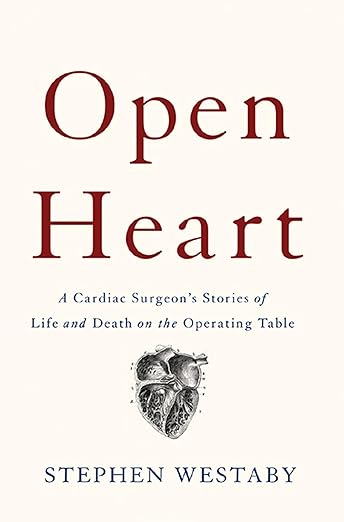
About Open Heart: A Cardiac Surgeon's Stories of Life and Death on the Operating Table by Stephen Westaby – A Memoir of Heart Surgery, Risk, Innovation, and Patient Care
Open Heart by Stephen Westaby is a medical memoir built around real cases from a long career in cardiac surgery. Westaby writes about operations where a small decision can change whether a patient lives, dies, or spends months trying to recover. He also explains what it feels like for a surgeon to work repeatedly in situations where the result is never guaranteed.
The book moves through major moments in Westaby’s career rather than following one single patient. He writes about children born with severe heart problems, adults whose hearts are failing, people waiting for transplants, and patients kept alive by mechanical devices. Alongside the medical work, he discusses fear, responsibility, professional confidence, grief, and the emotional distance surgeons sometimes need in order to return to the operating room after a bad outcome.
A Career Built Around the Human Heart
Stephen Westaby decided at a young age that he wanted to become a heart surgeon. He has described watching heart surgery on television as a child and being struck by the possibility of repairing a heart that could no longer work properly on its own.
That interest eventually became a career lasting more than three decades. Westaby worked as a cardiac surgeon in Oxford and became known for taking on difficult cases, including patients with advanced heart failure and complex congenital conditions.
The official US publisher says he reflects in Open Heart on more than 11,000 operations. That scale matters because the book is not based on one unusual experience. It comes from years of repeated decisions where technical skill, speed, judgment, equipment, teamwork, and chance all mattered.
The Operating Room Is Shown Without Softening It
Open Heart gives readers a close view of cardiac surgery. Westaby writes about opening the chest, stopping and restarting the heart, controlling bleeding, using machines to support circulation, and responding when an operation changes suddenly.
The details can be graphic. Readers who are uncomfortable with blood, surgery, severe illness, or death should know that the book does not hide those parts of the work.
At the same time, the technical detail has a purpose. It helps readers understand why heart surgery requires concentration and why a routine-looking procedure can become dangerous within seconds. The operating room is presented as a workplace where careful preparation and fast choices matter.
The Book Focuses on Patients, Not Only Procedures
Westaby explains the medical problem in each case, but he also gives readers a sense of the person behind it. A heart operation affects families, pregnancies, work, childhood, plans, and relationships. A successful technical result can still leave a patient facing a difficult recovery. A failed operation can leave a surgical team carrying the memory for years.
This makes the memoir useful for readers who want medical stories with human context. The book is not a textbook and should not be used as medical advice. Instead, it shows what high-risk treatment can look like from the surgeon’s side and why patients and doctors sometimes have to make decisions with incomplete certainty.
One Early Death Changes the Way Westaby Thinks
The publisher highlights an early moment when Westaby watched a patient die during open-heart surgery. What stayed with him was not only the death itself but the way the surgeons walked away and continued working.
He came to understand that a certain level of emotional control is necessary in a profession where loss can happen despite preparation and effort. This does not mean the surgeon stops caring.
The book repeatedly shows that caring too deeply without any emotional protection can make it impossible to continue operating. Westaby presents detachment as a working tool rather than a lack of compassion.
Mechanical Hearts Become a Major Part of the Story
One of the strongest themes in Open Heart is the use of mechanical devices to support failing hearts. Westaby became an important figure in the development and use of artificial heart technology and ventricular assist devices.
These machines can help move blood when the natural heart is too weak to do the job alone.
In the book, mechanical support is not presented as simple or perfect. Devices can bring infection risk, equipment problems, difficult maintenance, and a life that may depend on batteries, cables, or external systems.
Even so, they can give patients time that would otherwise not exist. Westaby was especially interested in using heart pumps not only as a temporary bridge to transplant but, in some cases, as longer-term support.
Peter Houghton Shows What Long-Term Mechanical Support Can Mean
One of the best-known cases connected with Westaby’s career is Peter Houghton. Houghton lived for years with a Jarvik 2000 mechanical heart pump after severe heart failure.
His case became important because it showed that a patient could live outside hospital for a long period with continuous mechanical support. That did not mean life became normal.
Living with an implanted pump required care, batteries, medical follow-up, and acceptance of a device that had become essential to survival.
The case allowed Westaby to discuss both the promise and the cost of artificial heart technology. For readers interested in medical innovation, this is one of the most memorable parts of the memoir.
Some Cases Involve Very Young Patients
Open Heart also includes children with serious heart disease. Operating on a baby or child changes the emotional weight of a case because the patient may have had very little time to live normally before becoming critically ill.
Westaby describes situations where surgery or mechanical support offered a chance that did not exist through medication alone.
Not every case ends well. The official publisher mentions a baby who receives a heart transplant but dies after the transplant.
Cases like this show why the book is not built around guaranteed medical success. A surgeon can perform a difficult procedure correctly and still lose the patient.
Julie's Case Shows the Possibility of Recovery
Another well-known case involves Julie, a young woman whose heart became dangerously weak after a viral illness.
Westaby used mechanical support to keep her circulation going while her heart had time to recover.
The case became important because it showed that, in some situations, a failing heart may recover enough to allow the device to be removed.
That outcome supported the idea that mechanical assistance could sometimes be used as a bridge to recovery rather than only as a bridge to transplantation.
For general readers, the medical lesson is easier to understand through a real person than through technical explanation alone.
Transplantation Is Important but Limited
Heart transplantation appears throughout Westaby’s work, but the book also shows why transplantation cannot solve every case of heart failure. Donor hearts are limited.
Some patients become too sick to wait. Others may not qualify for transplantation or may have medical problems that make the procedure unsuitable.
This is one reason Westaby became so interested in mechanical circulatory support.
A pump can sometimes keep a patient alive while waiting for a donor heart. In other cases, it may offer an alternative when transplantation is not realistic.
The memoir therefore gives readers a clear introduction to one of the central practical problems in advanced heart failure: there are more patients who need help than there are donor hearts available.
Innovation Often Comes With Uncertainty
New medical technology can save lives, but using it also creates difficult questions.
A surgeon may know that an established treatment is failing while a newer device offers hope but less long-term evidence.
Westaby’s career involved many situations where innovation and risk were close together.
He writes as someone willing to push beyond standard practice when he believed a patient had no good alternative.
That attitude helped produce important advances, but it also creates ethical questions about evidence, consent, hospital rules, funding, and how much uncertainty is acceptable.
Readers do not need medical training to understand the basic problem. When every option carries serious risk, the safest choice is not always obvious.
The Memoir Also Looks at the Emotional Cost of Surgery
A surgeon may leave the operating room after a death and still have another patient waiting.
Open Heart repeatedly returns to that pressure.
Westaby writes about the need to stay functional after bad outcomes, even when the memory remains.
The work can create confidence because surgeons must act decisively, but it can also create guilt and self-questioning.
Success is public and visible. Failure can be personal and difficult to discuss.
The memoir gives readers a view of medical responsibility from the person holding the instruments.
That perspective can be uncomfortable, especially when Westaby describes mistakes, limits, or decisions made under extreme pressure.
Open Heart and Fragile Lives Are the Same Memoir
Readers may see this book under two different titles.
In the United States, Basic Books published it as Open Heart: A Cardiac Surgeon's Stories of Life and Death on the Operating Table.
In the United Kingdom, HarperCollins published the same memoir as Fragile Lives: A Heart Surgeon's Stories of Life and Death on the Operating Table.
The US hardcover was released on June 20, 2017 and is listed by Hachette at 304 pages with ISBN 9780465094837.
The UK edition has different pagination, so customers should check the exact format if page count or ISBN matters.
Who Will Enjoy Open Heart?
Open Heart is a strong choice for readers interested in medicine, surgery, cardiology, medical memoirs, medical technology, intensive care, and real patient stories.
It may also appeal to readers who enjoyed books such as Do No Harm by Henry Marsh or Being Mortal by Atul Gawande.
The book contains graphic descriptions of surgery, serious illness, blood, death, and unsuccessful treatment.
Readers who are sensitive to those subjects should consider that before choosing it.
For medical students and healthcare readers, the book can offer a personal view of decision-making and surgical culture, but it is still a memoir rather than a clinical guide.
Book Quality at Bookish Wonderland
Bookish Wonderland offers this title with premium eye-soothing cream paper, crystal-clear printing, and high-quality stitched plus glue binding.
The softer paper tone supports comfortable reading during longer sessions. Clear printing helps with medical terms, names, and detailed case descriptions. The stronger binding supports repeated reading and shelf storage.
The copy is suitable for personal reading, gifting, medical-interest collections, or readers who enjoy nonfiction based on real professional experience.
Why Order from Bookish Wonderland?
Bookish Wonderland delivers books across Bangladesh, including inside and outside Dhaka. Cash on Delivery is available nationwide. Customers in Dhaka can also ask about fast or urgent delivery when available.
If you are checking Open Heart by Stephen Westaby Book price in Bangladesh, it is useful to compare the physical quality of the copy along with the listed price.
Book customization is also available. For stock, customization, or delivery questions, you can contact Bookish Wonderland through Facebook or Instagram.
A Direct Look at Life Inside Cardiac Surgery
Open Heart by Stephen Westaby gives readers a close view of cardiac surgery through real patients, difficult operations, mechanical pumps, transplantation, recovery, and loss.
Westaby shows how technical decisions can affect individual lives and why even experienced surgeons cannot control every outcome. The memoir suits readers who want medical nonfiction with practical detail and human stories.
Order your copy from Bookish Wonderland for nationwide delivery, Cash on Delivery, premium cream paper, clear printing, and strong stitched plus glue binding.
If you require any customization or have any questions, please inbox us via FB or Insta.
| Primary Specification | |
| Author | Stephen Westaby |
| Narrator | Gordon Griffin |
| Editor | Linda Mark |
| Genre | Medical Nonfiction, Memoir, Biography; Autobiography |
| ISBN-13/ISSN | 978-0465094837 |
| ISBN-10 | 046509483X |
| Publisher | Basic Books |
| Publishing Date | June 20, 2017 |
| Edition | 1st |
| Language | English |
| Reading Age | 16+ |
| Format | Printed Book |
| Physical Specification & Quality | |
| Paper Quality | Premium eye-soothing cream paper |
| Binding Quality | High quality stitched and glue binding (for longevity) |
| Print Quality | Crystal-clear print |
| Pages | 304 pages |
| Country | USA |
| Logistics Information | |
| Weight | 325 gm |
| Length | 8.5 inches |
| Width | 5.6 inches |
| Height | 0.72 inch |