

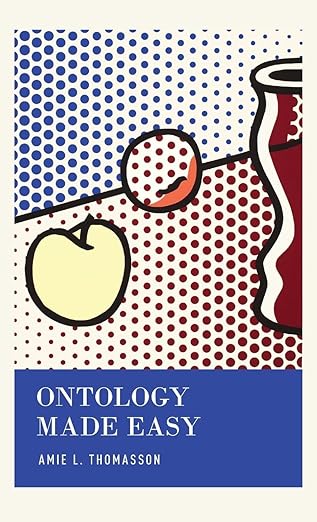
About Ontology Made Easy by Amie L. Thomasson – A Clear Guide to Existence, Metaphysics, Language, and Easy Ontology
Ontology Made Easy by Amie L. Thomasson is a philosophy book about a central question in metaphysics: what exists? Philosophers debate objects, properties, numbers, events, propositions, fictional characters, and many other kinds of things. Thomasson asks whether some of these debates are harder than necessary.
Her main idea is the “easy approach to ontology.” Instead of treating every existence question as a deep mystery requiring a special metaphysical method, she argues that many questions can be answered by examining how our words and concepts work and then checking relevant facts.
When philosophers ask whether tables, numbers, properties, or other entities exist, Thomasson asks what rules govern those terms and what evidence is actually needed to answer the question.
What Ontology Means
Ontology is the branch of philosophy that studies what exists.
A basic ontological question might ask whether numbers exist. Another might ask whether properties such as redness exist, whether fictional characters exist in any sense, or whether ordinary objects such as tables and chairs should be counted as real entities.
These questions can become highly technical because philosophers disagree about what counts as existence, what kinds of things should be accepted, and what methods can settle the disagreement.
Thomasson enters this debate by challenging the idea that ontology must always be difficult. She argues that once the meaning and use of our terms are understood, many existence questions can be answered more directly than traditional metaphysical debates suggest.
Why Thomasson Calls Her Approach Easy
The word “easy” in the title does not mean that every chapter is simple or that the book avoids difficult philosophy.
It refers to a method.
Thomasson argues that many existence claims can be reached through straightforward reasoning from claims that are not controversial. If there are five books on a table, for example, it is easy to say that the number of books on the table is five. If a house is red, ordinary language gives us a way to say that the house has the property of being red.
For Thomasson, these kinds of inferences matter because they show that some entities philosophers debate about can be accepted without a long metaphysical struggle.
The challenge is to explain why these simple forms of reasoning should be trusted and what happens when philosophers reject them.
The Book Responds to Hard Ontology
A major target of the book is what Thomasson calls “hard ontology.”
Hard ontology treats existence questions as deep theoretical problems and asks which entities belong in our most fundamental description of reality.
Thomasson thinks this approach can produce long debates without a clear method for deciding who is right.
Her alternative shifts attention toward concepts, language, rules of use, and the role of our terms. Instead of searching for hidden metaphysical facts beyond ordinary evidence, philosophers can ask what our concepts require and whether the relevant conditions are met.
Carnap Is an Important Background Figure
Rudolf Carnap is one of the most important historical influences on Ontology Made Easy.
Carnap distinguished between questions asked within a linguistic framework and questions about whether to adopt that framework.
Thomasson develops this idea while responding to later analytic philosophy.
She does not simply repeat Carnap. She addresses objections shaped by Quine and later metaphysics, making the book a modern defense and development of a broadly Carnapian approach to ontology.
Quine Provides Another Major Point of Reference
W. V. O. Quine had enormous influence on modern ontology.
Many philosophers influenced by Quine focus on what entities a theory must quantify over and what commitments follow from accepting it.
Thomasson argues that later neo-Quinean debates can become difficult to resolve because philosophers disagree about which entities belong in our ontology and lack a clear neutral method for settling the dispute.
Her alternative helps readers compare Carnapian and Quinean approaches and understand why metaontology asks both what exists and how existence questions should be answered.
Metaontology Is Central to the Book
Ontology asks what exists. Metaontology asks how ontological questions should be understood and what methods can answer them.
Ontology Made Easy is therefore as much about metaontology as ontology.
Thomasson examines the language used in existence debates and asks what makes a question meaningful.
Her view is that meaningful terms come with rules or conditions for their use. Once those are understood, we can often see what evidence is needed.
Some questions are settled conceptually, others empirically, and some by both. The approach rejects the need for a mysterious extra method available only to metaphysicians.
Conceptual Truth Plays an Important Role
The book gives an important role to conceptual truth: connections we can recognize through understanding the relevant terms.
Thomasson argues that some existence inferences depend on these conceptual links.
This leads into debates about analyticity, meaning, and whether philosophers can rely on conceptual knowledge.
The middle and later chapters are therefore more technical than the title may suggest. The proposed method is “easy,” but defending it still requires detailed argument.
Easy Arguments Are a Key Tool
Thomasson uses what are often called easy arguments.
These begin with an ordinary or uncontroversial statement and move to an existence claim through a simple conceptual step.
For example, if there are five books on a table, then there is a number that is the number of books on the table: five.
The point is not that every philosophical problem can be solved with one sentence.
The point is that some existence claims may follow from ordinary truths plus rules built into our concepts.
If that is correct, then denying the existence of numbers, properties, propositions, or other disputed entities may require rejecting forms of reasoning that are deeply connected with ordinary language and thought.
The Book Discusses Competing Views
Ontology Made Easy does not present Thomasson’s position without engaging alternatives.
She discusses fictionalism, quantifier variance, neo-Quinean ontology, technical notions of existence, and several other approaches in contemporary metaphysics.
The book also engages philosophers including Eli Hirsch, Ted Sider, Thomas Hofweber, Karen Bennett, and others.
This makes it useful for postgraduate students, researchers, and advanced undergraduates who want more than an introduction.
Readers can see not only what Thomasson believes, but also how her view fits into a larger philosophical debate.
The Notre Dame Philosophical Reviews assessment notes that the book provides a valuable overview of competing positions even while raising objections to parts of Thomasson’s argument.
For readers working through metaphysics, the book also provides a useful map of competing methods, showing why disagreements about existence often depend on prior assumptions about language, evidence, and meaning.
The Book Is Best for Readers With Some Philosophy Background
Despite the friendly title, Ontology Made Easy is an academic philosophy book.
It is not written like a beginner’s self-help guide or a basic introduction to metaphysics.
Readers will encounter technical terms such as quantifier variance, deflationism, conceptual truth, sortal terms, fictionalism, and neo-Quinean ontology.
A reader who already knows basic metaphysics or analytic philosophy will find the argument easier to follow.
Students can also use the book alongside a course, lecture notes, or an introductory text.
The writing is clear by academic standards, but the subject itself is abstract and requires patient reading.
Why the Book Matters in Contemporary Metaphysics
The book matters because it challenges the assumption that difficult ontological debates must be answered using increasingly complex metaphysical theories.
Thomasson argues that some debates may be misguided because the answers are already available through conceptual and empirical methods.
If she is right, philosophers can redirect energy toward questions that have clearer practical or theoretical value.
Her later work continues this larger project of rethinking metaphysics.
In a 2025 preface, Thomasson describes Ontology Made Easy as the first part of a trilogy aimed at demystifying metaphysics and redirecting it toward more fruitful work.
That places this book inside a longer philosophical project rather than treating it as an isolated argument.
Publication and Edition Details
Oxford University Press published Ontology Made Easy in New York in 2015.
The hardcover edition has ISBN 9780199385119 and ISBN-10 0199385114.
Bibliographic records list xiii plus 345 pages, with the bibliography beginning on page 331 and the index on page 341.
The book is classified under philosophy and metaphysics.
Oxford Academic also lists it as part of Oxford Scholarship Online.
Different electronic or later print formats may display pagination differently, so readers who need a specific edition for study or citation should check the ISBN and format before ordering.
About Amie L. Thomasson
Amie L. Thomasson is a philosopher known for work in metaphysics, metaontology, philosophy of mind, social ontology, philosophy of art, and related areas.
At the time Ontology Made Easy was published, she was a professor at the University of Miami.
She is now the Daniel P. Stone Professor of Intellectual and Moral Philosophy at Dartmouth College.
Her publications include several books and many academic articles.
Ontology Made Easy develops themes connected with her earlier work while giving a fuller defense of her easy approach to existence questions.
Who Should Read Ontology Made Easy?
This book is a strong choice for philosophy students, researchers, teachers, and readers interested in metaphysics, analytic philosophy, ontology, philosophy of language, or philosophical method.
It is especially useful for readers studying Carnap, Quine, metaontology, ontological commitment, or debates about numbers, properties, propositions, and ordinary objects.
Because the book is academic, beginners may prefer to read a short introduction to ontology first.
For university study, it can support essays, seminars, thesis work, and advanced discussion.
The book is also useful for readers who want to understand why philosophers disagree not only about what exists, but about how existence questions should be asked in the first place.
Book Quality at Bookish Wonderland
Bookish Wonderland offers this title with premium eye-soothing cream paper, crystal-clear printing, and high-quality stitched plus glue binding.
The softer cream paper supports longer reading sessions, which is useful for a dense academic text. Clear printing helps keep technical vocabulary, examples, notes, and philosophical arguments easy to follow. Strong binding supports repeated study, annotation, and shelf storage.
The copy is suitable for personal reading, university study, research, teaching, or building a philosophy collection.
Why Order from Bookish Wonderland?
Bookish Wonderland delivers books across Bangladesh, including inside and outside Dhaka. Cash on Delivery is available nationwide.
Customers in Dhaka can also ask about fast or urgent delivery when available.
If you are checking Ontology Made Easy by Amie L. Thomasson Book price in Bangladesh, it is useful to compare the physical quality of the copy along with the listed price.
Book customization is also available. For stock, customization, or delivery questions, you can contact Bookish Wonderland through Facebook or Instagram.
A Focused Book for Serious Philosophy Readers
Ontology Made Easy by Amie L. Thomasson asks whether philosophers have made existence questions unnecessarily difficult.
Its answer is a carefully defended easy approach based on conceptual and empirical methods, ordinary language, and rules for using our terms.
The book gives readers a direct route into major debates about ontology while also explaining why the method of asking the question matters.
For students and readers already interested in analytic metaphysics, it offers a clear position to study, question, defend, or criticize.
Order your copy from Bookish Wonderland for nationwide delivery, Cash on Delivery, premium cream paper, clear printing, and strong stitched plus glue binding.
If you require any customization or have any questions, please inbox us via FB or Insta.
| Primary Specification | |
| Author | Amie L. Thomasson |
| Genre | Philosophy, Metaphysics, Metaontology |
| ISBN-13/ISSN | 978-0190878665 |
| ISBN-10 | 0190878665 |
| Publisher | Oxford University Press |
| Publishing Date | January 2, 2018 |
| Language | English |
| Reading Age | 18+ |
| Format | Printed Book |
| Physical Specification & Quality | |
| Paper Quality | Premium eye-soothing cream paper |
| Binding Quality | High quality stitched and glue binding (for longevity) |
| Print Quality | Crystal-clear print |
| Pages | 362 pages |
| Country | USA |
| Logistics Information | |
| Weight | 385 gm |
| Length | 8.5 inches |
| Width | 5.6 inches |
| Height | 0.9 inch |