

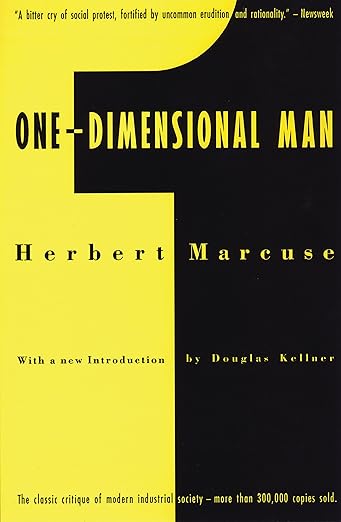
About One-Dimensional Man by Herbert Marcuse: A Clear Guide to Modern Society, Freedom, and Critical Thought
A Book That Asks You to Look at Everyday Life Differently.One-Dimensional Man by Herbert Marcuse is a major work of social and political philosophy that asks a simple but difficult question: how free are people when the world around them teaches them what to want, what to buy, what to accept, and even how to think? First published in 1964, the book became closely linked with debates about industrial society, consumer culture, technology, mass media, and political opposition. Marcuse looks at both capitalist and Soviet-style industrial systems and argues that highly organized societies can reduce the space for deep criticism, even when people feel comfortable and materially secure. The book is not a light story or a quick self-help guide. It is a serious work for readers who want to question the ideas, habits, systems, and messages that shape daily life.
Marcuse’s main concern is what he calls “one-dimensional” thought: a way of thinking in which people find it harder to imagine a truly different society. The existing system can begin to feel natural and impossible to change. Marcuse asks readers to look behind everyday choices and ask what alternatives may be missing.
Why This Book Still Draws Serious Readers
Many books explain how society works. One-Dimensional Man goes further by asking why people may accept systems that limit them without always seeing those limits. Marcuse studies how modern life can make control feel normal. Instead of control always appearing as force, it may appear through convenience, products, entertainment, language, work, and technology. That idea made the book important to the New Left and to later debates in critical theory. Routledge describes it as an influential critique of contemporary Western societies and notes its impact on young radicals after its publication. Beacon Press also identifies the book as one of Marcuse’s major works and notes that it became important during the political changes of the 1960s.
The book is useful not because readers must agree with every argument, but because it gives them a framework for better questions. What happens when advertising turns wants into needs? What happens when political language becomes so narrow that important alternatives are not discussed? Can technology improve life while also helping large systems organize and control it? Can a society offer comfort and still limit freedom in less visible ways? These are the kinds of questions Marcuse places in front of the reader.
When Modern Life Feels Normal but Something Still Seems Wrong
A common problem in modern life is that people are surrounded by information, products, choices, screens, opinions, and entertainment, yet may still feel that many choices lead in the same direction. We may have more things to buy but fewer chances to ask why we need them. We may have more information but less time to think deeply. We may hear many opinions while the basic rules of work, consumption, and social success remain almost untouched.
One-Dimensional Man gives a language for studying this problem. Marcuse does not offer a simple ten-step fix. Instead, he trains the reader to notice how a system can shape needs, speech, habits, and ideas. His solution is not a shopping list of actions. It is the recovery of critical thought: the ability to say that what exists is not the only thing that can exist. This is one reason the book is still read in philosophy, sociology, political theory, cultural studies, media studies, and courses on critical theory.
What You Will Find Inside One-Dimensional Man
The book is organized around three broad movements. First, Marcuse studies what he sees as a “one-dimensional society.” He discusses new forms of control, the narrowing of political life, the role of consumer satisfaction, and changes in public language. Second, he turns to “one-dimensional thought,” where he examines forms of reasoning and philosophy that, in his view, can lose their negative or critical power. Finally, he considers whether alternatives are still possible and what liberation could mean. Routledge’s table of contents shows chapters on new forms of control, the closing of the political universe, technological rationality, positive thinking, philosophy, and the possibility of an alternative.
This structure means the book moves from everyday social life into deeper philosophy. Some pages may feel direct, while others may require slow reading. It is often useful to pause after a paragraph and restate Marcuse’s point in simple words. The reward is a book that can make familiar life look different.
The Big Idea Behind “One-Dimensional” Thinking
Marcuse uses “one-dimensional” to describe a society and a way of thinking in which strong alternatives are pushed aside. People may still argue, vote, buy different products, watch different media, and choose different lifestyles, yet the deepest structure of society may remain largely unquestioned. In Marcuse’s analysis, advanced industrial systems can absorb criticism and turn opposition into something harmless, marketable, or easy to manage.
He also discusses “false needs.” This does not mean every comfort is bad or every product is useless. The idea is that some needs may be created or strengthened by social systems in ways that keep people tied to patterns of work and consumption. A person may experience those needs as personal and natural even when they are shaped by advertising, status, competition, or social pressure. Routledge’s encyclopedia summary of Marcuse explains this part of his critique as a concern that consumerism can manufacture and satisfy needs in ways that prevent deeper awareness of social conditions.
A Critical Look at Technology Without Calling Technology Evil
One-Dimensional Man is sometimes described too simply as an attack on technology. That misses an important part of Marcuse’s argument. His concern is not that machines or technical knowledge are automatically bad. He is interested in how technological systems can carry social values. A system built only around efficiency, production, control, and measurable results may encourage people to treat those goals as if they were neutral facts.
For a modern reader, this can open questions about algorithms, workplace systems, social platforms, data, and automation. The book was written long before smartphones and social media, so it does not discuss them directly, but its questions about technology and power can still help readers examine newer systems.
Why Students and Serious Readers Keep Returning to It
This is a strong choice for readers of philosophy, sociology, politics, media, culture, history, or critical theory. Readers familiar with Karl Marx, Theodor Adorno, Max Horkheimer, Erich Fromm, or related social criticism may also find Marcuse useful for comparison.
What Makes the Reading Experience Worth the Effort
One-Dimensional Man is not designed to be read at top speed. Its value comes from careful reading. The language can be dense because Marcuse brings together philosophy, social theory, politics, economics, language, and culture. That may sound difficult, but the core questions are very human: What is freedom? What do we really need? Who shapes our desires? Why do some ideas become normal? Why do other ideas sound impossible before they are even discussed?
A good use case is reading one chapter at a time, marking key lines, and writing short notes beside difficult ideas. Students can use it for coursework or research, teachers can use sections for discussion, and book clubs can treat each chapter as a separate topic. Readers interested in media, marketing, or technology can focus on manufactured needs, language, and technological rationality.
A Physical Edition Made for Focused Reading
At Bookish Wonderland, this edition is prepared for readers who want a comfortable printed copy for long study sessions. The pages use premium eye-soothing cream paper, which is easier on the eyes than harsh bright paper during extended reading. The text is produced with crystal-clear printing so dense passages remain sharp and easy to follow. High-quality stitched and glue binding is used for better longevity, helping the book stay firm through repeated reading, note-taking, discussion, and study.
These details matter with a serious philosophy book because readers often return to earlier chapters, compare ideas, underline passages, and review terms. A durable printed copy supports repeated study and long-term shelf use.
What You Gain From Reading It
The biggest benefit of this book is a stronger habit of questioning. Marcuse encourages readers to look at work, products, media, political speech, technology, entertainment, and social habits, then ask what assumptions sit behind them. This can make readers more careful when they hear a slogan, see an advertisement, or accept that something is simply “the way things are.”
It can also improve comparison. Because Marcuse criticizes both Western capitalist society and Soviet communist society, the book does not fit neatly into a simple praise of one industrial system against another. Beacon Press notes that Marcuse’s critique addressed both capitalist society and the disappointments of Soviet communism. That wider frame gives readers more room to examine how different systems can use technology, production, institutions, and social pressure in different ways.
Who Should Read One-Dimensional Man by Herbert Marcuse
Choose this book if you are a university student, researcher, teacher, philosophy reader, social science reader, or curious adult interested in freedom, conformity, technology, consumer culture, and social control. It also suits readers who already know some political theory and want a classic text that challenges easy answers.
This is not a fast motivational read. It asks for concentration. If you enjoy books that make you stop, question, disagree, and return to important passages, it can be a rewarding addition to your reading list.
Book Price in Bangladesh and Ordering from Bookish Wonderland
If you are searching for One-Dimensional Man by Herbert Marcuse Book price in Bangladesh, Bookish Wonderland gives you a simple way to order a premium printed copy. Nationwide delivery is available inside and outside Dhaka, with Cash on Delivery across Bangladesh. For customers in Dhaka who need the book quickly for class, research, or a reading group, a fast or urgent delivery option may also be available.
Why Buy This Book from Bookish Wonderland
For a demanding book, readability and durability matter. Bookish Wonderland offers cream paper, clear print, and stitched plus glue binding for longer use. You can order from anywhere in Bangladesh, choose Cash on Delivery, and use faster delivery in Dhaka when available.
The goal is simple: make serious English books easier to access in a durable physical form. Whether you need One-Dimensional Man for a university course, research, a reading group, or your personal collection, this edition is built for repeated reading.
Add a Classic of Critical Theory to Your Reading List
One-Dimensional Man by Herbert Marcuse remains a demanding and influential study of modern industrial society. It asks readers to question comfort, choice, language, technology, consumption, and the limits of accepted debate. You do not need to agree with Marcuse to benefit from reading him. The value comes from seeing how a major twentieth-century thinker builds an argument about freedom and control, then testing that argument for yourself.
If you want a book that pushes you to examine the world around you, this is a title to study slowly and keep for future reference. Order your copy from Bookish Wonderland. For order help or customization, inbox Bookish Wonderland through Facebook or Instagram.
If you require any customization or have any questions, please inbox us via FB or Insta.
| Primary Specification | |
| Author | Herbert Marcuse |
| Genre | Philosophy, Political Philosophy, Social Theory, Critical Theory |
| ISBN-13/ISSN | 978-0807014172 |
| ISBN-10 | 0807014176 |
| Publisher | Beacon Press |
| Publishing Date | October 1, 1991 |
| Edition | 2nd edition |
| Language | English |
| Reading Age | 18+ years |
| Format | Printed Book |
| Physical Specification & Quality | |
| Paper Quality | Premium eye-soothing cream paper |
| Binding Quality | High quality stitched and glue binding (for longevity) |
| Print Quality | Crystal-clear print |
| Pages | 260 pages |
| Country | United States |
| Logistics Information | |
| Weight | 263g |
| Length | 8.5 inch |
| Width | 5.6 inch |
| Height | 0.91 inch |