

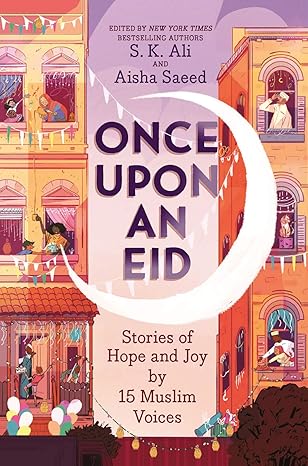
About Once Upon an Eid by S. K. Ali and Aisha Saeed – 15 Joyful Muslim Stories About Eid, Family, Hope and Belonging
Once Upon an Eid by S. K. Ali and Aisha Saeed is a warm collection of stories about the joy, meaning, and many different ways Muslims celebrate Eid. Edited by S. K. Ali and Aisha Saeed, the book brings together 15 Muslim voices and gives young readers many kinds of Eid experiences in one place. Some stories are funny. Some are gentle. Some are emotional. All of them show that Eid can look different from one family, culture, or country to another while still carrying a shared feeling of celebration.
The collection also includes a poem, a graphic-novel chapter, and illustrations by Sara Alfageeh, which gives the book extra variety.
It is especially good for children who want to see Muslim life represented with warmth, and for readers who want to learn how Eid can be celebrated in many communities.
One holiday, many different stories
Eid is a special time for Muslims, but no two families celebrate it in exactly the same way. That is one of the strongest ideas in Once Upon an Eid.
For one child, Eid may mean waking up early and smelling food from the kitchen. For another, it may mean putting on a new outfit, going to Eid prayer, visiting relatives, giving gifts, or waiting for a favorite sweet. Some children may celebrate in large families. Others may live in places where only a small Muslim community is nearby.
Instead of giving readers one picture of Eid, it gives many. That helps Muslim children see that their own family traditions are part of a wider world. It also helps non-Muslim readers learn that Muslim communities are diverse, with different languages, foods, cultures, and family experiences.
This makes the book feel welcoming rather than narrow. The shared center is joy, faith, family, and belonging.
Stories that make Muslim children feel seen
Children often connect strongly with books when they recognize parts of their own lives on the page.
Once Upon an Eid gives Muslim children a chance to read about characters who understand the excitement of Eid without needing the holiday to be explained as something unusual. The stories treat Muslim families, traditions, and celebrations as normal parts of life.
A child may recognize the rush of getting ready, the happiness of seeing relatives, the smell of special food, the hope of receiving gifts, or the excitement of wearing something new. Another child may recognize family problems, disappointment, or a celebration that does not go exactly as planned.
Representation works best when characters are allowed to be full people. They can be excited, shy, funny, worried, kind, stubborn, or confused. They are not only there to teach readers about religion.
Eid is important, but so are friendship, family, mistakes, hope, and growing up.
A simple way to learn about Eid through real feelings
For readers who do not celebrate Eid, this anthology offers a friendly way to learn.
Instead of starting with a list of facts, the book starts with people. Readers see what the day feels like through children and families. Food, clothing, prayer, visits, gifts, and community appear naturally inside stories.
This makes learning easier because emotions come first.
A reader can understand the excitement of waiting for a celebration even if their own holiday is different. They can understand family gatherings, special meals, or the wish for a perfect day. Once that emotional connection is made, the cultural details become easier to remember.
The book can therefore work well in homes, schools, libraries, reading groups, and classrooms where children are learning about different communities.
It opens the door to questions in a gentle way: What is Eid? Why do families celebrate differently? What foods are special? What traditions matter most? How can people share joy even when their backgrounds are not the same?
Fifteen voices keep the book fresh
A collection can feel repetitive if every story sounds the same. Once Upon an Eid avoids that by bringing together many writers.
The contributors include well-known Muslim authors and creators such as G. Willow Wilson, Hena Khan, N. H. Senzai, Hanna Alkaf, Rukhsana Khan, Randa Abdel-Fattah, Jamilah Thompkins-Bigelow, Huda Al-Marashi, Asmaa Hussein, and others.
Each writer brings a different voice, setting, family, and mood.
That means one story may be funny while another is quiet. One may focus on food, another on family, another on giving, disappointment, friendship, or hope. The changes in style make the book easy to return to because every new section can feel like a fresh start.
The anthology also includes a poem and a graphic-novel chapter, so the reading experience changes in form as well as voice.
For young readers who find long novels difficult, this structure can be very helpful. They can finish one complete story at a time and still feel a sense of progress.
Food, family and celebration fill the pages with warmth
Eid is often remembered through the senses.
A smell from the kitchen can bring back a whole childhood memory. A special dish can remind someone of a grandparent. A new outfit can make a child feel proud and excited. A family gathering can be noisy, busy, funny, and loving all at once.
Once Upon an Eid uses these kinds of details to make the holiday feel alive.
The publisher highlights foods such as samosas and bean pie, showing from the beginning that Muslim celebrations do not all look or taste the same. That variety is important. Islam is shared across many cultures, and the book reflects that broad community.
For readers in Bangladesh, this can feel especially meaningful because Eid is already connected with food, family visits, new clothes, prayer, and shared joy. At the same time, the stories allow readers to see how Muslim families in other places create their own traditions.
Joy is important, but the stories are not all simple
A joyful book does not need every character to have a perfect day.
Part of what makes this anthology useful is that it allows different emotions to appear around Eid. A celebration can include excitement and disappointment. Family gatherings can include love and stress. Someone may feel left out, worried, or sad even during a happy holiday.
Those feelings make the stories more believable.
Children learn that a special day does not have to be perfect to matter. A small act of kindness can change someone’s mood. A family problem can be handled with patience. Hope can remain even when plans go wrong.
This gives the collection emotional value beyond the holiday itself. It can help young readers think about empathy, generosity, patience, gratitude, and how people care for one another.
A strong choice for young readers and family reading
ABRAMS lists Once Upon an Eid for readers ages 8 to 12, making it especially suitable for middle-grade readers.
The short-story format also makes it flexible. A child can read independently, or a parent can read one story with them and talk about it afterward. Siblings can choose favorite stories. Teachers can use selected pieces for classroom discussion.
Because the book contains different voices and forms, readers can also compare how each writer creates a mood or tells a story.
Parents looking for books with positive Muslim representation may appreciate the focus on celebration, culture, family, and everyday life. Teachers and librarians may find it useful when building diverse reading lists.
The book does not need to be saved only for Eid. The stories can be read at any time of year because the feelings inside them are wider than one day.
What makes Once Upon an Eid worth reading
This collection has several features that make it easy to recommend:
- Fifteen Muslim voices sharing different experiences of Eid.
- Stories centered on joy, family, faith, food, friendship, and belonging.
- Representation of different Muslim cultures and communities.
- A mix of short stories, a poem, a graphic-novel chapter, and illustrations.
- Accessible reading for middle-grade children.
- A format that works well for independent reading or family reading.
- Strong discussion value for schools, libraries, and book clubs.
- Warm stories that can be enjoyed by Muslim and non-Muslim readers.
- A useful introduction to the diversity found within Muslim communities.
- Illustrations by Sara Alfageeh that add visual interest throughout the collection.
The result is a book that feels celebratory without making every story identical.
Who should read Once Upon an Eid?
This book is a strong choice for Muslim children who want stories that reflect their faith and celebrations. It is also a good choice for parents who want a family-friendly collection connected to Eid.
Teachers, librarians, and non-Muslim families can use it as an accessible way to learn about Muslim life through fiction rather than through a dry explanation.
It may especially suit readers who enjoy short stories because they can move from one voice to another without committing to one long plot. Children who are still building reading confidence may also enjoy being able to complete one story at a time.
The collection can make a thoughtful Eid-season read, a classroom title, a holiday reading project, or a year-round book about family and belonging.
A premium reading copy from Bookish Wonderland
Once Upon an Eid is the kind of collection children and families may return to around the holiday season, so comfortable reading and durability matter.
Bookish Wonderland offers a reader-friendly copy with premium eye-soothing cream paper, crystal-clear print, and high-quality stitched plus glue binding for better longevity. The soft cream paper supports comfortable reading, while the clear printing helps both text and illustrated elements stay easy to follow.
For readers comparing the Book price in Bangladesh for Once Upon an Eid by S. K. Ali and Aisha Saeed, Bookish Wonderland offers a convenient local option for ordering this joyful Muslim anthology.
Nationwide delivery is available across Bangladesh, including delivery inside and outside Dhaka. Cash on delivery is available, and fast or urgent delivery options may also be available in Dhaka.
A book that celebrates both difference and togetherness
One of the best things about Once Upon an Eid is that it does not suggest there is only one correct way for Eid to feel.
Families may eat different foods, wear different clothes, speak different languages, and live in very different places. Yet many of the emotions are shared: excitement, gratitude, love, hope, and the wish to be close to people who matter.
A Muslim child can recognize the shared holiday while discovering traditions that are new to them. A non-Muslim child can learn that a global faith includes many cultures and voices.
Make your next family reading time more joyful
Once Upon an Eid by S. K. Ali and Aisha Saeed offers a bright, varied, and heartfelt way to experience Eid through stories.
It gives children fifteen Muslim voices instead of one single view. It includes family moments, food, prayer, gifts, traditions, humor, hope, and the little surprises that make celebrations memorable. The short-story format makes it easy to read in small sessions, while the range of voices keeps each section fresh.
If you want a book that celebrates Muslim children with warmth and lets young readers see how many different forms Eid joy can take, this collection is a strong choice.
Order Once Upon an Eid by S. K. Ali and Aisha Saeed from Bookish Wonderland and enjoy a thoughtful collection that celebrates faith, family, culture, kindness, and the many ways Muslim communities share the happiness of Eid.
If you require any customization or have any questions, please inbox us via FB or Insta.
| Primary Specification | |
| Narrator | Siiri Scott, Neil Shah |
| Editor | S. K. Ali and Aisha Saeed |
| Genre | Juvenile Fiction; Religious/Muslim Fiction; Short Stories; Holidays & Celebrations |
| ISBN-13/ISSN | 978-1419754036 |
| ISBN-10 | 1419754033 |
| Publisher | Harry N. Abrams |
| Publishing Date | April 27, 2021 |
| Language | English |
| Reading Age | 8+ |
| Format | Printed book |
| Physical Specification & Quality | |
| Paper Quality | Premium eye-soothing cream paper |
| Binding Quality | High quality stitched and glue binding (for longevity) |
| Print Quality | Crystal-clear print |
| Pages | 272 pages |
| Country | USA |
| Logistics Information | |
| Weight | 293 gm |
| Length | 8.5 inches |
| Width | 5.6 inches |
| Height | 0.61 inch |